New Semester
Started
Get
50% OFF
Study Help!
--h --m --s
Claim Now
Question Answers
Textbooks
Find textbooks, questions and answers
Oops, something went wrong!
Change your search query and then try again
S
Books
FREE
Study Help
Expert Questions
Accounting
General Management
Mathematics
Finance
Organizational Behaviour
Law
Physics
Operating System
Management Leadership
Sociology
Programming
Marketing
Database
Computer Network
Economics
Textbooks Solutions
Accounting
Managerial Accounting
Management Leadership
Cost Accounting
Statistics
Business Law
Corporate Finance
Finance
Economics
Auditing
Tutors
Online Tutors
Find a Tutor
Hire a Tutor
Become a Tutor
AI Tutor
AI Study Planner
NEW
Sell Books
Search
Search
Sign In
Register
study help
engineering
machine elements in mechanical design
Theory Of Machines Kinematics And Dynamics 3rd Edition Sadhu Singh - Solutions
Synthesize a slider-crank mechanism with eccentricity, \(e=0.9 \mathrm{~cm}\) for the two input positions of input link \(\theta_{12}=56^{\circ}\) and output displacement of slider \(x_{12}=1.6 \mathrm{~cm}\).
Synthesize a slider-crank mechanism with eccentricity, \(e=0.9 \mathrm{~cm}\) for the three input positions \(\theta_{12}=40^{\circ}, \theta_{13}=80^{\circ}\) and output displacement of slider \(x_{12}=1.8 \mathrm{~cm}\) and \(x_{13}=4.8 \mathrm{~cm}\).
Synthesize a four-bar linkage using Freudenstein's equation to satisfy the following specifications.\[ \begin{aligned} & \theta_{2}=60^{\circ}, \theta_{4}=90^{\circ} \\ & \omega_{2}=5 \mathrm{rad} / \mathrm{s}, \omega_{4}=3 \mathrm{rad} / \mathrm{s} \\ & \alpha_{2}=2 \mathrm{rad} / \mathrm{s}^{2},
Synthesize a four-bar mechanism such that \(\theta_{12}=50^{\circ}, \theta_{23}=40^{\circ}\) and \(\phi_{12}=80^{\circ}, \phi_{23}=50^{\circ}\).
Define vibrations. How they are caused?
The effect of the spring mass can be accounted for to calculate the natural frequency of a springmass system by adding \(n\) times the mass of spring to the main mass, where(a) \(n=\frac{1}{2}\)(b) \(n=\frac{1}{3}\)(c) \(n=\frac{1}{4}\)(d) \(n=\frac{3}{4}\).
Determine the frequency of free vibrations of a fluid column of length \(L\) in a \(U\)-tube if the density of the fluid is \(ho\) and area of cross-section of tube is \(A\).
What are free and damped vibrations?
The equivalent stiffness of two springs of equal stiffness in series becomes(a) \(\frac{1}{4}\)(b) \(\frac{1}{2}\)(c) \(\frac{1}{3}\)(d) 2 times.
A spring-mass system of stiffness \(k_{1}\) and mass \(m\) is suspended at the end of a cantilever of length \(l_{1}\). The cantilever is supported at a distance \(l_{2}\) by another spring of stiffness \(k_{2}\). Assuming the cantilever to be of negligible mass, determine the frequency of natural
What are forced vibrations?
The equivalent stiffness of two springs of equal stiffness in parallel becomes(a) Twice(b) One-half(c) One-third(d) One-fourth.
A vibrating system consists of a mass of \(40 \mathrm{~kg}\) and a spring of stiffness \(25 \mathrm{~N} / \mathrm{mm}\) and damper. The damping provided is only \(15 \%\) of the critical value. Determine(a) the damping factor,(b) critical damping coefficient,(c) damped natural frequency,(d)
What are the elements of a vibrating system?
Damping ratio (५) is defined as:(a) \(\zeta=\frac{c_{c}}{c}\)(b) \(\frac{c}{c_{c}}\)(c) \(c \times c_{c}\)(d) \(\left(\frac{c}{c_{c}}\right)^{2}\).
In a single-degree damped vibrating system, a suspended mass of \(10 \mathrm{~kg}\) makes 25 oscillations in \(15 \mathrm{~s}\). The amplitude decreases to \(1 / 4\) th of the initial value after 5 oscillations. Determine(a) stiffness of the spring,(b) logarithmic decrement,(c) damping factor,
Define logarithmic decrement. What is its significance?
For an underdamped system(a) \(\zeta1\)(d) \(\zeta=0\).
A machine part having a mass of \(2 \mathrm{~kg}\) vibrates in a viscous medium. A harmonic exciting force of \(25 \mathrm{~N}\) acts on the part and causes a resonant amplitude of \(12 \mathrm{~mm}\) with a period of \(0.2 \mathrm{~s}\). Find the damping coefficient.If the frequency of the
What is the type of motion for underdamped, critically damped, and overdamped system?
For a critically damped system, damping ratio is(a) 1.0(b) 0.5(c) 2(d) 3.
A single-cylinder vertical diesel engine has a mass of \(350 \mathrm{~kg}\) and is mounted on a steel frame. The static deflection due to the weight of the frame is \(2 \mathrm{~mm}\). The reciprocating masses of the engine amounts to \(15 \mathrm{~kg}\) and the stroke of the engine is \(150
Define damping coefficient and critical damping coefficient.
For an underdamped system, motion is(a) Exponentially decreasing(b) Oscillatory(c) Non-oscillatory(d) Aperiodic.
A refrigerator unit having a mass of \(40 \mathrm{~kg}\) is to be supported on four springs, each having a spring stiffness \(k\). The unit operates at \(460 \mathrm{rpm}\). Find the value of stiffness \(k\) if only \(10 \%\) of the shaking force is allowed to be transmitted to the supporting
What is magnification factor?
For a critically damped system, motion is(a) Non-oscillatory(b) Exponentially decreasing(c) Oscillatory(d) Aperiodic.
A rotor has a mass of \(10 \mathrm{~kg}\) and is mounted midway on a \(20 \mathrm{~mm}\) diameter horizontal shaft supported at the ends by two bearings \(1.2 \mathrm{~m}\) apart. The shaft rotates at \(2000 \mathrm{rpm}\). If the centre of rotor of the rotor is \(0.10 \mathrm{~mm}\) away from the
Define the terms vibration isolation and transmissibility.
Logarithmic decrement \((\delta)\) is defined as:(a) \(\delta=\ln \left(\frac{x_{n+1}}{x_{n}}\right)\)(b) \(\delta=\ln \left(\frac{x_{n}}{x_{n+1}}\right)\)(c) \(\delta=2 \ln \frac{x_{n}}{x_{n+1}}\)(d) \(\delta=\frac{1}{2} \ln \left(\frac{x_{n}}{x_{n+1}}\right)\).
An electric motor running at \(450 \mathrm{rpm}\) is supported on a spring and a dashpot. The spring stiffness is \(6000 \mathrm{~N} / \mathrm{m}\) and the dashpot offers resistance of \(500 \mathrm{~N}\) at \(5 \mathrm{~m} / \mathrm{s}\). The unbalanced mass \(0.5 \mathrm{~kg}\) rotates at \(6
What do you understand by whirling of a shaft?
The relationship between natural frequency and damped natural frequency is:(a) \(\omega_{d}=\omega_{n} \zeta\)(b) \(\omega_{d}=\omega_{n} \sqrt{1+\zeta^{2}}\)(c) \(\omega_{d}=\omega_{n} \sqrt{1-\zeta^{2}}\)(d) \(\omega_{d}=\omega_{n}\left(1-\zeta^{2}\right)\).
A shaft \(15 \mathrm{~mm}\) diameter and \(1 \mathrm{~m}\) long is held in long bearings. The weight of the disc at the centre of the shaft is \(15 \mathrm{~N}\). The eccentricity of the centre of gravity of the disc from centre of rotor is \(0.3 \mathrm{~mm}\). The permissible stress in the shaft
Magnification factor for \(\beta=1\) is(a) \(\frac{1}{\zeta}\)(b) \(\frac{1}{2 \zeta}\)(c) \(\frac{1}{\zeta^{2}}\)(d) \(\frac{1}{\zeta^{1 / 2}}\).
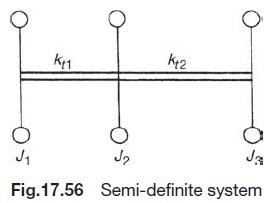
For the semi-definite system shown in Fig.17.56, if \(J_{1}=1.2 \mathrm{~kg} \cdot \mathrm{m}^{2}, J_{2}=J_{3}=2 J_{1}, k_{11}=25 \times 10^{3}\) \(\mathrm{N} \mathrm{m} / \mathrm{rad}\), and \(k_{12}=2 k_{11}\), find the natural frequencies and relative amplitude of the principal modes. K11 K+2
Force transmissibility is unity, when(a) \(\beta=1\)(b) \(\beta=\sqrt{2}\)(c) \(\beta\sqrt{2}\).
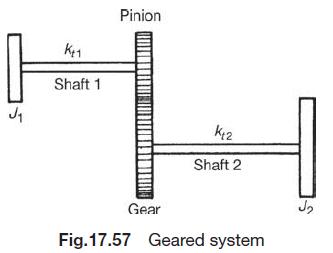
Neglecting the inertia effect of the pinion and gear in Fig. 17.57 , let \(J_{1}=0.2 \mathrm{~kg} \cdot \mathrm{m}^{2}, J_{2}=4 J_{1}\); \(k_{11}=60 \times 10^{3} \mathrm{~N} \mathrm{~m} / \mathrm{rad}, k_{12}=7 k_{11}\), and the gear ratio 3:1. Find the natural frequencies of the system:(a)
Which of the following methods gives lower bound on the natural frequency?(a) Dunkerley's method(b) Energy method(c) Rayleigh's method(d) Equilibrium method.
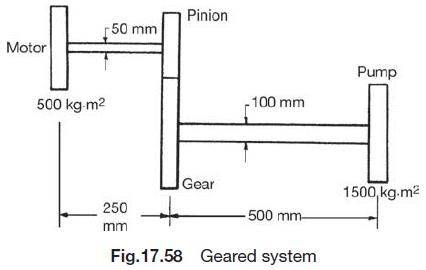
A motor shaft of diameter \(50 \mathrm{~mm}\) drives a pump shaft of diameter \(100 \mathrm{~mm}\) through a spur gear pair, as shown in Fig. 17.58 . The motor rotor has a moment of inertia of \(500 \mathrm{~kg} \cdot \mathrm{m}^{2}\) and the pump rotor has \(1500 \mathrm{~kg} \cdot
Equivelent length \(l_{e}\) of a stepped shaft is(a) \(l_{e}=l_{1}+\left(\frac{d_{1}}{d_{2}}\right)^{4} l_{2}+\left(\frac{d_{1}}{d_{3}}\right)^{4} l_{3}+\cdots\)(b) \(l_{e}=l_{1}+\left(\frac{d_{1}}{d_{2}}\right)^{3} l_{2}+\left(\frac{d_{1}}{d_{3}}\right)^{3} l_{3}+\cdots\)(c)
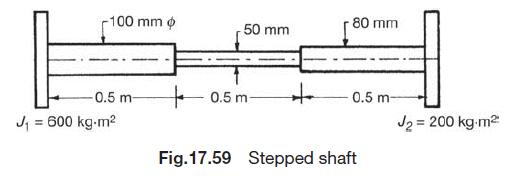
Determine the natural frequency and position of the node for the free torsional vibrations of the stepped shaft shown in Fig.17.59. \(G=80 \mathrm{GPa}\). -100 mm -80 mm 50 mm -0.5 m- J = 600 kg.m +0.5 m- 0.5 m- J = 200 kg.m Fig.17.59 Stepped shaft
A torsional system having \(m\) rotors on a vibrating shaft has(a) \(m\) nodes(b) \((m-1)\) nodes(c) \((m-2)\) nodes(d) \(2 m\) nodes.
Calculate the natural frequency of a shaft of diameter \(100 \mathrm{~mm}\) and length \(3 \mathrm{~m}\) carrying two discs of diameters \(1.25 \mathrm{~m}\) and \(2 \mathrm{~m}\) at its ends and weighing \(500 \mathrm{~N}\) and \(900 \mathrm{~N}\) respectively. For the shaft, \(G=84 \mathrm{GPa}\).
The following dynamometer is widely used for the absorption of wide range of power at wide range of speed(a) Hydraulic(b) Belt transmission(c) Rope brake(d) Electric generator.
The equivalent coefficient of friction for a block brake is(a) \(4 \mu \sin \theta /(\sin \theta+\theta)\)(b) \(4 \mu \sin (\theta / 2) /[\sin (\theta / 2)+\theta / 2]\)(c) \(4 \mu \sin (\theta / 2) /(\sin \theta+\theta)\)(d) \(\mu \sin \theta /(\sin \theta+\theta)\).
The equivalent radius of a block brake is(a) \(4 r \sin \theta /(\sin \theta+\theta)\)(b) \(4 r \sin (\theta / 2) /(\sin (\theta / 2)+\theta / 2)\)(c) \(4 r \sin (\theta / 2) /(\sin \theta+\theta)\)(d) \(r \sin \theta /(\sin \theta+\theta)\)where \(r=\) drum radius.
The ratio of tensions on the tight side to slack side of multi-block brake is(a) \((1-n \mu \tan \theta) /(1+n \mu \tan \theta)\)(b) \((1+n \mu \tan \theta) /(1-n \mu \tan \theta)\)(c) \([(1+\mu \tan \theta) /(1-\mu \tan \theta)]^{n}\)(d) \([(1-\mu \tan \theta) /(1+\mu \tan \theta)]^{n}\).
The stopping distance for a vehicle by applying brakes when all the four wheels are sliding as compared with when all the four wheels are in a limiting state of sliding is(a) More(b) Less(c) Same(d) Unpredictable.
The stopping distance for a four-wheel vehicle is(a) Unaltered by an increase in weight of vehicle(b) Decreases with increase of coefficient of friction(c) Directly proportional to square of velocity of vehicle(d) All of the above.
Dynamometer is a device used on a prime mover for measuring(a) Torque developed(b) Power developed(c) Power absorbed(d) All of the above.
Which of the following is an absorption dynamometer?(a) Prony brake dynamometer(b) Rope brake dynamometer(c) Froude's hydraulic dynamometer(d) All of the above.
Which of the following is a transmission dynamometer?(a) Torsion dynamometer(b) Belt dynamometer(c) Hydraulic dynamometer(d) Prony brake dynamometer.
Which type of brake is commonly used in cars?(a) Band brake(b) Shoe brake(c) Band and block brake(d) Internal expanding shoe brake.
In a self-locking brake, the force required to apply the brake is(a) Zero(b) Minimum(c) Maximum(d) Average.
When the frictional force helps the applied force in applying the brake, the brake is called(a) Automatic(b) Self-locking(c) Self-energizing.
What is a brake?
What are the various types of brakes?
Differentiate between a self-locking and self-energizing brake.
What are the advantages of internal expanding shoe brake?
What is the effect of applying brakes only to the front wheels of a vehicle?
What is the advantage of a pivoted shoe brake?
What is the difference between a shoe brake and band brake?
How do the internal expanding shoe brakes become self-locking?
What is a dynamometer?
What are the various types of dynamometers?
What is the principle of working of an absorption dynamometer?
What is a transmission dynamometer?
Why the pulley of a rope brake dynamometer water cooled?
What is a clutch? State its different types.
Differentiate between dry and wet clutches.
Where do we use multi-plate clutches?
The drum diameter of a single-block brake is \(1 \mathrm{~m}\). It sustains \(240 \mathrm{Nm}\) of torque at \(400 \mathrm{rpm}\). The coefficient of friction is 0.32 . The distance of the fulcrum from the vertical centre line of the drum is \(150 \mathrm{~mm}\) and length of lever is \(800
A bicycle and rider of mass \(90 \mathrm{~kg}\) are travelling at a speed of \(15 \mathrm{~km} / \mathrm{h}\) on a level road. A brake is applied to the rear wheel which is \(0.7 \mathrm{~m}\) in diameter. How far will the bicycle travel? The pressure applied on the brake is \(100 \mathrm{~N}\) and
A car moving on a level road at a speed of \(45 \mathrm{~km} / \mathrm{h}\) has a wheel base \(2.8 \mathrm{~m}\), distance of CG from ground level \(0.6 \mathrm{~m}\), and the distance of CG from rear wheels \(1.1 \mathrm{~m}\). Find the distance travelled by the car before coming to rest when the
In a belt transmission dynamometer, the distance between the centre of driving pulley and dead weights is \(1 \mathrm{~m}\). Find the value of dead weights required to keep the lever in horizontal position if power transmitted is \(7.5 \mathrm{~kW}\) and the diameter of each of the driving as well
In a Prony brake dynamometer, the spring balance reading is \(200 \mathrm{~N}\), radius of brake drum is \(0.3 \mathrm{~m}\), and distance between the drum axis and hinge of the blocks is \(0.6 \mathrm{~m}\). Determine the pressure exerted on the drum by tightening the screw, tangential force
A single-plate clutch transmits \(20 \mathrm{~kW}\) at \(1000 \mathrm{rpm}\). The maximum pressure intensity between the plates is \(0.09 \mathrm{MPa}\). The outer diameter of the plate is \(350 \mathrm{~mm}\) and both the sides of the plate are effective. The coefficient of friction is 0.25 .
A clutch in a motor car is of single-plate type having both sides of the plate effective. It is required to transmit \(35 \mathrm{~kW}\) at \(1500 \mathrm{rpm}\). The axial thrust is \(0.075 \mathrm{MPa}\). The ratio between the external and internal radii of the plate is 1.5 and coefficient of
A multi-plate clutch of alternate bronze and steel plates having effective diameters of \(175 \mathrm{~mm}\) and \(72.5 \mathrm{~mm}\) has to transmit \(25 \mathrm{~kW}\) at \(2000 \mathrm{rpm}\). The end thrust is \(1600 \mathrm{~N}\) and coefficient of friction is 0.1 . Calculate the number of
A cone clutch has a radii of \(130 \mathrm{~mm}\) and \(150 \mathrm{~mm}\). The semi-cone angle is \(20^{\circ}\). If coefficient of friction is 0.25 and uniform normal pressure is \(0.15 \mathrm{MPa}\), find(a) necessary axial load and(b) power that can be transmitted at \(1000 \mathrm{rpm}\).
The external and internal radii of a friction plate of a clutch are \(120 \mathrm{~mm}\) and \(60 \mathrm{~mm}\) respectively. The total axial thrust is \(1500 \mathrm{~N}\). For uniform wear, find the maximum, minimum and average pressure on the contact surfaces.
A power of \(60 \mathrm{~kW}\) is transmitted by a multi-plate clutch at \(1500 \mathrm{rpm}\). The axial intensity of pressure is not to exceed \(15 \mathrm{MPa}\). The coefficient of friction for the friction surfaces is 0.15 . The external radius of friction surface is \(120 \mathrm{~mm}\) and
A cone clutch of semi-cone angle \(15^{\circ}\) is used to transmit \(30 \mathrm{~kW}\) at \(800 \mathrm{rpm}\). The mean frictional surface radius is \(150 \mathrm{~mm}\) and normal intensity of pressure of the mean radius is not to exceed \(0.15 \mathrm{MPa}\). The coefficient of friction is 0.2
What is a cam? What is its use?
How cams can be classified?
What are the various types of followers?
Name the different motions that a follower can have.
Differentiate between (a) base circle and prime circle and (b) cam angle and pressure angle.
Compare the knife-edge follower with roller follower.
What is a tangent cam?
Compare various types of follower motions.
Define pressure angle of a cam.
Differentiate between trace point and pitch point.
How the cam size is defined?
What are the methods for reducing pressure angle of a cam?
How undercutting can be avoided in cams?
What is an offset follower?
The pitch point on a cam is(a) any point on the pitch curve(b) the point on cam pitch curve having the maximum pressure angle(c) any point on pitch circle(d) a point at a distance equal to pitch circle radius from the centre.
In its simplest form, a cam mechanism consists of following number of links(a) 1(b) 2(c) 3(d) 4 .
Showing 800 - 900
of 1879
First
2
3
4
5
6
7
8
9
10
11
12
13
14
15
16
Last
Step by Step Answers

 Get 50% OFF
Claim Now
Get 50% OFF
Claim Now