New Semester
Started
Get
50% OFF
Study Help!
--h --m --s
Claim Now
Question Answers
Textbooks
Find textbooks, questions and answers
Oops, something went wrong!
Change your search query and then try again
S
Books
FREE
Study Help
Expert Questions
Accounting
General Management
Mathematics
Finance
Organizational Behaviour
Law
Physics
Operating System
Management Leadership
Sociology
Programming
Marketing
Database
Computer Network
Economics
Textbooks Solutions
Accounting
Managerial Accounting
Management Leadership
Cost Accounting
Statistics
Business Law
Corporate Finance
Finance
Economics
Auditing
Tutors
Online Tutors
Find a Tutor
Hire a Tutor
Become a Tutor
AI Tutor
AI Study Planner
NEW
Sell Books
Search
Search
Sign In
Register
study help
engineering
numerical methods with chemical engineering applications
Numerical Methods With Chemical Engineering Applications 1st Edition Kevin D. Dorfman, Prodromos Daoutidis - Solutions
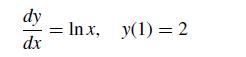
Solve the following ordinary differential equation dy dx = Inx, y(1)=2
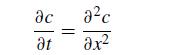
Solve Eq. (1.2.70) subject to an initial condition c(x, 0) = 1 and homogeneous boundary conditions at x = 0 and x = L. Әс at О a2c = D— 3х2 (1.2.70)
Solve the following ordinary differential equation y = 3xy + xy(3) = 1
Write a MATLAB function that determines the product n S= = П j=jo (1.4.1)
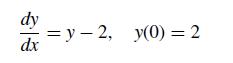
Solve the following ordinary differential equation dy dx =y-2, y(0) = 2
Write aMATLAB program that computes the product in Eq. (1.4.1) until it exceeds a particular value smax. S= п П j=jo (1.4.1)
Solve the following ordinary differential equation y" + 3y + 2y = 0, y(0) = 1, y(2) = 2
Write a MATLAB program that computes n terms in the sum n - Σ' sinj| j=1 S= (1.4.3)
Solve the following ordinary differential equation y"-2y, y(0) = 2, y(0) = 0 =
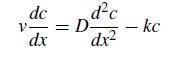
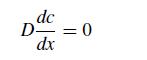
Solve the convection–diffusion–reaction problemsubject to no-flux at x = 0,and a concentration c = c0 at x = L. Before solving this problem, you should convert it into dimensionless form, wherein you can fix the Péclet number as vL/D = 1 and the Dämkohler number as kL2/D = 2. dc V =
Solve the following ordinary differential equation d²y dx² dy - 2- dx = 0, y(0) = 2, dy -(0) = 1 dx
Solve the following ordinary differential equation d'y dx² = 4y+1, y(0) = 1, dy dx -(0) = 0
Solve the following ordinary differential equation for the function y(x)subject to y(0) = 0 and y(1) = 1. y"+y=(1-²) sin лx
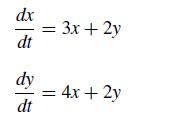
Solve the system of ordinary differential equationssubject to x(0) = 0 and y(0) = 1. dx dt dy dt = 3x + 2y || = 4x + 2y =
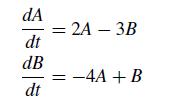
Determine the trajectory of the kinetic systemwith initial conditions A(0) = 1 and B(0) = 2. Does the system reach steady state? dA dt dB dt = 2A- 3B -4A + B
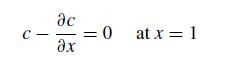
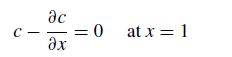
Use separation of variables to obtain an eigenfunction solution of the formfor the unsteady-diffusion equationsubject to the constant concentration boundary condition c(0, t) = 0 and the reaction– diffusion boundary conditionand the initial condition c(x, 0) = 1. c(x, t) = (Cn sin λnx + dn cos
Consider the reversible reaction A ⇌ B with a forward rate constant of 3 and a reverse rate constant of 2. If we start with 1 mole of A and 1 mole of B, compute the number of moles of each species as a function of time. Confirm that you solution agrees with thermodynamic equilibrium in the limit
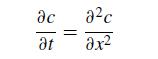
Use separation of variables to solve the unsteady-diffusion equationsubject to no flux at the left boundaryand zero concentration c(1, t) = 0 on the right boundary. The initial condition is c(x, 0) = 1. дс at || а2с ах2
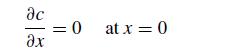
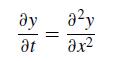
Consider the partial differential equationsubject to ∂y/∂x = 0 at x = 0 and y = 0 at x = 1. When you solve this problem using separation of variables, what are the eigenvalues? ду at а у zre
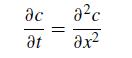
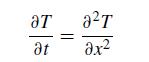
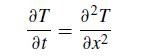
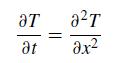
Solvesubject to the initial condition T(x, 0) = 1 and the boundary conditions T(0, t) = 0 and T(1, t) = 0. Report your answer in terms of the non-zero Fourier modes. aT at || а т ах2
Consider a box of length L = 1 that is initially in contact with a heat reservoir on the left at T = 1 and a heat reservoir on the right with T = 0. When this system reaches equilibrium, it will have a temperature distribution T(x) = 1 − x. When the system has equilibrated, the box is
Consider a slab of thickness 2W that is initially at a temperature TH. The slab is in contact with a cold reservoir at some temperature TC < TH. The slab has a thermal conductivity k and the heat transfer coefficient h is infinitely large. Starting from the unsteady heat equation, find an
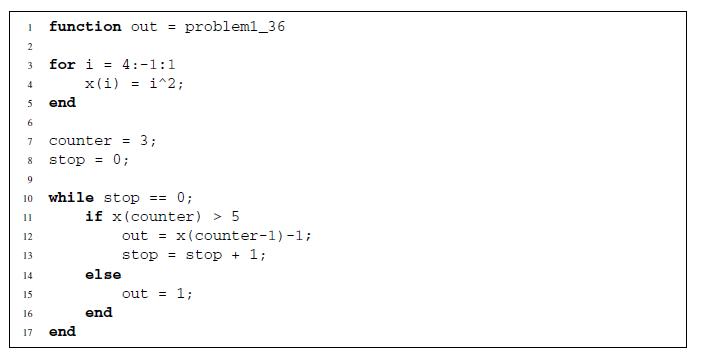
What is the output of the following MATLAB code? 1 2 3 4 5 6 7 counter = 3; 8 stop = 0; 9 10 11 12 N 13 function out = 15 16 17 for i = 4:-1:1 x(i) = 1^2; end while stop == 0; end problem1_36 if x (counter) > 5 else end out= x(counter-1)-1; stop stop + 1; out = 1;
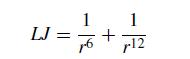
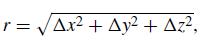
In numerical methods, there are often many ways to make a calculation that give the same answer but have vastly different efficiencies. In this problem, we are going to consider a common calculation in molecular dynamics simulations, which requires computing the term(If you are familiar with this
Express the 103493.234 as a 16 bit word in base 10.
Using the LU decomposition in Problem 2.32, determine the value of x2 for Ax = b if the forcing function isData from Problem 2.32:In LU decomposition, determine the missing value of L for 5 --[:] b 10 0
What happens if we switch the order of the equations in Example 2.8?Example 2.8Solve the systemby Jacobi’s method with an initial guess (0, 0). 2x1 + x₂ = 2 x12x₂ = -2 (2.13.7)
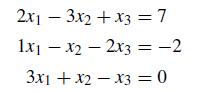
Use LU decomposition to solve the system of equations 2x13x2 + x3 = 7 1x₁x22x3 = -2 3x1 + x2x3 = 0
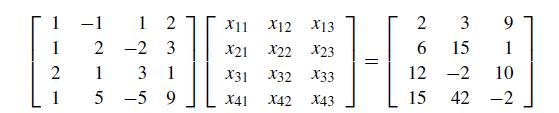
Use LU decomposition with Doolittle’s method to solve the set of equations given by 1 2 1 -1 1 2 -2 1 2 3 3 5-59 1 X11 X12 X13 X21 X22 X23 X31 X32 X33 X41 X42 X43 2 9 6 15 1 12 -2 10 15 42 -2 3
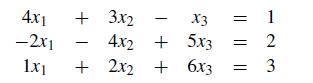
Use LU decomposition (Doolitle’s method) to solve the system of equations 4x1 -2x1 1x1 + 3x2 X3 4x2 + 5x3 + 2x2 + 6x3 - - 1 2 23 3
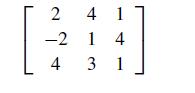
Use LU decomposition to compute the inverse of 2 -2 4 4 1 14 3 1
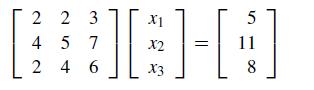
Determine the solution tousing(a) Gauss elimination without pivoting(b) LU decomposition. Show the values of U, L, and y. 2 2 3 xX1 BAHA X2 X3 457 246 5 11 8
Solve the following problem(a) Using Cramer’s rule(b) Using Gauss elimination with partial pivoting(c) Using LU decomposition. [²2][3]-[2] y 12
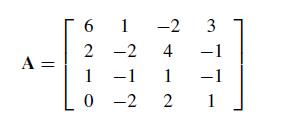
For the matrixwhich definition of the norm gives the largest value and which definition gives the smallest value? You only need to consider the L1, Le, and L∞ norms. A = 6 1 2-2 1 -1 0-2 -2 4 1 2 3 - 1 – 1 1
Solve the following system of equationsusing(a) Naive Gauss elimination(b) Gauss elimination with pivoting(c) LU decomposition. 6 [][][] y 15 Z 6 1 2 3 4 5 6 1 3 2
Consider the matrixDetermine the values of x such that the Euclidean norm of the matrix is larger than the 2-norm. A = [2, 4] -1
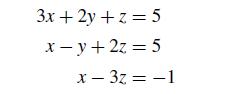
What is the condition number on the system below using the Euclidean norm? 3x + 2y + z = 5 x-y + 2z = 5 x - 3z = -1
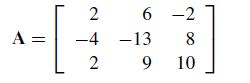
Compute the L1 norm for the matrix A || 2 -4 2 6-2 8 10 -13 9
Compute the L1, L2, and L∞ norms for the vector x = [10 3 –4 –1 5].
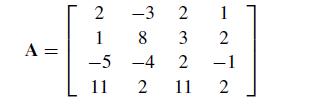
For the matrixwhich definition of the norm gives the largest value and which definition gives the smallest value? You only need to consider the L1, Le, and L∞ norms. A || 2 1 -5 11 -3 2 8 3 1 2 2 -1 11 2 -4 2
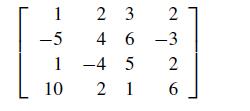
Compute the L1, Le, and L∞ norms for the matrix 1 2 3 2 -5 4 6 -3 1-4 5 2 216 10
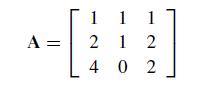
Use the 1-norm to determine the condition number of A: || 1 2 1 1 12 402 1 22
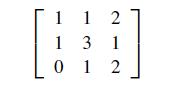
Compute the condition number forusing the Euclidean norm. 1 1 12 13 0 1 1 2
Compute the condition number for the matrixusing the Euclidean norm. A = [ 1 ² ] 12 01
Compute the 1-norm, Euclidean norm, spectral norm, and infinity norm of 3 - [22] 1 A =
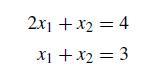
Consider the 2 × 2 system of equationsWhat is the value of the 1-norm of ||Ax(1) − b||1 after one iteration of Jacobi’s method with the initial guess x(0)1 = 1, x(0)2 = 0? 2x1 + x₂ = 4 x1 + x₂ = 3
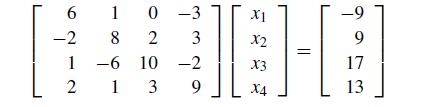
Perform the first two iterations of Jacobi’s method for the system of equationsusing an initial guess x = 0. 6 -2 1 2 10-3 2 3 8 -6 10 10 13 -2 9 X1 X2 X3 X4 || -9 9 17 13
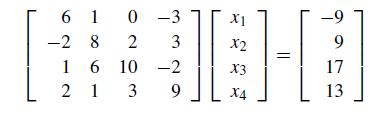
Perform the first two iterations of Gauss–Seidel for the system of equationsusing an initial guess x = 0. 6 1 03 -28 2 3 16 10 -2 2 1 3 9 2 X3 X4 || -9 9 17 13
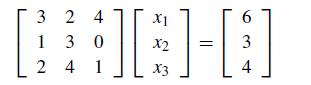
Determine x(1)2 for the system of equationsusing Gauss–Seidel with an initial guess of x1 = 0, x2 = 0, x3 = 0. 3 24 X1 [CHO 1 30 X2 24 1 X3 6 3 4
Show that the matrix A in Problem 2.58 is diagonally dominant.Data from Problem 2.58Perform the first two iterations of Jacobi’s method for the system of equationsusing an initial guess x = 0. 6 -2 1 2 10-3 2 3 8 -6 10 10 13 -2 9 X1 X2 X3 X4 || -9 9 17 13
Is the matrix from Problem 2.46 diagonally dominant?Problem 2.46Compute the L1 norm for the matrix A || 2 -4 2 6-2 8 10 -13 9
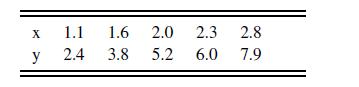
Perform linear regression for the following data set. X 1.1 1.6 2.0 2.3 2.8 у 2.4 2.4 3.8 5.2 6.0 7.9
For numerical calculations, the computer is limited by two major constraints: the amount of memory available and the speed of the processor. Let’s examine how these constraints affect our ability to perform Gauss elimination on an old Mac. The Mac SE/30s was equipped with 2 MB (megabytes) of
If I want to solve a 200 × 200 matrix with a bandwidth of 5 and p = q, what is the ratio of the time required for full Gauss elimination relative to using a banded Gauss elimination solver?
Let’s assume we have a computer that can solve a 1000 × 1000 system in 2 seconds using Gauss elimination. If this is in fact a banded system with p = q = 2 and I can solve the same problem in five iterations using Jacobi’s method, estimate how long will it take. Which method would you prefer
Let’s assume we have a computer that can solve a 100 × 100 system in 1 second using Gauss elimination. Estimate the time required to solve the following problems on the same computer. You must indicate the scaling as well as the time.(a) 1000 × 1000 system using Gauss elimination(b) 1000 ×
What are the magnitudes of the eigenvalues of 1 A=[27] 1
What are the criteria for the number of iterations such that Jacobi’s method is faster than Gauss elimination for solving a linear problem that is not banded?
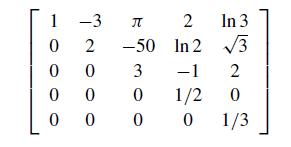
Consider the matrix(a) What is the determinant of the matrix A?(b) What is the bandwidth of the matrix A?(c) What is the 1-norm of the matrix A?(d) How many eigenvalues do you expect to have for A? (If you know the eigenvalues, you can include them too but this is not required.)(e) Is matrix A
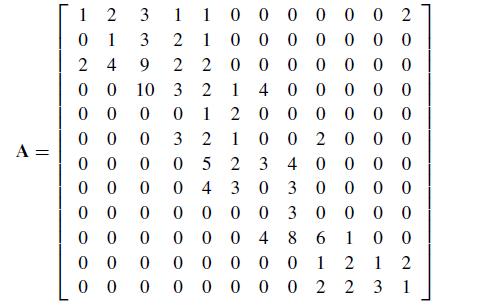
Answer the following questions about this 12 × 12 matrix:(a) What is the bandwidth?(b) Assuming this system has a solution for a given vector b, are you guaranteed to have convergence using successive relaxation? Explain your answer.(c) If you perform Gauss elimination with partial pivoting, what
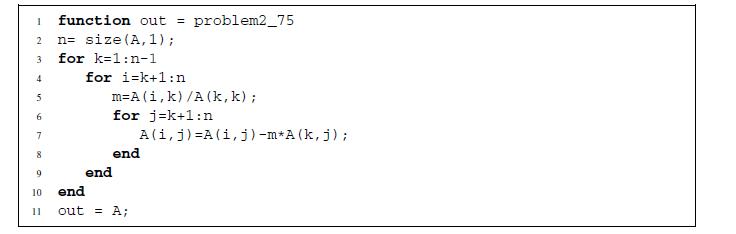
What numerical method is implemented by the code listed below (be specific). 1 2 3 4 5 6 7 8 9 10 11 function out = problem2_75 n= size (A, 1); for k=1:n-1 for i=k+1:n m=A (i, k)/A (k, k); for j=k+1:n end end A(i, j)=A(i, j)-m*A (k, j); end out= A;
Consider the following program:What system of equations is being solved by this method? What method is used for the solution? Will this program converge to a solution? To save you time, we have already determined that the condition number is 2.6473. You should be as specific as possible in your
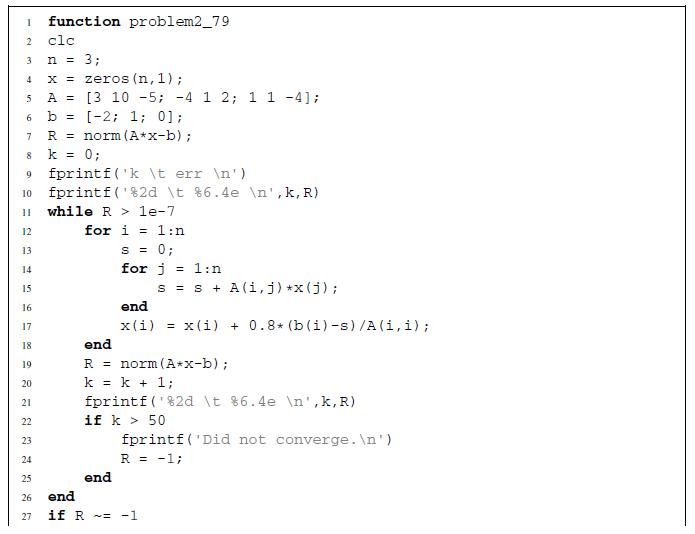
Answer the following questions about this MATLAB program. You can assume that the norm computed by MATLAB is the 1-norm. (We are using the 1-norm to simplify the problem, not because MATLAB actually uses the 1-norm.)(a) What mathematical problem is solved by this program?(b) What numerical method
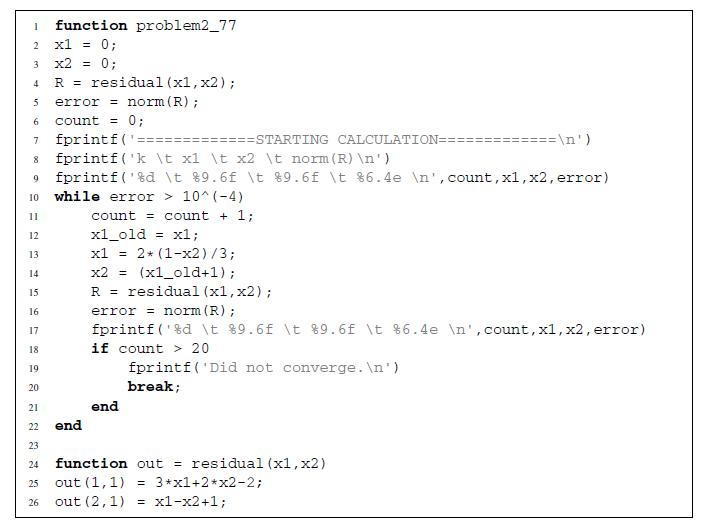
Answer the following questions about this program:(a) What mathematical problem does this program solve?(b) What numerical method does this program use?(c) What is the initial condition used to start the numerical method?(d) What is the criteria for convergence?(e) What is the reason you might
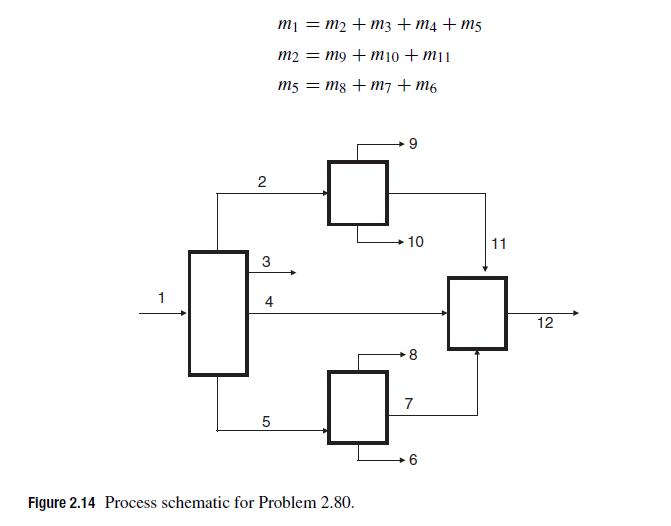
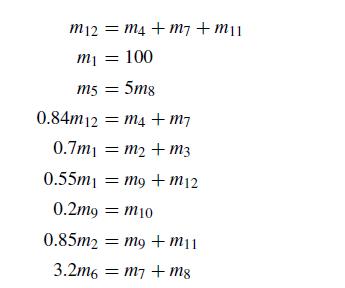
Consider the process flow diagram shown in Fig. 2.14. We can write this out as the system of equationsThe first four equations are the mass balances; the next eight equations are the process specifications.(a) Write a MATLAB program that generates the matrix A and vector b required to solve the
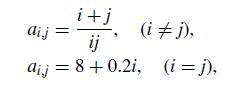
In this problem, you are going to investigate the work required to solve a matrix system using Gauss–Seidel. The matrix system is defined by the entriesand the forcing vector entries areYour program should first check to see if the matrix is diagonally dominant and output a value of 1 (if
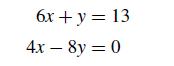
A convenient way to visualize the evolution of a two-dimensional system is to make a phase plane plot. We will do more of this type of calculation in Chapter 5. For now, we would like to see how the solution to the system of equationschanges when you use Jacobi’s method with an initial guess x(0)
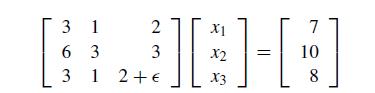
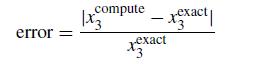
We want to explore the accuracy of MATLAB’s solution to the following set of equationsfor values of ϵ from 10−1 to 10−15. For this problem, you are allowed to use the slash command to solve the system of equations and the cond function to compute the condition number.Write a MATLAB function
In this problem, we want to figure out how the rate of convergence to the successive over-relaxation (SOR) solution of a linear system of equations depends on the relaxation parameter for w = 0.1, 0.2, . . . , 1.9. You can download the 100 × 100 matrix A and the 100 × 1 forcing function b as a
We saw that the time t required to solve a banded matrix of size n × n with a bandwidth p = q scales like t ∼ np2. In this problem, we will explore the ability of MATLAB’s internal solver to handle large, banded matrices.Write aMATLAB program that determines the time required to solve a 500 ×
Show thatis a linear equation. f(x) = x (3.1.9)
Show thatis a nonlinear function. f(x)=x² (3.1.13)
Consider the Newton’s method calculation of the roots of the nonlinear equation f (x) = x3. If the initial guess is x(0) = 2, what is x(1)?
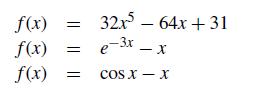
For the nonlinear functions that follow, provide the Newton iteration formula that you would use to find the roots of f (x) = 0: f(x) f(x) f(x) = 32x5 - 64x +31 e-3x X COS X - X
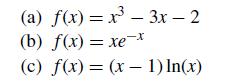
For the nonlinear functions that follow, provide the Newton iteration formula that you would use to find the roots of f (x) = 0: (a) f(x)=x²-3x - 2 (b) f(x) = xe-t (c) f(x) = (x - 1) In(x)
Construct a fixed-point method to find the root of the functionusing an initial guess x(0) = 1. f(x) = ex-x (3.2.13)
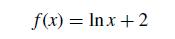
Consider using Newton’s method to find the real root ofwith an initial guess x(0) = 2. What is x(1)? Do you see any potential problem here? f(x)= Inx+2
Use Picard’s method to find the roots offor the initial guesses −0.1, 0.6, 1.99, and 2.01. f(x)=x²-3x+2=0 (3.3.2)
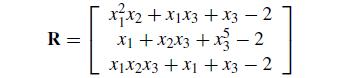
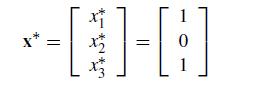
Consider the system of nonlinear equationsA root of this system isShow that the convergence of Newton–Raphson is independent of the value of ϵ for an initial guessfor any real number ϵ. R = xx2 + x1 x3 + x3 - 2 x1 + x2x3 + x2 X1 X2 X3 + x1 + x3 - 2
Use Newton’s method to find the root of Eq. (3.2.13) using an initial guess x(0) = 1. f(x) = ex-x (3.2.13)
For what values of x(0) do you expect to have a problem with the Newton’s method solution to compute the roots of f(x) = tan x?
Determine the number of steps required to find the root of f (x) = x2 by Newton’s method as a function of the initial guess x0 if the goal is to reach a tolerance |f (x∗)| ≤ ϵ.
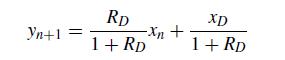
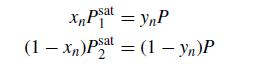
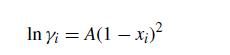
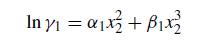
This problem involves computing the liquid–vapor P–x–y diagram from the two parameter Margulies model. In this model, the activity coefficients are given byandThe parameters α and β are already in dimensionless form in units of RT and are restricted to have the valuesandFor this problem, we
Recall the derivation of the Newton iteration formula discussed in the lecture; it was based on a Taylor series expansion of the function f(x) around an estimate of the root x(k−1), truncated after the linear term. You are asked to derive a more accurate iteration scheme as follows: Start from
Write a MATLAB program that uses Newton–Raphson to compute the solution to the following system of equationsfor an initial guess of x = y = z = 0.2. How many iterations are required such that ||δ|| 1³ - 1² Z + sin(лy) = 0 xу³-сos(лz) - z=0 X + сos[л(x-z)] - 2e¹ = 0 Z
Consider the simple equation f (x) = x3 − x2. Do the following analysis for this equation:(a) Determine the three roots by hand.(b) Perform the first five iterations by hand for Picard’s method for an initial guess of 0.1.(c) Write a MATLAB program to compute the solution by Picard’s method.
In this problem, you will use your knowledge of solving systems of nonlinear equations and continuation methods to determine both the composition and the temperature distribution in an ideal staged rectification column. Recall from mass and energy balances that the operating line for a rectifying
We want to explore the ability of Newton’s method to find roots to the equation sin(πx) = 0. You should already know the roots of this equation. Write a MATLAB program that determines the roots of the equation for initial guesses x = 0, 0.01, 0.02, . . . , 1.99, 2.00 by using Newton’s method.
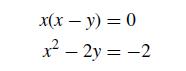
Consider the system of equationsFind all of the real roots of this system of equations by hand. Write aMATLAB program that demonstrates quadratic convergence towards each of the real roots of the system.Your program should display the ||x − x∗|| to screen to demonstrate quadratic equation for a
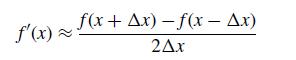
In this problem, you are going to look at how the numerical accuracy of the derivative affects the rate of convergence in Newton’s method. Consider the calculation of the root ofwith an initial guess x(0) = 1. In the most accurate case, you would use an analytical calculation of f′(x). However,
For a packed bed, the Ergun equation provides a relationship between the pressure drop per unit length and the properties of the bed,where η is the fluid viscosity, v0 is the superficial velocity, Dp is the particle diameter, ρ is the fluid density, and ϵ is the void fraction of the bed.
Consider the partial differential equationsubject to the constant concentration boundary condition c(0, t) = 0 and the reaction–diffusion boundary conditionand the initial condition c(x, 0) = 1. The solution to this problem iswhere λn are the positive roots ofthe Fourier coefficients for n = 1,
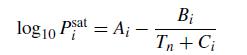
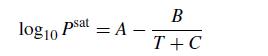
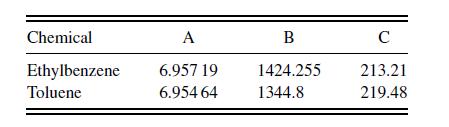
A vapor–liquid mixture of ethylbenzene and toluene has a partial pressure of 250 mm Hg of ethylbenzene and 343 mm Hg of toluene. Write a MATLAB program that will compute the composition of the liquid phase and the temperature of this mixture if we assume ideal gas and liquid behavior. You can
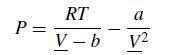
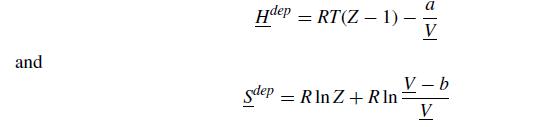
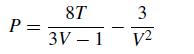
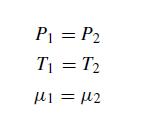
The overall goal of this problem is to compute the P–V and P–T equilibrium diagramsfor a single component fluid described by the van derWaals equation of state. Let us recall the key things we need to know from thermodynamics, following the notation from Sandler’s textbook. The van der Waals
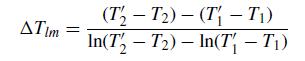
This problem involves the analysis of a counter-current heat exchanger. The design equation for a counter-current heat exchanger iswhere Q is the heat transferred between streams, A is the area of the exchanger, and the log-mean temperature is defined aswhere T1 is the inlet temperature of the
Consider non-ideal liquid phases where the activity coefficient is given by the one-parameter modelThe saturation pressure of species 1 is 800 mm Hg, and the saturation pressure of species 2 is 1000 mm Hg.(a) Write a MATLAB program that uses Newton’s method to compute the azeotrope pressure as a
Let’s look at another way to compute phase diagrams from an equation of state without using departure functions but still requiring a numerical solution. The van der Waals equation of state can be written in a convenient, dimensionless form aswhere the reduced pressure is denoted by P ≡ ˆP/Pc,
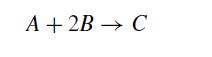
Consider the implicit Euler integration of the unsteady mass balance equations with time step h corresponding to the batch reactionwhich we can write aswith a reaction rate k. What are the equations required for implicit Euler, the residual and the Jacobian to compute the values at the next time
Consider the nonlinear ordinary differential equationwith y(2) = 2. Estimate y(2.5)(a) Using the explicit Euler’s method with h = 0.1(b) Using the fourth-order Runge–Kutta method with h = 0.5. dy x+y dx X
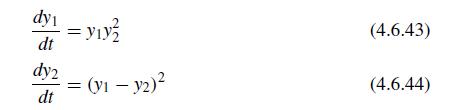
Write a program to solve the system of equationsusing implicit Euler. The initial conditions are y1(0) = 1 and y2(0) = 2. dy1 = yiy dt dy2 dt = (y₁ - y2)² (4.6.43) (4.6.44)
Showing 100 - 200
of 375
1
2
3
4
Step by Step Answers

 Get 50% OFF
Claim Now
Get 50% OFF
Claim Now













![5 --[:] b 10 0](https://dsd5zvtm8ll6.cloudfront.net/si.question.images/images/question_images/1697/6/1/3/888652f884047fab1697613886502.jpg)
![2 4 2 6 13 9 2 8 17 1 = [ 2 1 L = 00 1 ;] - [ 0 L3,2 1 2 62 1 4 003 0 X = X1 X2 X3](https://dsd5zvtm8ll6.cloudfront.net/si.question.images/images/question_images/1697/6/1/3/858652f88229a16d1697613856894.jpg)

![[2][3]-[2] y 12](https://dsd5zvtm8ll6.cloudfront.net/si.question.images/images/question_images/1697/6/1/3/993652f88a915a411697613990938.jpg)
![6 [][][] y 15 Z 6 1 2 3 4 5 6 1 3 2](https://dsd5zvtm8ll6.cloudfront.net/si.question.images/images/question_images/1697/6/1/4/011652f88bb51a001697614009163.jpg)
![A = [2, 4] -1](https://dsd5zvtm8ll6.cloudfront.net/si.question.images/images/question_images/1697/6/1/4/075652f88fb3b2d91697614072841.jpg)
![A = [ 1 ] 12 01](https://dsd5zvtm8ll6.cloudfront.net/si.question.images/images/question_images/1697/6/1/4/190652f896e9709f1697614189158.jpg)
![3 - [22] 1 A =](https://dsd5zvtm8ll6.cloudfront.net/si.question.images/images/question_images/1697/6/1/4/210652f898269d691697614208016.jpg)
![1 A=[27] 1](https://dsd5zvtm8ll6.cloudfront.net/si.question.images/images/question_images/1697/6/1/5/139652f8d23d35c61697615137581.jpg)
![1 function problem2_76 2 A = [2,3,1;-2, 3,2; 1, 2,5]; 3 b = [1; 4; 2]; 4 x = [0; 0;0]; 5 6 7 8 9 10 12 13 15](https://dsd5zvtm8ll6.cloudfront.net/si.question.images/images/question_images/1697/6/1/5/211652f8d6bcdc6c1697615208851.jpg)






![[:] x(0) = x* +](https://dsd5zvtm8ll6.cloudfront.net/si.question.images/images/question_images/1697/6/2/5/075652fb3f3380e31697625073435.jpg)



![1 - 1 Z + sin(y) = 0 x-os(z) - z=0 X + os[(x-z)] - 2e = 0 Z](https://dsd5zvtm8ll6.cloudfront.net/si.question.images/images/question_images/1697/6/2/5/225652fb489531491697625222486.jpg)