New Semester
Started
Get
50% OFF
Study Help!
--h --m --s
Claim Now
Question Answers
Textbooks
Find textbooks, questions and answers
Oops, something went wrong!
Change your search query and then try again
S
Books
FREE
Study Help
Expert Questions
Accounting
General Management
Mathematics
Finance
Organizational Behaviour
Law
Physics
Operating System
Management Leadership
Sociology
Programming
Marketing
Database
Computer Network
Economics
Textbooks Solutions
Accounting
Managerial Accounting
Management Leadership
Cost Accounting
Statistics
Business Law
Corporate Finance
Finance
Economics
Auditing
Tutors
Online Tutors
Find a Tutor
Hire a Tutor
Become a Tutor
AI Tutor
AI Study Planner
NEW
Sell Books
Search
Search
Sign In
Register
study help
engineering
thermodynamics an engineering approach
Thermodynamics An Engineering Approach 9th Edition Yunus Cengel, Michael Boles, Mehmet Kanoglu - Solutions
The amount of fuel introduced into a spark-ignition engine is used in part to control the power produced by the engine. Gasoline produces approximately 42,000 kJ/kg when burned with air in a spark-ignition engine. Develop a schedule for gasoline consumption and maximum cycle temperature versus
In an ideal Brayton cycle, air is compressed from 100 kPa and 25°C to 1 MPa, and then heated to 927°C before entering the turbine. Under cold-air-standard conditions, the air temperature at the turbine exit is(a) 349°C(b) 426°C(c) 622°C(d) 733°C(e) 825°C
In an ideal Brayton cycle, air is compressed from 95 kPa and 25°C to 1400 kPa. Under cold-air-standard conditions, the thermal efficiency of this cycle is(a) 40 percent(b) 44 percent(c) 49 percent(d) 54 percent(e) 58 percent
Air enters a turbojet engine at 320 m/s at a rate of 30 kg/s and exits at 570 m/s relative to the aircraft. The thrust developed by the engine is(a) 2.5 kN(b) 5.0 kN(c) 7.5 kN(d) 10 kN(e) 12.5 kN
A Carnot cycle operates between the temperature limits of 300 and 2000 K and produces 400 kW of net power. The rate of entropy change of the working fluid during the heat addition process is(a) 0 kW/K(b) 0.200 kW/K(c) 0.174 kW/K(d) 0.235 kW/K(e) 1.33 kW/K
Repeat Prob. 9–190 using helium as the working fluid.Data From Q#190:Using appropriate software, determine the effect of the number of compression and expansion stages on the thermal efficiency of an ideal regenerative Brayton cycle with multistage compression and expansion. Assume that the
Repeat Prob. 9–187 using helium as the working fluid.Data From Q#187:Using appropriate software, determine the effects of pressure ratio, maximum cycle temperature, regenerator effectiveness, and compressor and turbine efficiencies on the net work output per unit mass and on the thermal
Repeat Prob. 9–187 by considering the variation of specific heats of air with temperature.Data From Q#187:Using appropriate software, determine the effects of pressure ratio, maximum cycle temperature, regenerator effectiveness, and compressor and turbine efficiencies on the net work output per
Repeat Prob. 9–184 using helium as the working fluid.Data From Q#184:Using appropriate software, determine the effects of pressure ratio, maximum cycle temperature, and compressor and turbine isentropic efficiencies on the net work output per unit mass and the thermal efficiency of a simple
Using the cutoff ratio rc and the pressure ratio during constant-volume heat addition process rp, determine the amount of heat added to the dual cycle. Develop an equation for qin /(cvT1rk–1) in terms of k, rc, and rp. Use constant specific heats at room temperature.
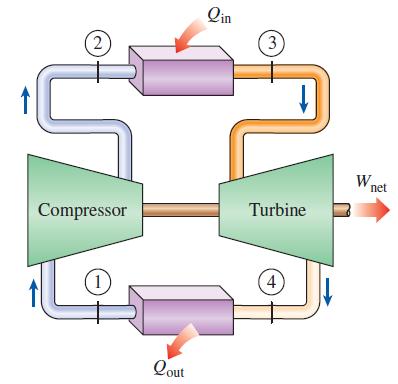
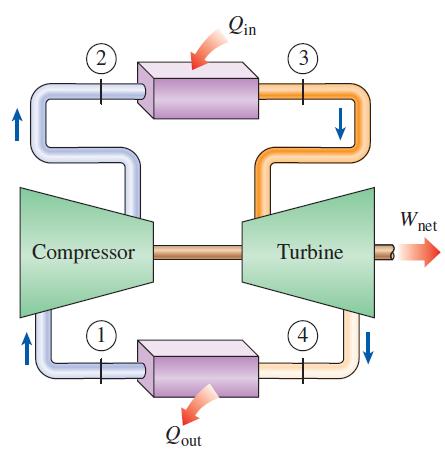
A Brayton cycle with a pressure ratio of 15 operates with air entering the compressor at 70 kPa and 0°C, and the turbine at 600°C. Calculate the net specific work produced by this cycle treating the air as an ideal gas with(a) Constant specific heats(b) Variable specific heats. Qin 2 3 W net
Repeat Prob. 9–170 using constant specific heats at room temperature.Data From Repeat Prob. 9–170:Consider a simple ideal Brayton cycle with air as the working fluid. The pressure ratio of the cycle is 6, and the minimum and maximum temperatures are 300 and 1300 K, respectively. Now the
Consider a simple ideal Brayton cycle operating between the temperature limits of 300 and 1250 K. Using constant specific heats at room temperature, determine the pressure ratio for which the compressor and the turbine exit temperatures of air are equal.
A four-cylinder, four-stroke, 1.6-L gasoline engine operates on the Otto cycle with a compression ratio of 11. The air is at 100 kPa and 37°C at the beginning of the compression process, and the maximum pressure in the cycle is 8 MPa. The compression and expansion processes may be modeled as
Repeat Prob. 9–162 using argon as the working fluid.Data From Q#162:Consider an engine operating on the ideal Diesel cycle with air as the working fluid. The volume of the cylinder is 1200 cm3 at the beginning of the compression process, 75 cm3 at the end, and 150 cm3 after the heat-addition
A Diesel cycle has a compression ratio of 22 and begins its compression at 85 kPa and 15°C. The maximum cycle temperature is 1200°C. Utilizing air-standard assumptions, determine the thermal efficiency of this cycle using(a) Constant specific heats at room temperature(b) Variable specific heats.
An Otto cycle with a compression ratio of 8 begins its compression at 94 kPa and 10°C. The maximum cycle temperature is 900°C. Utilizing air-standard assumptions, determine the thermal efficiency of this cycle using(a) Constant specific heats at room temperature(b) Variable specific heats.
Repeat Prob. 9–157 when the lake is at 60°F and the Carnot cycle’s thermal efficiency is to be 60 percent.Data From Q#157:An ideal gas Carnot cycle uses helium as the working fluid and rejects heat to a lake at 15°C. Determine the pressure ratio, compression ratio, and minimum temperature of
An ideal gas Carnot cycle uses helium as the working fluid and rejects heat to a lake at 15°C. Determine the pressure ratio, compression ratio, and minimum temperature of the heat source for this cycle to have a thermal efficiency of 50 percent.
Repeat Prob. 9–154 using constant specific heats at room temperature.Data From Repeat Prob. 9–154 uAn air-standard cycle with variable specific heats is executed in a closed system with 0.003 kg of air, and it consists of the following three processes:1-2 Isentropic compression from 100 kPa and
A gas turbine operates with a regenerator and two stages of reheating and intercooling. Air enters this engine at 14 psia and 60°F, the pressure ratio for each stage of compression is 3, the air temperature when entering a turbine is 940°F, the engine produces 1000 hp, and the regenerator
A gas turbine for an automobile is designed with a regenerator. Air enters the compressor of this engine at 100 kPa and 20°C. The compressor pressure ratio is 8, the maximum cycle temperature is 800°C, and the cold airstream leaves the regenerator 10°C cooler than the hot airstream at the inlet
A simple ideal Brayton cycle uses argon as the working fluid. At the beginning of the compression, P1 = 15 psia and T1 = 80°F; the maximum cycle temperature is 1200°F; and the pressure in the combustion chamber is 150 psia. The argon enters the compressor through a 3 ft2 opening with a velocity
An air-standard dual cycle has a compression ratio of 20 and a cutoff ratio of 1.3. The pressure ratio during the constant-volume heat addition process is 1.2. This cycle is operated at 14 psia and 70°F at the beginning of the compression. Calculate the exergy that is lost each time the cycle is
Reconsider Prob. 9–140. In the problem statement, replace the inlet mass flow rate with an inlet volume flow rate of 18.1 m3/s. Using appropriate software, investigate the effect of compressor inlet temperature in the range of –20 to 30°C on the force that must be applied to the brakes to hold
Reconsider Prob. 9–138E. How much change would result in the thrust if the propeller diameter were reduced to 8 ft while maintaining the same mass flow rate through the compressor?Note: The mass flow rate ratio will no longer be 20.Data From Q#138:A turboprop aircraft propulsion engine operates
A turboprop aircraft propulsion engine operates where the air is at 8 psia and −10°F, on an aircraft flying at a speed of 600 ft/s. The Brayton cycle pressure ratio is 10, and the air temperature at the turbine inlet is 940°F. The propeller diameter is 10 ft and the mass flow rate through the
Is the effect of turbine and compressor irreversibilities of a turbojet engine to reduce(a) The net work(b) The thrust(c) The fuel consumption rate?
Reconsider Prob. 9–127E. Determine the change in the rate of heat addition to the cycle when the isentropic efficiency of each compressor is 88 percent and that of each turbine is 93 percent.Data From Q#127:A gas turbine operates with a regenerator and two stages of reheating and intercooling.
A gas turbine operates with a regenerator and two stages of reheating and intercooling. Air enters this engine at 14 psia and 60°F; the pressure ratio for each stage of compression is 3; the air temperature when entering a turbine is 940°F; and the regenerator operates perfectly. Determine the
Repeat Prob. 9–123 using argon as the working fluid.Data From Q#123:Consider a regenerative gas-turbine power plant with two stages of compression and two stages of expansion. The overall pressure ratio of the cycle is 9. The air enters each stage of the compressor at 300 K and each stage of the
In an ideal gas-turbine cycle with intercooling, reheating, and regeneration, as the number of compression and expansion stages is increased, the cycle thermal efficiency approaches(a) 100 percent(b) The Otto cycle efficiency(c) The Carnot cycle efficiency.
Repeat Prob. 9–114 for a regenerator effectiveness of 70 percent.Data From Q#114:Air enters the compressor of a regenerative gas turbine engine at 310 K and 100 kPa, where it is compressed to 900 kPa and 650 K. The regenerator has an effectiveness of 80 percent, and the air
Repeat Prob. 9–114 using constant specific heats at room temperature.Data From Repeat Prob. 9–114: Air enters the compressor of a regenerative gas turbine engine at 310 K and 100 kPa, where it is compressed to 900 kPa and 650 K. The regenerator has an effectiveness of 80 percent, and the
In an ideal regenerator, is the air leaving the compressor heated to the temperature at(a) The turbine inlet(b) The turbine exit(c) Slightly above the turbine exit?
A simple ideal Brayton cycle uses argon as the working fluid. At the beginning of the compression, P1 = 15 psia and T1 = 80°F; the maximum cycle temperature is 1200°F; and the pressure in the combustion chamber is 150 psia. The argon enters the compressor through a 3 ft2 opening with a velocity
Repeat Prob. 9–93 for a pressure ratio of 15.Data From Repeat Prob. 9–93:An aircraft engine operates on a simple ideal Brayton cycle with a pressure ratio of 10. Heat is added to the cycle at a rate of 500 kW; air passes through the engine at a rate of 1 kg/s; and the air at the beginning of
Repeat Prob. 9–88 when the isentropic efficiencies of the turbine and compressor are 90 percent and 80 percent, respectively, and there is a 50-kPa pressure drop across the combustion chamber.Data From Q#88:A simple ideal Brayton cycle operates with air with minimum and maximum temperatures of
Repeat Prob. 9–88 when the isentropic efficiency of the turbine is 90 percent and that of the compressor is 80 percent.Data From Q#88:A simple ideal Brayton cycle operates with air with minimum and maximum temperatures of 27°C and 727°C. It is designed so that the maximum cycle pressure is 2000
Repeat Prob. 9–88 when the isentropic efficiency of the turbine is 90 percent.Data From Q#88:A simple ideal Brayton cycle operates with air with minimum and maximum temperatures of 27°C and 727°C. It is designed so that the maximum cycle pressure is 2000 kPa and the minimum cycle pressure is
A simple ideal Brayton cycle operates with air with minimum and maximum temperatures of 27°C and 727°C. It is designed so that the maximum cycle pressure is 2000 kPa and the minimum cycle pressure is 100 kPa. Determine the net work produced per unit mass of air each time this cycle is executed
An ideal Stirling cycle uses energy reservoirs at 40°F and 640°F and uses hydrogen as the working gas. It is designed such that its minimum volume is 0.1 ft3, maximum volume is 1 ft3, and maximum pressure is 400 psia. Calculate the amount of external heat addition, external heat rejection, and
Reconsider Prob. 9–75E. How much heat is stored (and recovered) in the regenerator?Data From Q#75:An air-standard Stirling cycle operates with a maximum pressure of 600 psia and a minimum pressure of 10 psia. The maximum volume of the air is 10 times the minimum volume. The temperature during the
An air-standard Stirling cycle operates with a maximum pressure of 600 psia and a minimum pressure of 10 psia. The maximum volume of the air is 10 times the minimum volume. The temperature during the heat rejection process is 100°F. Calculate the specific heat added to and rejected by this cycle,
What cycle is composed of two isothermal and two constant-volume processes?
Repeat Prob. 9–65E if the compression ratio were reduced to 12.Data From Q#65:An air-standard dual cycle has a compression ratio of 20 and a cutoff ratio of 1.3. The pressure ratio during the constant-volume heat addition process is 1.2. Determine the thermal efficiency, amount of heat added, and
An air-standard dual cycle has a compression ratio of 20 and a cutoff ratio of 1.3. The pressure ratio during the constant-volume heat addition process is 1.2. Determine the thermal efficiency, amount of heat added, and the maximum gas pressure and temperature when this cycle is operated at 14 psia
Repeat Prob. 9–60 using nitrogen as the working fluid.Data From Q#60:A four-cylinder, two-stroke 2.4-L diesel engine that operates on an ideal Diesel cycle has a compression ratio of 22 and a cutoff ratio of 1.8. Air is at 70°C and 97 kPa at the beginning of the compression process. Using the
A four-cylinder, two-stroke 2.4-L diesel engine that operates on an ideal Diesel cycle has a compression ratio of 22 and a cutoff ratio of 1.8. Air is at 70°C and 97 kPa at the beginning of the compression process. Using the cold-air-standard assumptions, determine how much power the engine will
Reconsider Prob. 9–58. Using appropriate software, study the effect of varying the compression ratio from 14 to 24. Plot the net work output, mean effective pressure, and thermal efficiency as a function of the compression atio. Plot the T-s and P-v diagrams for the cycle when the compression
Repeat Prob. 9–57, but replace the isentropic expansion process with a polytropic expansion process with the polytropic exponent n = 1.35. Use variable specific heats.Data From Q#57:An ideal diesel engine has a compression ratio of 20 and uses air as the working fluid. The state of air at
An ideal Diesel cycle has a maximum cycle temperature of 2000°C. The state of the air at the beginning of the compression is P1 = 95 kPa and T1 = 15°C. This cycle is executed in a four-stroke, eight-cylinder engine with a cylinder bore of 10 cm and a piston stroke of 12 cm. The minimum volume
Rework Prob. 9–50 when the isentropic compression efficiency is 90 percent and the isentropic expansion efficiency is 95 percent.Data From Q#50:An ideal Diesel cycle has a compression ratio of 18 and a cutoff ratio of 1.5. Determine the maximum air temperature and the rate of heat addition to
An ideal Diesel cycle has a compression ratio of 18 and a cutoff ratio of 1.5. Determine the maximum air temperature and the rate of heat addition to this cycle when it produces 200 hp of power; the cycle is repeated 1200 times per minute; and the state of the air at the beginning of the
Repeat Prob. 9–42 when isentropic processes are used in place of the polytropic processes?Data From Q#42:Someone has suggested that the air-standard Otto cycle is more accurate if the two isentropic processes are replaced with polytropic processes with a polytropic exponent n = 1.3. Consider such
Someone has suggested that the air-standard Otto cycle is more accurate if the two isentropic processes are replaced with polytropic processes with a polytropic exponent n = 1.3. Consider such a cycle when the compression ratio is 8, P1 = 95 kPa, T1 = 15°C, and the maximum cycle temperature is
A six-cylinder, 4-L spark-ignition engine operating on the ideal Otto cycle takes in air at 90 kPa and 20°C. The minimum enclosed volume is 15 percent of the maximum enclosed volume. When operated at 2500 rpm, this engine produces 90 hp. Determine the rate of heat addition to this engine. Use
An ideal Otto cycle has a compression ratio of 7. At the beginning of the compression process, P1 = 90 kPa, T1 = 27°C, and V1 = 0.004 m3. The maximum cycle temperature is 1127°C. For each repetition of the cycle, calculate the heat rejection and the net work production. Also calculate the thermal
Reconsider Prob. 9–32E. Determine the rate of heat addition and rejection for this ideal Otto cycle when it produces 140 hp.Data From Prob. 9–32E:Determine the mean effective pressure of an ideal Otto cycle that uses air as the working fluid; its state at the beginning of the compression is 14
Determine the mean effective pressure of an ideal Otto cycle that uses air as the working fluid; its state at the beginning of the compression is 14 psia and 60°F; its temperature at the end of the combustion is 1500°F; and its compression ratio is 9. Use constant specific heats at room
The thermal energy reservoirs of an ideal gas Carnot cycle are at 1240°F and 40°F, and the device executing this cycle rejects 100 Btu of heat each time the cycle is executed. Determine the total heat supplied to and the total work produced by this cycle each time it is executed.
Repeat Prob. 9–19 using helium as the working fluid.Data From Repeat Prob. 9–19:An air-standard Carnot cycle is executed in a closed system between the temperature limits of 350 and 1200 K. The pressures before and after the isothermal compression are 150 and 300 kPa, respectively. If the net
Can any ideal gas power cycle have a thermal efficiency greater than 55 percent when using thermal energy reservoirs at 627°C and 17°C?
What are the air-standard assumptions? What is the difference between spark-ignition and compression-ignition engines?
Repeat Prob. 8–114 if heat were supplied to the pressure cooker from a heat source at 180°C instead of the electrical heating unit?Data From Q#114:A 4-L pressure cooker has an operating pressure of 175 kPa. Initially, one-half of the volume is filled with liquid water and the other half by water
Air enters a compressor at ambient conditions of 100 kPa and 20°C at a rate of 6.2 m3/s with a low velocity and exits at 900 kPa, 60°C, and 80 m/s. The compressor is cooled by cooling water that experiences a temperature rise of 10°C. The isothermal efficiency of the compressor is 70 percent.
Repeat Prob. 9–14 using constant specific heats at room temperature.Data From Q#14 :An air-standard cycle with variable specific heats is executed in a closed system with 0.003 kg of air and consists of the following three processes:1-2 v = constant heat addition from 95 kPa and 17°C
An adiabatic nozzle is designed to accelerate an ideal gas from nearly 0 m/s, P1, and T1 to V m/s. As the efficiency of this nozzle decreases, the pressure at the nozzle exit must also be decreased to maintain the speed at V. Plot the change in the flow exergy as a function of the nozzle efficiency
A steam boiler may be thought of as a heat exchanger. The combustion gases may be modeled as a stream of air because their thermodynamic properties are close to those of air. Using this model, consider a boiler that is to convert saturated liquid water at 500 psia to a saturated vapor while keeping
The temperature of the air in a building can be maintained at a desirable level during winter by using different methods of heating. Compare heating this air in a heat exchanger unit with condensing steam to heating it with an electric-resistance heater. Perform a second-law analysis to determine
Consider natural gas, electric resistance, and heat pump heating systems. For a specified heating load, which one of these systems will do the job with the least irreversibility? Explain.
Domestic hot-water systems involve a high level of irreversibility, and thus they have low second-law efficiencies. The water in these systems is heated from about 15°C to about 60°C, and most of the hot water is mixed with cold water to reduce its temperature to 45°C or even lower before it is
Human beings are probably the most capable creatures, and they have a high level of physical, intellectual, emotional, and spiritual potentials or exergies. Unfortunately people make little use of their exergies, letting most of their exergies go to waste. Draw four exergy-versus-time charts, and
Steam enters a turbine steadily at 4 MPa and 600°C and exits at 0.2 MPa and 150°C in an environment at 25°C. The decrease in the exergy of the steam as it flows through the turbine is(a) 879 kJ/kg(b) 1123 kJ/kg(c) 1645 kJ/kg(d) 1910 kJ/kg(e) 4260 kJ/kg
A house is maintained at 21°C in winter by electric resistance heaters. If the outdoor temperature is 3°C, the second-law efficiency of the resistance heaters is(a) 0%(b) 4.1%(c) 6.1%(d) 8.6%(e) 16.3%
Heat is lost through a plane wall steadily at a rate of 800 W. If the inner and outer surface temperatures of the wall are 20°C and 9°C, respectively, and the environment temperature is 0°C, the rate of exergy destruction within the wall is(a) 0 W(b) 11 W(c) 15 W(d) 29 W(e) 76 W
Obtain a relation for the second-law efficiency of a heat engine that receives heat QH from a source at temperature
Refrigerant-134a at 1600 kPa and 80°C is expanded adiabatically in a closed system to 100 kPa with an isentropic expansion efficiency of 85 percent. Determine the second-law efficiency of this expansion. Take T0 = 25°C and P0 = 100 kPa.
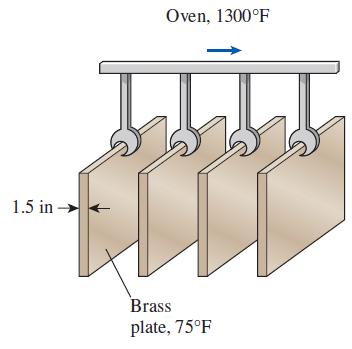
In a production facility, 1.5-in-thick, 1-ft × 3-ft square brass plates (ρ = 532.5 lbm/ft3 and cp = 0.091 Btu/ lbm·°F) that are initially at a uniform temperature of 75°F areheated by passing them through an oven at 1300°F at a rate of 175 per minute. If the plates remain in the oven until
A rigid 50-L nitrogen cylinder is equipped with a safety relief valve set at 1200 kPa. Initially, this cylinder contains nitrogen at 1200 kPa and 20°C. Heat is now transferredto the nitrogen from a thermal energy reservoir at 500°C, and nitrogen is allowed to escape until the mass of nitrogen
One ton of liquid water at 65°C is brought into a well insulated and well-sealed 3-m × 4-m × 7-m room initially at 16°C and 100 kPa. Assuming constant specific heats for both the air and water at room temperature, determine(a) The final equilibrium temperature in the room(b) The exergy
Argon gas enters an adiabatic turbine at 1350°F and 200 psia at a rate of 40 lbm/min and exhausts at 20 psia. If the power output of the turbine is 105 hp, determine(a) The isentropic efficiency(b) The second-law efficiency of the turbine. Assume the surroundings to be at 77°F.
An adiabatic turbine operates with air entering at 550 kPa and 425 K and leaving at 110 kPa and 325 K. Calculate the second-law efficiency of this turbine. Take T0 = 25°C.
A crater lake has a base area of 20,000 m2, and the water it contains is 12 m deep. The ground surrounding the crater is nearly flat and is 105 m below the base of the lake. Determine the maximum amount of electrical work, in kWh, that can be generated by feeding this water to a hydroelectric power
An aluminum pan has a flat bottom whose diameter is 30 cm. Heat is transferred steadily to boiling water in the pan through its bottom at a rate of 1100 W. If the temperatures of the inner and outer surfaces of the bottom of the pan are 104°C and 105°C, respectively, determine the rate of exergy
Derive an expression for the work potential of the single-phase contents of a rigid adiabatic container when the initially empty container is filled through a single opening from a source of working fluid whose properties remain fixed.
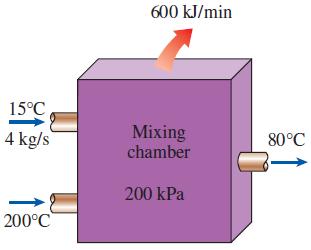
Liquid water at 200 kPa and 15°C is heated in a chamber by mixing it with superheated steam at 200 kPa and 200°C. Liquid water enters the mixing chamber at a rate of 4 kg/s, and the chamber is estimated to lose heat to the surrounding air at 25°C at a rate of 600 kJ/min. If the mixture leaves
How much exergy is lost in a rigid vessel filled with 1 kg of liquid R-134a, whose temperature remains constant at 30°C, as R-134a vapor is released from the vessel? This vessel may exchange heat with the surrounding atmosphere, which is at 100 kPa and 30°C. The vapor is released until the last
A 0.6-m3 rigid tank is filled with saturated liquid water at 135°C. A valve at the bottom of the tank is now opened, and one-half of the total mass is withdrawn from the tank in liquid form. Heat is transferred to water from a source of 210°C so that the temperature in the tank remains constant.
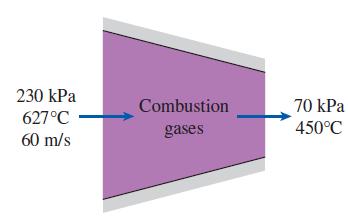
Hot combustion gases enter the nozzle of a turbojet engine at 230 kPa, 627°C, and 60 m/s and exit at 70 kPa and 450°C. Assuming the nozzle to be adiabatic and the surroundings to be at 20°C, determine(a) The exit velocity(b) The decrease in the exergy of the gases. Take k = 1.3 and cp = 1.15
An adiabatic turbine operates with air entering at 550 kPa, 425 K, and 150 m/s and leaving at 110 kPa, 325 K, and 50 m/s. Determine the actual and maximum work production for this turbine, in kJ/kg. Why are the maximum and actual works not the same? Take T0 = 25°C.
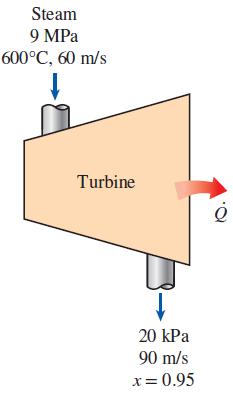
Steam enters a turbine at 9 MPa, 600°C, and 60 m/s and leaves at 20 kPa and 90 m/s with a moisture content of 5 percent. The turbine is not adequately insulated, and it estimated that heat is lost from the turbine at a rate of 220 kW. The power output of the turbine is 4.5 MW. Assuming the
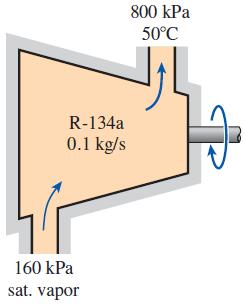
The adiabatic compressor of a refrigeration system compresses R-134a from a saturated vapor at 160 kPa to 800 kPa and 50°C. What is the minimum power required by this compressor when its mass flow rate is 0.1 kg/s? Take T0 = 25°C. 800 kPa 50°C R-134a 0.1 kg/s 160 kPa sat. vapor
Air is compressed by a compressor from 101 kPa and 27°C to 400 kPa and 220°C at a rate of 0.15 kg/s. Neglecting the changes in kinetic and potential energies and assuming the surroundings to be at 25°C, determine the reversible power input for this process.
Air enters a compressor at 14.7 psia and 77°F and is compressed to 140 psia and 200°F. Determine the minimum work required for this compression, in Btu/lbm, with the same inlet and outlet states. Does the minimum work require an adiabatic compressor?
An adiabatic steam nozzle has steam entering at 500 kPa, 200°C, and 30 m/s, and leaving as a saturated vapor at 200 kPa. Calculate the second-law efficiency of the nozzle. Take T0 = 25°C.
Refrigerant-134a enters an expansion valve at 1200 kPa as a saturated liquid and leaves at 200 kPa. Determine(a) The temperature of R-134a at the outlet of the expansion valve(b) The entropy generation and the exergy destruction during this process. Take T0 = 25°C.
Reconsider Prob. 8–41. Using appropriate software, study the effect of final pressure in the tank on the exergy destroyed during the process. Plot the exergy destroyed as a function of the final pressure for final pressures between 45 and 5 kPa, and discuss the results.Data From Q#41:A rigid tank
An insulated piston–cylinder device contains 0.018 m3 of saturated refrigerant-134a vapor at 0.6 MPa pressure. The refrigerant is now allowed to expand in a reversible manner until the pressure drops to 0.16 MPa. Determine the change in the exergy of the refrigerant during this process and
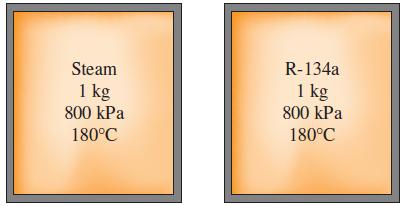
Which has the capability to produce the most work in a closed system – 1 kg of steam at 800 kPa and 180°C or 1 kg of R–134a at 800 kPa and 180°C? Take T0 = 25°C and P0 = 100 kPa. Steam R-134a 1 kg 1 kg 800 kPa 800 kPa 180°C 180°C
Showing 300 - 400
of 689
1
2
3
4
5
6
7
Step by Step Answers

 Get 50% OFF
Claim Now
Get 50% OFF
Claim Now