New Semester
Started
Get
50% OFF
Study Help!
--h --m --s
Claim Now
Question Answers
Textbooks
Find textbooks, questions and answers
Oops, something went wrong!
Change your search query and then try again
S
Books
FREE
Study Help
Expert Questions
Accounting
General Management
Mathematics
Finance
Organizational Behaviour
Law
Physics
Operating System
Management Leadership
Sociology
Programming
Marketing
Database
Computer Network
Economics
Textbooks Solutions
Accounting
Managerial Accounting
Management Leadership
Cost Accounting
Statistics
Business Law
Corporate Finance
Finance
Economics
Auditing
Tutors
Online Tutors
Find a Tutor
Hire a Tutor
Become a Tutor
AI Tutor
AI Study Planner
NEW
Sell Books
Search
Search
Sign In
Register
study help
engineering
thermodynamics an engineering approach
Thermodynamics An Engineering Approach 9th Edition Yunus Cengel, Michael Boles, Mehmet Kanoglu - Solutions
A heat engine that propels a ship produces 500 Btu/lbm of work while rejecting 300 Btu/lbm of heat. What is its thermal efficiency?
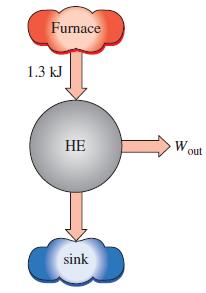
A heat engine has a total heat input of 1.3 kJ and a thermal efficiency of 35 percent. How much work will it produce? Furnace 1.3 kJ НЕ W out sink
To maintain altitude, the temperature of the air inside a hot-air balloon must remain within a 1°C band, while the volume cannot vary by more than 1 percent. At a 300-m altitude, the air in a 1000 m3 hot-air balloon needs to maintain a 35°C average temperature. This balloon loses heat at a rate
Pneumatic nail drivers used in construction require 0.02 ft3 of air at 100 psia and 1 Btu of energy to drive a single nail. You have been assigned the task of designing a compressed-air storage tank with enough capacity to drive 500 nails. The pressure in this tank cannot exceed 500 psia, and the
Saturated water vapor at 40°C is to be condensed as it flows through a tube at a rate of 0.20 kg/s. The condensate leaves the tube as a saturated liquid at 40°C. The rate of heat transfer from the tube is(a) 34 kJ/s(b) 481 kJ/s(c) 2406 kJ/s(d) 514 kJ/s(e) 548 kJ/s
Steam is accelerated by a nozzle steadily from a low velocity to a velocity of 280 m/s at a rate of 2.5 kg/s. If the temperature and pressure of the steam at the nozzle exit are 400°C and 2 MPa, the exit area of the nozzle is(a) 8.4 cm2(b) 10.7 cm2(c) 13.5 cm2(d) 19.6 cm2(e) 23.0 cm2
Steam enters a diffuser steadily at 0.5 MPa, 300°C, and 90 m/s at a rate of 3.5 kg/s. The inlet area of the diffuser is(a) 22 cm2(b) 53 cm2(c) 126 cm2(d) 175 cm2(e) 203 cm2
Refrigerant-134a at 1.4 MPa and 70°C is throttled to a pressure of 0.6 MPa. The temperature of the refrigerant after throttling is(a) 70°C(b) 66°C(c) 57°C(d) 49°C(e) 22°C
In a heating system, cold outdoor air at 7°C flowing at a rate of 4 kg/min is mixed adiabatically with heated air at 70°C flowing at a rate of 5 kg/min. The exit temperature of the mixture is(a) 34°C(b) 39°C(c) 42°C(d) 57°C(e) 70°C
A pressure cooker is a pot that cooks food much faster than ordinary pots by maintaining a higher pressure and temperature during cooking. The pressure inside the pot is controlled by a pressure regulator (the petcock) that keeps the pressure at a constant level by periodically allowing some steam
A small positioning control rocket in a satellite is driven by a 2-ft3 container filled with R-134a at –10°F. Upon launch, the container is completely filled with saturated liquid R-134a. The rocket is designed for short bursts of 5-s duration. During each burst, the mass flow rate leaving the
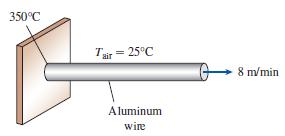
Repeat Prob. 5–162 for a copper wire (ρ = 8950 kg/m3 and cp = 0.383 kJ/kg · °C).Data From Q# 162:Long aluminum wires of diameter 5 mm (ρ = 2702 kg/m3 and cp = 0.896 kJ/kg · °C) are extruded at a temperature of 350°C and are cooled to 50°C in atmospheric air at 25°C. If the wire is
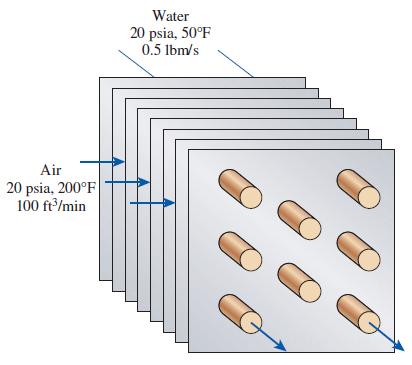
Consider a heat exchanger that uses hot air to heat cold water. Air enters this heat exchanger at 20 psia and 200°F at a rate of 100 ft3/min and leaves at 17 psia and 100°F. Water enters this unit at 20 psia and 50°F at a rate of 0.5 lbm/s and exits at 17 psia and 90°F. Determine the total flow
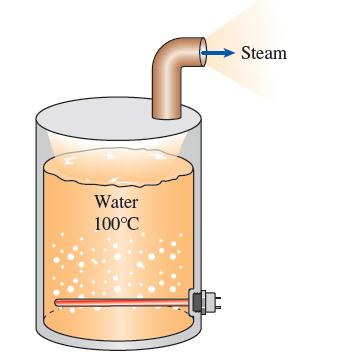
Water is boiled at 100°C electrically by a 3-kW resistance wire. Determine the rate of evaporation of water. Steam Water 100°C
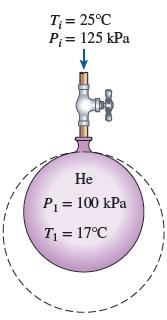
A balloon initially contains 40 m3 of helium gas at atmospheric conditions of 100 kPa and 17°C. The balloon is connected by a valve to a large reservoir that supplies helium gas at 125 kPa and 25°C. Now the valve is opened, and helium is allowed to enter the balloon until pressure equilibrium
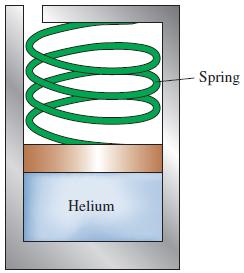
A spring-loaded piston–cylinder device contains 5 kg of helium as the system, as shown in Fig. P4–77. This system is heated from 100 kPa and 20°C to 800 kPa and 160°C. Determine the heat transferred to and the work produced by this system. -Spring Helium
In an informative article in a magazine it is stated that tires lose roughly 1 psi of pressure for every 10°F drop in outside temperature. Investigate whether this is a valid statement.
An adiabatic closed system is accelerated from 0 m/s to 30 m/s. Determine the specific energy change of this system, in kJ/kg.
The steam requirements of a manufacturing facility are being met by a boiler whose rated heat input is 5.5 × 10⁶ Btu/h. The combustion efficiency of the boiler is measured to be 0.7 by a handheld flue gas analyzer. After tuning up the boiler, the combustion efficiency rises to 0.8. The boiler
The U.S. Department of Energy estimates that 570,000 barrels of oil would be saved per day if every household in the United States lowered the thermostat setting in winter by 6°F (3.3°C). Assuming the average heating season to be 180 days and the cost of oil to be $55/barrel, determine how much
A grist mill of the 1800s employed a waterwheel that was 14 m high; 480 L/min of water flowed onto the wheel near the top. How much power, in kW, could this waterwheel have produced?
An automobile moving through the air causes the air velocity (measured with respect to the car) to decrease and fill a larger flow channel. An automobile has an effective flow channel area of 3 m2. The car is traveling at 90 km/h on a day when the barometric pressure is 70 cm of mercury and the
What is the specific volume of water at 5 MPa and 100°C? What would it be if the incompressible liquid approximation were used? Determine the accuracy of this approximation.
Saturated steam coming off the turbine of a steam power plant at 40°C condenses on the outside of a 3-cm-outerdiameter,35-m-long tube at a rate of 70 kg/h. Determine the rate of heat transfer from the steam to the cooling water flowing through the pipe.
Reconsider Prob. 3–51. Using appropriate software, investigate the effect of pressure on the total mass of water in the tank. Let the pressure vary from 0.1 MPa to 1 MPa. Plot the total mass of water against pressure, and discuss the results. Also, show the process in Prob. 3–51 on a P-v
Reconsider Prob. 3–54E. Using appropriate software, investigate the effect of initial pressure on the quality of water at the final state. Let the pressure vary from 100 psia to 300 psia. Plot the quality against initial pressure, and discuss the results. Also, show the process in Prob. 3–54E
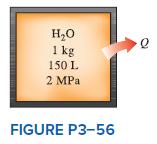
One kilogram of water fills a 150-L rigid container at an initial pressure of 2 MPa. The container is then cooled to 40°C. Determine the initial temperature and the final pressure of the water. H,0 1 kg 150 L. 2 MPa FIGURE P3-56
10 kg of R-134a fill a 0.7-m3 weighted piston–cylinder device at a pressure of 200 kPa. The container is now heated until the temperature is 30°C. Determine the initial temperature and final volume of the R-134a.
A mass of 0.1 kg of helium fills a 0.2 m3 rigid vessel at 350 kPa. The vessel is heated until the pressure is 700 kPa. Calculate the temperature change of helium (in °C and K) as a result of this heating.
100 grams of carbon monoxide are contained in a weighted piston–cylinder device. Initially the carbon monoxide is at 1000 kPa and 200°C. It is then heated until its temperature is 500°C. Determine the final volume of the carbon monoxide, treating it as(a) An ideal gas and(b) A Benedict
A 3-m3 rigid vessel contains steam at 2 MPa and 500°C. The mass of the steam is(a) 13 kg (b) 17 kg(c) 22 kg(d) 28 kg (e) 35 kg
Water is boiling at 1 atm pressure in a stainless steel pan on an electric range. It is observed that 1.25 kg of liquid water evaporates in 30 min. The rate of heat transfer to the water is(a) 1.57 kW (b) 1.86 kW (c) 2.09 kW(d) 2.43 kW (e) 2.51 kW
Nitrogen in a rigid vessel is cooled by rejecting 100 kJ/kg of heat. Determine the internal energy change of the nitrogen, in kJ/kg.
Nitrogen at 100 psia and 300°F in a rigid container is cooled until its pressure is 50 psia. Determine the work done and the heat transferred during this process, in Btu/lbm.
A piston–cylinder device containing carbon-dioxide gas undergoes an isobaric process from 15 psia and 80°F to 200°F. Determine the work and the heat transfer associated with this process, in Btu/lbm.
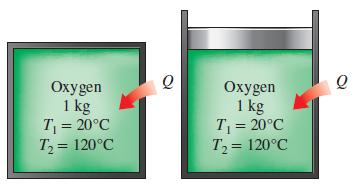
1 kg of oxygen is heated from 20 to 120°C. Determine the amount of heat transfer required when this is done during a(a) Constant-volume process and(b) Isobaric process. Oxygen 1 kg T = 20°C T, = 120°C Охудen 1 kg T = 20°C T = 120°C %3! %3D
An ideal gas contained in a piston–cylinder device undergoes an isothermal compression process which begins with an initial pressure and volume of 100 kPa and 0.6 m3, respectively. During the process there is a heat transfer of 60 kJ from the ideal gas to the surroundings. Determine the volume
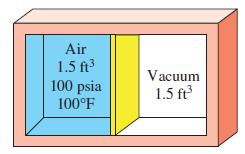
A 3-ft3 adiabatic rigid container is divided into two equal volumes by a thin membrane, as shown in Fig. P4–73E. Initially, one of these chambers is filled with air at 100 psia and 100°F while the other chamber is evacuated. Determine the internal energy change of the air when the membrane is
A piston–cylinder device contains 2.2 kg of nitrogen initially at 100 kPa and 25°C. The nitrogen is now compressed slowly in a polytropic process during which PV1.3 = constant until the volume is reduced by one-half. Determine the work done and the heat transfer for this process.
A 1-kg block of iron is heated from 25 to 75°C. What is the change in the iron’s total internal energy and enthalpy?
Which of two gases—neon or air—requires less work when compressed in a closed system from P1 to P2 using a polytropic process with n = 1.5?
Which of two gases—neon or air—produces more work when expanded from P1 to P2 in a closed-system polytropic process with n = 1.2?
Consider a classroom that is losing heat to the outdoors at a rate of 12,000 kJ/h. If there are 40 students in class, each dissipating sensible heat at a rate of 84 W, determine if it is necessary to turn the heater in the classroom on to prevent the room temperature from dropping.
A rigid tank contains a gas mixture with a specific heat of cv = 0.748 kJ/kg·K. The mixture is cooled from 200 kPa and 200°C until its pressure is 100 kPa. Determine the heat transfer during this process, in kJ/kg.
Reconsider Prob. 4–134. Using appropriate software, investigate the effect of the initial temperature of the ice on the final mass required. Let the ice temperature vary from –26 to 0°C. Plot the mass of ice against the initial temperature of ice, and discuss the results.Data From P-134:
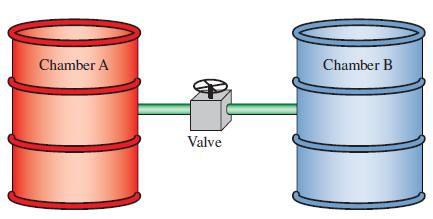
Two adiabatic chambers, 2 m3 each, are interconnected by a valve, as shown in Fig. P4–137, with one chamber containing oxygen at 1000 kPa and 127°C and the other chamber evacuated. The valve is now opened until the oxygen fills both chambers and both tanks have the same pressure. Determine the
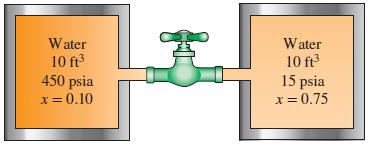
Two 10-ft3 adiabatic tanks are connected by a valve. Initially, one tank contains water at 450 psia with 10 percent quality, while the second contains water at 15 psia with 75 percent quality. The valve is now opened, allowing the water vapor from the high-pressure tank to move to the lowpressure
A 0.5-m3 rigid tank contains nitrogen gas at 600 kPa and 300 K. Now the gas is compressed isothermally to a volume of 0.2 m3. The work done on the gas during this compression process is(a) 82 kJ(b) 180 kJ(c) 240 kJ(d) 275 kJ(e) 315 kJ
Air is compressed by an adiabatic compressor from 100 kPa and 20°C to 1.8 MPa and 400°C. Air enters the compressor through a 0.15-m2 opening with a velocity of 30 m/s. It exits through a 0.08-m2 opening. Calculate the mass flow rate of air and the required power input.
Someone claims, based on temperature measurements, that the temperature of a fluid rises during a throttling process in a well-insulated valve with negligible friction. How do you evaluate this claim? Does this process violate any thermodynamic laws?
Hot and cold streams of a fluid are mixed in a rigid mixing chamber. The hot fluid flows into the chamber at a mass flow rate of 5 kg/s with an energy in the amount of 150 kJ/kg. The cold fluid flows into the chamber with a mass flow rate of 15 kg/s and carries energy in the amount of 50 kJ/kg.
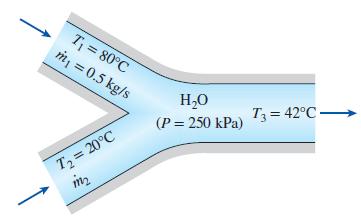
A hot-water stream at 80°C enters a mixing chamber with a mass flow rate of 0.5 kg/s where it is mixed with a stream of cold water at 20°C. If it is desired that the mixture leave the chamber at 42°C, determine the mass flow rate of the cold-water stream. Assume all the streams are at a pressure
Water at 80°F and 20 psia is heated in a chamber by mixing it with saturated water vapor at 20 psia. If both streams enter the mixing chamber at the same mass flow rate, determine the temperature and the quality of the exiting stream.
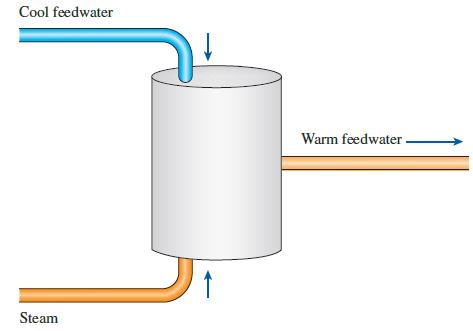
An adiabatic open feedwater heater in an electric power plant mixes 0.2 kg/s of steam at 100 kPa and 160°C with 10 kg/s of feedwater at 100 kPa and 50°C to produce feedwater at 100 kPa 60°C at the outlet. Determine the outlet mass flow rate and the outlet velocity when the outlet pipe diameter
An open feedwater heater heats the feedwater by mixing it with hot steam. Consider an electric power plant with an open feedwater heater that mixes 0.1 lbm/s of steam at 10 psia and 200°F with 2.0 lbm/s of feedwater at 10 psia and 100°F to produce 10 psia and 120°F feedwater at the outlet. The
Two streams of water are mixed in an insulated container to form a third stream leaving the container. The first stream has a flow rate of 30 kg/s and a temperature of 90°C. The flow rate of the second stream is 200 kg/s, and its temperature is 50°C. What is the temperature of the third stream?
Saturated liquid water is heated in a steady-flow steam boiler at a constant pressure of 2 MPa at a rate of 4 kg/s to an outlet temperature of 250°C. Determine the rate of heat transfer in the boiler.
Argon steadily flows into a constant-pressure heater at 300 K and 100 kPa with a mass flow rate of 6.24 kg/s. Heat transfer in the rate of 150 kW is supplied to the argon as it flows through the heater.(a) Determine the argon temperature at the heater exit, in °C.(b) Determine the argon volume
A 0.05-m3 rigid tank initially contains refrigerant- 134a at 0.8 MPa and 100 percent quality. The tank is connected by a valve to a supply line that carries refrigerant-134a at 1.2 MPa and 40°C. Now the valve is opened, and the refrigerant is allowed to enter the tank. The valve is closed when it
The air in an insulated, rigid compressed-air tank whose volume is 0.5 m3 is initially at 2400 kPa and 20°C. Enough air is now released from the tank to reduce the pressure to 2000 kPa. Following this release, what is the temperature of the remaining air in the tank?
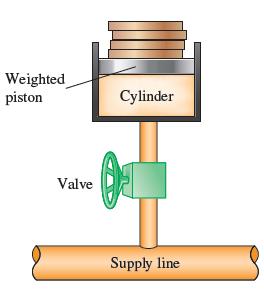
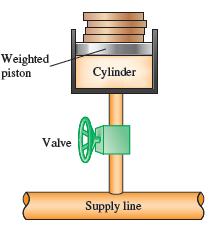
The weighted piston of the device shown in Fig. P5–134E maintains the pressure of the piston-cylinder contents at 200 psia. Initially, this system contains no mass. The valve is now opened, and steam from the line flows into the cylinder until the volume is 10 ft3. This process is adiabatic, and
Repeat Prob. 5–134E when the supply line carries oxygen at 300 psia and 450°F.Data From Q#134:The weighted piston of the device shown in Fig. P5–134E maintains the pressure of the piston-cylinder contents at 200 psia. Initially, this system contains no mass. The valve is now opened, and steam
Underground water is being pumped into a pool whose cross section is 6 m × 9 m while water is discharged through a 7-cm-diameter orifice at a constant average velocity of 4 m/s. If the water level in the pool rises at a rate of 2.5 cm/ min, determine the rate at which water is supplied to the
Helium steadily enters a pipe with a mass flow rate of 8 kg/s at 427°C and 100 kPa and leaves the pipe at 27°C. The pressure during the process is constant at 100 kPa.(a) Determine the heat transfer for the process, in kW.(b) Determine the volume flow rate of the helium at the pipe exit, in m3/s.
A glass of water with a mass of 0.32 kg at 20°C is to be cooled to 0°C by dropping ice cubes at 0°C into it. The latent heat of fusion of ice is 334 kJ/kg, and the specific heat of water is 4.18 kJ/kg·°C. The amount of ice that needs to be added is(a) 32 g(b) 40 g(c) 80 g(d) 93 g(e) 110 g
An apple with an average mass of 0.18 kg and average specific heat of 3.65 kJ/kg·°C is cooled from 17°C to 5°C. The amount of heat transferred from the apple is(a) 7.9 kJ(b) 11.2 kJ (c) 14.5 kJ(d) 17.6 kJ(e) 19.1 kJ
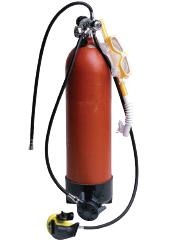
Compressed gases and phase-changing liquids are used to store energy in rigid containers. What are the advantages and disadvantages of each substance as a means of storing energy?
A 1982 U.S. Department of Energy article (FS#204) states that a leak of one drip of hot water per second can cost $1.00 per month. Making reasonable assumptions about the drop size and the unit cost of energy, determine if this claim is reasonable.
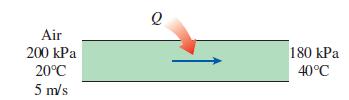
Air enters a 16cm diameter pipe steadily at 200 kPa and 20°C with a velocity of 5 m/s. Air is heated as it flows, and it leaves the pipe at 180 kPa and 40°C. Determine(a) The volume flow rate of air at the inlet(b) The mass flow rate of air(c) The velocity and volume flow rate at the exit. Air
A steam pipe is to transport 200 lbm/s of steam at 200 psia and 600°F. Calculate the minimum diameter this pipe can have so that the steam velocity does not exceed 59 ft/s.
Air enters the 1m2 inlet of an aircraft engine at 100 kPa and 20°C with a velocity of 180 m/s. Determine the volume flow rate, in m3/s, at the engine’s inlet and the mass flow rate, in kg/s, at the engine’s exit.
Water enters the constant 130 mm inside-diameter tubes of a boiler at 7 MPa and 65°C and leaves the tubes at 6 MPa and 450°C with a velocity of 80 m/s. Calculate the velocity of the water at the tube inlet and the inlet volume flow rate.
An air compressor compresses 6 L of air at 120 kPa and 20°C to 1000 kPa and 400°C. Determine the flow work, in kJ/kg, required by the compressor.
A house is maintained at 1 atm and 24°C, and warm air inside a house is forced to leave the house at a rate of 90 m3/h as a result of outdoor air at 5°C infiltrating into the house through the cracks. Determine the rate of net energy loss of the house due to mass transfer.
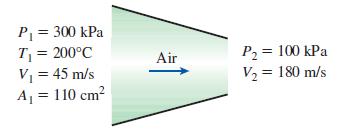
Air enters an adiabatic nozzle steadily at 300 kPa, 200°C, and 45 m/s and leaves at 100 kPa and 180 m/s. The inlet area of the nozzle is 110 cm2. Determine(a) The mass flow rate through the nozzle(b) The exit temperature of the air(c) The exit area of the nozzle. P= 300 kPa T = 200°C V = 45 m/s A
Reconsider Prob. 5–39.Data From Q#39:Air enters an adiabatic nozzle steadily at 300 kPa, 200°C, and 45 m/s and leaves at 100 kPa and 180 m/s. The inlet area of the nozzle is 110 cm2. Determine(a) The mass flow rate through the nozzle(b) The exit temperature of the air(c) The exit
Consider an adiabatic turbine operating steadily. Does the work output of the turbine have to be equal to the decrease in the energy of the steam flowing through it?
Air is expanded from 1000 kPa and 600°C at the inlet of a steady-flow turbine to 100 kPa and 200°C at the outlet. The inlet area and velocity are 0.1 m2 and 30 m/s, respectively, and the outlet velocity is 10 m/s. Determine the mass flow rate and outlet area.
Air enters a gas turbine at 150 psia and 700°F and leaves at 15 psia and 100°F. Determine the inlet and outlet volume flow rates when the mass flow rate through this turbine is 5 lbm/s.
Refrigerant-134a enters a compressor at 100 kPa and –24°C with a flow rate of 1.35 m3/min and leaves at 800 kPa and 60°C. Determine the mass flow rate of R-134a and the power input to the compressor.
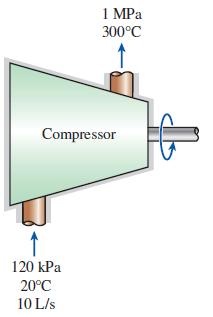
An adiabatic air compressor compresses 10 L/s of air at 120 kPa and 20°C to 1000 kPa and 300°C. Determine(a) The work required by the compressor, in kJ/kg, and(b) The power required to drive the air compressor, in kW. 1 MPa 300°C Compressor 120 kPa 20°C 10 L/s
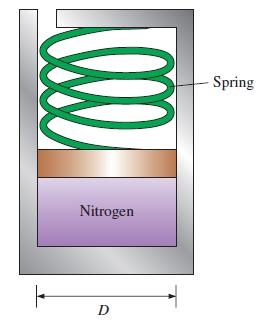
A mass of 10 g of nitrogen is contained in the springloaded piston–cylinder device shown in Fig. P4–54. The spring constant is 1 kN/m, and the piston diameter is 10 cm. When the spring exerts no force against the piston, the nitrogen is at 120 kPa and 27°C. The device is now heated until its
Neon is compressed from 100 kPa and 20°C to 500 kPa in an isothermal compressor. Determine the change in the specific volume and specific enthalpy of neon caused by this compression.
What is the change in the internal energy, in Btu/lbm, of air as its temperature changes from 100 to 200°F? Is there any difference if the temperature were to change from 0 to 100°F?
2 kg of saturated liquid water at 150°C is heated at constant pressure in a piston–cylinder device until it is saturated vapor. Determine the heat transfer required for this process.
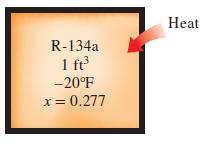
A rigid 1-ft3 vessel contains R-134a originally at –20°F and 27.7 percent quality. The refrigerant is then heated until its temperature is 100°F. Calculate the heat transfer required to do this. Heat R-134a 1 fr -20°F x= 0.277
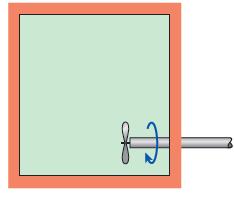
A substance is contained in a well-insulated rigid container that is equipped with a stirring device, as shown in Fig. P4–30. Determine the change in the internal energy of this substance when 15 kJ of work is applied to the stirring device.
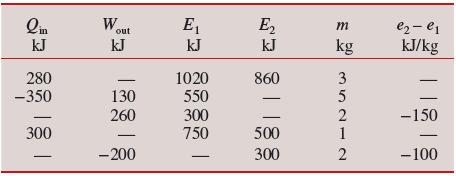
Complete each line of the following table on the basis of the conservation of energy principle for a closed system. W. E, E, e2- e; kJ/kg m out kJ kJ kJ kJ kg 280 1020 550 860 3 5 -350 130 260 -150 300 750 2 1 300 500 -200 300 2 -100 |1818
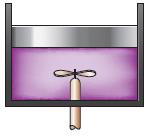
A closed system like that shown in Fig. P4–27E is operated in an adiabatic manner. First, 15,000 lbf·ft of work are done by this system. Then, work is applied to the stirring device to raise the internal energy of the fluid by 10.28 Btu. Calculate the net increase in the internal energy of this
Argon is compressed in a polytropic process with n = 1.2 from 120 kPa and 30°C to 1200 kPa in a piston–cylinder device. Determine the final temperature of the argon.
A mass of 5 kg of saturated water vapor at 150 kPa is heated at constant pressure until the temperature reaches 200°C. Calculate the work done by the steam during this process.
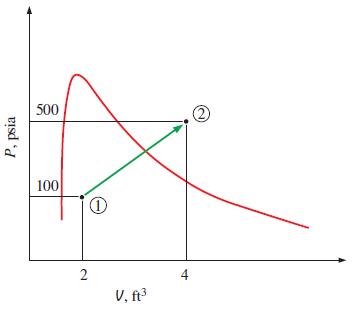
Calculate the total work, in Btu, produced by the process of Fig. P4–5E. 500 100 O. 2 4 V, ft3 P, psia
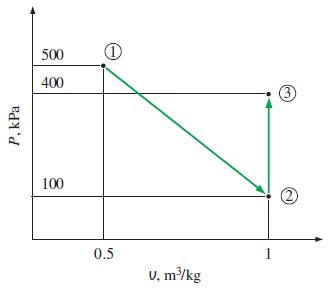
Calculate the total work, in kJ, for process 1–3 shown in Fig. P4–4 when the system consists of 2 kg of nitrogen. 500 400 100 0.5 1 U, m/kg P, kPa
A 240-m3 rigid tank is filled with a saturated liquid–vapor mixture of water at 200 kPa. If 25 percent of the mass is liquid and 75 percent of the mass is vapor, the total mass in the tank is(a) 240 kg (b) 265 kg (c) 307 kg(d) 361 kg (e) 450 kg
Oxygen is maintained at 4 MPa and 20°C. Compare the specific volume of the oxygen under this condition as predicted by(a) The ideal-gas equation of state(b) The Beattie-Bridgeman equation of state and(c) The compressibility factor.
A 9-m3 tank contains nitrogen at 17°C and 600 kPa. Some nitrogen is allowed to escape until the pressure in the tank drops to 400 kPa. If the temperature at this point is 15°C, determine the amount of nitrogen that has escaped.
Water initially at 300 kPa and 250°C is contained in a constant-volume tank. The water is allowed to cool until its pressure is 150 kPa. On the P-v and T-v diagrams, sketch, with respect to the saturation lines, the process curve passing through both the initial and final states of the water.
One kilogram of R-134a fills a 0.090-m3 rigid container at an initial temperature of –40°C. The container is then heated until the pressure is 280 kPa. Determine the initial pressure and final temperature.
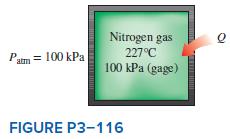
A rigid tank contains nitrogen gas at 227°C and 100 kPa gage. The gas is heated until the gage pressure reads 250 kPa. If the atmospheric pressure is 100 kPa, determine the final temperature of the gas, in °C. Nitrogen gas 227°C Pam = 100 kPa 100 kPa (gage) FIGURE P3-116
1 lbm of carbon dioxide is heated in a constant pressure apparatus. Initially, the carbon dioxide is at 1000 psia and 200°F, and it is heated until its temperature becomes 800°F. Determine the final volume of the carbon dioxide, treating it as(a) An ideal gas and(b) A Benedict-Webb-Rubin gas.
Showing 500 - 600
of 689
1
2
3
4
5
6
7
Step by Step Answers

 Get 50% OFF
Claim Now
Get 50% OFF
Claim Now