New Semester
Started
Get
50% OFF
Study Help!
--h --m --s
Claim Now
Question Answers
Textbooks
Find textbooks, questions and answers
Oops, something went wrong!
Change your search query and then try again
S
Books
FREE
Study Help
Expert Questions
Accounting
General Management
Mathematics
Finance
Organizational Behaviour
Law
Physics
Operating System
Management Leadership
Sociology
Programming
Marketing
Database
Computer Network
Economics
Textbooks Solutions
Accounting
Managerial Accounting
Management Leadership
Cost Accounting
Statistics
Business Law
Corporate Finance
Finance
Economics
Auditing
Tutors
Online Tutors
Find a Tutor
Hire a Tutor
Become a Tutor
AI Tutor
AI Study Planner
NEW
Sell Books
Search
Search
Sign In
Register
study help
engineering
thermodynamics an engineering approach
Thermodynamics An Engineering Approach 9th Edition Yunus Cengel, Michael Boles, Mehmet Kanoglu - Solutions
Methane is contained in a piston–cylinder device and is heated at constant pressure of 5 MPa from 100 to 250°C. Determine the heat transfer, work, and entropy change per unit mass of the methane using(a) The ideal-gas assumption(b) The generalized charts(c) Real fluid data. This problem is
Propane at 500 kPa and 100°C is compressed in a steady-flow device to 4000 kPa and 500°C. Calculate the change in the specific entropy of the propane and the specific work required for this compression(a) Treating the propane as an ideal gas with temperature-variable specific heats(b) Using the
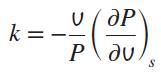
Estimate the cp of nitrogen at 300 kPa and 400 K, using(a) The relation in Prob. 12–91,Data From Q#91:Consider an infinitesimal reversible adiabatic compression or expansion process. By taking s = s(P, v) and using the Maxwell relations, show that for this process Pvk = constant, where k is the
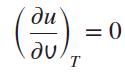
For ideal gases, the development of the constant-volume specific heat yieldsProve this by using the definitions of pressure and temperature, T = (∂u/∂s)v and P = −(∂u/∂v)s. ди = 0 du.
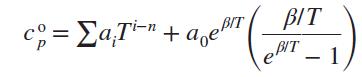
Develop expressions for h, u, s°, Pr, and vr for an ideal gas whose cop is given bywhere ai, a0, n, and β are empirical constants. c = Ea,T- BIT eNT - 1
Reconsider Prob. 12–79. Determine the exergy destruction associated with the process. Assume T0 = 30°C.Data From Reconsider Prob. 12–79:Propane is compressed isothermally by a piston–cylinder device from 100°C and 1 MPa to 4 MPa. Using the generalized charts, determine the work done and the
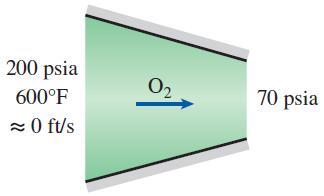
Oxygen is adiabatically and reversibly expanded in a nozzle from 200 psia and 600°F to 70 psia. Determine the velocity at which the oxygen leaves the nozzle, assuming that it enters with negligible velocity, treating the oxygen as an ideal gas with temperature-variable specific heats and using the
Determine the enthalpy change and the entropy change of oxygen per unit mole as it undergoes a change of state from 220 K and 5 MPa to 300 K and 10 MPa(a) By assuming ideal-gas behavior(b) By accounting for the deviation from ideal-gas behavior.
Saturated water vapor at 300°C is expanded while its pressure is kept constant until its temperature is 700°C. Calculate the change in the specific enthalpy and entropy using(a) The departure charts(b) The property tables.
Why is the generalized enthalpy departure chart prepared by using PR and TR as the parameters instead of P and T?
What is the enthalpy departure?
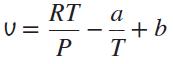
The equation of state of a gas is given bywhere a and b are constants. Use this equation of state to derive an equation for the Joule-Thomson coefficient inversion line. RT U = a + b T %3D
What is the most general equation of state for which the Joule-Thomson coefficient is always zero?
Estimate the Joule-Thomson coefficient of refrigerant-134a at 30 psia and 20°F.
Estimate the Joule-Thomson coefficient of refrigerant-134a at 200 kPa and 20°C.
The pressure of a fluid always decreases during an adiabatic throttling process. Is this also the case for the temperature?
Does the Joule-Thomson coefficient of a substance change with temperature at a fixed pressure?
What does the Joule-Thomson coefficient represent?
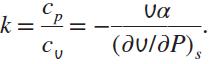
Demonstrate that Va k = Cu (dulaP),
Determine the change in the enthalpy of air, in kJ/kg, as it undergoes a change of state from 100 kPa and 20°C to 600 kPa and 300°C using the equation of state P(v – a) = RT where a = 0.10 m3/kg, and compare the result to the value obtained by using the ideal gas equation of state.
Estimate the specific heat difference cp – cv for liquid water at 1000 psia and 300°F.
The saturation table for refrigerant-134a lists the following at −40°C: P = 51.25 kPa, hfg = 225.86 kJ/kg, and vfg = 0.35993 m3/kg. Estimate the saturation pressure of refrigerant-134a at −50°C and −30°C.
Estimate sfg of the substance in Prob. 12–29 at 80°C.Data From Q#29:Two grams of a saturated liquid are converted to a saturated vapor by being heated in a weighted piston–cylinder device arranged to maintain the pressure at 200 kPa. During the phase conversion, the volume of the system
Two grams of a saturated liquid are converted to a saturated vapor by being heated in a weighted piston–cylinder device arranged to maintain the pressure at 200 kPa. During the phase conversion, the volume of the system increases by 1000 cm3, 5 kJ of heat are required, and the temperature of the
What approximations are involved in the Clapeyron-Clausius equation?
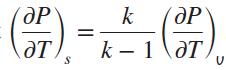
Prove that ƏP k k – 1\aT
Show how you would evaluate T, v, u, a, and g from the thermodynamic function h = h(s, P).
Repeat Prob. 12–8 for helium.Data From Q#8:Consider air at 350 K and 0.75 m3/kg. Using Eq. 12–3, determine the change in pressure corresponding to an increase of(a) 1 percent in temperature at constant specific volume(b) 1 percent in specific volume at constant temperature(c) 1 percent in both
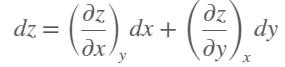
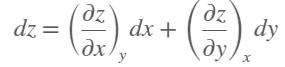
Consider air at 350 K and 0.75 m3/kg. Using Eq. 12–3, determine the change in pressure corresponding to an increase of(a) 1 percent in temperature at constant specific volume(b) 1 percent in specific volume at constant temperature(c) 1 percent in both the temperature and specific volume. dz dz dx
Consider a function f(x) and its derivative df/dx. Can this derivative be determined by evaluating dx/df and taking its inverse?
Consider a function z(x, y) and its partial derivative (∂z/∂y)x. Can this partial derivative still be a function of x?
Consider a function z(x, y) and its partial derivative (∂z/∂y)x. If this partial derivative is equal to zero for all values of x, what does it indicate?
Consider a function z(x, y) and its partial derivative (∂z/∂y)x. Under what conditions is this partial derivative equal to the total derivative dz/dy?
In the 1800s, before the development of modern air conditioning, it was proposed to cool air for buildings with the following procedure using a large piston–cylinder device [“ John Gorrie: Pioneer of Cooling and Ice Making,” ASHRAE Journal 33, no. 1 (Jan. 1991)]:1. Pull in a charge of outdoor
Consider a solar pond power plant operating on closed Rankine cycle. Using refrigerant-134a as the working fluid, specify the operating temperatures and pressures in the cycle, and estimate the required mass flow rate of refrigerant- 134a for a net power output of 50 kW. Also, estimate the surface
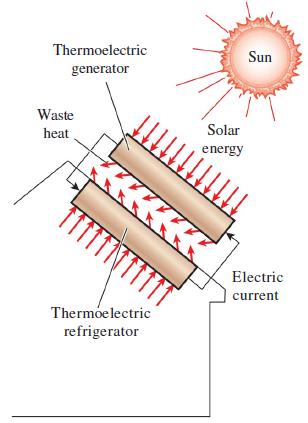
It is proposed to use a solar-powered thermoelectric system installed on the roof to cool residential buildings. The system consists of a thermoelectric refrigerator that is powered by a thermoelectric power generator whose top surface is a solar collector. Discuss the feasibility and the cost of
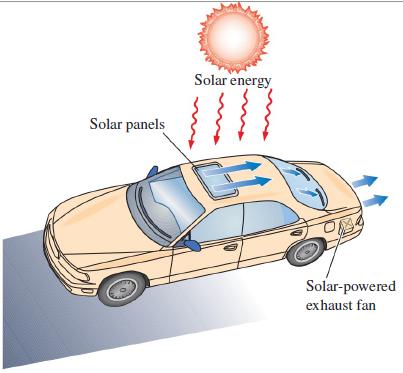
The temperature in a car parked in the sun can approach 100°C when the outside air temperature is just 25°C, and it is desirable to ventilate the parked car to avoid such high temperatures. However, the ventilating fans may run down the battery if they are powered by it. To avoid that happening,
Solar or photovoltaic (PV) cells convert sunlight to electricity and are commonly used to power calculators, satellites, remote communication systems, and even pumps. The conversion of light to electricity is called the photoelectric effect. It was first discovered in 1839 by Frenchman Edmond
Design a thermoelectric refrigerator that is capable of cooling a canned drink in a car. The refrigerator is to be powered by the cigarette lighter of the car. Draw a sketch of your design. Semiconductor components for building thermoelectric power generators or refrigerators are available from
The heat supplied by a heat pump used to maintain a building’s temperature is often supplemented by another source of direct heat. The fraction of the total heat required that is supplied by supplemental heat increases as the temperature of the environmental air (which serves as the
Develop and discuss techniques that apply the principle of regeneration to improve the performance of vapor compression refrigeration systems.
An absorption air-conditioning system is to remove heat from the conditioned space at 20°C at a rate of 90 kJ/s while operating in an environment at 35°C. Heat is to be supplied from a geothermal source at 140°C. The minimum rate of heat supply is(a) 13 kJ/s(b) 18 kJ/s(c) 30 kJ/s(d) 37 kJ/s(e)
Consider a heat pump that operates on the ideal vapor-compression refrigeration cycle with R-134a as the working fluid between the pressure limits of 0.24 and 1.2 MPa. The coefficient of performance of this heat pump is(a) 5.9(b) 5.3(c) 4.9(d) 4.2(e) 3.8
A refrigerator removes heat from a refrigerated space at 0°C at a rate of 1.5 kJ/s and rejects it to an environment at 20°C. The minimum required power input is(a) 102 W(b) 110 W(c) 140 W(d) 150 W(e) 1500 W
An absorption refrigeration system is to remove heat from the refrigerated space at 2°C at a rate of 28 kW while operating in an environment at 25°C. Heat is to be supplied from a solar pond at 95°C. What is the minimum rate of heat supply required?
Repeat Prob. 11–122 if the heat exchanger provides 9.51°C of subcooling.Data From Q#122:The refrigeration system of Fig. P11–122 is another variation of the basic vapor-compression refrigeration system which attempts to reduce the compression work. In this system, a heat exchanger is used to
Reconsider Prob. 11–120E. The refrigeration system of that problem cools one reservoir at −15°F and one at 40°F while rejecting heat to a reservoir at 80°F. Which process has the highest exergy destruction?Data From Reconsider Prob. 11–120E:A two-evaporator compression refrigeration system
Rework Prob. 11–116 with a 2.7°C sub cooling at the exit of the condenser.Data From Rework Prob. 11–116:A refrigerator using refrigerant-134a as the working fluid operates the condenser at 700 kPa and the evaporator at −10°C. This refrigerator freezes water while rejecting heat to the
A refrigerator using refrigerant-134a as the working fluid operates the condenser at 700 kPa and the evaporator at −10°C. This refrigerator freezes water while rejecting heat to the ambient air at 22°C. The compressor has an isentropic efficiency of 85 percent. Determine the process that causes
Consider an ice-producing plant that operates on the ideal vapor-compression refrigeration cycle and uses refrigerant-134a as the working fluid. The refrigeration cycle operating conditions require an evaporator pressure of 140 kPa and the condenser pressure of 1200 kPa. Cooling water flows through
A copper wire and a constantan wire are formed into a closed circuit by connecting the ends. Now one junction is heated by a burning candle while the other is maintained at room temperature. Do you expect any electric current to flow through this circuit?
An iron wire and a constantan wire are formed into a closed circuit by connecting the ends. Now both junctions are heated and are maintained at the same temperature. Do you expect any electric current to flow through this circuit?
Consider a circular copper wire formed by connecting the two ends of a copper wire. The connection point is now heated by a burning candle. Do you expect any current to flow through the wire?
What is a thermoelectric circuit?
Reconsider Prob. 11–80. How will the answers change when the isentropic efficiency of each compressor is 85 percent and the isentropic efficiency of the turbine is 95 percent?Data From Reconsider Prob. 11–80:An ideal gas refrigeration system with two stages of compression with intercooling as
An ideal gas refrigeration cycle uses air as the working fluid. The air is at 5 psia and −10°F as it enters the compressor with a compression ratio of 4. The temperature at the turbine entrance is 100°F. Determine this cycle’s COP. Use constant specific heats at room temperature.
An ideal gas refrigeration system operates with air as the working fluid. Air is at 100 kPa and 20°C before compression and 500 kPa and 30°C before expansion. The system is to provide 15 kW of cooling. Calculate the rate at which air is circulated in this system, as well as the rates of heat
Repeat Prob. 10–3 for a heat rejection pressure of 10 kPa.Data From Repeat Prob. 10–3: A steady-flow Carnot cycle uses water as the working fluid. Water changes from saturated liquid to saturated vapor as heat is transferred to it from a source at 250°C. Heat rejection takes place at a
Water enters the boiler of a steady-flow Carnot engine as a saturated liquid at 300 psia and leaves with a quality of 0.95. Steam leaves the turbine at a pressure of 20 psia. Show the cycle on a T-s diagram relative to the saturation lines, and determine(a) The thermal efficiency(b) The quality at
Simple ideal Rankine cycle with water as the working fluid operates between the pressure limits of 3 MPa in the boiler and 30 kPa in the condenser. If the quality at the exit of the turbine cannot be less than 85 percent, what is the maximum thermal efficiency this cycle can have?
Reconsider Prob. 10–25. Using appropriate software, determine how much the thermal efficiency of the cycle would change if there were a 50 kPa pressure drop across the boiler.Data From Reconsider Prob. 10–25A simple Rankine cycle uses water as the working fluid. The boiler operates at
A simple ideal Rankine cycle with water as the working fluid operates between the pressure limits of 4 MPa in the boiler and 20 kPa in the condenser and a turbine inlet temperature of 700°C. The boiler is sized to provide a steam flow of 50 kg/s. Determine the power produced by the turbine and
Reconsider Prob. 10–21. Irreversibilities in the turbine cause the steam quality at the outlet of the turbine to be 70 percent. Determine the isentropic efficiency of the turbine and the thermal efficiency of the cycle.Data From Q#21:A simple ideal Rankine cycle with water as the working fluid
Is there an optimal pressure for reheating the steam of a Rankine cycle? Explain.
Consider a steam power plant that operates on the ideal reheat Rankine cycle. The plant maintains the boiler at 17.5 MPa, the reheater at 2 MPa, and the condenser at 50 kPa. The temperature is 550°C at the entrance of the high-pressure turbine, and 300°C at the entrance of the low-pressure
Reconsider Prob. 10–34. How much does the thermal efficiency of the cycle change when the temperature at the entrance to the low-pressure turbine is increased to 550°C?Data From Q#34:Consider a steam power plant that operates on the ideal reheat Rankine cycle. The plant maintains the boiler at
Consider a simple ideal Rankine cycle and an ideal regenerative Rankine cycle with one open feedwater heater. The two cycles are very much alike, except the feedwater in the regenerative cycle is heated by extracting some steam just before it enters the turbine. How would you compare the
Cold feedwater enters a 200-kPa open feedwater heater of a regenerative Rankine cycle at 70°C with a flow rate of 10 kg/s. Bleed steam is available from the turbine at 200 kPa and 160°C. At what rate must bleed steam be supplied to the open feedwater heater so the feedwater leaves this unit as a
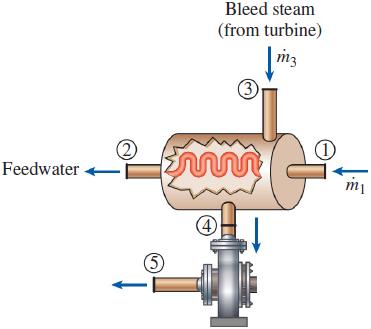
In a regenerative Rankine cycle. the closed feedwater heater with a pump as shown in the figure is arranged so that the water at state 5 is mixed with the water at state 2 to form a feedwater which is a saturated liquid at 200 psia. Feedwater enters this heater at 350°F and 200 psia with a flow
An ideal reheat Rankine cycle with water as the working fluid operates the inlet of the high-pressure turbine at 8000 kPa and 450°C; the inlet of the low-pressure turbine at 500 kPa and 500°C; and the condenser at 10 kPa. Which component of the cycle offers the greatest opportunity to regain lost
A combined gas–steam power cycle uses a simple gas turbine for the topping cycle and simple Rankine cycle for the bottoming cycle. Atmospheric air enters the gas turbine at 101 kPa and 20°C, and the maximum gas cycle temperature is 1100°C. The compressor pressure ratio is 8; the compressor
Reconsider Prob. 10–83. An ideal regenerator is added to the gas cycle portion of the combined cycle. How much does this change the efficiency of this combined cycle?Data From Reconsider Prob. 10–83:A combined gas–steam power cycle uses a simple gas turbine for the topping cycle and simple
Reconsider Prob. 10–83. Determine which components of the combined cycle are the most wasteful of work potential.Data From Reconsider Prob. 10–83:A combined gas–steam power cycle uses a simple gas turbine for the topping cycle and simple Rankine cycle for the bottoming cycle. Atmospheric air
Feedwater at 4000 kPa is heated at a rate of 6 kg/s from 200°C to 245°C in a closed feedwater heater of a regenerative Rankine cycle. Bleed steam enters this unit at 3000 kPa with a quality of 90 percent and leaves as a saturated liquid. Calculate the rate at which bleed steam is required.
Repeat Prob. 10–98 assuming both the pump and the turbine are isentropic.Data From Q#98:Consider a steam power plant that operates on a regenerative Rankine cycle and has a net power output of 150 MW. Steam enters the turbine at 10 MPa and 500°C and the condenser at 10 kPa. The
Stack gases exhausting from electrical power plants are at approximately 150°C. Design a basic Rankine cycle that uses water, refrigerant-134a, or ammonia as the working fluid and that produces the maximum amount of work from this energy source while rejecting heat to the ambient air at 40°C. You
A natural gas–fired furnace in a textile plant is used to provide steam at 130°C. At times of high demand, the furnace supplies heat to the steam at a rate of 30 MJ/s. The plant also uses up to 6 MW of electrical power purchased from the local power company. The plant management is considering
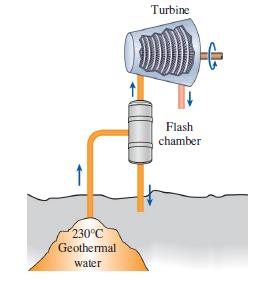
A 10-MW geothermal power plant is being considered at a site where geothermal water at 230°C is available. Geothermal water is to be flashed into a chamber to a lower pressure where part of the water evaporates. The liquid is returned to the ground while the vapor is used to drive the steam
A steady-flow Carnot refrigeration cycle uses refrigerant-134a as the working fluid. The refrigerant changes from saturated vapor to saturated liquid at 60°C in the condenser as it rejects heat. The evaporator pressure is 180 kPa. Show the cycle on a T-s diagram relative to saturation lines, and
Does the ideal vapor-compression refrigeration cycle involve any internal Irreversibilities?
A 10-kW cooling load is to be served by operating an ideal vapor compression refrigeration cycle with its evaporator at 400 kPa and its condenser at 800 kPa. Calculate the refrigerant mass flow rate and the compressor power requirement when refrigerant-134a is used.
An air conditioner using refrigerant-134a as the working fluid and operating on the ideal vapor-compression refrigeration cycle is to maintain a space at 22°C while operating its condenser at 1000 kPa. Determine the COP of the system when a temperature difference of 2°C is allowed for the
An ideal vapor-compression refrigeration cycle using refrigerant-134a as the working fluid is used to cool a brine solution to −5°C. This solution is pumped to various buildings for the purpose of air-conditioning. The refrigerant evaporates at −10°C with a total mass flow rate of 7 kg/s, and
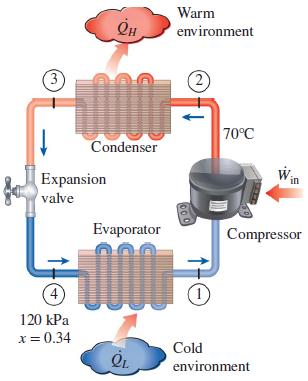
A refrigerator uses refrigerant-134a as the working fluid and operates on the ideal vapor-compression refrigeration cycle except for the compression process. The refrigerant enters the evaporator at 120 kPa with a quality of 34 percent and leaves the compressor at 70°C. If the compressor consumes
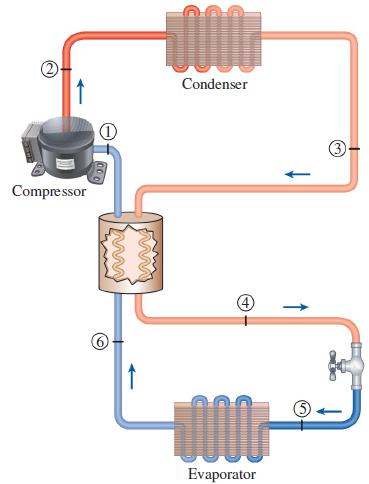
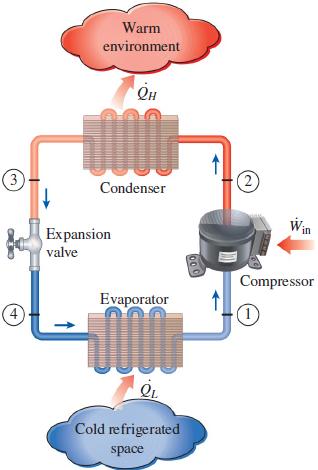
An ideal vapor-compression refrigeration cycle that uses refrigerant-134a as its working fluid maintains a condenser at 800 kPa and the evaporator at −20°C. Determine this system’s COP and the amount of power required to service a 150 kW cooling load. Warm environment (3 (2 Condenser in valve
A refrigerator uses refrigerant-134a as its working fluid and operates on the ideal vapor-compression refrigeration cycle. The refrigerant evaporates at 5°F and condenses at 180 psia. This unit serves a 45,000 Btu/h cooling load. Determine the mass flow rate of the refrigerant and the power that
Repeat Prob. 11–19E using appropriate software if ammonia is used in place of refrigerant-134a.Data From Q#19:A refrigerator uses refrigerant-134a as its working fluid and operates on the ideal vapor-compression refrigeration cycle. The refrigerant evaporates at 5°F and condenses at 180 psia.
A refrigerator uses refrigerant-134a as the working fluid and operates on the vapor-compression refrigeration cycle. The evaporator and condenser pressures are 200 kPa and 1400 kPa, respectively. The isentropic efficiency of the compressor is 88 percent. The refrigerant enters the compressor at a
A heat pump that operates on the ideal vapor-compression cycle with refrigerant-134a is used to heat a house and maintain it at 26°C by using underground water at 14°C as the heat source. Select reasonable pressures for the evaporator and the condenser, and explain why you chose those values.
A heat pump operates on the ideal vapor-compression refrigeration cycle and uses refrigerant-134a as the working fluid. The condenser operates at 1000 kPa and the evaporator at 200 kPa. Determine this system’s COP and the rate of heat supplied to the evaporator when the compressor consumes 6 kW.
The liquid leaving the condenser of a 100,000 Btu/h heat pump using refrigerant-134a as the working fluid is subcooled by 9.5°F. The condenser operates at 160 psia and the evaporator at 50 psia. How does this sub cooling change the power required to drive the compressor as compared to an ideal
Reconsider Prob. 11–44E. What is the effect on the compressor power requirement when the vapor entering the compressor is superheated by 10°F and the condenser operates ideally?Data From Reconsider Prob. 11–44E:The liquid leaving the condenser of a 100,000 Btu/h heat pump using
Reconsider Prob. 11–48. What is the effect on the COP when the vapor entering the compressor is superheated by 2°C and the compressor has no Irreversibilities?Data From Q#48:A heat pump using refrigerant-134a as a refrigerant operates its condenser at 800 kPa and its evaporator at −1.25°C. It
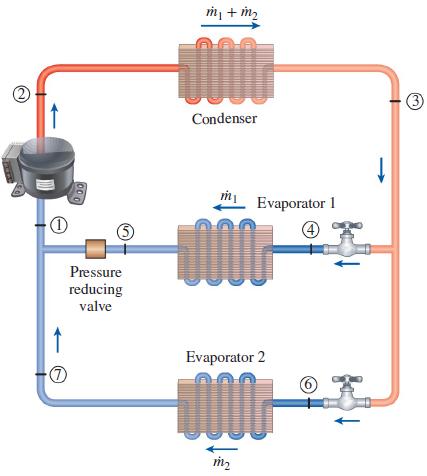
Can a vapor-compression refrigeration system with a single compressor handle several evaporators operating at different pressures? How?
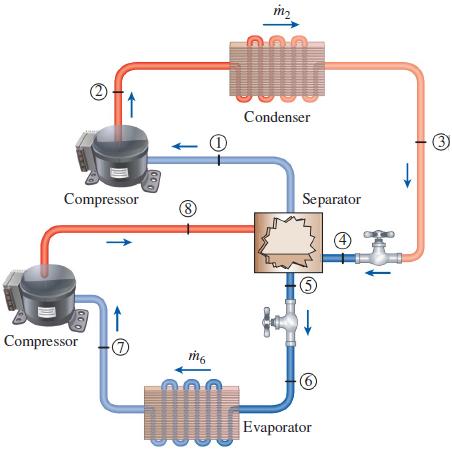
A two-stage compression refrigeration system with an adiabatic liquid-vapor separation unit as shown in Fig. P11–60 uses refrigerant-134a as the working fluid. The system operates the evaporator at −40°C, the condenser at 800 kPa, and the separator at −10.1°C. This system is to serve a
A two-stage compression refrigeration system with an adiabatic liquid-vapor separation unit like that in Fig. P11– 60 uses refrigerant-134a as the working fluid. The system operates the evaporator at 60 psia, the condenser at 300 psia, and the separator at 120 psia. The compressors use 25 kW of
Repeat Prob. 11–63E if the 30 psia evaporator is to be replaced with a 60 psia evaporator to serve a 15,000 Btu/h cooling load.Data From Q#63:A two-evaporator compression refrigeration system like that in Fig. P11–62 uses refrigerant-134a as the working fluid. The system operates evaporator 1
In gas refrigeration cycles, can we replace the turbine with an expansion valve as we did in vapor-compression refrigeration cycles? Why?
How do we achieve very low temperatures with gas refrigeration cycles?
A gas turbine operates with a regenerator and two stages of reheating and intercooling. This system is designed so that when air enters the compressor at 100 kPa and 15°C, the pressure ratio for each stage of compression is 3, the air temperature when entering a turbine is 500°C, and the
Showing 200 - 300
of 689
1
2
3
4
5
6
7
Step by Step Answers

 Get 50% OFF
Claim Now
Get 50% OFF
Claim Now