New Semester
Started
Get
50% OFF
Study Help!
--h --m --s
Claim Now
Question Answers
Textbooks
Find textbooks, questions and answers
Oops, something went wrong!
Change your search query and then try again
S
Books
FREE
Study Help
Expert Questions
Accounting
General Management
Mathematics
Finance
Organizational Behaviour
Law
Physics
Operating System
Management Leadership
Sociology
Programming
Marketing
Database
Computer Network
Economics
Textbooks Solutions
Accounting
Managerial Accounting
Management Leadership
Cost Accounting
Statistics
Business Law
Corporate Finance
Finance
Economics
Auditing
Tutors
Online Tutors
Find a Tutor
Hire a Tutor
Become a Tutor
AI Tutor
AI Study Planner
NEW
Sell Books
Search
Search
Sign In
Register
study help
engineering
thermodynamics an engineering approach
Thermodynamics An Engineering Approach 9th Edition Yunus Cengel, Michael Boles, Mehmet Kanoglu - Solutions
In the liquefaction process, why are gases compressed to very high pressures?
A heat pump using refrigerant-134a as a refrigerant operates its condenser at 800 kPa and its evaporator at −1.25°C. It operates on the ideal vapor-compression refrigeration cycle, except for the compressor, which has an isentropic efficiency of 85 percent. How much do the compressor
A photographic equipment manufacturer uses a flow of 64,500 lbm/h of steam in its manufacturing process. Currently the spent steam at 3.8 psia and 224°F is exhausted to the atmosphere. Do the preliminary design of a system to use the energy in the waste steam economically. If electricity is
Design the condenser of a steam power plant that has a thermal efficiency of 40 percent and generates 10 MW of net electric power. Steam enters the condenser as saturated vapor at 10 kPa, and it is to be condensed outside horizontal tubes through which cooling water from a nearby river flows. The
A steam power plant operates on the simple ideal Rankine cycle between the pressure limits of 10 kPa and 5 MPa, with a turbine inlet temperature of 600°C. The rate of heat transfer in the boiler is 450 kJ/s. Disregarding the pump work, the power output of this plant is(a) 118 kW(b) 140 kW(c) 177
A simple ideal Rankine cycle with water as the working fluid operates between the pressure limits of 4 MPa in the boiler and 20 kPa in the condenser and a turbine inlet temperature of 700°C. Calculate the exergy destruction in each of the components of the cycle when heat is being rejected to the
An ideal reheat Rankine cycle with water as the working fluid operates the inlet of the high-pressure turbine at 8000 kPa and 450°C, the inlet of the low-pressure turbine at 500 kPa and 500°C, and the condenser at 10 kPa. Determine the mass flow rate through the boiler needed for this system to
A simple ideal Rankine cycle with water as the working fluid operates between the pressure limits of 15 MPa in the boiler and 100 kPa in the condenser. Saturated steam enters the turbine. Determine the work produced by the turbine, the heat transferred in the boiler, and thermal efficiency of the
Atmospheric air at a pressure of 1 atm and dry-bulb temperature of 30°C has a relative humidity of 80 percent. Using the psychrometric chart, determine(a) The wet-bulb temperature(b) The humidity ratio(c) The enthalpy(d) The dew-point temperature(e) The water vapor pressure.
What is vapor pressure?
Can the water vapor in air be treated as an ideal gas? Explain.
Is the relative humidity of saturated air necessarily 100 percent?
Moist air is passed through a cooling section where it is cooled and dehumidified. How do(a) The specific humidity(b) The relative humidity of air change during this process?
Is it possible to obtain saturated air from unsaturated air without adding any moisture? Explain.
Repeat Prob. 14–14 for a temperature of 40°C.Data From Q#14:A tank contains 15 kg of dry air and 0.17 kg of water vapor at 30°C and 100 kPa total pressure. Determine(a) The specific humidity(b) The relative humidity(c) The volume of the tank.
A room contains air at 85°F and 13.5 psia at a relative humidity of 60 percent. Determine(a) The partial pressure of dry air(b) The specific humidity(c) The enthalpy per unit mass of dry air.
Humid air at 100 psia and 400°F and a humidity ratio of 0.025 lbm H2O/lbm dry air is expanded to 15 psia in an isentropic nozzle. How much of the initial water vapor has been converted to liquid water at the nozzle outlet?
What is the dew-point temperature?
When are the dry-bulb and dew-point temperatures identical?
When are the adiabatic saturation and wet-bulb temperatures equivalent for atmospheric air?
The air in a room has a dry-bulb temperature of 26°C and a wet-bulb temperature of 21°C. Assuming a pressure of 100 kPa, determine(a) The specific humidity(b) The relative humidity(c) The dew-point temperature.
The air in a room has a dry-bulb temperature of 75°F and a wet-bulb temperature of 60°F. Assuming a pressure of 14.3 psia, determine(a) The specific humidity(b) The relative humidity(c) The dew-point temperature.
How do constant-enthalpy and constant-wet-bulb temperature lines compare on the psychrometric chart?
At what states on the psychrometric chart are the dry-bulb, wet-bulb, and dew-point temperatures identical?
Can the enthalpy values determined from a psychrometric chart at sea level be used at higher elevations?
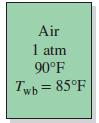
Atmospheric air at a pressure of 1 atm and dry-bulb temperature of 90°F has a wet-bulb temperature of 85°F. Using the psychrometric chart, determine(a) The relative humidity(b) The humidity ratio(c) The enthalpy(d) The dew-point temperature(e) The water vapor pressure. Air 1 atm 90°F Twb = 85°F
Reconsider Prob. 14–39E. Determine the adiabatic saturation temperature of the humid air.Data From Prob. 14–39E:Atmospheric air at a pressure of 1 atm and dry-bulb temperature of 90°F has a wet-bulb temperature of 85°F. Using the psychrometric chart. Air 1 atm 90°F Twb = 85°F
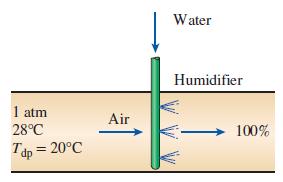
Reconsider Prob. 14–43. Determine the adiabatic saturation temperature of the humid air.Data From Prob. 14–43. Atmospheric air at a pressure of 1 atm and dry-bulb temperature of 28°C has a dew-point temperature of 20°C. Using the psychrometric chart. Water Humidifier 1 atm 28°C Air
What does a modern air-conditioning system do besides heating or cooling the air?
How does the human body respond to(a) Hot weather(b) Cold weather(c) Hot and humid weather?
What are humidification and dehumidification?
Humid air at 150 kPa, 40°C, and 70 percent relative humidity is cooled at constant pressure in a pipe to its dewpoint temperature. Calculate the heat transfer, in kJ/kg dry air, required for this process.
Air enters a heating section at 95 kPa, 10°C, and 30 percent relative humidity at a rate of 6 m3/min, and it leaves at 25°C. Determine(a) The rate of heat transfer in the heating section(b) The relative humidity of the air at the exit.
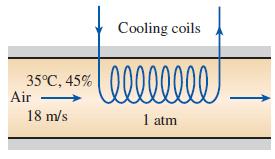
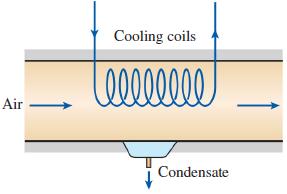
Air enters a 30-cm-diameter cooling section at 1 atm, 35°C, and 45 percent relative humidity at 18 m/s. Heat is removed from the air at a rate of 750 kJ/min. Determine(a) The exit temperature(b) The exit relative humidity of the air(c) The exit velocity. Cooling coils 35°C, 45% Air 18 m/s 1 atm
Atmospheric air at 1 atm, 30°C, and 80 percent relative humidity is cooled to 20°C while the mixture pressure remains constant. Calculate the amount of water, in kg/kg dry air, removed from the air and the cooling requirement, in kJ/kg dry air, when the liquid water leaves the system at 22°C.
Ten thousand cubic feet per hour of atmospheric air at 1 atm and 85°F with a dew-point temperature of 70°F are to be cooled to 60°F. Determine the rate at which condensate leaves this system and the cooling rate when the condensate leaves the system at 65°F.
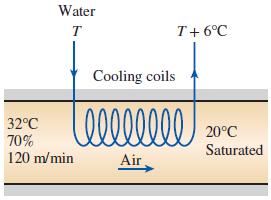
Air enters a 40-cm-diameter cooling section at 1 atm, 32°C, and 70 percent relative humidity at 120 m/min. The air is cooled by passing it over a cooling coil through which cold water flows. The water experiences a temperature rise of 6°C. The air leaves the cooling section saturated at 20°C.
Repeat Prob. 14–79 for a total pressure of 88 kPa for air.Data From Repeat Prob. 14–79:Air enters a 40-cm-diameter cooling section at 1 atm, 32°C, and 70 percent relative humidity at 120 m/min. The air is cooled by passing it over a cooling coil through which cold water flows. The water
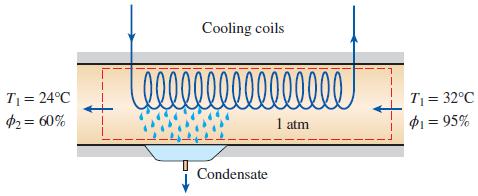
On a summer day in New Orleans, Louisiana, the pressure is 1 atm: the temperature is 32°C; and the relative humidity is 95 percent. This air is to be conditioned to 24°C and 60 percent relative humidity. Determine the amount of cooling, in kJ, required and water removed, in kg, per 1000 m3 of dry
Reconsider Prob. 14–82. How far will the temperature of the humid air have to be reduced to produce the desired dehumidification?Data From Reconsider Prob. 14–82:On a summer day in New Orleans, Louisiana, the pressure is 1 atm: the temperature is 32°C; and the relative humidity is 95 percent.
Atmospheric air from the inside of an automobile enters the evaporator section of the air conditioner at 1 atm, 27°C, and 50 percent relative humidity. The air returns to the automobile at 10°C and 90 percent relative humidity. The passenger compartment has a volume of 2 m3, and five air changes
Humid air at 101.3 kPa, 39°C dry bulb, and 50 percent relative humidity is cooled at constant pressure to a temperature 10°C below its dew-point temperature.(a) Sketch the system hardware and the psychrometric diagram for the process.(b) If it has been determined that the rate of heat transfer
Saturated humid air at 70 psia and 200°F is cooled to 100°F as it flows through a 3-in-diameter pipe with a velocity of 50 ft/s and at constant pressure. Calculate the rate at which liquid water is formed inside this pipe and the rate at which the air is cooled.
What is evaporative cooling? Will it work in humid climates?
Desert dwellers often wrap their heads with a water soaked porous cloth. On a desert where the pressure is 1 atm, temperature is 45°C, and relative humidity is 15 percent, what is the temperature of this cloth?
Air enters an evaporative (or swamp) cooler at 14.7 psi, 95°F, and 20 percent relative humidity, and it exits at 80 percent relative humidity. Determine(a) The exit temperature of the air and(b) The lowest temperature to which the air can be cooled by this evaporative cooler.
Air at 1 atm, 20°C, and 70 percent relative humidity is first heated to 35°C in a heating section and then passed through an evaporative cooler, where its temperature drops to 25°C. Determine(a) The exit relative humidity(b) The amount of water added to air, in kg H2O/kg dry air.
Consider the adiabatic mixing of two airstreams. Does the state of the mixture on the psychrometric chart have to be on the straight line connecting the two states?
Saturated humid air at 1 atm and 10°C is to be mixed with atmospheric air at 1 atm, 32°C, and 80 percent relative humidity, to form air of 70 percent relative humidity. Determine the proportions at which these two streams are to be mixed and the temperature of the resulting air.
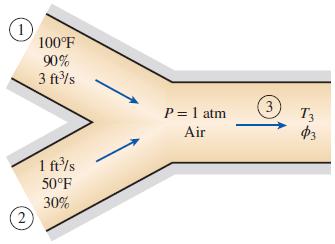
Reconsider Prob. 14–104E. Calculate the rate of entropy generation for this process.Data From Q#104:Two humid airstreams are adiabatically mixed at 1 atm pressure to form a third stream. The first stream has a temperature of 100°F, a relative humidity of 90 percent, and a volume flow rate of 3
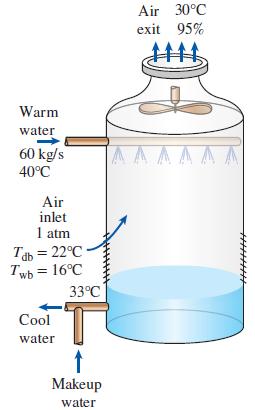
A wet cooling tower is to cool 60 kg/s of water from 40 to 33°C. Atmospheric air enters the tower at 1 atm with dry and wet-bulb temperatures of 22 and 16°C, respectively, and leaves at 30°C with a relative humidity of 95 percent. Using the psychrometric chart, determine(a) The volume flow rate
Water at 100°F is to be cooled in a cooling tower which it enters at a rate of 10,000 lbm/h. Humid air enters this tower at 1 atm, 60°F, and 20 percent relative humidity with a dry airflow rate of 7000 lbm/h and leaves at 75°F and 0.018 lbm H2O/lbm dry air. Determine the relative humidity at
Water at 30°C is to be cooled to 22°C in a cooling tower which it enters at a rate of 5 kg/s. Humid air enters this tower at 1 atm and 15°C with a relative humidity of 25 percent and leaves at 18°C with a relative humidity of 95 percent. Determine the mass flow rate of dry air through this
Reconsider Prob. 14–112. How much work potential, in kJ/kg dry air, is lost in the cooling tower? Take T0 = 15°C.Data From Q#112:Water at 30°C is to be cooled to 22°C in a cooling tower which it enters at a rate of 5 kg/s. Humid air enters this tower at 1 atm and 15°C with a relative humidity
The U.S. Department of Energy estimates that 190,000 barrels of oil would be saved per day if every household in the United States raised the thermostat setting in summer by 6°F (3.3°C). Assuming the average cooling season to be 120 days and the cost of oil to be $70/barrel, determine how much
A laboratory has a volume of 700 m3 and must have one complete air change per minute when being used. Outside atmospheric air at 100 kPa, 30°C dry bulb, and 60 percent relative humidity is ducted into the laboratory air-conditioning equipment and conditioned to 20°C dry bulb and 12°C wet bulb,
Air at 15 psia, 60°F, and 70 percent relative humidity flows in a 6-in diameter duct at a velocity of 27 ft/s. Determine(a) The dew-point temperature(b) The volume flow rate of air(c) The mass flow rate of dry air.
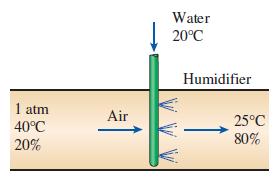
During a summer day in El Paso, Texas, outdoor air is at 1 atm, 40°C, and 20 percent relative humidity. Water at 20°C is evaporated into this air to produce air at 25°C and 80 percent relative humidity. How much water, in kg H2O/kg dry air, is required and how much cooling, in kJ/kg dry air, has
What is the difference between dry air and atmospheric air?
A pressurized mixture of nitrogen and argon is supplied to a directional control nozzle on a space satellite. Plot the gas velocity at the nozzle exit as a function of the argon mass fraction with fixed pressure and temperature at the entrance and pressure at the exit. The force produced by this
Prolonged exposure to mercury even at relatively low but toxic concentrations in the air is known to cause permanent mental disorders, insomnia, and pain and numbness in the hands and the feet, among other things. Therefore, the maximum allowable concentration of mercury vapor in the air at
You have a rigid tank equipped with a pressure gauge. Describe a procedure by which you could use this tank to blend ideal gases in prescribed mole-fraction portions.
The simple additive rule may not be appropriate for the volume of binary mixtures of gases, Prove this for a pair of gases of your choice at several different temperatures and pressures using Kay’s rule and the principle of corresponding states.
An ideal-gas mixture consists of 60 percent helium and 40 percent argon gases by mass. The mixture is now expanded isentropically in a turbine from 400°C and 1.2 MPa to a pressure of 200 kPa. The mixture temperature at the turbine exit is(a) 56°C(b) 195°C(c) 130°C(d) 112°C(e) 400°C
A piston–cylinder device contains an ideal-gas mixture of 3 kmol of He gas and 7 kmol of Ar gas at 70°C and 400 kPa. Now the gas expands at constant pressure until its volume doubles. The amount of heat transfer to the gas mixture is(a) 286 MJ(b) 71 MJ(c) 30 MJ(d) 15 MJ(e) 6.6 MJ
One compartment of an insulated rigid tank contains 2 kmol of CO2 at 20°C and 150 kPa while the other compartment contains 5 kmol of H2 gas at 35°C and 300 kPa. Now the partition between the two gases is removed, and the two gases form a homogeneous ideal-gas mixture. The temperature of the
A 60-L rigid tank contains an ideal-gas mixture of 5 g of N2 and 5 g of CO2 at a specified pressure and temperature. If N2 were separated from the mixture and stored at mixture temperature and pressure, its volume would be(a) 30 L(b) 37 L(c) 42 L(d) 49 L(e) 60 L
Using Dalton’s law, show thatfor a real-gas mixture of k gases, where Z is the compressibility factor. Z„ = EyZi %3D i=1
A mixture of gases consists of 1 kmol of carbon dioxide, 1 kmol of nitrogen, and 0.3 kmol of oxygen. Determine the total amount of work required to compress this mixture isothermally from 10 kPa and 27°C to 100 kPa.
A mixture of gases is assembled by first filling an evacuated 0.15-m3 tank with neon until the pressure is 35 kPa. Oxygen is added next until the pressure increases to 105 kPa. Finally, nitrogen is added until the pressure increases to 140 kPa. During each step of the tank’s filling, the contents
Reconsider Prob. 13–79. Using appropriate software, investigate the effect of the salinity of the ocean on the maximum power generated. Let the salinity vary from 0 to 5 percent. Plot the power produced versus the salinity of the ocean, and discuss the results.Data From Q#79:A river is
A river is discharging into the ocean at a rate of 150,000 m3/s. Determine the amount of power that can be generated if the river water mixes with the ocean water reversibly. Take the salinity of the ocean to be 2.5 percent on mass basis, and assume both the river and the ocean are at 15°C.
A mixture of hydrogen and oxygen has a hydrogen mass fraction of 0.33. Determine the difference in the entropy of the mixture between a state of 750 kPa, 150°C and another state of 150 kPa, 150°C, in kJ/kg·K.
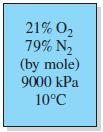
In a liquid-oxygen plant, it is proposed that the pressure and temperature of air that is initially at 9000 kPa and 10°C be adiabatically reduced to 50 kPa and −73°C. Using Kay’s rule and the departure charts, determine whether this is possible. If so, then how much work per unit mass will
A mixture of gases consists of 0.1 kg of oxygen, 1 kg of carbon dioxide, and 0.5 kg of helium. This mixture is heated from 10°C to 260°C while its pressure is maintained constant at 350 kPa. Determine the change in the volume of the mixture and the total heat transferred to the mixture.
A mixture of nitrogen and carbon dioxide has a carbon dioxide mass fraction of 50 percent. This mixture is heated at constant pressure in a closed system from 120 kPa and 30°C to 200°C. Calculate the work produced during this heating in kJ/kg.
When evaluating the entropy change of the components of an ideal-gas mixture, do we have to use the partial pressure of each component or the total pressure of the mixture?
Answer Prob. 13–46C and 13–47C for entropy.Data From Q#46:Is the total internal energy of an ideal-gas mixture equal to the sum of the internal energies of each individual gas in the mixture? Answer the same question for a real-gas mixture.Data From Q#47:Is the specific internal energy of a gas
Is the specific internal energy of a gas mixture equal to the sum of the specific internal energies of each individual gas in the mixture?
Is the total internal energy of an ideal-gas mixture equal to the sum of the internal energies of each individual gas in the mixture? Answer the same question for a real-gas mixture.
The dry stack gas of an electrical-generation station boiler has the following Orsat analysis: 15 percent CO2, 15 percent O2, and 1 percent CO. This gas passes through a 10-ft2- cross-section metering duct at a velocity of 20 ft/s at standard atmospheric pressure and 200°F. Determine the gas
One pound-mass of a gas whose density is 0.001 lbm/ft3 is mixed with 2 lbm of a gas whose density is 0.002 lbm/ft3 such that the pressure and temperature of the gases do not change. Determine the resulting mixture’s volume, in ft3, and specific volume, in ft3/lbm.
One liter of a liquid whose specific volume is 0.0003 m3/kg is mixed with 2 liters of a liquid whose specific volume is 0.00023 m3/kg in a container whose total volume is 3 liters. What is the density of the resulting mixture, in kg/m3?
The mass fractions of a mixture of gases are 15 percent nitrogen, 5 percent helium, 60 percent methane, and 20 percent ethane. Determine the mole fractions of each constituent, the mixture’s apparent molecular weight, the partial pressure of each constituent when the mixture pressure is 1200 kPa,
Separation units often use membranes, absorbers, and other devices to reduce the mole fraction of selected constituents in gaseous mixtures. Consider a mixture of hydrocarbons that consists of 60 percent (by volume) methane, 30 percent ethane, and 10 percent propane. After passing through a
Is this statement correct? The pressure of an ideal gas mixture is equal to the sum of the partial pressures of each individual gas in the mixture. If not, how would you correct it?
Consider a rigid tank that contains a mixture of two ideal gases. The gas mixture is heated, and the pressure and temperature in the tank rise. Will the partial pressure of each component change? How about the pressure fraction of each component?
Consider a rigid tank that contains a mixture of two ideal gases. A valve is opened and some gas escapes. As a result, the pressure in the tank drops. Will the partial pressure of each component change? How about the pressure fraction of each component?
In a gas mixture, which component will have the higher partial pressure—the one with the higher mole number or the one with the larger molar mass?
Repeat Prob. 13–9 by replacing N2 with O2.Data From Repeat Prob. 13–9:A gas mixture has the following composition on a mole basis: 60 percent N2 and 40 percent CO2. Determine the gravimetric analysis of the mixture, its molar mass, and the gas constant.
What is the apparent gas constant for a gas mixture? Can it be larger than the largest gas constant in the mixture?
What is the apparent molar mass for a gas mixture? Does the mass of every molecule in the mixture equal the apparent molar mass?
Consider a mixture of two gases. Can the apparent molar mass of this mixture be determined by simply taking the arithmetic average of the molar masses of the individual gases? When will this be the case?
Somebody claims that the mass and mole fractions for a mixture of CO2 and N2O gases are identical. Is this true? Why?
The sum of the mole fractions for an ideal-gas mixture is equal to 1. Is this also true for a real-gas mixture?
Consider a mixture of several gases of identical masses. Will all the mass fractions be identical? How about the mole fractions?
Consider the function z = z(x, y). Write an essay on the physical interpretation of the ordinary derivative dz/dx and the partial derivative (∂z/∂x)y. Explain how these two derivatives are related to each other and when they become equivalent.
Several attempts have been made to express the partial derivatives of the most common thermodynamic properties in a compact and systematic manner in terms of measurable properties. The work of P. W. Bridgman is perhaps the most fruitful of all, and it resulted in the well-known Bridgman’s table.
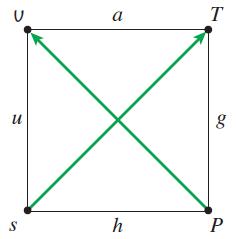
There have been several attempts to represent the thermodynamic relations geometrically, the best known of these being Koenig’s thermodynamic square shown in the figure. There is a systematic way of obtaining the four Maxwell relations as well as the four relations for du, dh, dg, and da from
Based on data from the refrigerant-134a tables, the Joule-Thompson coefficient of refrigerant-134a at 0.8 MPa and 60°C is approximately(a) 0(b) 5°C/MPa(c) 11°C/MPa(d) 16°C/MPa(e) 25°C/MPa
Showing 100 - 200
of 689
1
2
3
4
5
6
7
Step by Step Answers

 Get 50% OFF
Claim Now
Get 50% OFF
Claim Now