New Semester
Started
Get
50% OFF
Study Help!
--h --m --s
Claim Now
Question Answers
Textbooks
Find textbooks, questions and answers
Oops, something went wrong!
Change your search query and then try again
S
Books
FREE
Study Help
Expert Questions
Accounting
General Management
Mathematics
Finance
Organizational Behaviour
Law
Physics
Operating System
Management Leadership
Sociology
Programming
Marketing
Database
Computer Network
Economics
Textbooks Solutions
Accounting
Managerial Accounting
Management Leadership
Cost Accounting
Statistics
Business Law
Corporate Finance
Finance
Economics
Auditing
Tutors
Online Tutors
Find a Tutor
Hire a Tutor
Become a Tutor
AI Tutor
AI Study Planner
NEW
Sell Books
Search
Search
Sign In
Register
study help
engineering
thermodynamics an engineering approach
Thermodynamics An Engineering Approach 9th Edition Yunus Cengel, Michael Boles, Mehmet Kanoglu - Solutions
A house that is losing heat at a rate of 35,000 kJ/h when the outside temperature drops to 4°C is to be heated by electric resistance heaters. If the house is to be maintained at 25°C at all times, determine the reversible work input for this process and the irreversibility.
It is well known that the actual work between the two specified states depends on the path followed during the process. Can we say the same for the reversible work?
Is a process during which no entropy is generated (Sgen = 0) necessarily reversible?
What final state will maximize the work output of a device?
Refrigerant-134a at 700 kPa and 40°C is expanded adiabatically in a closed system to 60 kPa. Determine the work produced, in kJ/kg, and final enthalpy for an isentropic expansion efficiency of 80 percent.
A rigid tank contains 7.5 kg of saturated water mixture at 400 kPa. A valve at the bottom of the tank is now opened, and liquid is withdrawn from the tank. Heat is transferred to the steam such that the pressure inside the tank remains constant. The valve is closed when no liquid is left in the
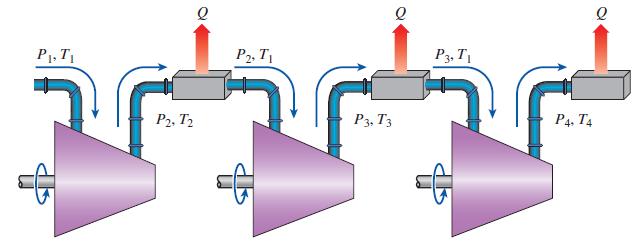
In large gas-compression stations (for example, on a natural gas pipeline), the compression is done in several stages as in Fig. P7–252. At the end of each stage, the compressed gas is cooled at constant pressure back to the temperature at the inlet of the compressor. Consider a compression
Identify the major sources of entropy generation in your house and propose ways of reducing them.
Liquid water is to be compressed by a pump whose isentropic efficiency is 85 percent from 0.2 MPa to 5 MPa at a rate of 0.15 m3/min. The required power input to this pump is(a) 8.5 kW(b) 10.2 kW(c) 12.0 kW(d) 14.1 kW(e) 15.3 kW
Heat is lost through a plane wall steadily at a rate of 1500 W. If the inner and outer surface temperatures of the wall are 20°C and 5°C, respectively, the rate of entropy generation within the wall is(a) 0.07 W/K(b) 0.15 W/K(c) 0.28 W/K(d) 1.42 W/K(e) 5.21 W/K
Argon gas expands in an adiabatic turbine from 3 MPa and 750°C to 0.3 MPa at a rate of 5 kg/s. The maximum power output of the turbine is(a) 0.64 MW(b) 1.12 MW(c) 1.60 MW(d) 1.95 MW(e) 2.40 MW
The temperature of an ideal gas having constant specific heats is given as a function of specific entropy and pressure as T(s, P) = A P ( k − 1 ) /k exp (s / cp) where A is a constant. Determine the T-P relation for this ideal gas undergoing an isentropic process.
A rigid, adiabatic container is filled through a single opening from a source of working fluid whose properties remain fixed. How does the final specific entropy of the single-phase contents of this container compare to the initial specific entropy?
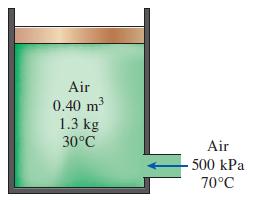
A 0.40-m3 insulated piston–cylinder device initially contains 1.3 kg of air at 30°C. At this state, the piston is free to move. Now air at 500 kPa and 70°C is allowed to enter the cylinder from a supply line until the volume increases by 50 percent. Using constant specific heats at room
A hot-water pipe at 80°C is losing heat to the surrounding air at 5°C at a rate of 1600 W. Determine the rate of entropy generation in the surrounding air in W/K.
Reconsider Prob. 7–199E. The filled compressed-air storage tank is discharged at a later time through the turbine until the pressure in the tank is 1 atm. During this discharge, the temperature of the air in the storage tank remains constant at 70°F. Calculate the total work produced by the
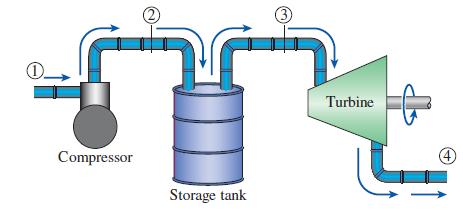
An engineer has proposed that compressed air be used to “level the load’ in an electrical-generation and distribution system. The proposed system is illustrated in Fig. P7–199E. During those times when electrical-generation capacity exceeds the demand for electrical energy, the excess
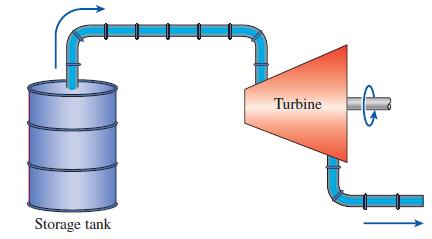
Work can be produced by passing the vapor phase of a two-phase substance stored in a tank through a turbine as shown in Fig. P7–198E. Consider such a system using R-134a, which is initially at 80°F, and a 10-ft3 tank that initially is entirely filled with liquid R-134a. The turbine is
The compressor of a refrigerator compresses saturated R-134a vapor at -10°C to 800 kPa. How much work, in kJ/kg, does this process require when the process is isentropic?
Reconsider Prob. 7–187. Determine the change in the work and heat transfer when the compression process is isentropic rather than isothermal.Data From Q#187:Carbon dioxide is compressed in a reversible, isothermal process from 100 kPa and 20°C to 400 kPa using a steady flow device with one inlet
Carbon dioxide is compressed in a reversible, isothermal process from 100 kPa and 20°C to 400 kPa using a steady flow device with one inlet and one outlet. Determine the work required and the heat transfer, both in kJ/kg, for this compression.
Ten lbm of R-134a is expanded without any heat transfer in a closed system from 120 psia and 100°F to 20 psia. If the isentropic expansion efficiency is 95 percent, what is the final volume of this steam?
One hundred kg of saturated steam at 100 kPa is to be adiabatically compressed in a closed system to 1000 kPa. How much work is required if the isentropic compression efficiency is 90 percent?
What is the maximum volume that 3 kg of oxygen at 950 kPa and 373°C can be adiabatically expanded to in a piston–cylinder device if the final pressure is to be 100 kPa?
Is it possible to expand water at 30 psia and 70 percent quality to 10 psia in a closed system undergoing an isothermal, reversible process while exchanging heat with an energy reservoir at 300°F?
What is the minimum internal energy that steam can achieve as it is expanded adiabatically in a closed system from 1500 kPa and 320°C to 100 kPa?
A proposed heat pump design creates a heating effect of 25 kW while using 5 kW of electrical power. The thermal energy reservoirs are at 300 K and 260 K. Is this possible according to the increase of entropy principle?
The energy used to compress air in the United States is estimated to exceed one-half quadrillion (0.5 × 10¹⁵) kJ per year. It is also estimated that 10 to 40 percent of the compressed air is lost through leaks. Assuming, on average, 20 percent of the compressed air is lost through air leaks and
Compressed air is one of the key utilities in manufacturing facilities, and the total installed power of compressed-air systems in the United States is estimated to be about 20 million horsepower. Assuming the compressors operate at full load for one-third of the time on average and the average
The compressed-air requirements of a plant are being met by a 100-hp screw compressor that runs at full load during 40 percent of the time and idles the rest of the time during operating hours. The compressor consumes 35 percent of the rated power when idling and 90 percent of the power when
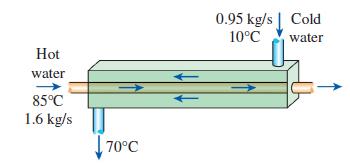
Cold water (cp = 4.18 kJ/kg⋅°C) leading to a shower enters a well-insulated, thin-walled, double-pipe, counter flow heat exchanger at 10°C at a rate of 0.95 kg/s and is heated to 70°C by hot water (cp = 4.19 kJ/kg⋅°C) that enters at 85°C at a rate of 1.6 kg/s. Determine(a) The rate of heat
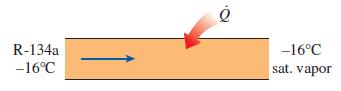
In an ice-making plant, water at 0°C is frozen at atmospheric pressure by evaporating saturated R-134a liquid at –16°C. The refrigerant leaves this evaporator as a saturated vapor, and the plant is sized to produce ice at 0°C at a rate of 5500 kg/h. Determine the rate of entropy generation in
An adiabatic steady-flow device compresses argon at 200 kPa and 27°C to 2 MPa. If the argon leaves this compressor at 550°C, what is the isentropic efficiency of the compressor?
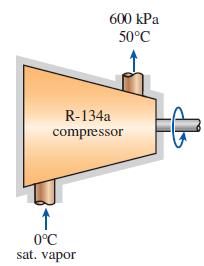
The adiabatic compressor of a refrigeration system compresses saturated R-134a vapor at 0°C to 600 kPa and 50°C. What is the isentropic efficiency of this compressor? 600 kPa 50°C R-134a compressor 0°C sat. vapor
Repeat Prob. 7–120 for a turbine efficiency of 85 percent.Data From Q#120:Steam at 3 MPa and 400°C is expanded to 30 kPa in an adiabatic turbine with an isentropic efficiency of 92 percent. Determine the power produced by this turbine, in kW, when the mass flow rate is 2 kg/s.
Steam at 3 MPa and 400°C is expanded to 30 kPa in an adiabatic turbine with an isentropic efficiency of 92 percent. Determine the power produced by this turbine, in kW, when the mass flow rate is 2 kg/s.
Air is compressed isothermally from 13 psia and 55°F to 80 psia in a reversible steady-flow device. Calculate the work required, in Btu/lbm, for this compression.
Oxygen at 300 kPa and 90°C flowing at an average velocity of 3 m/s is expanded in an adiabatic nozzle. What is the maximum velocity of the oxygen at the outlet of this nozzle when the outlet pressure is 120 kPa?
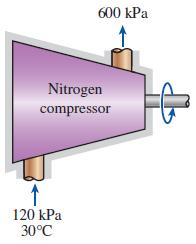
Nitrogen at 120 kPa and 30°C is compressed to 600 kPa in an adiabatic compressor. Calculate the minimum work needed for this process in kJ/kg. 600 kPa Nitrogen compressor 120 kPa 30°C
Which of the two gases—neon or air—has the lower final temperature as it is expanded isentropically from 1000 kPa and 500°C to 100 kPa in a piston–cylinder device?
Which of the two gases—helium or nitrogen—has the higher final temperature as it is compressed isentropically from 100 kPa and 25°C to 1 MPa in a closed system?
Air is expanded isentropically from 100 psia and 500°F to 20 psia in a closed system. Determine its final temperature.
Determine the final temperature when air is expanded isentropically from 1000 kPa and 477°C to 100 kPa in a piston–cylinder device.
Air is expanded from 200 psia and 500°F to 100 psia and 50°F. Assuming constant specific heats, determine the change in the specific entropy of air.
What is the difference between entropies of oxygen at 150 kPa and 39°C and oxygen at 150 kPa and 337°C on a perunit-mass basis?
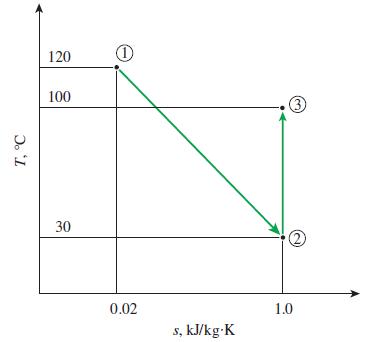
Calculate the heat transfer, in kJ/kg. for the reversible steady-flow process 1-3 shown on a T-s diagram in Fig. P7–60. 120 100 30 0.02 1.0 s, kJ/kg-K T, °C
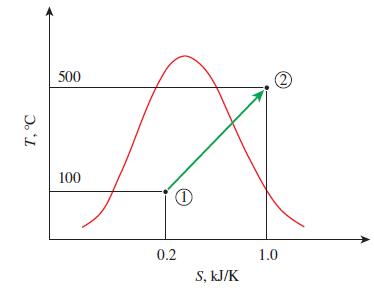
Determine the total heat transfer for the reversible process 1-2 shown in Fig. P7–59. 500 100 0.2 1.0 S, kJ/K T, °C
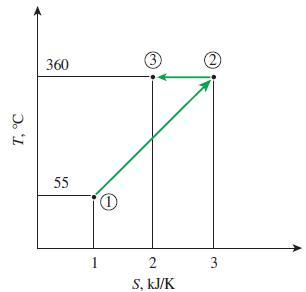
Determine the total heat transfer for the reversible process 1-3 shown in Fig. P7–58. 3 360 55 1 2 S, kJ/K T, °C
Water at 10°C and 81.4 percent quality is compressed isentropically in a closed system to 3 MPa. How much work does this process require in kJ/kg?
The compressor in a refrigerator compresses saturated R-134a vapor at 0°F to 200 psia. Calculate the work required by this compressor, in Btu/lbm, when the compression process is isentropic.
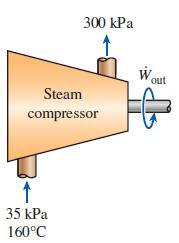
Water vapor enters a compressor at 35 kPa and 160°C and leaves at 300 kPa with the same specific entropy as at the inlet. What are the temperature and the specific enthalpy of water at the compressor exit? 300 kPa W out Steam compressor 35 kPa 160°C
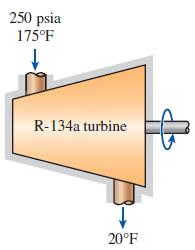
R-134a vapor enters into a turbine at 250 psia and 175°F. The temperature of R-134a is reduced to 20°F in this turbine while its specific entropy remains constant. Determine the change in the enthalpy of R-134a as it passes through the turbine. 250 psia 175°F R-134a turbine 20°F
Using the relation ds = (δQ/T)int rev for the definition of entropy, calculate the change in the specific entropy of R-134a as it is heated at a constant pressure of 200 kPa from a saturated liquid to a saturated vapor. Use the R-134a tables to verify your answer.
Two lbm of water at 300 psia fill a weighted piston–cylinder device whose volume is 2.5 ft3. The water is then heated at constant pressure until the temperature reaches 500°F. Determine the resulting change in the water’s total entropy.
One lbm of R-134a is expanded isentropically in a closed system from 100 psia and 100°F to 10 psia. Determine the total heat transfer and work production for this process.
A rigid vessel filled with a fluid is allowed to leak some fluid out through an opening. During this process, the specific entropy of the remaining fluid remains constant. How does the entropy of the environment change during this process?
A rigid vessel is filled with a fluid from a source whose properties remain constant. How does the entropy of the surroundings change if the vessel is filled such that the specific entropy of the vessel contents remains constant?
Air is compressed by a 40-kW compressor from P1 to P2. The air temperature is maintained constant at 25°C during this process as a result of heat transfer to the surrounding medium at 20°C. Determine the rate of entropy change of the air. State the assumptions made in solving this problem.
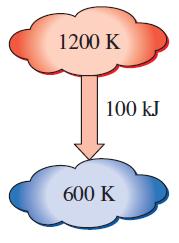
In Prob. 7–19, assume that the heat is transferred from the cold reservoir to the hot reservoir contrary to the Clausius statement of the second law. Prove that this violates the increase of entropy principle—as it must according to Clausius.Data From Q#19:Heat in the amount of 100 kJ is
A completely reversible air conditioner provides 36,000 Btu/h of cooling for a space maintained at 70°F while rejecting heat to the environmental air at 110°F. Calculate the rate at which the entropies of the two reservoirs change and verify that this air conditioner satisfies the increase of
Heat is transferred at a rate of 2 kW from a hot reservoir at 800 K to a cold reservoir at 300 K. Calculate the rate at which the entropy of the two reservoirs changes and determine if the second law is satisfied.
Calculate and plot the thermal efficiency of a completely reversible heat engine as a function of the source temperature up to 2000 R with the sink temperature fixed at 500 R.
Consider a Carnot heat-pump cycle executed in a steady-flow system in the saturated liquid–vapor mixture region using refrigerant-134a flowing at a rate of 0.18 kg/s as the working fluid. It is known that the maximum absolute temperature in the cycle is 1.2 times the minimum absolute temperature,
Using a thermometer, measure the temperature of the main food compartment of your refrigerator, and check if it is between 1 and 4°C. Also, measure the temperature of the freezer compartment, and check if it is at the recommended value of –18°C.
Devise a Carnot heat engine using steady-flow components, and describe how the Carnot cycle is executed in that engine. What happens when the directions of heat and work interactions are reversed?
Show that the work produced by a reversible process exceeds that produced by an equivalent irreversible process by considering a weight moving down a plane both with and without friction.
A refrigerator is removing heat from a cold medium at 3°C at a rate of 5400 kJ/h and rejecting the waste heat to a medium at 30°C. If the coefficient of performance of the refrigerator is 2, the power consumed by the refrigerator is(a) 0.5 kW(b) 0.75 kW(c) 1.0 kW(d) 1.5 kW(e) 3.0 kW
A heat pump cycle is executed with R–134a under the saturation dome between the pressure limits of 1.2 and 0.16 MPa. The maximum coefficient of performance of this heat pump is(a) 5.7(b) 5.2(c) 4.8(d) 4.5(e) 4.1
The label on a washing machine indicates that the washer will use $85 worth of hot water if the water is heated by a 90 percent efficient electric heater at an electricity rate of $0.125/kWh. If the water is heated from 18 to 45°C, the amount of hot water an average family uses per year is(a) 19.5
The drinking water needs of an office are met by cooling tap water in a refrigerated water fountain from 23 to 6°C at an average rate of 18 kg/h. If the COP of this refrigerator is 3.1, the required power input to this refrigerator is(a) 1100 W(b) 355 W(c) 195 W(d) 115 W(e) 35 W
Prove that a refrigerator’s COP cannot exceed that of a completely reversible refrigerator that shares the same thermal energy reservoirs.
Reconsider Prob. 6–133. Using appropriate software, investigate the effect of the net work output on the required temperature of the steam during the heat rejection process. Let the work output vary from 40 to 60 kJ.Data From Q#133:Consider a Carnot heat-engine cycle executed in a closed system
Consider a Carnot heat-engine cycle executed in a closed system using 0.025 kg of steam as the working fluid. It is known that the maximum absolute temperature in the cycle is twice the minimum absolute temperature, and the net work output of the cycle is 60 kJ. If the steam changes from saturated
A refrigeration system uses a water-cooled condenser for rejecting the waste heat. The system absorbs heat from a space at 25°F at a rate of 21,000 Btu/h. Water entersthe condenser at 65°F at a rate of 1.45 lbm/s. The COP of the system is estimated to be 1.9. Determine (a) The power input to
A heat pump designer claims to have an air-source heat pump whose coefficient of performance is 1.8 when heating a building whose interior temperature is 300 K and when the atmospheric air surrounding the building is at 260 K. Is this claim valid?
A manufacturer of ice cream freezers claims that its product has a coefficient of performance of 1.3 while freezing ice cream at 250 K when the surrounding environment is at 300 K. Is this claim valid?
Calculate and plot the COP of a completely reversible refrigerator as a function of the temperature of the sink up to 500 K with the temperature of the source fixed at 250 K.
The structure of a house is such that it loses heat at a rate of 4500kJ/h per °C difference between the indoors and outdoors. A heat pump that requires a power input of 4 kW is used to maintain this house at 24°C. Determine the lowest outdoor temperature for which the heat pump can meet the
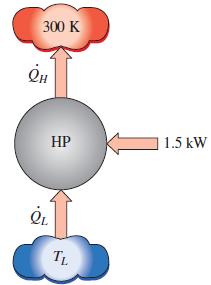
A completely reversible heat pump has a COP of 1.6 and a sink temperature of 300 K. Calculate(a) The temperature of the source(b) The rate of heat transfer to the sink when 1.5 kW of power is supplied to this heat pump. 300 K HP 1.5 kW TL
A Carnot refrigerator absorbs heat from a space at 15°C at a rate of 16,000 kJ/h and rejects heat to a reservoir at 36°C. Determine the COP of the refrigerator, the power input, in kW, and the rate of heat rejected to high-temperature reservoir, in kJ/h.
An air-conditioning system is used to maintain a house at 70°F when the temperature outside is 100°F. The house is gaining heat through the walls and the windows at a rate of 800 Btu/min, and the heat generation rate within the house from people, lights, and appliances amounts to 100 Btu/min.
A heat pump operates on a Carnot heat pump cycle with a COP of 12.5. It keeps a space at 24°C by consuming 2.15 kW of power. Determine the temperature of the reservoir from which the heat is absorbed and the heating load provided by the heat pump.
A completely reversible refrigerator is driven by a 10-kW compressor and operates with thermal energy reservoirs at 250 K and 300 K. Calculate the rate of cooling provided by this refrigerator.
Determine the minimum work per unit of heat transfer from the source reservoir that is required to drive a heat pump with thermal energy reservoirs at 460 K and 535 K.
A thermodynamicist claims to have developed a heat pump with a COP of 1.7 when operating with thermal energy reservoirs at 273 K and 293 K. Is this claim valid?
A homeowner buys a new refrigerator with no freezer compartment and a deep freezer for the new kitchen. Which of these devices would you expect to have a lower COP? Why?
It is claimed that the efficiency of a completely reversible heat engine can be doubled by doubling the temperature of the energy source. Justify the validity of this claim.
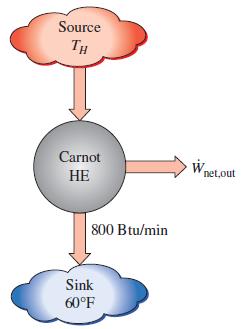
A heat engine is operating on a Carnot cycle and has a thermal efficiency of 75 percent. The waste heat from this engine is rejected to a nearby lake at 60°F at a rate of 800 Btu/min. Determine(a) The power output of the engine(b) The temperature of the source. Source TH Carnot net,out НЕ 800
A thermodynamicist claims to have developed a heat engine with 50 percent thermal efficiency when operating with thermal energy reservoirs at 1260 R and 510 R. Is this claim valid?
Reconsider Prob. 6-77. You also know that the metallurgical temperature limit for the blades in the turbine is 1000 K before they will incur excessive creep. Now what is the maximum efficiency for this plant?Data From Q#77:You are an engineer in an electric-generation station. You know that the
You are an engineer in an electric-generation station. You know that the flames in the boiler reach a temperature of 1200 K and that cooling water at 300 K is available from a nearby river. What is the maximum efficiency your plant will ever achieve?
A refrigerator is used to cool water from 23 to 5°C in a continuous manner. The heat rejected in the condenser is 570 kJ/min and the power is 2.65 kW. Determine the rate at which water is cooled in L/min and the COP of the refrigerator. The specific heat of water is 4.18 kJ/kg·°C and its density
A heat pump with a COP of 1.4 is to produce a 100,000 Btu/h heating effect. How much power does this device require, in hp?
A heat pump has a COP of 1.7. Determine the heat transferred to and from this heat pump when 50 kJ of work is supplied.
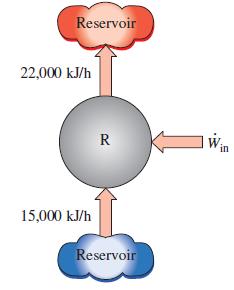
A food refrigerator is to provide a 15,000-kJ/h cooling effect while rejecting 22,000 kJ/h of heat. Calculate the COP of this refrigerator. Reservoir 22,000 kJ/h Win R 15,000 kJ/h Reservoir
An automotive air conditioner produces a 1-kW cooling effect while consuming 0.75 kW of power. What is the rate at which heat is rejected from this air conditioner?
A food freezer is to produce a 5-kW cooling effect, and its COP is 1.3. How many kW of power will this refrigerator require for operation?
The coefficient of performance of a residential heat pump is 1.6. Calculate the heating effect in kJ/s this heat pump will produce when it consumes 2 kW of electrical power.
Repeat Prob. 6–27 for a simple payback period of three years instead of five years.Data From Q#27:A country needs to build new power plants to meet the increasing demand for electric power. One possibility is to build coal-fired power plants, which cost $1300 per kW to construct and have an
Reconsider Prob. 6–27. Using appropriate software, investigate the price of coal for varying simple payback periods, plant construction costs, and operating efficiency.Data From Q#27:A country needs to build new power plants to meet the increasing demand for electric power. One possibility is to
Showing 400 - 500
of 689
1
2
3
4
5
6
7
Step by Step Answers

 Get 50% OFF
Claim Now
Get 50% OFF
Claim Now