New Semester
Started
Get
50% OFF
Study Help!
--h --m --s
Claim Now
Question Answers
Textbooks
Find textbooks, questions and answers
Oops, something went wrong!
Change your search query and then try again
S
Books
FREE
Study Help
Expert Questions
Accounting
General Management
Mathematics
Finance
Organizational Behaviour
Law
Physics
Operating System
Management Leadership
Sociology
Programming
Marketing
Database
Computer Network
Economics
Textbooks Solutions
Accounting
Managerial Accounting
Management Leadership
Cost Accounting
Statistics
Business Law
Corporate Finance
Finance
Economics
Auditing
Tutors
Online Tutors
Find a Tutor
Hire a Tutor
Become a Tutor
AI Tutor
AI Study Planner
NEW
Sell Books
Search
Search
Sign In
Register
study help
mathematics
applied calculus
Calculus And Its Applications 14th Edition Larry Goldstein, David Lay, David Schneider, Nakhle Asmar - Solutions
A random variable X has a cumulative distribution function F (x) = (x2 - 9)/16 on 3 ≤ x ≤ 5.(a) Find the density function for X.(b) Find a such that Pr (a … X ) = 1/4.
The time (in minutes) required to complete an assembly on a production line is a random variable X with the cumulative distribution function F (x) = 1/125x3, 0 ≤ x ≤ 5.(a) Find E(X ) and give an interpretation of this quantity.(b) Compute Var (X ).
What is the expected value of an exponential random variable?
Repeat Exercise 10 with p = .6.Exercise 10If X is a geometric random variable with parameter p = .9, compute the probabilities p0,. . . , p5 and make a histogram.
Find the value of k that makes the given function a probability density function on the specified interval.f (x) = kx2(1 - x), 0 ≤ x ≤ 1
In a study of the vacancies occurring in the U.S. Supreme Court, it has been determined that the time elapsed between successive resignations is an exponential random variable with expected value 2 years.A new president takes office at the same time that a justice retires. Find the probability that
A random variable X has a uniform density function f (x) = 1/5 on 20 ≤ x ≤ 25.(a) Find E (X ) and Var (X ).(b) Find b such that Pr (X ≤ b) = .3.
The useful life (in hundreds of hours) of a certain machine component is a random variable X with the cumulative distribution function F (x) = 19x2, 0 ≤ x ≤ 3.(a) Find E(X ), and give an interpretation of this quantity.(b) Compute Var (X ).
What is an exponential density function? Give an example.
If X is a geometric random variable with parameter p = .9, compute the probabilities p0,. . . , p5 and make a histogram.
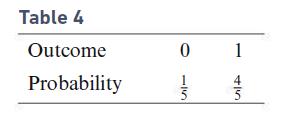
Table 4 is the probability table for a random variable X. Find E(X ), Var(X ), and the standard deviation of X. Table 4 Outcome Probability 0 15 1 45
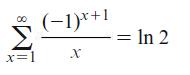
Convince yourself that the equation is correct by summing up the first 999 terms of the infinite series and comparing the sum with the value on the right. x=1 (-1)x+1 X = In 2
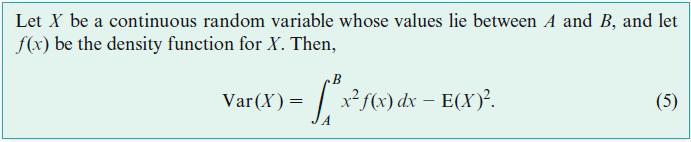
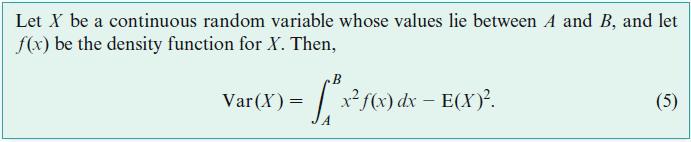
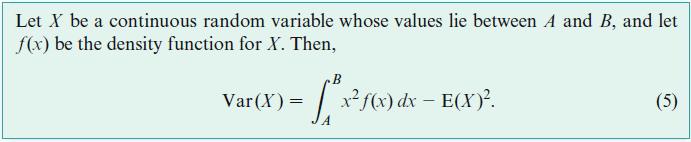
Find the expected value and variance for each random variable whose probability density function is given. When computing the variance, use formula (5). Let X be a continuous random variable whose values lie between A and B, and let f(x) be the density function for X. Then, Var(X) = x² f(x) dx =
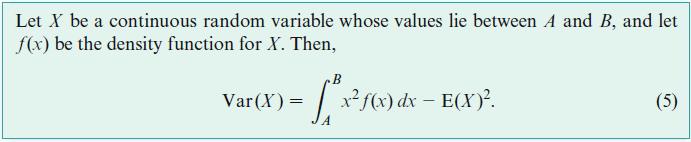
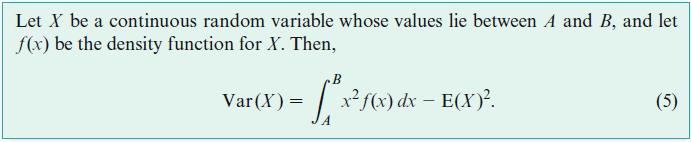
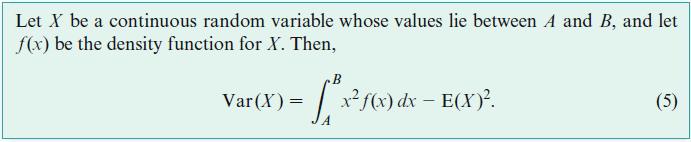
Find the expected value and variance for each random variable whose probability density function is given. When computing the variance, use formula (5). Let X be a continuous random variable whose values lie between A and B, and let f(x) be the density function for X. Then, Var(X) = x² f(x) dx =
Verify that each of the following functions is a probability density function. f(x) = √gx, 0 ≤ x ≤ 6 18
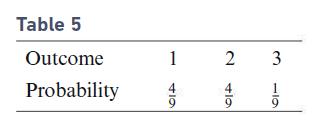
Find E(X), Var(X), and the standard deviation of X, where X is the random variable whose probability table is given in Table 5. Table 5 Outcome Probability 1 +10 2 +10 3
What is a probability table?
Let X be a continuous random variable on 0 ≤ x ≤ 2, with the density function f (x) = 3/8 x2.(a) Calculate Pr (X ≤ 1) and Pr (1 ≤ X ≤ 1.5).(b) Find E(X ) and Var (X ).
Find (by inspection) the expected values and variances of the exponential random variables with the density functions given in Exercises.3e-3x
Suppose that a random variable X has a Poisson distribution with λ = 3, as in Example 1. Compute the probabilities p6, p7, p8.
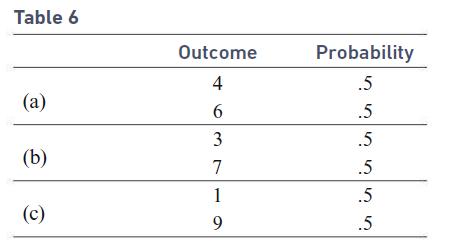
Compute the variances of the three random variables whose probability tables are given in Table 6. Relate the sizes of the variances to the spread of the values of the random variable. Table 6 (a) (b) (c) Outcome 4 6 3 7 1 9 Probability .5 .5 .5 .5 .5 .5
What is a discrete random variable?
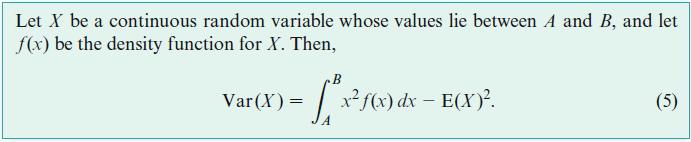
Find the expected value and variance for each random variable whose probability density function is given. When computing the variance, use formula (5). Let X be a continuous random variable whose values lie between A and B, and let f(x) be the density function for X. Then, Var(X) = x² f(x) dx =
Let X be a continuous random variable on 3 ≤ x ≤ 4, with the density function f (x) = 2(x - 3).(a) Calculate Pr (3.2 ≤ X) and Pr (3 ≤ X).(b) Find E(X) and Var(X).
Find (by inspection) the expected values and variances of the exponential random variables with the density functions given in Exercises.1/4e-x/4
Verify that each of the following functions is a probability density function.f (x) = 2(x - 1), 1 ≤ x ≤ 2
Let X be a Poisson random variable with parameter λ = 5. Compute the probabilities p0,. . . , p6 to four decimal places.
For any number A, verify that f (x) = eA-x, x ≥ A, is a density function. Compute the associated cumulative distribution for X.
Find (by inspection) the expected values and variances of the exponential random variables with the density functions given in Exercises..2e-0.2x
Verify that each of the following functions is a probability density function. f(x) = ½¼, 1 ≤ x ≤ 5
Repeat Exercise 2 with λ = .75 and make a histogram.Exercise 2Let X be a Poisson random variable with parameter λ = 5. Compute the probabilities p0,. . . , p6 to four decimal places.
Explain how to create a probability density histogram.
Find the expected value and variance for each random variable whose probability density function is given. When computing the variance, use formula (5). Let X be a continuous random variable whose values lie between A and B, and let f(x) be the density function for X. Then, Var(X) = x² f(x) dx =
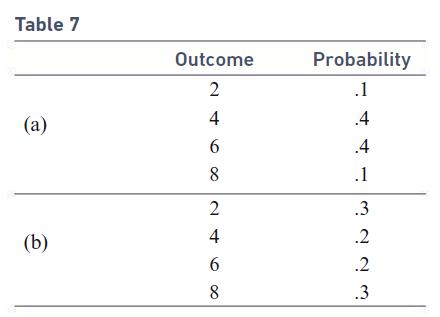
Compute the variances of the two random variables whose probability tables are given in Table 7. Relate the sizes of the variances to the spread of the values of the random variables. Table 7 (a) (b) Outcome 2 4 6 8 2 4 16∞ 6 8 Probability .1 .4 .4 .1 .3 .2 .2 .3
For any positive constants k and A, verify that the function f (x) = kAk/xk+1, x ≥ A, is a density function. The associated cumulative distribution function F (x) is called a Pareto distribution. Compute F (x).
Find the expected value and variance for each random variable whose probability density function is given. When computing the variance, use formula (5). Let X be a continuous random variable whose values lie between A and B, and let f(x) be the density function for X. Then, Var(X) = x² f(x) dx =
What are the two properties of a probability density function?
The monthly number of fire insurance claims filed with the Firebug Insurance Company is Poisson distributed with λ = 10.(a) What is the probability that in a given month no claims are filed?(b) What is the probability that in a given month no more than two claims are filed? (The number of claims
Verify that each of the following functions is a probability density function.f (x) = 5x4, 0 ≤ x ≤ 1
In a large factory there is an average of two accidents per day, and the time between accidents has an exponential density function with an expected value of 1/2day.Find the probability that the time between two accidents will be more than 1/2day and less than 1 day.
For any positive integer n, the function fn(x) = cn x(n-2)/2e-x/2, x ≥ 0, where cn is an appropriate constant, is called the chi-square density function with n degrees of freedom. Find c2 and c4 such that f2 (x) and f4 (x) are probability density functions.
The number of accidents per week at a busy intersection was recorded for a year. There were 11 weeks with no accidents, 26 weeks with one accident, 13 weeks with two accidents, and 2 weeks with three accidents. A week is to be selected at random and the number of accidents noted. Let X be the
Find the expected value and variance for each random variable whose probability density function is given. When computing the variance, use formula (5).f (x) = 5x4, 0 ≤ x ≤ 1 Let X be a continuous random variable whose values lie between A and B, and let f(x) be the density function for X.
Repeat Exercise 2 with λ = 2.5 and make a histogram.Exercise 2Let X be a Poisson random variable with parameter λ = 5. Compute the probabilities p0,. . . , p6 to four decimal places.
Verify that each of the following functions is a probability density function. f(x) = x, 0≤x≤ 3 8
Find (by inspection) the expected values and variances of the exponential random variables with the density functions given in Exercises.1.5e-1.5x
Verify that each of the following functions is a probability density function. f(x) = x - x², 0≤x≤2 3
On a typical weekend evening at a local hospital, the number of persons waiting for treatment in the emergency room is Poisson distributed with λ = 6.5.(a) What is the likelihood that either no one or only one person is waiting for treatment?(b) What is the likelihood that no more than four
In a large factory there is an average of two accidents per day, and the time between accidents has an exponential density function with an expected value of 1/2day.Find the probability that the time between accidents will be less than 8 hours (1/3 day).
For any positive number k, verify that f (x) = 1/(2k3)x2 e-x/k, x ≥ 0, is a density function.
The number of phone calls coming into a telephone switchboard during each minute was recorded during an entire hour. During 30 of the 1-minute intervals there were no calls, during 20 intervals there was one call, and during 10 intervals there were two calls. A 1-minute interval is to be selected
Find the expected value and variance for each random variable whose probability density function is given. When computing the variance, use formula (5).f (x) = 12x(1 - x)2, 0 ≤ x ≤ 1 Let X be a continuous random variable whose values lie between A and B, and let f(x) be the density function for
How is a probability density function used to calculate probabilities?
Consider a circle with radius 1.(a) What percentage of the points lies within 1/2 unit of the center?(b) Let c be a constant with 0 < c < 1. What percentage of the points lies within c unit of the center?
Find the value of k that makes the given function a probability density function on the specified interval.f (x) = kx, 1 ≤ x ≤ 3
What is a cumulative distribution function, and how is it related to the corresponding probability density function?
The number of typographical errors per page of a certain newspaper has a Poisson distribution, and there is an average of 1.5 errors per page.(a) What is the probability that a randomly selected page is error-free?(b) What is the probability that a page has either two or three errors?(c) What is
The amount of time required to serve a customer at a bank has an exponential density function with mean 3 minutes.Find the probability that a customer is served in less than 2 minutes.
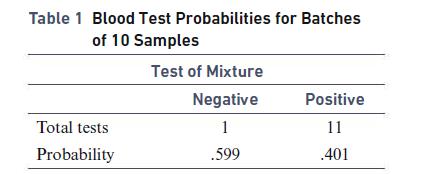
A medical laboratory tests many blood samples for a certain disease that occurs in about 5% of the samples. The lab collects samples from 10 persons and mixes together some blood from each sample. If a test on the mixture is positive, an additional 10 tests must be run, one on each individual
Use the comparison test to determine whether the infinite series is convergent or divergent. 00 k=1 5k cos² (K) [Compare with 4 00 जे
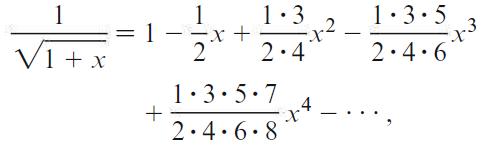
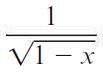
Given the Taylor series expansionfind the first four terms in the Taylor series ofat x = 0. 1 VITX 1 + 1 1.3 x + 2.4 1.3.5.7 2.4.6.8 x² x4 1.3.5 2.4.6
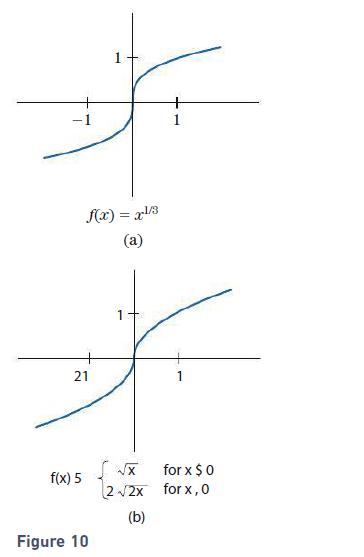
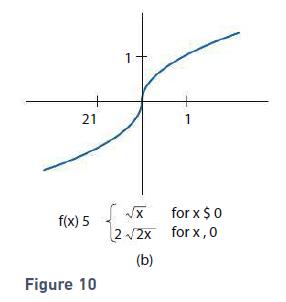
Present two examples in which successive repetitions of the Newton–Raphson algorithm do not approach a root. Apply the Newton–Raphson algorithm to the function f (x) = x1/3 whose graph is drawn in Fig. 10(a). Use x0 = 1. f(x) = x-¹/3 (a) 21 f(x) 5 Figure 10 1 2 √2x (b) + 1 for x $ 0 for x,0
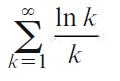
Determine if the given series is convergent. k=1 In k k
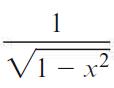
Find the first four terms in the Taylor series ofat x = 0. 1 1-x²
Use the comparison test to determine whether the infinite series is convergent or divergent. 00 k=0 1 (³)k + (²)k 00 Compare with Σ (3)* or ΕΞΟ __()+ ] k=0
Present two examples in which successive repetitions of the Newton–Raphson algorithm do not approach a root. Apply the Newton–Raphson algorithm to the function whose graph is drawn in Fig. 10(b). Use x0 = 1. 21 f(x) 5 Figure 10 1 X 2√2x (b) 1 for x $ 0 for x,0
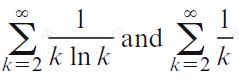
Can the comparison test be used withto deduce anything about the first series? 00 1 k=2 k lnk 3 ∞o - and Σ k=2 k
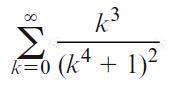
Determine if the given series is convergent. 00 k3 Σ k=0 (k4 + 1)² +
If f(x) = 3 + 4x - 5/2!(x2) + 7/3!(x3) what are f″(0) and f″′(0)?
If f(x) = 2 - 6(x - 1) + 3/2!(x - 1)2 - 5/3!(x - 1)3 + 1/4!(x - 1)4, what are f″(1) and f″′(1)?
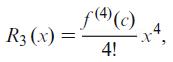
The third remainder for f (x) at x = 0 iswhere c is a number between 0 and x. Let f (x) = cos x, as in Check Your Understanding Problem 11.1. (a) Find a number M such that | f (4)(c)| ≤ M for all values of c.(b) In Check Your Understanding Problem 11.1, the error in using p3(.12) as an
A perpetuity is a periodic sequence of payments that continues forever. The capital value of the perpetuity is the sum of the present values of all future payments.Consider a perpetuity that promises to pay P dollars at the end of each month. (The first payment will be received in 1 month.) If the
Use Exercise 25 and the fact thatto find the Taylor series of ln(x + √1 + x2) at x = 0. √1 + x² dx = In(x + V1 + x²) + C
For what values of p isconvergent? 00 k=1 1 KP
A generous corporation not only gives its CEO a $1,000,000 bonus, but gives her enough money to cover the taxes on the bonus, the taxes on the additional taxes, the taxes on the taxes on the additional taxes, and so on. If she is in the 39.6% tax bracket, how large is her bonus?
The functions f (x) = x2 - 4 and g (x) = (x - 2)2 both have a zero at x = 2. Apply the Newton–Raphson algorithm to each function with x0 = 3, and determine the value of n for which xn appears on the screen as exactly 2. Graph the two functions and explain why the sequence for f(x) converges so
Let p4 (x) be the fourth Taylor polynomial of f(x) = ex at x = 0. Show that the error in using p4(.1) as an approximation for e0.1 is at most 2.5 * 10-7.
The coefficient of restitution of a ball, a number between 0 and 1, specifies how much energy is conserved when the ball hits a rigid surface. A coefficient of .9, for instance, means a bouncing ball will rise to 90% of its previous height after each bounce. The coefficients of restitution for a
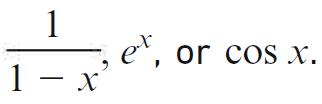
Find the Taylor series at x = 0 of the given function. Use suitable operations (differentiation, substitution, etc.) on the Taylor series at x = 0 ofsin 3x 1 1- x 9 et, or cos x.
Sum an appropriate infinite series to find the rational number whose decimal expansion is given. 4.011011 (= 4 + .011011)
Suppose that the line y = 4x + 5 is tangent to the graph of the function f(x) at x = 3. If the Newton–Raphson algorithm is used to find a root of f(x) = 0 with the initial guess x0 = 3, what is x1?
Find the sum of the given infinite series if it is convergent.where m is a positive number m 1 2 m² 1 + m³ 3 1 m 4 + 1 5 m
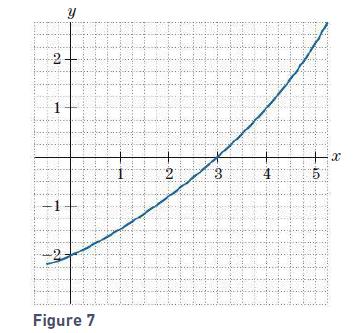
Redo Exercise 17 with x0 = 1.Exercise 17A function f(x) has the graph given in Fig. 7. Let x1 and x2 be the estimates of a root of f(x) obtained by applying the Newton–Raphson algorithm using an initial approximation of x0 = 5. Draw the appropriate tangent lines and estimate the numerical values
Find the Taylor series at x = 0 of the given function. Use suitable operations (differentiation, substitution, etc.) on the Taylor series at x = 0 ofcos x2 1 1- x 9 et, or cos x.
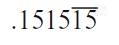
Sum an appropriate infinite series to find the rational number whose decimal expansion is given. .151515
Use the integral test to determine ifis convergent. Show that the hypotheses of the integral test are satisfied. 00 el/k Σ 2 k=1 k
Find the sum of the given infinite series if it is convergent.where m is a positive number 1 + m+ 1 m (m + 1)² + m³ + (m + 1)³ (m + 1)4 m² +
Determine the fourth Taylor polynomial of ln x at x = 1.
Find the Taylor series at x = 0 of the given function. Use suitable operations (differentiation, substitution, etc.) on the Taylor series at x = 0 ofcos 3x 1 1- x 9 et, or cos x.
Sum an appropriate infinite series to find the rational number whose decimal expansion is given. .222
A function f(x) has the graph given in Fig. 7. Let x1 and x2 be the estimates of a root of f(x) obtained by applying the Newton–Raphson algorithm using an initial approximation of x0 = 5. Draw the appropriate tangent lines and estimate the numerical values of x1 and x2. 2 Y HHH 48 Figure
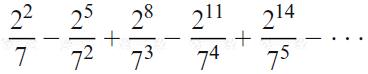
Find the sum of the given infinite series if it is convergent. | + I 비심 + 75 | 심
Determine the third Taylor polynomial of 1/ 5 -x at x = 4.
Find the Taylor series at x = 0 of the given function. Use suitable operations (differentiation, substitution, etc.) on the Taylor series at x = 0 ofln(1 + x2) 1 1- x 9 et, or cos x.
Use a second Taylor polynomial at x = 0 to estimate the area under the curve y = √cos x from x = -1 to x = 1. (The exact answer to three decimal places is 1.828.)
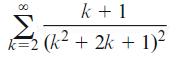
Use the integral test to determine whether the infinite series is convergent or divergent. (You may assume that the hypotheses of the integral test are satisfied.) JM8 k + 1 k=2(k². (k² + 2k + 1)²
Find the sum of the given infinite series if it is convergent. 8 83 ਲੋਕਾਂ ਤੱਕ ਕੁਝ 84 — +
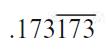
Sum an appropriate infinite series to find the rational number whose decimal expansion is given. .173173
Find the Taylor series at x = 0 of the given function. Use suitable operations (differentiation, substitution, etc.) on the Taylor series at x = 0 ofln(1 + x) 1 1- x 9 et, or cos x.
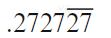
Sum an appropriate infinite series to find the rational number whose decimal expansion is given. .272727
Showing 2600 - 2700
of 5529
First
20
21
22
23
24
25
26
27
28
29
30
31
32
33
34
Last
Step by Step Answers

 Get 50% OFF
Claim Now
Get 50% OFF
Claim Now