New Semester
Started
Get
50% OFF
Study Help!
--h --m --s
Claim Now
Question Answers
Textbooks
Find textbooks, questions and answers
Oops, something went wrong!
Change your search query and then try again
S
Books
FREE
Study Help
Expert Questions
Accounting
General Management
Mathematics
Finance
Organizational Behaviour
Law
Physics
Operating System
Management Leadership
Sociology
Programming
Marketing
Database
Computer Network
Economics
Textbooks Solutions
Accounting
Managerial Accounting
Management Leadership
Cost Accounting
Statistics
Business Law
Corporate Finance
Finance
Economics
Auditing
Tutors
Online Tutors
Find a Tutor
Hire a Tutor
Become a Tutor
AI Tutor
AI Study Planner
NEW
Sell Books
Search
Search
Sign In
Register
study help
mathematics
applied calculus
Applied Calculus 6th Edition Deborah Hughes Hallett, Patti Frazer Lock, Andrew M. Gleason, Daniel E. Flath, Sheldon P. Gordon, David O. Lomen, David Lovelock, William G. McCallum, Brad G. Osgood, Andrew Pasquale - Solutions
A mortgage of $100,050 is repaid in 240 monthly payments of $900. Determine the monthly rate of interest.
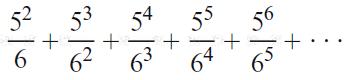
Find the sum of the given infinite series if it is convergent. + + + + 1 +
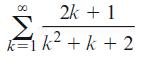
Use the integral test to determine whether the infinite series is convergent or divergent. (You may assume that the hypotheses of the integral test are satisfied.) 00 k= 2k + 1 ik² + k + 2 2
Use a second Taylor polynomial at x = 0 to estimate the area under the curve y = ln(1 + x2) from x = 0 to x = 1/2.
A $663 flat-screen TV is purchased with a down payment of $100 and a loan of $563 to be repaid in five monthly installments of $116. Determine the monthly rate of interest on the loan.
Use the integral test to determine whether the infinite series is convergent or divergent. (You may assume that the hypotheses of the integral test are satisfied.) ke*² k=1
Use the integral test to determine whether the infinite series is convergent or divergent. (You may assume that the hypotheses of the integral test are satisfied.) 00 k=1 k-3/4
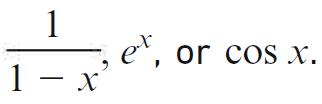
Find the Taylor series at x = 0 of the given function. Use suitable operations (differentiation, substitution, etc.) on the Taylor series at x = 0 of1 - e-x 1 1- x 9 et, or cos x.
Find the Taylor series at x = 0 of the given function. Use suitable operations (differentiation, substitution, etc.) on the Taylor series at x = 0 of3(e-2x - 2) 1 1- x 9 et, or cos x.
Determine all Taylor polynomials for f (x) = x2 + 2x + 1 at x = 0.
An investor buys a bond for $1000. She receives $10 at the end of each month for 2 months and then sells the bond at the end of the second month for $1040. Determine the internal rate of return on this investment.
Determine the sums of the following geometric series when they are convergent. 5 +4+3.2 + 2.56 +2.048 +
Use the integral test to determine whether the infinite series is convergent or divergent. (You may assume that the hypotheses of the integral test are satisfied.) 00 1 k=1e²k+1
Find the Taylor series at x = 0 of the given function. Use suitable operations (differentiation, substitution, etc.) on the Taylor series at x = 0 ofx3ex2 1 1- x 9 et, or cos x.
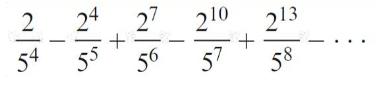
Determine the sums of the following geometric series when they are convergent. 3² + 34 36 38 + 28 + 211 214 + 310 + 217
Suppose that an investment of $500 yields returns of $100, $200, and $300 at the end of the first, second, and third months, respectively. Determine the internal rate of return on this investment.
Use the integral test to determine whether the infinite series is convergent or divergent. (You may assume that the hypotheses of the integral test are satisfied.) 00 Σ 03-k k=1
Sketch the graphs of f (x) = sin x and its first three Taylor polynomials at x = 0.
Use the Newton–Raphson algorithm with n = 3 to approximate the solution of the equation e2x = 1 + e-x.
Use the Newton–Raphson algorithm to find an approximate solution to e5-x = 10 - x.
Find the Taylor series at x = 0 of the given function. Use suitable operations (differentiation, substitution, etc.) on the Taylor series at x = 0 of5ex/3 1 1- x 9 et, or cos x.
Determine the sums of the following geometric series when they are convergent. 2 54 T 55 x 27 56 210 210 213 + 57 58
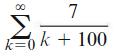
Use the integral test to determine whether the infinite series is convergent or divergent. (You may assume that the hypotheses of the integral test are satisfied.) 00 7 k=0k + 100
Determine the sums of the following geometric series when they are convergent. 1 + -1 + P + + 212 +
Use the Newton–Raphson algorithm to find an approximate solution to e-x = x2.
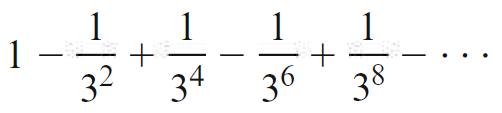
Determine the sums of the following geometric series when they are convergent. 1 - 1 3² + 1 1 1 34 36 38 +
Find the Taylor series at x = 0 of the given function by computing three or four derivatives and using the definition of the Taylor series.(1 + x)3
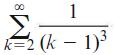
Use the integral test to determine whether the infinite series is convergent or divergent. (You may assume that the hypotheses of the integral test are satisfied.) 00 1 k=2 (k-1)³
Determine the third Taylor polynomial of the given function at x = 0.f(x) = 5e2x
Find the fifth Taylor polynomial of x3 - 7x2 + 8 at x = 0.
State the remainder formula for the nth Taylor polynomial of f (x) at x = a.
Use three repetitions of the Newton–Raphson algorithm to approximate the following:3√6
Determine the sums of the following geometric series when they are convergent. 1 + + 3|4 + 3|4 + ele + 4
Find the Taylor series at x = 0 of the given function by computing three or four derivatives and using the definition of the Taylor series.√1 + x
Use the integral test to determine whether the infinite series is convergent or divergent. (You may assume that the hypotheses of the integral test are satisfied.) 5 k=1k³/2
Determine the third Taylor polynomial of the given function at x = 0.f (x) = e-x/2
Find the fourth Taylor polynomial of (2x + 1)3/2 at x = 0.
In what way is the nth Taylor polynomial of f (x) at x = a like f (x) at x = a?
Use three repetitions of the Newton–Raphson algorithm to approximate the following:√7
Find the Taylor series at x = 0 of the given function by computing three or four derivatives and using the definition of the Taylor series.ln(1 - 3x)
Find the second Taylor polynomial of x(x + 1)3/2 at x = 0.
Determine the third Taylor polynomial of the given function at x = 0.f (x) = sin x
Define the nth Taylor polynomial of f (x) at x = a.
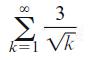
Use the integral test to determine whether the infinite series is convergent or divergent. (You may assume that the hypotheses of the integral test are satisfied.) 00 3 k=1Vk
Use three repetitions of the Newton–Raphson algorithm to approximate the following:√5
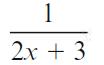
Find the Taylor series at x = 0 of the given function by computing three or four derivatives and using the definition of the Taylor series. 1 2x + 3
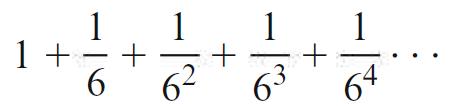
Determine the sums of the following geometric series when they are convergent. 1 + 1 6 + 1 + 6² 1 1 64 63 +
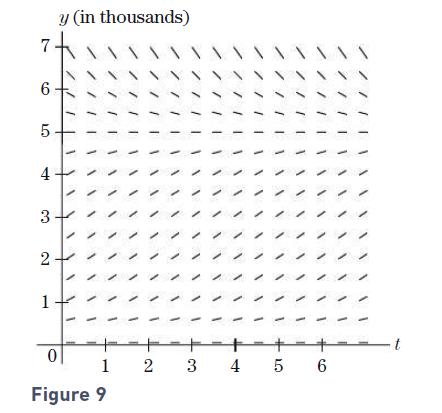
Refer to the differential equation in Exercise 39.(a) Obviously, if you start with zero fish, f(t) = 0 for all t. Confirm this on the slope field. Are there any other constant solutions?(b) Describe the population of fish if the initial population is greater than 5000; less than 5000. On the slope
Let f (t) denote the number (in thousands) of fish in a lake after t years, and suppose that f (t) satisfies the differential equation y′ = 0.1y (5 - y). The slope field for this equation is shown in Fig. 9.(a) With the help of the slope field, discuss what happens to an initial population of
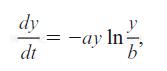
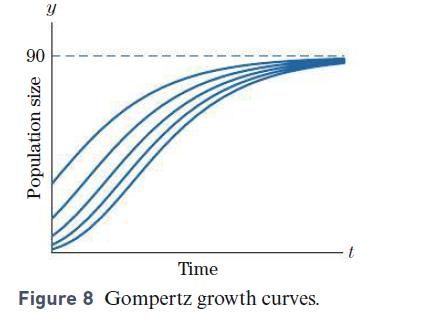
The Gompertz growth equation iswhere a and b are positive constants. This equation is used in biology to describe the growth of certain populations. Find the general form of solutions to this differential equation. (Figure 8 shows several solutions corresponding to a = .04 and b = 90.) dy dt = -ay
Draw the graph of g(x) = ex - 100x2 - 1, and use the graph to sketch the solution of the differential equation y′ = ey - 100y2 - 1 with initial condition y(0) = 4 on a ty-coordinate system.
Use Euler’s method with n = 5 on the interval 0 ≤ t ≤ 1 to approximate the solution f (t) to y' 2 (-10), y(0) = 9.
Draw the graph of g(x) = (x - 2)2 (x - 6)2, and use the graph to sketch the solutions of the differential equation y′ = (y - 2)2 (y - 6)2 with initial conditions y(0) = 1, y(0) = 3, y(0) = 5, and y(0) = 7 on a ty-coordinate system.
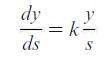
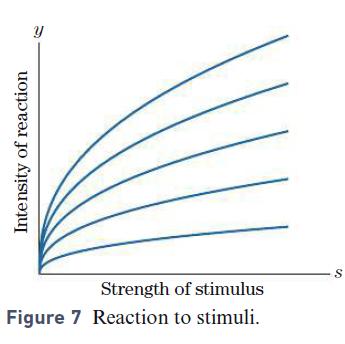
One problem in psychology is to determine the relation between some physical stimulus and the corresponding sensation or reaction produced in a subject. Suppose that, measured in appropriate units, the strength of a stimulus is s and the intensity of the corresponding sensation is some function of
When a certain liquid substance A is heated in a flask, it decomposes into a substance B at such a rate (measured in units of A per hour) that at any time t is proportional to the square of the amount of substance A present. Let y = f (t) be the amount of substance A present at time t. Construct
A parachutist has a terminal velocity of -176 feet per second. That is, no matter how long a person falls, his or her speed will not exceed 176 feet per second, but it will get arbitrarily close to that value. The velocity in feet per second, y(t), after t seconds satisfies the differential
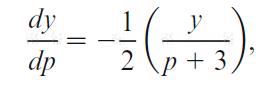
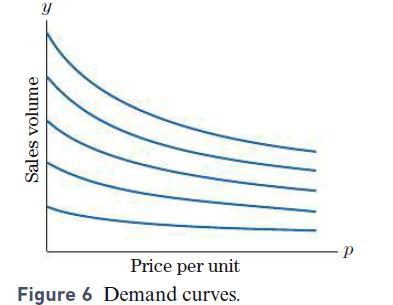
A model that describes the relationship between the price and the weekly sales of a product might have a form such aswhere y is the volume of sales and p is the price per unit. That is, at any time, the rate of decrease of sales with respect to price is directly proportional to the sales level and
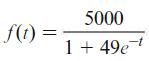
The functionis the solution of the differential equation y′ = .0002y(5000 - y) from Example 8.(a) Graph the function in the window [0, 10] by [-750, 5750].(b) In the home screen, compute .0002 f(3)(5000 - f (3)), and compare this value with f′(3). f(t) = 5000 1+ 49e t
Suppose that, once a sunflower plant has started growing, the rate of growth at any time is proportional to the product of its height and the difference between its height at maturity and its current height. Give a differential equation that is satisfied by f (t), the height at time t, and sketch
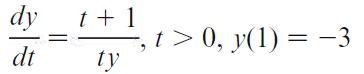
Solve the following differential equations with the given initial conditions. dy dt t + 1 ty −, t > 0, y(1) = −3
Some homeowner’s insurance policies include automatic inflation coverage based on the U.S. Commerce Department’s construction cost index (CCI). Each year, the property insurance coverage is increased by an amount based on the change in the CCI. Let f (t) be the CCI at time t years since January
Mothballs tend to evaporate at a rate proportional to their surface area. If V is the volume of a mothball, then its surface area is roughly a constant times V2/3. So the mothball’s volume decreases at a rate proportional to V2/3. Suppose that initially a mothball has a volume of 27 cubic
In certain learning situations a maximum amount, M, of information can be learned, and at any time, the rate of learning is proportional to the amount yet to be learned. Let y = f (t) be the amount of information learned up to time t. Construct and solve a differential equation that is satisfied by
Let t represent the total number of hours that a truck driver spends during a year driving on a certain highway connecting two cities, and let p(t) represent the probability that the driver will have at least one accident during these t hours. Then, 0 … p(t) … 1, and 1 - p(t) represents the
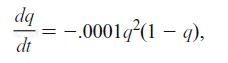
In the study of the effect of natural selection on a population, we encounter the differential equationwhere q is the frequency of a gene a and the selection pressure is against the recessive genotype aa. Sketch a solution of this equation when q(0) is close to but slightly less than 1.
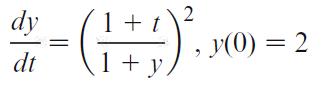
Solve the following differential equations with the given initial conditions. dy dt t = (1 + 7) ² y y(0) = 2
Consider the differential equation y′ = .2(10 - y) from Example 6. If the initial temperature of the steel rod is 510°, the function f (t) = 10 + 500e-0.2t is the solution of the differential equation. (a) Graph the function in the window [0, 30] by [-75, 550].(b) In the home screen,
Let f (t) be the solution to y = (t + 1)/y, y(0) = 1. Use Euler’s method with n = 3 on 0 ≤ t ≤ 1 to estimate f (1). Then, show that Euler’s method gives the exact value of f (1) by solving the differential equation.
The birth rate in a certain city is 3.5% per year, and the death rate is 2% per year. Also, there is a net movement of population out of the city at a steady rate of 3000 people per year. Let N = f (t) be the city’s population at time t.(a) Write a differential equation satisfied by N.(b) Use a
Suppose that in a chemical reaction, each gram of substance A combines with 3 grams of substance B to form 4 grams of substance C. The reaction begins with 10 grams of A, 15 grams of B, and 0 grams of C present. Let y = f (t) be the amount of C present at time t. The rate at which substance C is
Morphine is a drug that is widely used for pain management. However, morphine can cause fatal respiratory arrest. Since pain perception and drug tolerance vary with patients, morphine is gradually administered with small increments until pain is controlled or side effects begin to appear.In one
The health officials that studied the flu epidemic in Example 8 made an error in counting the initial number of infected people. They are now claiming that f (t) (the number of infected people after t days) is a solution of the initial-value problem y′ = .0002y (5000 - y), y(0) = 1500. Under this
Solve the initial-value problem.y′ + y = e2t, y(0) = -1
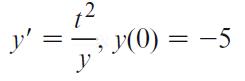
Solve the following differential equations with the given initial conditions. y' = y , y(0) = -5
A certain drug is administered intravenously to a patient at the continuous rate of r milligrams per hour. The patient’s body removes the drug from the bloodstream at a rate proportional to the amount of the drug in the blood, with constant of proportionality k = .5.(a) Write a differential
On the slope field in Fig. 4(a) or a copy of it, draw an approximation of a portion of the solution curve of the differential equation y′ = t - y that goes through the point (0, 2). In your opinion, based on the slope field, can this solution pass through the point (.5, 2.2)?
Solve the initial-value problem.ty′ - y = -1, y(1) = 1, t > 0
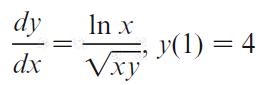
Solve the following differential equations with the given initial conditions. dy dx In x Vxy y(1) = 4
Solve the following differential equations with the given initial conditions.y′ = 5ty - 2t, y(0) = 1
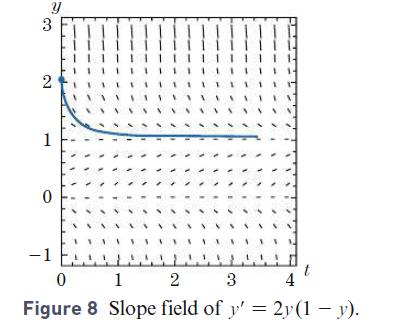
Figure 8 shows a portion of the solution curve of the differential equation y′ = 2y (1 - y) through the point (0, 2). On Fig. 8or a copy of it, draw an approximation of the solution curve of the differential equation y′ = 2y (1 - y) through the point (0, 3). Use the slope field to guide your
A bank account has $20,000 earning 5% interest compounded continuously. A pensioner uses the account to pay himself an annuity, drawing continuously at a $2000 annual rate. How long will it take for the balance in the account to drop to zero?
Figure 8 shows a slope field of the differential equation y′ = 2y (1 - y). With the help of this figure, determine the constant solutions, if any, of the differential equation. Verify your answer by substituting back into the equation.
Solve the initial-value problem.y′ + 2y cos(2t) = 2 cos(2t), y(π/2) = 0
A continuous annuity of $12,000 per year is to be funded by steady withdrawals from a savings account that earns 6% interest compounded continuously.(a) What is the smallest initial amount in the account that will fund such an annuity forever?(b) What initial amount will fund such an annuity for
Solve the initial-value problem.ty′ + y = sin t, y(π/2) = 0, t > 0
Consider the initial-value problem(a) Is the solution increasing or decreasing when t = 0?(b) Find the solution and plot it for 0 ≤ t ≤ 4. y' : = y 1 + t +10, y(0) 50.
Let f (t) be the solution to y′ = 2e2t-y, y(0) = 0. Use Euler’s method with n = 4 on 0 ≤ t ≤ 2 to estimate f (2). Then show that Euler’s method gives the exact value of f (2) by solving the differential equation.
If y0 > 1, is the solution y = f (t) of the initial-value problem y′ = 2y (1 - y), y (0) = y0, decreasing for all t > 0? Answer this question based on the slope field shown in Fig. 8.
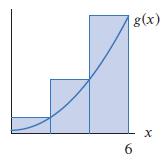
Rectangles have been drawn to approximate ∫60 g(x) dx.(a) Do the rectangles represent a left or a right sum?(b) Do the rectangles lead to an upper or a lower estimate?(c) What is the value of n?(d) What is the value of Δx? g(x) 6
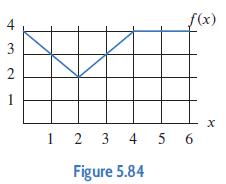
(a) Use Figure 5.84 to find ∫60 f(x) dx.(b) What is the average value of f on the interval x = 0 to x = 6? 4 3 2 1 نرا f(x) 1 2 3 4 5 6 Figure 5.84 X
A cup of coffee at 90◦C is put into a 20◦C room when t = 0. The coffee’s temperature is changing at a rate of r(t) = −7(0.9t) ◦C per minute, with t in minutes. Estimate the coffee’s temperature when t = 10.
Find the area under the graph of f(x) = x2 +2 between x = 0 and x = 6.
Explain in words what the integral represents and give units.∫31 v(t) dt, where v(t) is velocity in meters/sec and t is time in seconds.
You travel 30miles/hour for 2 hours, then 40miles/hour for 1∕2 hour, then 20 miles/hour for 4 hours.(a) What is the total distance you traveled?(b) Sketch a graph of the velocity function for this trip.(c) Represent the total distance traveled on your graph in part (b).
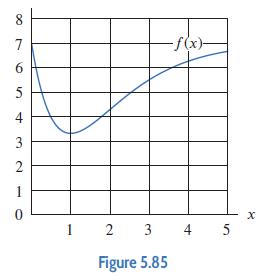
Use Figure 5.85 to estimate the following:(a) The integral ∫50 f(x) dx.(b) The average value of f between x = 0 and x = 5 by estimating visually the average height.(c) The average value of f between x = 0 and x = 5 by using your answer to part (a). ∞ 7 6 5 4 3 2 1 0 1 2 3 Figure
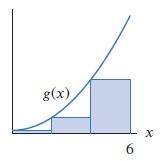
Rectangles have been drawn to approximate ∫60 g(x) dx.(a) Do the rectangles represent a left or a right sum?(b) Do the rectangles lead to an upper or a lower estimate?(c) What is the value of n?(d) What is the value of Δx? g(x) 6 X
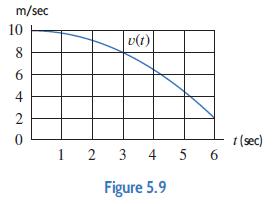
Figure 5.9 shows the velocity of an object for 0 ≤ t ≤ 6. Calculate the following estimates of the distance the object travels between t = 0 and t = 6, and indicate whether each result is an upper or lower estimate of the distance traveled.(a) A left sum with n = 2 subdivisions(b) A right sum
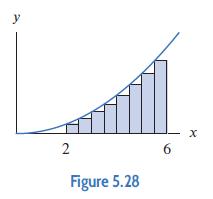
Figure 5.28 shows a Riemann sum approximation with n subdivisions to ∫ba f(x) dx.(a) Is it a left- or right-hand approximation? Would the other one be larger or smaller?(b) What are a, b, n, and Δx? y 2 Figure 5.28 6 X
If the marginal cost function C'(q) is measured in dollars per ton, and q gives the quantity in tons, what are the units of measurement for ∫900800 C'(q) dq? What does this integral represent?
Find the area under P = 100(0.6)t between t = 0 and t = 8.
Showing 2700 - 2800
of 5529
First
21
22
23
24
25
26
27
28
29
30
31
32
33
34
35
Last
Step by Step Answers

 Get 50% OFF
Claim Now
Get 50% OFF
Claim Now