New Semester
Started
Get
50% OFF
Study Help!
--h --m --s
Claim Now
Question Answers
Textbooks
Find textbooks, questions and answers
Oops, something went wrong!
Change your search query and then try again
S
Books
FREE
Study Help
Expert Questions
Accounting
General Management
Mathematics
Finance
Organizational Behaviour
Law
Physics
Operating System
Management Leadership
Sociology
Programming
Marketing
Database
Computer Network
Economics
Textbooks Solutions
Accounting
Managerial Accounting
Management Leadership
Cost Accounting
Statistics
Business Law
Corporate Finance
Finance
Economics
Auditing
Tutors
Online Tutors
Find a Tutor
Hire a Tutor
Become a Tutor
AI Tutor
AI Study Planner
NEW
Sell Books
Search
Search
Sign In
Register
study help
mathematics
applied calculus
Calculus And Its Applications 14th Edition Larry Goldstein, David Lay, David Schneider, Nakhle Asmar - Solutions
Differentiate (with respect to t or x):f (x) = 4 tan(x2 + x + 3)
Find t such that 0 ≤ t ≤ π and t satisfies the stated condition.cos t = cos(-π/6)
Differentiate (with respect to t or x):y = ex sin x
Differentiate (with respect to t or x):f (x) = 3 tan(1 - x2)
Find t such that 0 ≤ t ≤ π and t satisfies the stated condition.cos t = cos(3π/2)
Differentiate (with respect to t or x):y = (cos x + sin x)2
A soap manufacturer estimates that its marginal cost of producing soap powder is C′(x) = .2x + 100 dollars per ton at a production level of x tons per day. Fixed costs are $200 per day. Find the cost of producing x tons of soap powder per day.
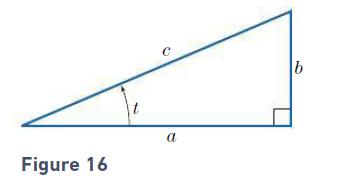
Exercises refer to various right triangles whose sides and angles are labeled as in Fig. 16. Round off all lengths of sides to one decimal place.If t = 1.1 and c = 10.0, find b. Figure 16 C a b
Differentiate (with respect to t or x):f (t) = cot t
Differentiate (with respect to t or x):y = cos(ex)
Find the four values of t between -2π and 2π at which sin t = -cos t.
Construct angles with the following radian measure.π/3, 5π/2, 6π
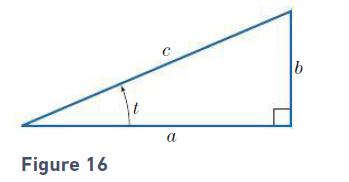
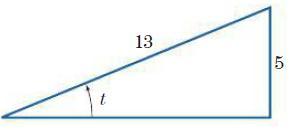
Exercises refer to various right triangles whose sides and angles are labeled as in Fig. 16. Round off all lengths of sides to one decimal place.Estimate t if a = 12, b = 5, and c = 13. Figure 16 C a b
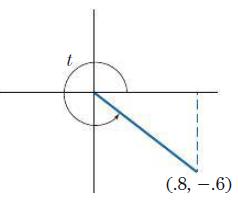
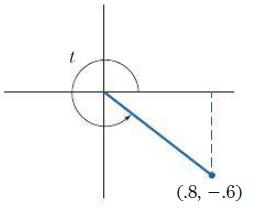
In Exercises, give the values of sin t and cos t, where t is the radian measure of the angle shown. t (.8, -.6)
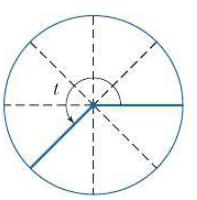
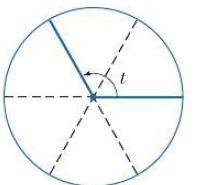
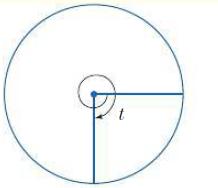
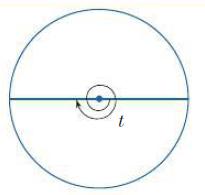
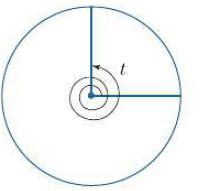
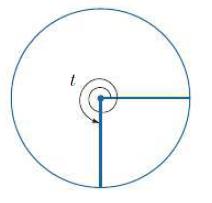
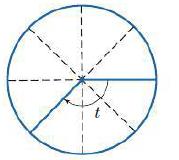
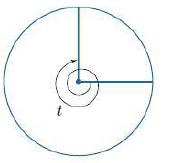
Give the radian measure of each angle described. t
Differentiate (with respect to t or x):f (t) = csc t
Differentiate (with respect to t or x):y = sin√x - 1
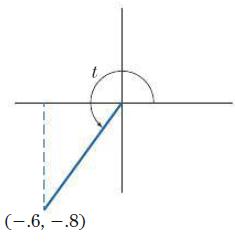
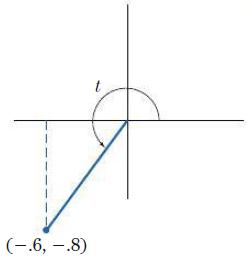
In Exercises, give the values of sin t and cos t, where t is the radian measure of the angle shown. (-.6, -.8)
Find the four values of t between -2π and 2π at which sin t = cos t.
Construct angles with the following radian measure.3π/2, 3π/4, 5π
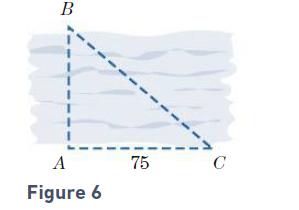
Find the width of a river at points A and B if the angle BAC is 90°, the angle ACB is 40°, and the distance from A to C is 75 feet. See Fig. 6. B A Figure 6 75 C
Give the radian measure of each angle described. 1 1
Differentiate (with respect to t or x):f (t) = sec t
The angle of elevation from an observer to the top of a church is .3 radian, while the angle of elevation from the observer to the top of the church spire is .4 radian. If the observer is 70 meters from the church, how tall is the spire on top of the church?
Differentiate (with respect to t or x):y = sin3 t2
If cos t = - 2/3, what are the possible values for sin t?
In Exercises, give the values of tan t and sec t, where t is the radian measure of the angle shown. (.8,-.6)
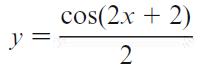
Differentiate (with respect to t or x): y = cos(2x + 2) 2
Differentiate (with respect to t or x):y = cos3 t
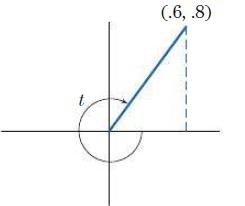
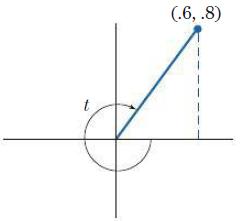
In Exercises, give the values of sin t and cos t, where t is the radian measure of the angle shown. (.6, .8)
Give the radian measure of each angle described.
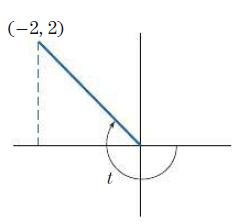
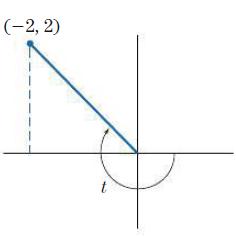
In Exercises, give the values of sin t and cos t, where t is the radian measure of the angle shown. (-2, 2)
In Exercises, give the values of tan t and sec t, where t is the radian measure of the angle shown. (-.6, -.8)
In Exercises, the point with the given coordinates determines an angle of t radians, where 0 ≤ t ≤ 2π. Find sin t, cos t, and tan t.(3, -4)
Give the radian measure of each angle described. t
In Exercises, give the values of tan t and sec t, where t is the radian measure of the angle shown. (.6,.8)
What are the derivatives of sin g(t), cos g(t), and tan g(t)?
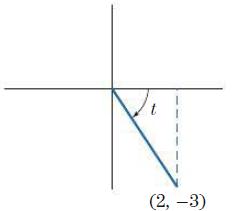
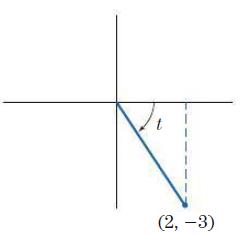
In Exercises, give the values of sin t and cos t, where t is the radian measure of the angle shown. (2, -3)
Differentiate (with respect to t or x):y = sin(p - t)
In Exercises, the point with the given coordinates determines an angle of t radians, where 0 ≤ t ≤ 2π. Find sin t, cos t, and tan t.(-.6, -.8)
State an identity involving tan t and sec t.
Give the radian measure of each angle described. t
In Exercises, give the values of tan t and sec t, where t is the radian measure of the angle shown. (-2, 2) t
Differentiate (with respect to t or x):y = t cos t
In Exercises, the point with the given coordinates determines an angle of t radians, where 0 ≤ t ≤ 2π. Find sin t, cos t, and tan t.(-.6, .8)
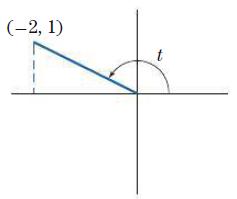
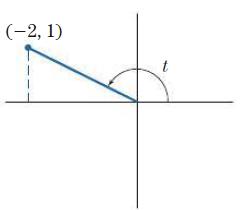
In Exercises, give the values of sin t and cos t, where t is the radian measure of the angle shown. (-2, 1) t
Give the radian measure of each angle described. t
Define cot t, sec t, and csc t for an angle of measure t.
Differentiate (with respect to t or x):y = t + cos pt
In Exercises, the point with the given coordinates determines an angle of t radians, where 0 ≤ t ≤ 2π. Find sin t, cos t, and tan t.(3, 4)
State as many identities involving the sine and cosine functions as you can recall.
In Exercises, give the values of tan t and sec t, where t is the radian measure of the angle shown. (2, -3)
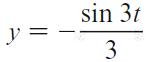
Differentiate (with respect to t or x): y = sin 3t 3
The annual world rate of water use t years after 1960, for t ≤ 35, was approximately 860e0.04t cubic kilometers per year. How much water was used between 1960 and 1995?
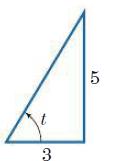
In Exercises, give the values of sin t and cos t, where t is the radian measure of the angle shown. 3 5
In Exercises, give the values of tan t and sec t, where t is the radian measure of the angle shown. (-2, 1) t
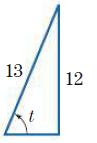
In Exercises, give the values of sin t and cos t, where t is the radian measure of the angle shown. 13 12
Construct angles with the following radian measure.-9π/2
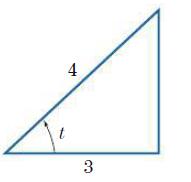
In Exercises, give the values of tan t and sec t, where t is the radian measure of the angle shown. t 4 3
Give the radian measure of each angle described.
Give verbal descriptions of the graphs of sin t and cos t.
Differentiate (with respect to t or x):y = 2 cos 3t
Construct angles with the following radian measure.5π/4
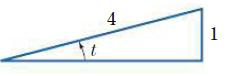
In Exercises, give the values of sin t and cos t, where t is the radian measure of the angle shown. t 4 1
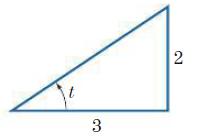
In Exercises, give the values of sin t and cos t, where t is the radian measure of the angle shown. 3 2
Give the radian measure of each angle described.
What does it mean when we say that the sine and cosine functions are periodic with period 2π?
In Exercises, give the values of tan t and sec t, where t is the radian measure of the angle shown. 13 5
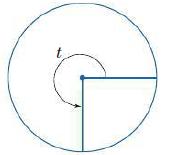
Determine the radian measure of the angles shown in Exercises. t
Differentiate (with respect to t or x):y = cos(- 4t)
Construct angles with the following radian measure.-π
Determine the radian measure of the angles shown in Exercises.
Convert the following to radian measure.990°, - 270°, - 540°
Define sin t, cos t, and tan t for an angle of measure t for any t.
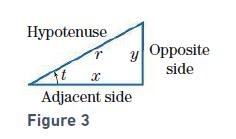
If 0 < t < π/2, use Fig. 3 to describe sec t as a ratio of the lengths of the sides of a right triangle. Hypotenuse r x Figure 3 y Opposite side t Adjacent side
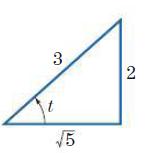
In Exercises, give the values of sin t and cos t, where t is the radian measure of the angle shown. 3 t √5 2
Convert the following to radian measure.450°, -210°, -90°
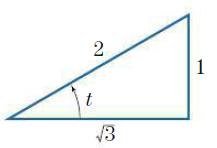
In Exercises, give the values of sin t and cos t, where t is the radian measure of the angle shown. 2 t √√3 1
Give the triangle interpretation of sin t, cos t, and tan t for t between 0 and π/2.
Describe cot t for 0 < t < π/2 as a ratio of the lengths of the sides of a right triangle.
Differentiate (with respect to t or x):y = 2 cos 2t
A company manufactures and sells two competing products, I and II, that cost $pI and $p II per unit, respectively, to produce. Let R(x, y) be the revenue from marketing x units of product I and y units of product II. Show that if the company’s profit is maximized when x = a, y = b, then ƏR - (a,
Determine the radian measure of the angles shown in Exercises. t
A company manufactures and sells two products, I and II, that sell for $p1 and $p2 per unit, respectively. Let C(x, y) be the cost of producing x units of product I and y units of product II. Show that if the company’s profit is maximized when x = a, y = b, then ac ax - (a, b) = p and ac ду -
Convert the following to radian measure.18°, 72°, 150°
Give the formula for converting degree measure to radian measure.
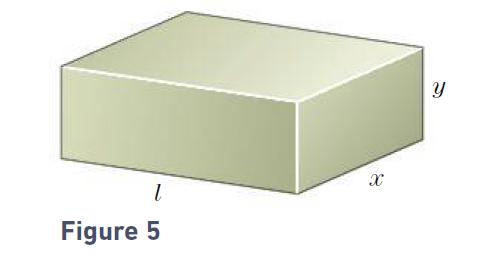
U.S. postal rules require that the length plus the girth of a package cannot exceed 84 inches. Find the dimensions of the rectangular package of greatest volume that can be mailed. 1 Figure 5 X Y
Differentiate (with respect to t or x):y = sin 4t
Convert the following to radian measure.30°, 120°, 315°
Explain the radian measure of an angle.
A monopolist manufactures and sells two competing products, I and II, that cost $30 and $20 per unit, respectively, to produce. The revenue from marketing x units of product I and y units of product II is 98x + 112y - .04xy - .1x2 - .2y2. Find the values of x and y that maximize the monopolist’s
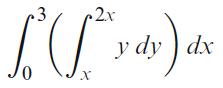
Calculate the following iterated integrals. 3 L •2x y dy dx
A company manufactures and sells two products, I and II, that sell for $10 and $9 per unit, respectively. The cost of producing x units of product I and y units of product II is 400 + 2x + 3y + .01(3x2 + xy + 3y2). Find the values of x and y that maximize the company’s profits. Profit = (revenue)
Find the dimensions of the rectangular box of least surface area that has a volume of 1000 cubic inches.
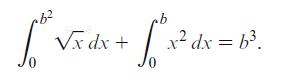
Show that for any positive number b we have [*²*√x dx + √* 3² dx = 1²₁ b³. 0
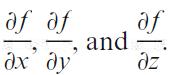
Let f (x, y, z) = (1 + x2y)/z. Find af af dx dy and af dz
Find the possible values of x, y, z at which f (x, y, z) = 5 + 8x - 4y + x2 + y2 + z2 assumes its minimum value.
Find the possible values of x, y, z at which f (x, y, z) = 2x2 + 3y2 + z2 - 2x - y - z assumes its minimum value.
Find all points (x, y) where f (x, y) has a possible relative maximum or minimum. Then, use the second-derivative test to determine, if possible, the nature of f (x, y) at each of these points. If the second-derivative test is inconclusive, so state.f (x, y) = x2 + 4xy + 2y4
Find all points (x, y) where f (x, y) has a possible relative maximum or minimum. Then, use the second-derivative test to determine, if possible, the nature of f (x, y) at each of these points. If the second-derivative test is inconclusive, so state.f (x, y) = 2x2 + y3 - x - 12y + 7
Showing 3500 - 3600
of 5529
First
29
30
31
32
33
34
35
36
37
38
39
40
41
42
43
Last
Step by Step Answers

 Get 50% OFF
Claim Now
Get 50% OFF
Claim Now