New Semester
Started
Get
50% OFF
Study Help!
--h --m --s
Claim Now
Question Answers
Textbooks
Find textbooks, questions and answers
Oops, something went wrong!
Change your search query and then try again
S
Books
FREE
Study Help
Expert Questions
Accounting
General Management
Mathematics
Finance
Organizational Behaviour
Law
Physics
Operating System
Management Leadership
Sociology
Programming
Marketing
Database
Computer Network
Economics
Textbooks Solutions
Accounting
Managerial Accounting
Management Leadership
Cost Accounting
Statistics
Business Law
Corporate Finance
Finance
Economics
Auditing
Tutors
Online Tutors
Find a Tutor
Hire a Tutor
Become a Tutor
AI Tutor
AI Study Planner
NEW
Sell Books
Search
Search
Sign In
Register
study help
mathematics
applied calculus
Calculus And Its Applications 14th Edition Larry Goldstein, David Lay, David Schneider, Nakhle Asmar - Solutions
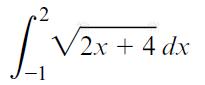
Calculate the following integrals. 2 -1 V2x + 4 dx
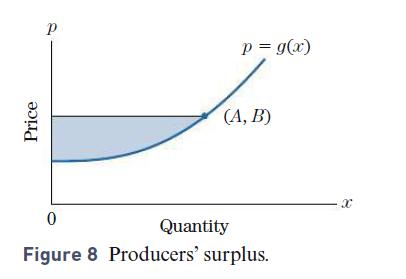
Figure 8 shows a supply curve for a commodity. It gives the relationship between the selling price of the commodity and the quantity that producers will manufacture. At a higher selling price, a greater quantity will be produced. Therefore, the curve is increasing. If (A, B) is a point on the
Figure 8 shows a supply curve for a commodity. It gives the relationship between the selling price of the commodity and the quantity that producers will manufacture. At a higher selling price, a greater quantity will be produced. Therefore, the curve is increasing. If (A, B) is a point
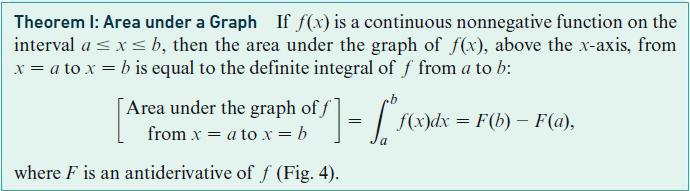
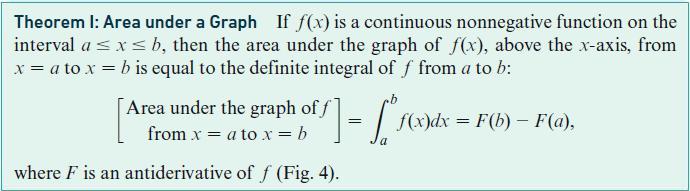
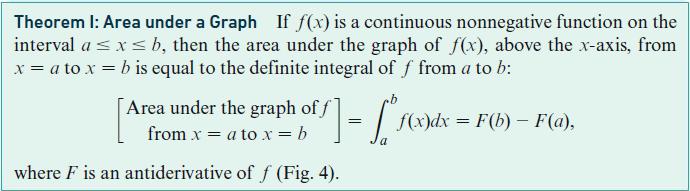
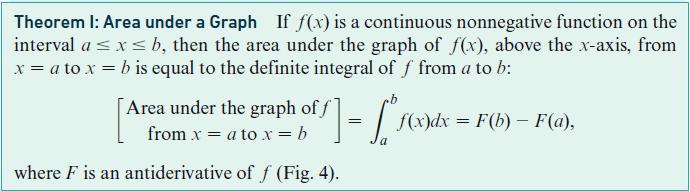
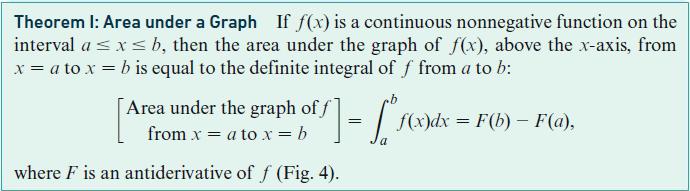
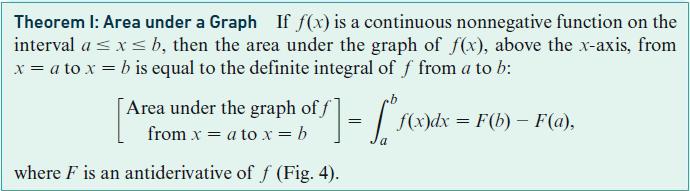
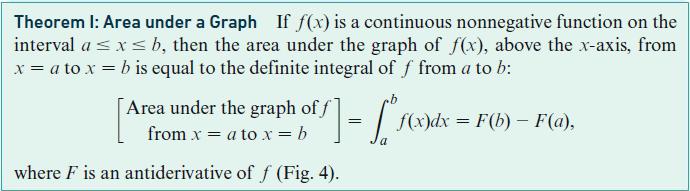
Use Theorem I to compute the shaded area in Exercise 11. Theorem I: Area under a Graph If f(x) is a continuous nonnegative function on the interval a ≤ x ≤ b, then the area under the graph of f(x), above the x-axis, from x = a to x = b is equal to the definite integral of f from a to
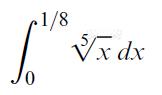
Calculate the following integrals. 1/8 S √x dx 0
Use Theorem I to compute the shaded area in Exercise 8. Theorem I: Area under a Graph If f(x) is a continuous nonnegative function on the interval a ≤ x ≤ b, then the area under the graph of f(x), above the x-axis, from x = a to x = b is equal to the definite integral of f from a to
Use Theorem I to compute the shaded area in Exercise 7. Theorem I: Area under a Graph If f(x) is a continuous nonnegative function on the interval a ≤ x ≤ b, then the area under the graph of f(x), above the x-axis, from x = a to x = b is equal to the definite integral of f from a to
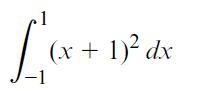
Calculate the following integrals. 1 La -1 (x + 1)² dx
Find the consumers’ surplus for each of the following demand curves at the given sales level, x. p=√16.02x; x = 350 P
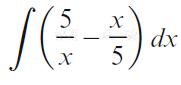
Calculate the following integrals. / ( ² - -/-). 5 dx
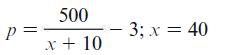
Find the consumers’ surplus for each of the following demand curves at the given sales level, x. P = Р 500 x + 10 3; x = 40
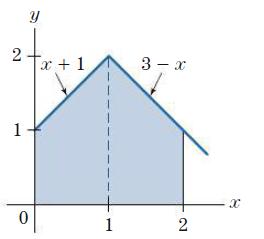
Set-up the definite integral that gives the area of the shaded region. Do not evaluate the integral. 2 1 0 Y x + 1 T 1 1 3-x 2
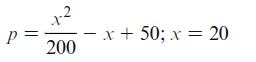
Find the consumers’ surplus for each of the following demand curves at the given sales level, x. p= +-2 200 x + 50; x = 20
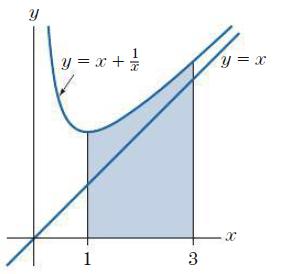
Set-up the definite integral that gives the area of the shaded region. Do not evaluate the integral. y y = x + // 1 3 y = x - X
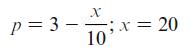
Find the consumers’ surplus for each of the following demand curves at the given sales level, x. P = 3- Р ; x = 20 10x=
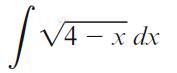
Calculate the following integrals. [V4-xdx
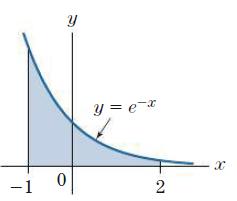
Find the area of the region between the curve and the x-axis.f (x) = e-x + 2 from -1 to 2
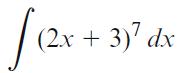
Calculate the following integrals. Je (2x + 3)7 dx
Set-up the definite integral that gives the area of the shaded region. Do not evaluate the integral. -1 y 0 y = ex 2 - X
Find the area of the region between the curve and the x-axis.f (x) = ex - 3 from 0 to ln 3
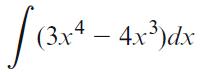
Calculate the following integrals. [(3x4 - 4x³3)dx
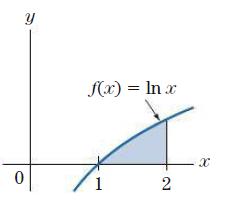
Set-up the definite integral that gives the area of the shaded region. Do not evaluate the integral. y 0 f(x) = ln x 1 2
Outline a procedure for finding the area of a region bounded by two curves.
One hundred dollars is deposited in the bank at 5% interest compounded continuously. What will be the average value of the money in the account during the next 20 years?
Find the area of the region between the curve and the x-axis.f (x) = x2 + 6x + 5 from 0 to 1.
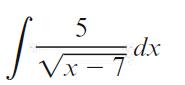
Calculate the following integrals. 5 Vx-7 dx
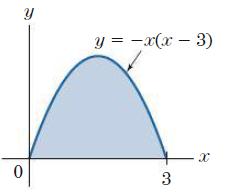
Set-up the definite integral that gives the area of the shaded region. Do not evaluate the integral. 0 " y = =xx = 3) 3 - C
How is F (x) |ba calculated, and what is it called?
One hundred grams of radioactive radium having a half-life of 1690 years is placed in a concrete vault. What will be the average amount of radium in the vault during the next 1000 years?
Find the area of the region between the curve and the x-axis.f (x) = x2 - 2x - 3, from 0 to 2.
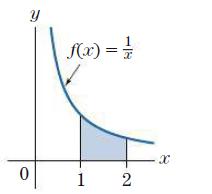
Set-up the definite integral that gives the area of the shaded region. Do not evaluate the integral. y 0 f(x) = // -18 1 2 X
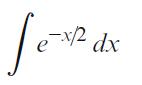
Calculate the following integrals. e -x/2² dx
Assuming that a country’s population is now 3 million and is growing exponentially with growth constant .02, what will be the average population during the next 50 years?
Find the area of the region between the curve and the x-axis.f (x) = x(x2 - 1), from -1 to 1.
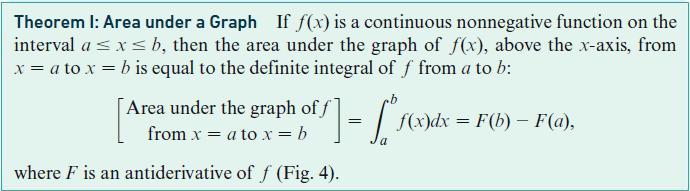
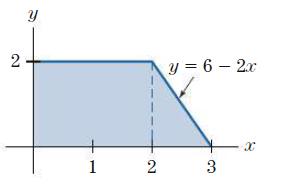
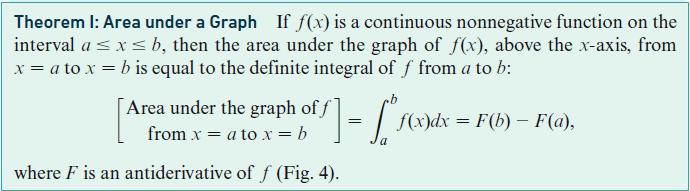
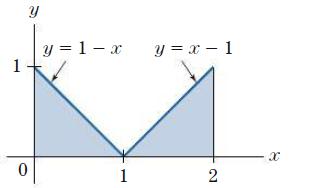
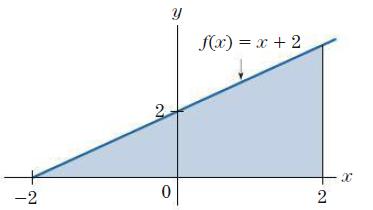
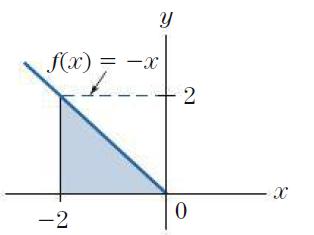
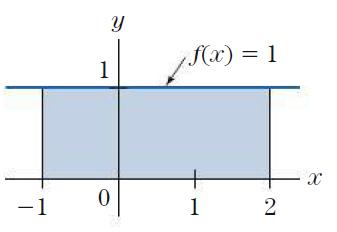
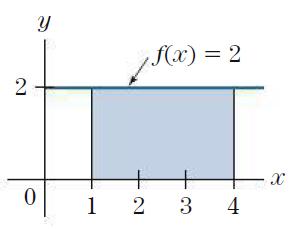
Compute the area of the shaded region in two different ways: (a) By using simple geometric formulas; (b) By applying Theorem I. Theorem I: Area under a Graph If f(x) is a continuous nonnegative function on the interval a ≤ x ≤ b, then the area under the graph of f(x), above the
What is the difference between a definite integral and an indefinite integral?
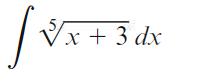
Calculate the following integrals. S x + 3 dx
During a certain 12-hour period, the temperature at time t (measured in hours from the start of the period) was T(t) = 47 + 4t - 1/3t2 degrees. What was the average temperature during that period?
Compute the area of the shaded region in two different ways: (a) By using simple geometric formulas; (b) By applying Theorem I. Theorem I: Area under a Graph If f(x) is a continuous nonnegative function on the interval a ≤ x ≤ b, then the area under the graph of f(x), above the
Find the area of the region between the curve and the x-axis.f (x) = 1 - x2, from -2 to 2
Determine the average value of f (x) over the interval from x = a to x = b, where f(x)=¹; a = 1, b = 9. Vx
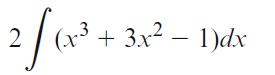
Calculate the following integrals. 2 f (x-³ 2 (x³ + 3x² - 1)dx
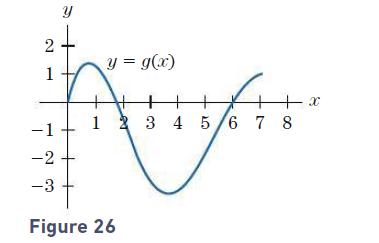
Let g(x) be the function pictured in Fig. 26. Determine whether ∫07 g(x)dx is positive, negative, or zero. 2 1 -1 -2 -3 Y y = g(x) HH + 1 2 3 4 5 6 7 8 Figure 26 foto. + +x
What is a definite integral?
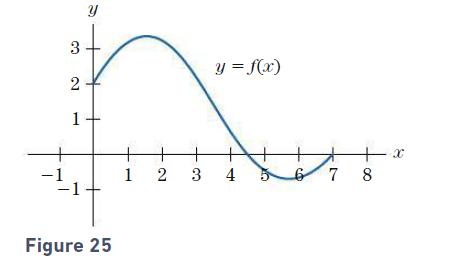
Let f (x) be the function pictured in Fig. 25. Determine whether ∫07 f (x)dx is positive, negative, or zero. - 3 2 1 y Figure 25 y = f(x) + 1 2 3 4 +x 7 8
Find all antiderivatives of each following function:f(x) = -4x
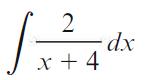
Calculate the following integrals. Л 2 х+4 dx
Compute the area of the shaded region in two different ways: (a) By using simple geometric formulas; (b) By applying Theorem I. Theorem I: Area under a Graph If f(x) is a continuous nonnegative function on the interval a ≤ x ≤ b, then the area under the graph of f(x), above the
Give an interpretation of the area under a rate of change function. Give a concrete example.
Shade the portion of Fig. 24 whose area is given by the integral Luo 2 y = f(x) y = g(x) y 0 - [f(x) = g(x)] + Figure 24 1 Lis [g(x) -f(x)]dx. 2 X
Determine the average value of f (x) over the interval from x = a to x = b, wheref (x) = 1/x; a = 1/3, b = 3.
Find all antiderivatives of each following function:f (x) = 3
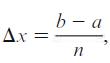
In the formulawhat do a, b, n, and Δx denote? Δι = b-a n
Compute the area of the shaded region in two different ways: (a) By using simple geometric formulas; (b) By applying Theorem I. Theorem I: Area under a Graph If f(x) is a continuous nonnegative function on the interval a ≤ x ≤ b, then the area under the graph of f(x), above the
What is a Riemann sum?
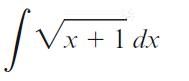
Calculate the following integrals. / √x + 1 dx
Determine the average value of f (x) over the interval from x = a to x = b, wheref(x) = 2; a = 0, b = 1.
Compute the area of the shaded region in two different ways: (a) By using simple geometric formulas; (b) By applying Theorem I. Theorem I: Area under a Graph If f(x) is a continuous nonnegative function on the interval a ≤ x ≤ b, then the area under the graph of f(x), above the
Find all antiderivatives of each following function:f(x) = e-3x
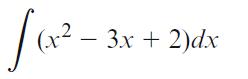
Calculate the following integrals. f (x2 3x + 2)dx
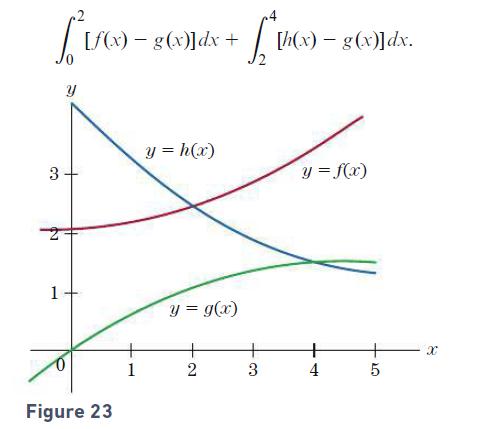
Shade the portion of Fig. 23 whose area is given by the integral fªvo 3 1 Y [f(x) = g(x)]dx + - Figure 23 1 y = h(x) y = g(x) Luco- + + 2 3 [h(x) = g(x)]dx. y = f(x) 4 + 5 X
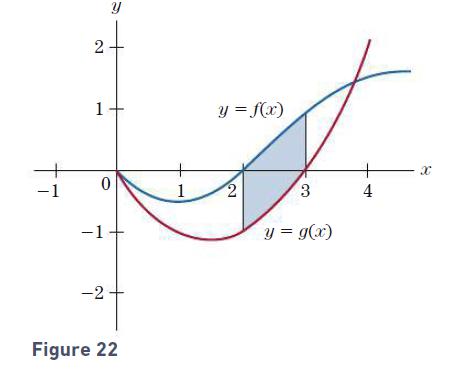
Write a definite integral or sum of definite integrals that gives the area of the shaded portions in Fig. 22. -1 2 1 0 -1 Y -2 Figure 22 1 y=f(x) 2 3 y = g(x) 4 20
Determine the average value of f (x) over the interval from x = a to x = b, wheref(x) = 100e-0.5x; a = 0, b = 4.
Find all antiderivatives of each following function:f(x) = e3x
Compute the area of the shaded region in two different ways: (a) By using simple geometric formulas; (b) By applying Theorem I. Theorem I: Area under a Graph If f(x) is a continuous nonnegative function on the interval a ≤ x ≤ b, then the area under the graph of f(x), above the
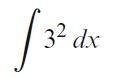
Calculate the following integrals. √3² 3² dx
State the formula for ∫h(x)dx for each of the following functions.(a) h(x)xr, r ≠ -1(b) h(x) = ekx(c) h(x) = 1/x(d) h(x) = f (x) + g(x)(e) h(x) = kf (x)
Determine the average value of f (x) over the interval from x = a to x = b, wheref (x) = 1 - x; a = -1, b = 1.
What does it mean to antidifferentiate a function?
Determine the average value of f (x) over the interval from x = a to x = b, wheref(x) = x2; a = 0, b = 3.
Find all antiderivatives of each following function:f(x) = x
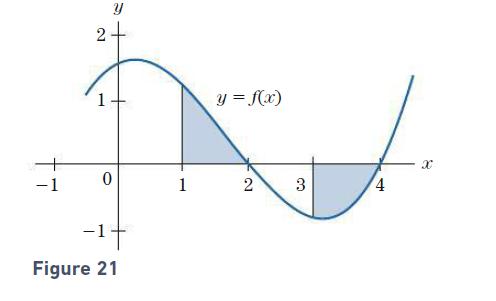
Write a definite integral or sum of definite integrals that gives the area of the shaded portions in Fig. 21. 2 0 y -1 Figure 21 1 y = f(x) 2 3 4 X
Suppose that the function P(t) satisfies the differential equation(a) Find an equation of the tangent line to the graph of y = P(t) at t = 0.(b) Find P(t).(c) What is the time constant of the decay curve y = P(t)? y'(t)=-.5y(t), y(0)= 10.
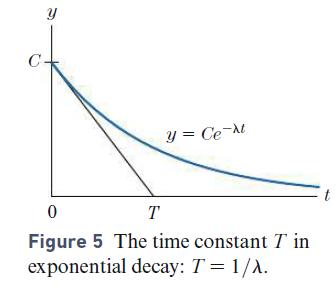
Let T be the time constant of the curve y = Ce-lt as defined in Fig. 5. Show that T = 1/λ. y y = Ce-xt 0 T Figure 5 The time constant T in exponential decay: T = 1/A. t
Consider the exponential decay function y = P0e-λt, with time constant T. We define the time to finish to be the time it takes for the function to decay to about 1% of its initial value P0. Show that the time to finish is about four times the time constant T.
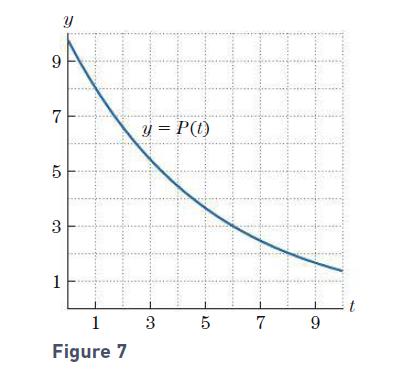
A sample of radioactive material decays over time (measured in hours) with decay constant .2. The graph of the exponential function y = P(t) in Fig. 7 gives the number of grams remaining after t hours.(a) How much was remaining after 1 hour?(b) Approximate the half-life of the material.(c) How fast
Consider an exponential decay function P(t) = P0e-λt, and let T denote its time constant. Show that, at t = T, the function P(t) decays to about onethird of its initial size. Conclude that the time constant is always larger than the half-life.
Many scientists believe there have been four ice ages in the past 1 million years. Before the technique of carbon dating was known, geologists erroneously believed that the retreat of the Fourth Ice Age began about 25,000 years ago. In 1950, logs from ancient spruce trees were found under glacial
In 1938, sandals woven from strands of tree bark were found in Fort Rock Creek Cave in Oregon. The bark contained 34% of the level of 14C found in living bark. Approximately how old were the sandals?
A 4500-year-old wooden chest was found in the tomb of the twenty-fifth century b.c. Chaldean king Meskalumdug of Ur. What percentage of the original 14C would you expect to find in the wooden chest?
According to legend, in the fifth century King Arthur and his knights sat at a huge round table. A round table alleged to have belonged to King Arthur was found at Winchester Castle in England. In 1976, carbon dating revealed the amount of radiocarbon in the table to be 91% of the radiocarbon
In 1947, a cave with beautiful prehistoric wall paintings was discovered in Lascaux, France. Some charcoal found in the cave contained 20% of the 14C expected in living trees. How old are the Lascaux cave paintings?
A sample of radioactive material has decay constant .25, where time is measured in hours. How fast will the sample be disintegrating when the sample size is 8 grams? For what sample size will the sample size be decreasing at the rate of 2 grams per day?
Forty grams of a certain radioactive material disintegrates to 16 grams in 220 years. How much of this material is left after 300 years?
In an animal hospital, 8 units of a sulfate were injected into a dog. After 50 minutes, only 4 units remained in the dog. Let f (t) be the amount of sulfate present after t minutes. At any time, the rate of change of f (t) is proportional to the value of f (t). Find the formula for f (t).
Ten grams of a radioactive material disintegrates to 3 grams in 5 years. What is the half-life of the radioactive material?
If dairy cows eat hay containing too much iodine 131, their milk will be unfit to drink. Iodine 131 has half-life of 8 days. If the hay contains 10 times the maximum allowable level of iodine 131, how many days should the hay be stored before it is fed to dairy cows?
Radioactive cobalt 60 has a half-life of 5.3 years. Find its decay constant.
The decay constant for the radioactive element cesium 137 is .023 when time is measured in years. Find its half-life.
Ten grams of a radioactive substance with decay constant .04 is stored in a vault. Assume that time is measured in days, and let P(t) be the amount remaining at time t.(a) Give the formula for P(t)(b) Give the differential equation satisfied by P(t).(c) How much will remain after 5 days?(d) What is
A person is given an injection of 300 milligrams of penicillin at time t = 0. Let f (t) be the amount (in milligrams) of penicillin present in the person’s bloodstream t hours after the injection. Then, the amount of penicillin decays exponentially, and a typical formula is f (t) = 300e-0.6t.(a)
The population (in millions) of a state t years after 2010 is given by the graph of the exponential function y = P(t) with growth constant .025 in Fig. 6. [In parts (c) and (d) use the differential equation satisfied by P(t).](a) What is the population in 2020?(b) When is the population 10
Radium 226 is used in cancer radiotherapy. Let P(t) be the number of grams of radium 226 in a sample remaining after t years, and let P(t) satisfy the differential equation P′(t) = -.00043P(t), P(0) = 12.(a) Find the formula for P(t).(b) What was the initial amount?(c) What is the decay
A sample of 8 grams of radioactive material is placed in a vault. Let P(t) be the amount remaining after t years, and let P(t) satisfy the differential equation P′(t) = -.021P(t).(a) Find the formula for P(t)(b) What is P(0)?(c) What is the decay constant?(d) How much of the material will remain
At the beginning of 1990, 20.2 million people lived in the metropolitan area of Mexico City, and the population was growing exponentially. The 1995 population was 23 million. (Part of the growth is due to immigration.) If this trend continues, how large will the population be in the year 2010?
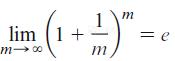
Verify thatby taking m increasingly large and noticing thatapproaches 2.718. lim (1 + m→∞0 m m = e
The world’s population was 5.51 billion on January 1, 1993, and 5.88 billion on January 1, 1998. Assume that, at any time, the population grows at a rate proportional to the population at that time. In what year will the world’s population reach 7 billion?
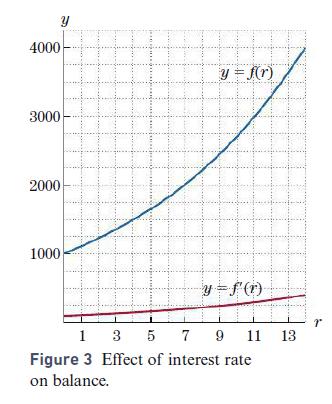
When $1000 is invested at r% interest (compounded continuously) for 10 years, the balance is f (r) dollars, where f is the function shown in Fig. 3.(a) What will the balance be at 7% interest?(b) For what interest rate will the balance be $3000?(c) If the interest rate is 9%, what is the growth
An investment of $2000 yields payments of $1200 in 3 years, $800 in 4 years, and $500 in 5 years. Thereafter, the investment is worthless. What constant rate of return r would the investment need to produce to yield the payments specified? The number r is called the internal rate of return on the
The rate of growth of a certain cell culture is proportional to its size. In 10 hours a population of 1 million cells grew to 9 million. How large will the cell culture be after 15 hours?
Showing 4000 - 4100
of 5529
First
34
35
36
37
38
39
40
41
42
43
44
45
46
47
48
Last
Step by Step Answers

 Get 50% OFF
Claim Now
Get 50% OFF
Claim Now