New Semester
Started
Get
50% OFF
Study Help!
--h --m --s
Claim Now
Question Answers
Textbooks
Find textbooks, questions and answers
Oops, something went wrong!
Change your search query and then try again
S
Books
FREE
Study Help
Expert Questions
Accounting
General Management
Mathematics
Finance
Organizational Behaviour
Law
Physics
Operating System
Management Leadership
Sociology
Programming
Marketing
Database
Computer Network
Economics
Textbooks Solutions
Accounting
Managerial Accounting
Management Leadership
Cost Accounting
Statistics
Business Law
Corporate Finance
Finance
Economics
Auditing
Tutors
Online Tutors
Find a Tutor
Hire a Tutor
Become a Tutor
AI Tutor
AI Study Planner
NEW
Sell Books
Search
Search
Sign In
Register
study help
mathematics
calculus 10th edition
Calculus 10th Edition Ron Larson, Bruce H. Edwards - Solutions
In Exercises find the area of the region.One petal of r = 3 cos 5θ
In Exercises find the area of the region.One petal of r = 2 sin 6θ
In Exercises find the area of the region.Interior of r = 2 + cos θ
In Exercises find the area of the region.Interior of r = 5(1 - sin θ)
In Exercises find the area of the region.Interior of r² = 4 sin 2θ
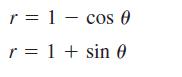
In Exercises find the points of intersection of the graphs of the equations. r = 1 = - cos 0 r = 1 + sin 0
In Exercises find the area of the region.Common interior of r = 4 cos θ and r = 2
In Exercises use a graphing utility to graph the polar equation. Find the area of the given region analytically.Inner loop of r = 3 - 6 cos θ
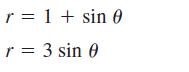
In Exercises find the points of intersection of the graphs of the equations. r = 1 + sin 0 r = 3 sin 0
In Exercises use a graphing utility to graph the polar equation. Find the area of the given region analytically.Inner loop of r = 2 + 4 sin θ
In Exercises use a graphing utility to graph the polar equation. Find the area of the given region analytically.Between the loops of r = 3 - 6 cos θ
In Exercises use a graphing utility to graph the polar equation. Find the area of the given region analytically.Between the loops of r = 2 + 4 sin θ
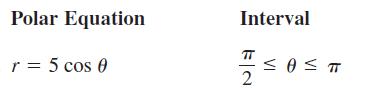
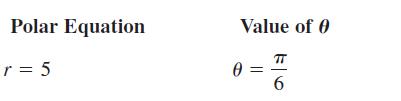
In Exercises find the length of the curve over the given interval. Polar Equation r = 5 cos 0 Interval = 0 Σπ 7/7 ≤0= 2
In Exercises find the length of the curve over the given interval. Polar Equation r = 3(1 - cos 0) Interval 0 ≤ 0 ≤ T
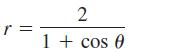
In Exercises find the eccentricity and the distance from the pole to the directrix of the conic. Then sketch and identify the graph. Use a graphing utility to confirm your results. 2 1 + cos 0
In Exercises write an integral that represents the area of the surface formed by revolving the curve about the given line. Use the integration capabilities of a graphing utility to approximate the integral accurate to two decimal places. Polar Equation r = 1 + 4 cos 0 Interval 0 < 0 < TT 2 Axis of
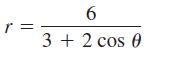
In Exercises find the eccentricity and the distance from the pole to the directrix of the conic. Then sketch and identify the graph. Use a graphing utility to confirm your results. r = 6 3 + 2 cos 0
In Exercises write an integral that represents the area of the surface formed by revolving the curve about the given line. Use the integration capabilities of a graphing utility to approximate the integral accurate to two decimal places. Polar Equation r = 2 sin 0 Interval 0 ≤ 0≤ 2 Axis of
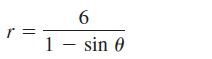
In Exercises find the eccentricity and the distance from the pole to the directrix of the conic. Then sketch and identify the graph. Use a graphing utility to confirm your results. r 6 1 - sin 0
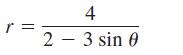
In Exercises find the eccentricity and the distance from the pole to the directrix of the conic. Then sketch and identify the graph. Use a graphing utility to confirm your results. || 4 2-3 sin 0
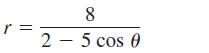
In Exercises find the eccentricity and the distance from the pole to the directrix of the conic. Then sketch and identify the graph. Use a graphing utility to confirm your results. 8 2 - 5 cos 0
In Exercises find a polar equation for the conic with its focus at the pole. (For convenience, the equation for the directrix is given in rectangular form.) Conic Parabola Eccentricity e = 1 Directrix x = 4
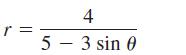
In Exercises find the eccentricity and the distance from the pole to the directrix of the conic. Then sketch and identify the graph. Use a graphing utility to confirm your results. r 4 5 - 3 sin 0
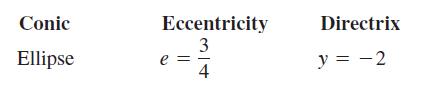
In Exercises find a polar equation for the conic with its focus at the pole. (For convenience, the equation for the directrix is given in rectangular form.) Conic Ellipse Eccentricity 3 4 Directrix y = -2
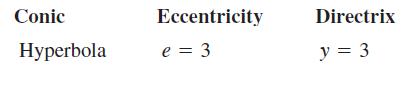
In Exercises find a polar equation for the conic with its focus at the pole. (For convenience, the equation for the directrix is given in rectangular form.) Conic Hyperbola Eccentricity e=3 Directrix y = 3
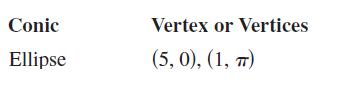
In Exercises find a polar equation for the conic with its focus at the pole. (For convenience, the equation for the directrix is given in rectangular form.) Conic Ellipse Vertex or Vertices (5, 0), (1, TT)
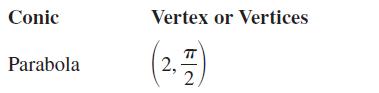
In Exercises find a polar equation for the conic with its focus at the pole. (For convenience, the equation for the directrix is given in rectangular form.) Conic Parabola Vertex or Vertices 2,
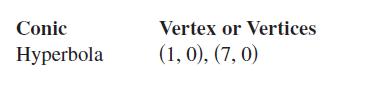
In Exercises find a polar equation for the conic with its focus at the pole. (For convenience, the equation for the directrix is given in rectangular form.) Conic Hyperbola Vertex or Vertices (1, 0), (7,0)
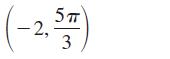
In Exercises plot the point in polar coordinates and find the corresponding rectangular coordinates for the point. -2, 5 п 3
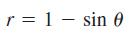
In Exercises find the area of the region.Interior of r = 1 - sin θ
In Exercises find a set of parametric equations for the rectangular equation that satisfies the given condition. y = x², t = 4 at the point (4, 16)
In Exercises convert the polar equation to rectangular form and sketch its graph.r = 4
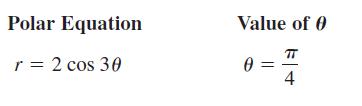
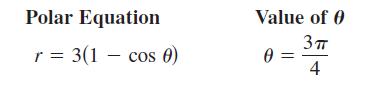
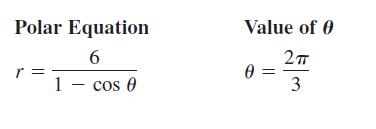
In Exercises use the result of Exercise 104 to find the angle ψ between the radial and tangent lines to the graph for the indicated value of θ. Use a graphing utility to graph the polar equation, the radial line, and the tangent line for the indicated value of θ. Identify the angle ψ.Data from
In Exercises use the result of Exercise 104 to find the angle ψ between the radial and tangent lines to the graph for the indicated value of θ. Use a graphing utility to graph the polar equation, the radial line, and the tangent line for the indicated value of θ. Identify the angle ψ.Data from
In Exercises use the result of Exercise 104 to find the angle ψ between the radial and tangent lines to the graph for the indicated value of θ. Use a graphing utility to graph the polar equation, the radial line, and the tangent line for the indicated value of θ. Identify the angle ψ.Data from
In Exercises use the result of Exercise 104 to find the angle ψ between the radial and tangent lines to the graph for the indicated value of θ. Use a graphing utility to graph the polar equation, the radial line, and the tangent line for the indicated value of θ. Identify the angle ψ.Data from
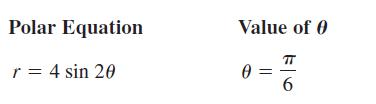
In Exercises determine whether the statement is true or false. If it is false, explain why or give an example that shows it is false.The polar equations r = sin 2θ, r = -sin 2θ, and r = sin (-2θ) all have the same graph.r = sin 20, r = -sin 20, and
In Exercises use the result of Exercise 104 to find the angle ψ between the radial and tangent lines to the graph for the indicated value of θ. Use a graphing utility to graph the polar equation, the radial line, and the tangent line for the indicated value of θ. Identify the angle ψ.Data from
In Exercises determine whether the statement is true or false. If it is false, explain why or give an example that shows it is false.If x > 0, then the point (x, y) on the rectangular coordinate system can be represented by (r, θ) on the polar coordinate system, where r = √x² + y² and θ =
In Exercises determine whether the statement is true or false. If it is false, explain why or give an example that shows it is false.If (r, θ₁) and (r, θ₂) represent the same point on the polar coordinate system, then θ1, = θ₂ +2πn for some integer n.
Sketch the graph of each equation.(a)(b) r = 1 - sin 0
In Exercises determine whether the statement is true or false. If it is false, explain why or give an example that shows it is false.If (r₁, θ₁) and (r₂, θ2) represent the same point on the polarcoordinate system, then |r₁|=|r₂|.
In Exercises use the result of Exercise 104 to find the angle ψ between the radial and tangent lines to the graph for the indicated value of θ. Use a graphing utility to graph the polar equation, the radial line, and the tangent line for the indicated value of θ. Identify the angle ψ.Data from
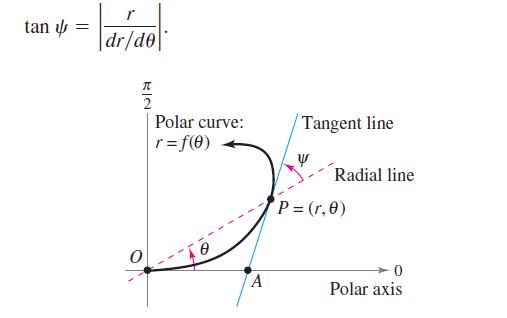
Prove that the tangent of the angle ψ(0 ≤ ψ ≤ π/2) between the radial line and the tangent line at the point (r, θ) on the graph of r = ƒ(θ) (see figure) is given by tan = dr/de R|N 2 Polar curve: r = f(0) A Tangent line Y Radial line P = (r, 0) 0 Polar axis
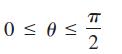
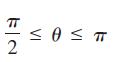
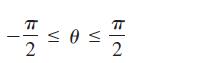
Sketch the graph of r = 4 sin θ over each interval.(a)(b)(c) 0 < 0 < < 2
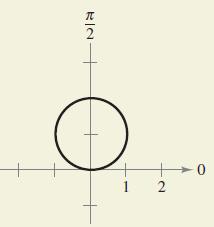
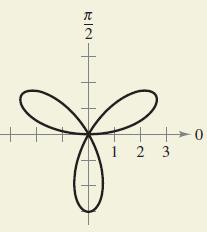
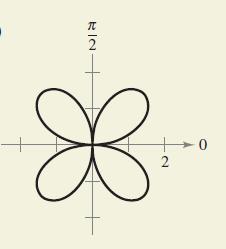
Identify each special polar graph and write its equation.(a)(b)(c)(d) π 元|2 1 1 2 -0
Write an equation for the rose curve r = 2 sin 2θ after it has been rotated by the given amount. Verify the results by using a graphing utility to graph the rotated rose curve for (a) θ = π/6, (b) θ = π/2, (c) θ = 2π/3(d) θ = π.
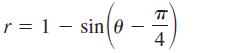
Write an equation for the limaçon r = 2 - sin θ after it hasbeen rotated by the given amount. Use a graphing utility tograph the rotated limaçon for (a) θ = π/4(b) θ = π/2(c) θ = π(d) θ = 3π/2.
In Exercises use a graphing utility to graph the equation and show that the given line is an asymptote of the graph. Name of Graph Hyperbolic spiral Polar Equation r = 2/0 Asymptote y = 2
The polar form of an equation of a curve is r = ƒ(sin θ). Show that the form becomes(a) r = ƒ(-cos θ) if the curve is rotated counterclockwise π/2 radians about the pole.(b) r = ƒ(-sin θ) if the curve is rotated counterclockwise π radians about the pole.(c) r = ƒ(cos θ) if the curve is
In Exercises use a graphing utility to graph the equation and show that the given line is an asymptote of the graph. Name of Graph Conchoid Polar Equation r = 2 - sec 0 Asymptote x = -1
Verify that if the curve whose polar equation is r = ƒ(θ) is rotated about the pole through an angle ∅,then an equation for the rotated curve is r = ƒ(θ - ∅).
Use a graphing utility to graph the polar equation r = 6[1 + cos(θ - ∅)] for (a) ∅ = 0 (b) ∅ = π/4 (c) ∅ = π/2 Use the graphs to describe the effect of the angle ∅. Write the equation as a function of sin θ for part (c).
In Exercises use a graphing utility to graph the equation and show that the given line is an asymptote of the graph. Name of Graph Strophoid Polar Equation r = 2 cos 20 sec 0 Asymptote x = -2
In Exercises use a graphing utility to graph the equation and show that the given line is an asymptote of the graph. Name of Graph Conchoid Polar Equation r = 2 + csc 0 Asymptote y = 1
How are the slopes of tangent lines determined in polar coordinates? What are tangent lines at the pole and how are they determined?
Give the equations for the coordinate conversion from rectangular to polar coordinates and vice versa.
Describe the differences between the rectangular coordinate system and the polar coordinate system.
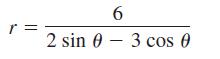
In Exercises sketch a graph of the polar equation. r 6 2 sin 3 cos 0
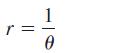
In Exercises sketch a graph of the polar equation. Ө
In Exercises sketch a graph of the polar equation.r² = 4 sin θ
In Exercises sketch a graph of the polar equation.r² = 4 cos 2θ
In Exercises sketch a graph of the polar equation.r = 2θ
In Exercises determine whether the statement is true or false. If it is false, explain why or give an example that shows it is false.Use the formula for the arc length of a curve in parametric form to derive the formula for the arc length of a polar curve.
A curve called the folium of Descartes can be represented by the parametric equations(a) Convert the parametric equations to polar form.(b) Sketch the graph of the polar equation from part (a).(c) Use a graphing utility to approximate the area enclosed by the loop of the curve. X = 3t 1 +
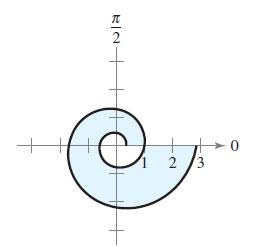
The curve represented by the equation r = aebθ, where a and b are constants, is called a logarithmic spiral. The figure shows the graph of r = eθ/6, -2π ≤ θ ≤ 2π. Find the area of the shaded region. T () 2 3 -0
In Exercises determine whether the statement is true or false. If it is false, explain why or give an example that shows it is false.If ƒ(θ) = g(θ) for θ = 0, π/2, and 3π/2, then the graphs of r = ƒ(θ) and r = g(θ) have at least four points of intersection.
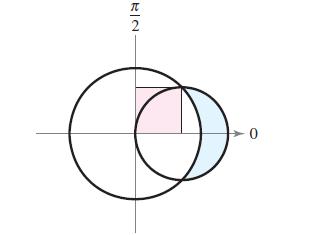
Area The larger circle in the figure is the graph of r = 1. Find the polar equation of the smaller circle such that the shaded regions are equal. RIN 2
In Exercises sketch a graph of the polar equation.r = 3 csc θ
In Exercises determine whether the statement is true or false. If it is false, explain why or give an example that shows it is false.If f(θ) > 0 for all θ and g(θ) < 0 for all θ, then the graphs ofr = f(θ) and r = g(θ) do not intersect.
In Exercises sketch a graph of the polar equation.r = 5 - 4 sin θ
In Exercises sketch a graph of the polar equation.r = 3 - 2 cos θ
Find the area of the circle given byCheck your result by converting the polar equation to rectangular form, then using the formula for the area of a circle. r = sin 0 + cos 0.
In Exercises sketch a graph of the polar equation.r = 1 + sin θ
In Exercises sketch a graph of the polar equation.r = 4(1 + cos θ)
The curve represented by the equation r = aθ, where a is a constant, is called the spiral of Archimedes.(a) Use a graphing utility to graph r = θ, where θ ≥ 0. What happens to the graph of r = aθ as a increases? What happens if θ ≤ 0? (b) Determine the points on the spiral r = aθ (a
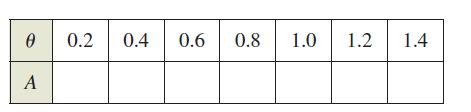
Consider the circle r = 3 sin θ.(a) Find the area of the circle.(b) Complete the table giving the areas A of the sectors of the circle between θ = 0 and the values of θ in the table.(c) Use the table in part (b) to approximate the values of θ for which the sector of the circle composes, 1/8,
In Exercises sketch a graph of the polar equation.r = 1
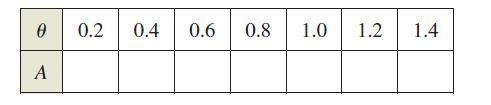
Consider the circle r = 8 cos θ. (a) Find the area of the circle. (b) Complete the table giving the areas A of the sectors of the circle between θ = 0 and the values of θ in the table.(c) Use the table in part (b) to approximate the values of θ for which the sector of the circle
In Exercises sketch a graph of the polar equation.r = 8
What conic section does the polar equation r = a sin θ + b cos θ represent?
Which graph, traced out only once, has a larger arc length? Explain your reasoning.(a)(b) Na + -0
In Exercises sketch a graph of the polar equation and find the tangents at the pole.r = 3 cos 2θ
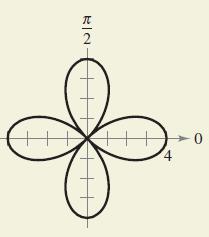
In Exercises sketch a graph of the polar equation and find the tangents at the pole.r = 3 sin 2θ
Find the surface area of the torus generated by revolving the circle given by r = a about the line r = b sec θ, where 0 < a < b.
In Exercises sketch a graph of the polar equation and find the tangents at the pole.r = -sin 5θ
Find the surface area of the torus generated by revolving the circle given by r = 2 about the line r = 5 sec θ.
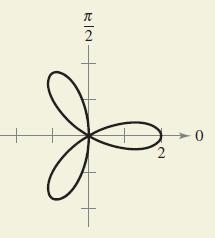
In Exercises sketch a graph of the polar equation and find the tangents at the pole.r = 4 cos 3θ
In Exercises sketch a graph of the polar equation and find the tangents at the pole.r = 3(1 - cos θ)
For each polar equation, sketch its graph, determine the interval that traces the graph only once, and find the area of the region bounded by the graph using a geometric formula and integration.(a) r = 10 cos θ(b) r = 5 sin θ
In Exercises use the integration capabilities of a graphing utility to approximate, to two decimal places, the area of the surface formed by revolving the curve about the polar axis. r = 4 cos 20,0 ≤ 0 ≤ 4
In Exercises sketch a graph of the polar equation and find the tangents at the pole.r = 2(1 - sin θ)
In Exercises find the area of the surface formed by revolving the curve about the given line. Polar Equation r = a(1 + cos 0) Interval 0 ≤ 0 ≤ T Axis of Revolution Polar axis
Give the integral formulas for the area of the surface of revolution formed when the graph of r = ƒ(θ) is revolved about(a) The polar axis.(b) The line θ = π/2.
In Exercises sketch a graph of the polar equation and find the tangents at the pole.r = 5 cos θ
Explain why finding points of intersection of polar graphs may require further analysis beyond solving two equations simultaneously.
In Exercises sketch a graph of the polar equation and find the tangents at the pole.r = 5 sin θ
In Exercises use the integration capabilities of a graphing utility to approximate, to two decimal places, the area of the surface formed by revolving the curve about the polar axis.r = θ, 0 ≤ θ ≤ π
In Exercises find the area of the surface formed by revolving the curve about the given line. Polar Equation r = eae Interval 0 ≤ 0 ≤ TT Axis of Revolution 0 = TT 2
In Exercises find the points of horizontal tangency (if any) to the polar curve.r = a sin θ cos²θ
Showing 3500 - 3600
of 9867
First
29
30
31
32
33
34
35
36
37
38
39
40
41
42
43
Last
Step by Step Answers

 Get 50% OFF
Claim Now
Get 50% OFF
Claim Now