New Semester
Started
Get
50% OFF
Study Help!
--h --m --s
Claim Now
Question Answers
Textbooks
Find textbooks, questions and answers
Oops, something went wrong!
Change your search query and then try again
S
Books
FREE
Study Help
Expert Questions
Accounting
General Management
Mathematics
Finance
Organizational Behaviour
Law
Physics
Operating System
Management Leadership
Sociology
Programming
Marketing
Database
Computer Network
Economics
Textbooks Solutions
Accounting
Managerial Accounting
Management Leadership
Cost Accounting
Statistics
Business Law
Corporate Finance
Finance
Economics
Auditing
Tutors
Online Tutors
Find a Tutor
Hire a Tutor
Become a Tutor
AI Tutor
AI Study Planner
NEW
Sell Books
Search
Search
Sign In
Register
study help
mathematics
calculus 10th edition
Calculus 10th Edition Ron Larson, Bruce H. Edwards - Solutions
In Exercises sketch the curve represented by the parametric equations (indicate the orientation of the curve), and write the corresponding rectangular equation by eliminating the parameter.x = |t - 1|, y = t + 2
In Exercises find the area of the region.Interior of r = 1 - sin θ (above the polar axis)
In Exercises the rectangular coordinates of a point are given. Plot the point and find two sets of polar coordinates for the point for 0 ≤ 0 < 2π.(0, -6)
In Exercises sketch the curve represented by the parametric equations (indicate the orientation of the curve), and write the corresponding rectangular equation by eliminating the parameter.x = 2t, y = |t - 2|
In Exercises the rectangular coordinates of a point are given. Plot the point and find two sets of polar coordinates for the point for 0 ≤ 0 < 2π.(2, 2)
In Exercises find the area of the region.One petal of r = cos 5θ
In Exercises plot the point in polar coordinates and find the corresponding rectangular coordinates for the point.(9.25, 1.2)
In Exercises plot the point in polar coordinates and find the corresponding rectangular coordinates for the point.(-4.5, 3.5)
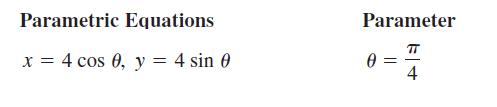
In Exercises find dy/dx and d²y/dx2, and find the slope and concavity (if possible) at the given value of the parameter. Parametric Equations X = 4 cos 0, y = 4 sin 0 Parameter TT 0
In Exercises sketch the curve represented by the parametric equations (indicate the orientation of the curve), and write the corresponding rectangular equation by eliminating the parameter. x = t - 3, y = t t - 3
In Exercises find dy/dx and d²y/dx2, and find the slope and concavity (if possible) at the given value of the parameter. Parametric Equations x = 1² + 5t + 4, y = 4t Parameter t = 0
In Exercises sketch the curve represented by the parametric equations (indicate the orientation of the curve), and write the corresponding rectangular equation by eliminating the parameter. y 4-8 = ¹ = x
In Exercises find the area of the region.One petal of r = sin 2θ
In Exercises find dy/dx and d²y/dx2, and find the slope and concavity (if possible) at the given value of the parameter. Parametric Equations x = t + 1, y = 1² + 3t Parameter t = − 1 -
In Exercises find the area of the region.One petal of r = 4 sin 3θ
In Exercises find dy/dx and d²y/dx2, and find the slope and concavity (if possible) at the given value of the parameter. Parametric Equations x = √t, y = 3t - 1 Parameter t = 1
In Exercises plot the point in polar coordinates and find the corresponding rectangular coordinates for the point.(-3, -1.57)
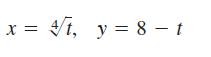
In Exercises sketch the curve represented by the parametric equations (indicate the orientation of the curve), and write the corresponding rectangular equation by eliminating the parameter.X = √t, y = t - 5
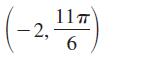
In Exercises plot the point in polar coordinates and find the corresponding rectangular coordinates for the point. -2, 11π 6
In Exercises find the area of the region.One petal of r = 2 cos 3θ
In Exercises find dy/dx and d²y/dx2, and find the slope and concavity (ifpossible) at the given value of the parameter. Parametric Equations x = 4t, y = 3t 2 - Parameter t = 3
In Exercises plot the point in polar coordinates and find the corresponding rectangular coordinates for the point.(√2, 2.36)
In Exercises sketch the curve represented by the parametric equations (indicate the orientation of the curve), and write the corresponding rectangular equation by eliminating the parameter. x = 3,y= 2
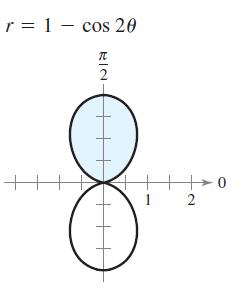
In Exercises write an integral that represents the area of the shaded region of the figure. Do not evaluate the integral. r = 1 cos 20 + RIN 2 2 0
In Exercises sketch the curve represented by the parametric equations (indicate the orientation of the curve), and write the corresponding rectangular equation by eliminating the parameter.x = t² + t, y = t² - t
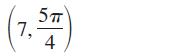
In Exercises plot the point in polar coordinates and find the corresponding rectangular coordinates for the point. 7, 5 п 4
In Exercises find the area of the region.Interior of r = 3 cos θ
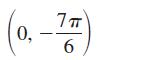
In Exercises plot the point in polar coordinates and find the corresponding rectangular coordinates for the point. 0, 7 п 6
In Exercises find dy/dx. x = 2e, y = e-9/2
In Exercises find the area of the region.Interior of r = 6 sin θ
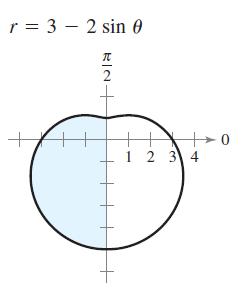
In Exercises write an integral that represents the area of the shaded region of the figure. Do not evaluate the integral. r = 32 sin 0 RIN+ 2 1 2 3 4 -0
In Exercises find dy/dx. x = sin² 0, y = cos²0
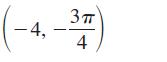
In Exercises plot the point in polar coordinates and find the corresponding rectangular coordinates for the point. -4, З п 4
In Exercises sketch the curve represented by the parametric equations (indicate the orientation of the curve), and write the corresponding rectangular equation by eliminating the parameter.x = 2t², y = t4 + 1
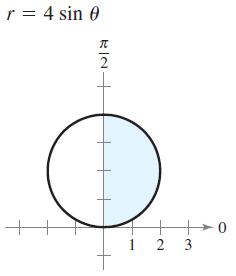
In Exercises write an integral that represents the area of the shaded region of the figure. Do not evaluate the integral. r = 4 sin 0 RIN 2 O + 1 2 3 0
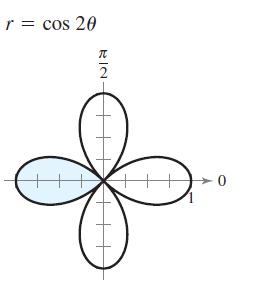
In Exercises write an integral that represents the area of the shaded region of the figure. Do not evaluate the integral. r = cos 20 I 2 - 0
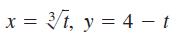
In Exercises find dy/dx. x = 3√t, y = 4 - t
In Exercises sketch the curve represented by the parametric equations (indicate the orientation of the curve), and write the corresponding rectangular equation by eliminating the parameter.x = t + 1, y = t²
In Exercises find dy/dx. x = t², y = 7 - 6t
In Exercises sketch the curve represented by the parametric equations (indicate the orientation of the curve), and write the corresponding rectangular equation by eliminating the parameter.x = 5 - 4t, y = 2 + 5t
In Exercises sketch the curve represented by the parametric equations (indicate the orientation of the curve), and write the corresponding rectangular equation by eliminating the parameter.x = 2t - 3, y = 3t + 1
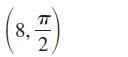
In Exercises plot the point in polar coordinates and find the corresponding rectangular coordinates for the point. 8,
(a) Use a graphing utility to graph each set of parametric equations.(b) Compare the graphs of the two sets of parametric equations in part (a). When the curve represents the motion of a particle and is time, what can you infer about the average speeds of the particle on the paths represented by
In Exercises use a graphing utility to graph the curve represented by the parametric equations. Indicate the direction of the curve. Identify any points at which the curve is not smooth. Prolate cycloid: x = 0 - 2 sin 0, y = 1 - / cos 0
In Exercises use a graphing utility to graph the curve represented by the parametric equations. Indicate the direction of the curve. Identify any points at which the curve is not smooth. Prolate cycloid: x = 204 sin 0, y = 24 cos 0
(a) Each set of parametric equations represents the motion of a particle. Use a graphing utility to graph each set.(b) Determine the number of points of intersection.(c) Will the particles ever be at the same place at the same time? If so, identify the point(s).(d) Explain what happens when the
In Exercises use a graphing utility to graph the curve represented by the parametric equations. Indicate the direction of the curve. Identify any points at which the curve is not smooth. Hypocycloid: x = 3 cos³ 0, y = 3 sin³0
In Exercises write an integral that represents the area of the surface generated by revolving the curve about the x-axis. Use a graphing utility to approximate the integral. Parametric Equations x = 3t, y = t + 2 Interval 0 ≤ t ≤4
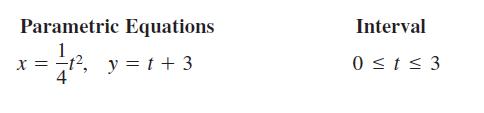
In Exercises write an integral that represents the area of the surface generated by revolving the curve about the x-axis. Use a graphing utility to approximate the integral. Parametric Equations = 1/12, t², y=t+3 4 X Interval 0 ≤ t ≤ 3
In Exercises use a graphing utility to graph the curve represented by the parametric equations. Indicate the direction of the curve. Identify any points at which the curve is not smooth. Curtate cycloid: x = 20 sin 0, y = 2 cos ( - -
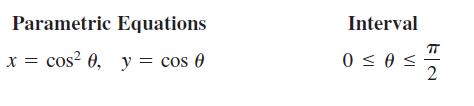
In Exercises write an integral that represents the area of the surface generated by revolving the curve about the x-axis. Use a graphing utility to approximate the integral. Parametric x = cos² 0, Equations y = cos 0 Interval 0 < 0 < TT 2
In Exercises use a graphing utility to graph the curve represented by the parametric equations. Indicate the direction of the curve. Identify any points at which the curve is not smooth. Witch of Agnesi: x = 2 cot 0, y = 2 sin²0
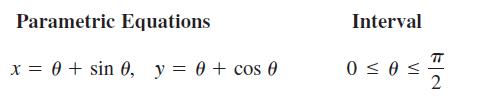
In Exercises write an integral that represents the area of the surface generated by revolving the curve about the x-axis. Use a graphing utility to approximate the integral. Parametric Equations x = 0 + sin 0, y = 0 + cos 0 Interval 0 ≤ 0 ≤ 2
In Exercises use a graphing utility to graph the curve represented by the parametric equations. Indicate the direction of the curve. Identify any points at which the curve is not smooth. Folium of Descartes: x = 3t/(1+³), y = 3t²/(1+f³)
In Exercises find the area of the surface generated by revolving the curve about each given axis.(a) x-axis(b) y-axis x = 2t, y = 3t, 0≤ t ≤ 3
In Exercises find the area of the surface generated by revolving the curve about each given axis.(a) x-axis(b) y-axis x = 1, y = 4 - 2t, 0≤ t ≤ 2
State the definition of a plane curve given by parametric equations.
In Exercises find the area of the surface generated by revolving the curve about each given axis. x = 5 cos 0, y = 5 sin 0, 0≤ 0 ≤ 2' y-axis
Explain the process of sketching a plane curve given by parametric equations. What is meant by the orientation of the curve?
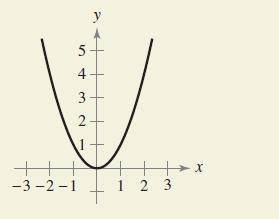
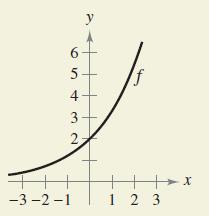
Which set of parametric equations is shown in the graph below? Explain your reasoning.(a)(b) x = t y = f
In Exercises find the area of the surface generated by revolving the curve about each given axis. x = t³, y = t + 1, 1 ≤ t ≤ 2, y-axis
In Exercises find the area of the surface generated by revolving the curve about each given axis. x = a cos³ 0, y = a sin³ 0, 0≤ 0 ≤ , x-axis
State the definition of a smooth curve.
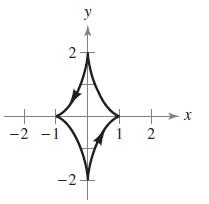
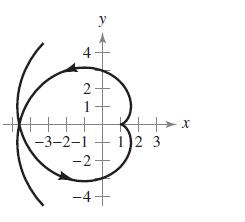
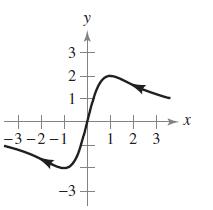
In Exercises match each set of parametric equations with the correct graph. [The graphs are labeled (a), (b), (c), and (d).] Explain your reasoning.(a)(b)(c)(d) -2 -1 2 y -2. 1 2 X
In Exercises find the area of the surface generated by revolving the curve about each given axis.(a) x-axis(b) y-axis x = a cos 0, y = b sin 0, 0≤ 0 ≤ 2π
In Exercises match each set of parametric equations with the correct graph. [The graphs are labeled (a), (b), (c), and (d).] Explain your reasoning.(a)(b)(c)(d) -2 -1 2 y -2. 1 2 X
In Exercises match each set of parametric equations with the correct graph. [The graphs are labeled (a), (b), (c), and (d).] Explain your reasoning.(a)(b)(c)(d) -2 -1 2 y -2. 1 2 X
Give the parametric form of the derivative.
In Exercises mentally determine dy/dx.x = t, y = 3
In Exercises match each set of parametric equations with the correct graph. [The graphs are labeled (a), (b), (c), and (d).] Explain your reasoning.(a)(b)(c)(d) -2 -1 2 y -2. 1 2 X
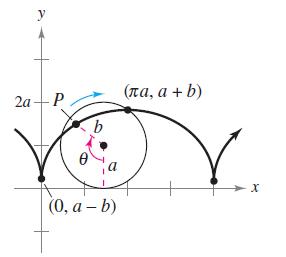
A wheel of radius a rolls along a line without slipping. The curve traced by a point P that is b units from the center (b < a) is called a curtate cycloid (see figure). Use the angle to find a set of parametric equations for this curve. y 2a P (0, a - b) (лa, a + b) X
In Exercises mentally determine dy/dx.x = t, y = 6t - 5
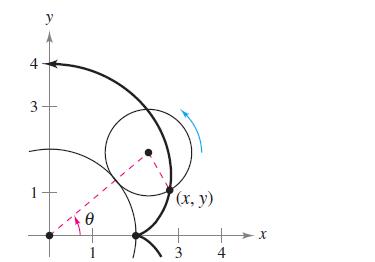
A circle of radius 1 rolls around the outside of a circle of radius 2 without slipping. The curve traced by a point on the circumference of the smaller circle is called an epicycloid (see figure). Use the angle θ to find a set of parametric equations for this curve. 4 3 1 10 1 (x, y) 3 4 X
Give the integral formula for arc length in parametric form.
Give the integral formulas for the areas of the surfaces of revolution formed when a smooth curve C is revolved about (a) The x-axis (b) The y-axis
In Exercises determine whether the statement is true or false. If it is false, explain why or give an example that shows it is false.The graph of the parametric equations x = t² and y = t² is the line y = x.
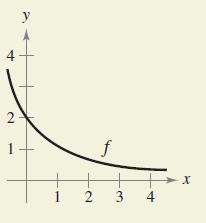
Using the graph of ƒ,(a) Determine whether dy/dt is positive or negativegiven that dx/dt is negative(b) Determinewhether dx/dt is positive or negative given thatdyldt is positive. Explain your reasoning.(i)(ii) 4 2 1 y 1 ta 2 f 3 4 X
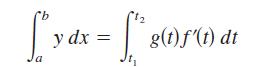
Use integration by substitution to show that if y is a continuous function of x on the interval a ≤ x ≤ b, where x = ƒ(t) and y = g(t), thenwhereand both g and ƒ' are continuous on [₁ y dx = ["²" g(t) f'(t) dt a
In Exercises determine whether the statement is true or false. If it is false, explain why or give an example that shows it is false.The curve represented by the parametric equations x = t and y = cos t can be written as an equation of the form y = ƒ(x).
In Exercises determine whether the statement is true or false. If it is false, explain why or give an example that shows it is false.If y is a function of t and x is a function of t, then y is a function of x.
A portion of a sphere of radius is removed by cutting out a circular cone with its vertex at the center of the sphere. The vertex of the cone forms an angle of 2θ. Find the surface area removed from the sphere.
Consider the parametric equations x = 8 cost and y = 8 sin t.(a) Describe the curve represented by the parametric equations.(b) How does the curve represented by the parametric equations x = 8 cos t + 3 and y = 8 sin t + 6 compare to the curve described in part (a)?(c) How does the original curve
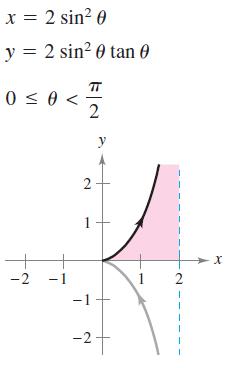
In Exercises find the area of the region. x = 2 sin² 0 y = 2 sin²0 tan 0 0 ≤ 0 < -2 -1 ㅠ 2 2 1 -1 -2 y 1 2 X
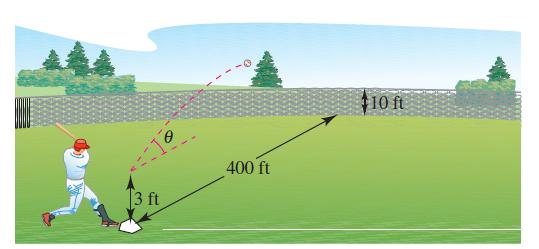
In Exercises consider a projectile launched at a height h feet above the ground and at an angle θ with the horizontal. When the initial velocity is vo feet per second, the path of the projectile is modeled by the parametric equations x = (v0 cos θ)t and y = h + (v0 sin θ)t - 16t².The
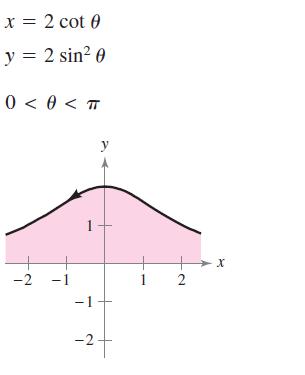
In Exercises find the area of the region. x = 2 cot 0 y = 2 sin² 0 0 < 0 < T -2 -1 -1 -2 y 2 X
In Exercises use a computer algebra system and the result of Exercise 77 to match the closed curve with its area.(a)(b)(c)(d)(e)(f)Data from in exercises 77Use integration by substitution to show that if y is a continuous function of x on the interval a ≤ x ≤ b, where x = ƒ(t) and y = g(t),
In Exercises use a computer algebra system and the result of Exercise 77 to match the closed curve with its area.(a)(b)(c)(d)(e)(f)Data from in exercises 77Use integration by substitution to show that if y is a continuous function of x on the interval a ≤ x ≤ b, where x = ƒ(t) and y = g(t),
In Exercises use a computer algebra system and the result of Exercise 77 to match the closed curve with its area.(a)(b)(c)(d)(e)(f)Data from in exercises 77Use integration by substitution to show that if y is a continuous function of x on the interval a ≤ x ≤ b, where x = ƒ(t) and y = g(t),
In Exercises use a computer algebra system and the result of Exercise 77 to match the closed curve with its area.(a)(b)(c)(d)(e)(f)Data from in exercises 77Use integration by substitution to show that if y is a continuous function of x on the interval a ≤ x ≤ b, where x = ƒ(t) and y = g(t),
In Exercises use a computer algebra system and the result of Exercise 77 to match the closed curve with its area.(a)(b)(c)(d)(e)(f) Data from in exercises 77Use integration by substitution to show that if y is a continuous function of x on the interval a ≤ x ≤ b, where x = ƒ(t) and y =
In Exercises use a computer algebra system and the result of Exercise 77 to match the closed curve with its area.(a)(b)(c)(d)(e)(f)Data from in exercises 77Use integration by substitution to show that if y is a continuous function of x on the interval a ≤ x ≤ b, where x = ƒ(t) and y = g(t),
In Exercises find the centroid of the region bounded by the graph of the parametric equations and the coordinate axes. x = √√√4-t, y = √t
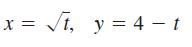
In Exercises find the centroid of the region bounded by the graph of the parametric equations and the coordinate axes. x = √√t, y = 4 - t
In Exercises find the volume of the solid formed by revolving the region bounded by the graphs of the given equations about the x-axis. x = 6 cos 0, y = 6 sin 0
In Exercises find the volume of the solid formed by revolving the region bounded by the graphs of the given equations about the x-axis. x = cos 0, y = 3 sin 0, a > 0
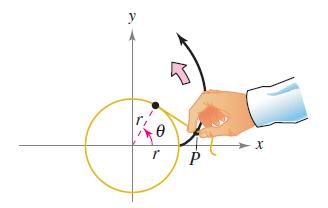
The involute of a circle is described by the endpoint P of a string that is held taut as it is unwound from a spool that does not turn (see figure). Show that a parametric representation of the involute is x = r(cos 0 + 0 sin ) and y=r(sin 0 - 0 cos 0).
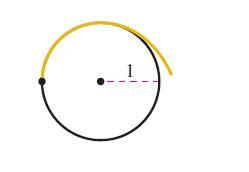
The figure shows a piece of string tied to a circle with a radius of one unit. The string is just long enough to reach the opposite side of the circle. Find the area that is covered when the string is unwound counterclockwise.
(a) Use a graphing utility to graph the curve given by(b) Describe the graph and confirm your result analytically.(c) Discuss the speed at which the curve is traced as t increases from -20 to 20. x = 1 - 1² 1 + 1² and y = 2t 1 + 1²
In Exercises determine whether the statement is true or false. If it is false, explain why or give an example that shows it is false.If x = f(t) and y = g(t), then d²y_g"(t) dx² f"(t)*
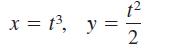
In Exercises determine whether the statement is true or false. If it is false, explain why or give an example that shows it is false.The curve given by x = t³, y = t² has a horizontal tangent at the origin because dy/dt = 0 when t = 0.
Showing 3800 - 3900
of 9867
First
32
33
34
35
36
37
38
39
40
41
42
43
44
45
46
Last
Step by Step Answers

 Get 50% OFF
Claim Now
Get 50% OFF
Claim Now