New Semester
Started
Get
50% OFF
Study Help!
--h --m --s
Claim Now
Question Answers
Textbooks
Find textbooks, questions and answers
Oops, something went wrong!
Change your search query and then try again
S
Books
FREE
Study Help
Expert Questions
Accounting
General Management
Mathematics
Finance
Organizational Behaviour
Law
Physics
Operating System
Management Leadership
Sociology
Programming
Marketing
Database
Computer Network
Economics
Textbooks Solutions
Accounting
Managerial Accounting
Management Leadership
Cost Accounting
Statistics
Business Law
Corporate Finance
Finance
Economics
Auditing
Tutors
Online Tutors
Find a Tutor
Hire a Tutor
Become a Tutor
AI Tutor
AI Study Planner
NEW
Sell Books
Search
Search
Sign In
Register
study help
mathematics
calculus 10th edition
Calculus 10th Edition Ron Larson, Bruce H. Edwards - Solutions
In Exercises find the area of the surface formed by revolving the curve about the given line. Polar Equation r = 6 cos 0 Interval 스플 0 < 0 < Axis of Revolution Polar axis
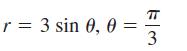
In Exercises use a graphing utility to (a) Graph the polar equation(b) Draw the tangent line at the given value of θ(c) Find dy/dx at the given value of θ r = 3 sin 0, 0 || = 3
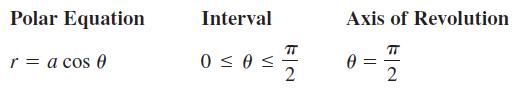
In Exercises find the area of the surface formed by revolving the curve about the given line. Polar Equation r = a cos 0 Interval 0 ≤ 0 ≤ T 2 Axis of Revolution 0 = π 2
In Exercises find the points of horizontal tangency (if any) to the polar curve.r = 2 csc θ + 3
In Exercises use a graphing utility to graph the polar equation over the given interval. Use the integration capabilities of the graphing utility to approximate the length of the curve accurate to two decimal places. Polar Equation r = 2 sin(2 cos 0) Interval 0 ≤ 0 ≤ T
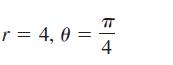
In Exercises use a graphing utility to (a) Graph the polar equation(b) Draw the tangent line at the given value of θ(c) Find dy/dx at the given value of θ r = 4,0 = 4
In Exercises find the points of horizontal and vertical tangency (if any) to the polar curve.r = a sin θ
In Exercises use a graphing utility to graph the polar equation over the given interval. Use the integration capabilities of the graphing utility to approximate the length of the curve accurate to two decimal places. Polar Equation r = sin(3 cos 0) Interval 0 < 0 < Ꮱ
In Exercises find the points of horizontal and vertical tangency (if any) to the polar curve.r = 1 - sin θ
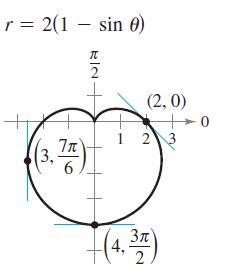
In Exercises find dy/dx and the slopes of the tangent lines shown on the graph of the polar equation. r = 2(1 - sin A) 2 【(3.7%) 6. (2, 0) 1 2 3 (4,37) -0
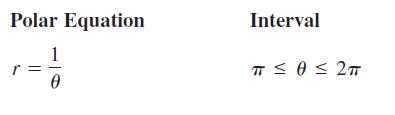
In Exercises use a graphing utility to graph the polar equation over the given interval. Use the integration capabilities of the graphing utility to approximate the length of the curve accurate to two decimal places. Polar Equation 1 Ꮎ Interval π ε θ = 2π
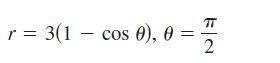
In Exercises use a graphing utility to (a) Graph the polar equation(b) Draw the tangent line at the given value of θ(c) Find dy/dx at the given value of θ r = 3(1 cos 0), 0 - E|N
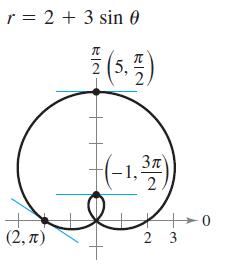
In Exercises find dy/dx and the slopes of the tangent lines shown on the graph of the polar equation. r = 2 + 3 sin ( (2,л) П 25, Т П RIN (-1,3,7) 2 23 -0
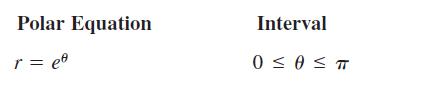
In Exercises use a graphing utility to graph the polar equation over the given interval. Use the integration capabilities of the graphing utility to approximate the length of the curve accurate to two decimal places. Polar Equation r = eº Interval 0 ≤ 0 ≤ T
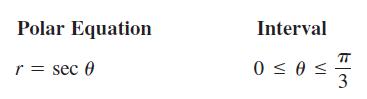
In Exercises use a graphing utility to graph the polar equation over the given interval. Use the integration capabilities of the graphing utility to approximate the length of the curve accurate to two decimal places. Polar Equation r = sec 0 Interval 0 ≤ 0 ≤ 3
In Exercises use a graphing utility to (a) Graph the polar equation(b) Draw the tangent line at the given value of θ(c) Find dy/dx at the given value of θr = 3 2 cos θ, θ = θ
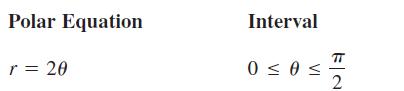
In Exercises use a graphing utility to graph the polar equation over the given interval. Use the integration capabilities of the graphing utility to approximate the length of the curve accurate to two decimal places. Polar Equation r = 20 Interval 0 ≤ 0≤ TT 2
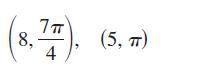
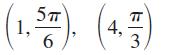
In Exercises use the result of Exercise 54 to approximate the distance between the two points in polar coordinates.Data from in Exercise 54(a) Verify that the Distance Formula for the distance between the two points (r₁, θ₁) and (r₂, θ₂) in polar coordinates is(b) Describe the positions
In Exercises use a graphing utility to graph the curve represented by the parametric equations. Indicate the direction of the curve. Identify any points at which the curve is not smooth. Cycloid: x = 0+ sin 0, y = 1 - cos 0
In Exercises use a graphing utility to graph the curve represented by the parametric equations. Indicate the direction of the curve. Identify any points at which the curve is not smooth. Cycloid: x = 2(0 - sin 0), x = 2(0 sin 0), y = 2(1 cos 0) -
When the projectile in Exercise 55 is launched at an angle θ with the horizontal, its parametric equations are Use a graphing utility to find the angle that maximizes the range of the projectile. What angle maximizes the arc length of the trajectory?Data from in Exercise 55The path of a
Consider the parametric equations(a) Use a graphing utility to graph the curve represented by the parametric equations.(b) Use a graphing utility to find the points of horizontal tangency to the curve.(c) Use the integration capabilities of a graphing utility to approximate the arc length over the
In Exercises use the result of Exercise 54 to approximate the distance between the two points in polar coordinates.Data from in Exercise 54(a) Verify that the Distance Formula for the distance between the two points (r₁, θ₁) and (r₂, θ₂) in polar coordinates is(b) Describe the positions
The path of a projectile is modeled by the parametric equationswhere x and y are measured in feet.(a) Use a graphing utility to graph the path of the projectile.(b) Use a graphing utility to approximate the range of the projectile.(c) Use the integration capabilities of a graphing utility to
In Exercises find the length of the curve over the given interval. Polar Equation r = 8(1 + cos 0) Interval 0 ≤ 0 ≤ 2π
In Exercises use the result of Exercise 54 to approximate the distance between the two points in polar coordinates.Data from in Exercise 54(a) Verify that the Distance Formula for the distance between the two points (r₁, θ₁) and (r₂, θ₂) in polar coordinates is(b) Describe the positions
In Exercises use the result of Exercise 54 to approximate the distance between the two points in polar coordinates.Data from in Exercise 54(a) Verify that the Distance Formula for the distance between the two points (r₁, θ₁) and (r₂, θ₂) in polar coordinates is(b) Describe the positions
In Exercises find a set of parametric equations for the rectangular equation that satisfies the given condition. y = 4x², t = 1 at the point (1, 3)
In Exercises find the length of the curve over the given interval. Polar Equation r = 1 + sin 0 Interval 0 ≤ 0 ≤ 2π
(a) Verify that the Distance Formula for the distance between the two points (r₁, θ₁) and (r₂, θ₂) in polar coordinates is(b) Describe the positions of the points relative to each other for θ₁ = θ₂. Simplify the Distance Formula for this case. Is the simplification what you
In Exercises find the length of the curve over the given interval. Polar Equation r = 2a cos 0 Interval -750S 2 2
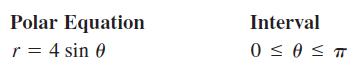
In Exercises find the length of the curve over the given interval. Polar Equation r = 4 sin 0 Interval 0 ≤ 0 ≤ T
Convert the equationto rectangular form and verify that it is the equation of a circle. Find the radius and the rectangular coordinates of the center of the circle. r = 2(h cos 0 + k sin 0)
In Exercises find a set of parametric equations for the rectangular equation that satisfies the given condition. y = 4x + 1, t = -1 at the point (-2,-7)
In Exercises find a set of parametric equations for the rectangular equation that satisfies the given condition. y = 2x = 5, t = 0 at the point (3, 1) -
In Exercises find the arc length of the curve on the interval[0, 2π].Involute of a circle: x = cos θ + θ sin θ, y = sin θ - θ cos θ
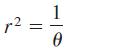
In Exercises use a graphing utility to graph the polar equation. Find an interval for θ over which the graph is traced only once. r² 2 1 -1 0
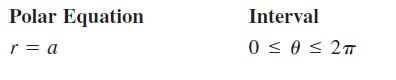
In Exercises find the length of the curve over the given interval. Polar Equation r = a Interval 0 ≤ 0 ≤ 2π
In Exercises find the length of the curve over the given interval. Polar Equation r = 8 Interval 0 ≤ 0 ≤ 2π
In Exercises find the arc length of the curve on the interval[0, 2π].Cycloid arch: x = a(θ - sin θ), y = a(1 - cos θ)
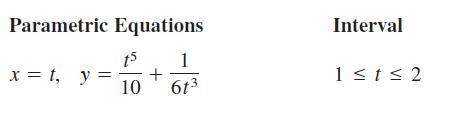
In Exercises find the arc length of the curve on the given interval. Parametric Equations t5 1 10 6t³ x = 1, y + Interval 1 ≤t≤2
Sketch the strophoidConvert this equation to rectangular coordinates. Find the area enclosed by the loop. r = sec 0 - 2 cos 0, 플
In Exercises find the arc length of the curve on the interval[0, 2π].Circle circumference: x = a cos θ, y = a sin θ
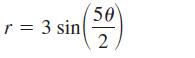
In Exercises use a graphing utility to graph the polar equation. Find an interval for θ over which the graph is traced only once. r = 3 sin 50 2
In Exercises find two different sets of parametric equations for the rectangular equation.y = x²
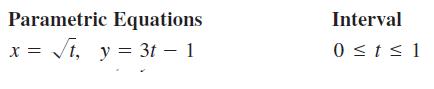
In Exercises find the arc length of the curve on the given interval. Parametric Equations x = = √√t, y = 3t - 1 Interval 0 ≤t≤1
In Exercises find the arc length of the curve on the interval[0, 2π].Hypocycloid perimeter: x = a cos³ θ, y = a sin³ θ
In Exercises find two different sets of parametric equations for the rectangular equation.y = x³
In Exercises use a graphing utility to graph the polar equation. Find an interval for θ over which the graph is traced only once.r² = 4 sin 2θ
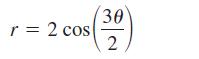
In Exercises use a graphing utility to graph the polar equation. Find an interval for θ over which the graph is traced only once. r = 2 cos 30 2,
In Exercises find two different sets of parametric equations for the rectangular equation.y = 4/(x - 1)
Find the area of the region enclosed byr = a cos (nθ) for n = 1, 2, 3, . . . Use the results to make a conjecture about the area enclosed by the function when n is even and when n is odd.
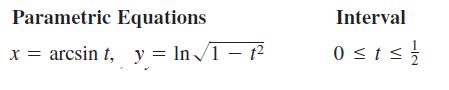
In Exercises find the arc length of the curve on the given interval. Parametric Equations x = arcsin t, y = In√1 - 1² Interval 0≤t≤ 1/1/
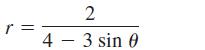
In Exercises use a graphing utility to graph the polar equation. Find an interval for θ over which the graph is traced only once. 2 4 - 3 sin 0
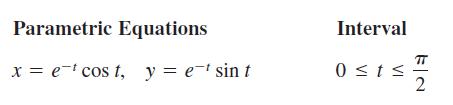
In Exercises find the arc length of the curve on the given interval. Parametric Equations x = et cost, y = et sin t Interval 0 ≤t≤ 2
The area inside one or more of the three interlocking circlesis divided into seven regions. Find the area of each region. r = 2a cos 0, r = 2a sin 0, and r = a
In Exercises find two different sets of parametric equations for the rectangular equation.y = 6x - 5
In Exercises find the arc length of the curve on the given interval. Parametric Equations x = 6t², y = 21³ Interval 1≤t≤ 4
The radiation from a transmitting antenna is not uniform in all directions. The intensity from a particular antenna is modeled by r = a cos2 θ.(a) Convert the polar equation to rectangular form.(b) Use a graphing utility to graph the model for a = 4 and a = 6.(c) Find the area of the geographical
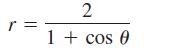
In Exercises use a graphing utility to graph the polar equation. Find an interval for θ over which the graph is traced only once. r = 2 1 + cos 0
In Exercises use the results to find a set of parametric equations for the line or conic.Hyperbola: vertices: (0, ± 1); foci: (0, ± 2)
In Exercises find the arc length of the curve on the given interval. Parametric Equations x = 3t + 5, y = 7 - 2t Interval -1 ≤ t ≤ 3
In Exercises use the results to find a set of parametric equations for the line or conic.Hyperbola: vertices: (±4, 0); foci: (±5, 0)
In Exercises find the area of the region.Common interior of r = a cos θ and r = a sin θ, where a > 0
In Exercises use a graphing utility to graph the polar equation. Find an interval for θ over which the graph is traced only once.r = 4 + 3 cos θ
In Exercises use the results to find a set of parametric equations for the line or conic.Ellipse: vertices: (4, 7), (4, -3); foci: (4, 5), (4, -1)
In Exercises find the area of the region.Common interior of r = a(1 + cos θ) and r=a sin θ
In Exercises use a graphing utility to graph the polar equation. Find an interval for θ over which the graph is traced only once.r = 2 + sin θ
In Exercises use the results to find a set of parametric equations for the line or conic.Ellipse: vertices: (±10, 0); foci: (+8, 0)
In Exercises determine the open-intervals on which the curve is concave downward or concave upward.x = 4 cos t, y = 2 sin t, 0 < t < 2π
In Exercises find the area of the region.Inside r = 2a cos θ and outside r = a
In Exercises use a graphing utility to graph the polar equation. Find an interval for θ over which the graph is traced only once.r = 3(1 − 4 cos θ)
In Exercises use the results to find a set of parametric equations for the line or conic.Circle: center: (-6, 2); radius: 4
In Exercises determine the open-intervals on which the curve is concave downward or concave upward.x = sin t, y = cos t, 0 < t < π
In Exercises find the area of the region.Inside r = a(1 + cos θ) and outside r = a cos θ
In Exercises use a graphing utility to graph the polar equation. Find an interval for θ over which the graph is traced only once.r = 2 - 5 cos θ
In Exercises use the results to find a set of parametric equations for the line or conic.Circle: center: (3, 1); radius: 2
In Exercises determine the open-intervals on which the curve is concave downward or concave upward.x = t², y = ln t
In Exercises use a graphing utility to graph the polar equations. Find the area of the given region analytically.Inside r = 3 sin θ and outside r = 1+ sin θ
In Exercises convert the polar equation to rectangular form and sketch its graph.r = cot θ csc θ
In Exercises use the results to find a set of parametric equations for the line or conic.Line: passes through (1, 4) and (5, -2)
In Exercises determine the open-intervals on which the curve is concave downward or concave upward.x = 2t + ln t, y = 2t - Int
In Exercises use a graphing utility to graph the polar equations. Find the area of the given region analytically.Inside r = 2 cos θ and outside r = 1
In Exercises eliminate the parameter and obtain the standard form of the rectangular equation. Hyperbola: x = h + a sec 0, y = k + b tan 0
In Exercises convert the polar equation to rectangular form and sketch its graph.r = sec θ tan θ
In Exercises determine the open-intervals on which the curve is concave downward or concave upward.x = 2 + t², y = t² + t³
In Exercises use the results to find a set of parametric equations for the line or conic.Line: passes through (0, 0) and (4, -7)
In Exercises use a graphing utility to graph the polar equations. Find the area of the given region analytically.Common interior of r = 2 cos θ and r = 2 sin θ
In Exercises eliminate the parameter and obtain the standard form of the rectangular equation. Ellipse: x = h + a cos 0, y = k + b sin 0
In Exercises convert the polar equation to rectangular form and sketch its graph.r = 2 csc θ
In Exercises eliminate the parameter and obtain the standard form of the rectangular equation. Circle: x = h + r cos 0, y = k + r sin 0
In Exercises determine the open-intervals on which the curve is concave downward or concave upward.x = 3t², y = t³ - t
In Exercises use a graphing utility to graph the polar equations. Find the area of the given region analytically.Common interior of r = 4 sin θ and r = 2
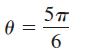
In Exercises convert the polar equation to rectangular form and sketch its graph. Ө = 5 п 6
In Exercises convert the polar equation to rectangular form and sketch its graph.r = 3 sec θ
In Exercises find all points (if any) of horizontal and vertical tangency to the curve. Use a graphing utility to confirm your results.x = cos² θ, y = cos θ
In Exercises use a graphing utility to graph the polar equations. Find the area of the given region analytically.Common interior of r = 5 - 3 sin θ and r = 5 - 3 cos θ
(a) Use a graphing utility to graph the curves represented by the two sets of parametric equations.(b) Describe the change in the graph when the sign of the parameter is changed.(c) Make a conjecture about the change in the graph of parametric equations when the sign of the parameter is changed.(d)
In Exercises find all points (if any) of horizontal and vertical tangency to the curve. Use a graphing utility to confirm your results.x = sec θ, y = tan θ
In Exercises use a graphing utility to graph the polar equations. Find the area of the given region analytically.Common interior of r = 3 - 2 sin θ and r = -3 + 2 sin θ
Showing 3600 - 3700
of 9867
First
30
31
32
33
34
35
36
37
38
39
40
41
42
43
44
Last
Step by Step Answers

 Get 50% OFF
Claim Now
Get 50% OFF
Claim Now