New Semester
Started
Get
50% OFF
Study Help!
--h --m --s
Claim Now
Question Answers
Textbooks
Find textbooks, questions and answers
Oops, something went wrong!
Change your search query and then try again
S
Books
FREE
Study Help
Expert Questions
Accounting
General Management
Mathematics
Finance
Organizational Behaviour
Law
Physics
Operating System
Management Leadership
Sociology
Programming
Marketing
Database
Computer Network
Economics
Textbooks Solutions
Accounting
Managerial Accounting
Management Leadership
Cost Accounting
Statistics
Business Law
Corporate Finance
Finance
Economics
Auditing
Tutors
Online Tutors
Find a Tutor
Hire a Tutor
Become a Tutor
AI Tutor
AI Study Planner
NEW
Sell Books
Search
Search
Sign In
Register
study help
mathematics
calculus 10th edition
Calculus 10th Edition Ron Larson, Bruce H. Edwards - Solutions
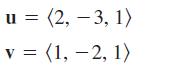
Find u × v and show that it is orthogonal to both u and v. u = (2, -3, 1) v = (1, -2, 1)
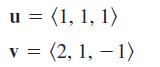
Find the angle θ between the vectors (a) In radians (b) In degrees u = (1, 1, 1) v = (2, 1, 1)
Describe and sketch the surface.y² - z² = 16
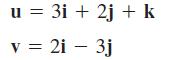
Find the angle θ between the vectors (a) In radians (b) In degrees u = 3i + 2j + k v = 2i - 3j
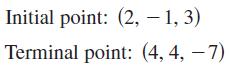
The initial and terminal points of a vector are given. (a) Sketch the directed line segment(b) Find the component form of the vector(c) Write the vector using standard unit vector notation(d) Sketch the vector with its initial point at the origin. Initial point: (2, -1, 3) Terminal point: (4,
Classify and sketch the quadric surface. Use a computer algebra system or a graphing utility to confirm your sketch. 1 I = 2 + 4 + x2
Sketch the graph of each equation given in cylindrical coordinates.(a) r = 2 cos θ (b) z = r2 cos θ
Convert the point from rectangular coordinates to cylindrical coordinates.(2√3, -2, 6)
Find a set of parametric equations of the line.The line passes through the point (2, 3, 4) and is parallel to the xz-plane and the yz-plane.
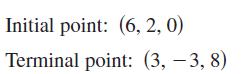
The initial and terminal points of a vector are given. (a) Sketch the directed line segment(b) Find the component form of the vector(c) Write the vector using standard unit vector notation(d) Sketch the vector with its initial point at the origin. Initial point: (6, 2, 0) Terminal point: (3,
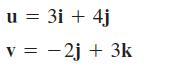
Find the angle θ between the vectors (a) In radians (b) In degrees u = 3i + 4j v=2j + 3k
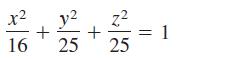
Classify and sketch the quadric surface. Use a computer algebra system or a graphing utility to confirm your sketch. x² 16 + y² 25 + z² 25
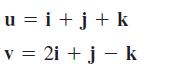
Find u × v and show that it is orthogonal to both u and v. u = i + j+k v = 2i + j - k
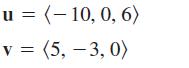
Find u × v and show that it is orthogonal to both u and v. u= (-10, 0, 6) v = (5, -3,0)
Find an equation in cylindrical coordinates for the equation given in rectangular coordinates.z = 4
Find a set of parametric equations of the line.The line passes through the point (-4, 5, 2) and is parallel to the xy-plane and the yz-plane.
Use vectors to determine whether the points are collinear. (3, 4, 1), (-1, 6, 9), (5, 3, -6)
Use vectors to determine whether the points are collinear. (5, 4, 7), (8, -5, 5), (11, 6, 3)
Find an equation in cylindrical coordinates for the equation given in rectangular coordinates.x = 9
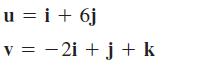
Find u × v and show that it is orthogonal to both u and v. u = i + 6j v=-2i+j+ k
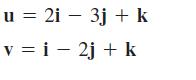
Find the angle θ between the vectors (a) In radians (b) In degrees u = 2i3j+ k v=i - 2j + k
Classify and sketch the quadric surface. Use a computer algebra system or a graphing utility to confirm your sketch.16x² - y² + 16z² = 4
Find an equation in cylindrical coordinates for the equation given in rectangular coordinates.x2 + y2 + z2 = 17
Find a set of parametric equations of the line.The line passes through the point (2, 3, 4) and is perpendicular to the plane given by 3x + 2y - z = 6.
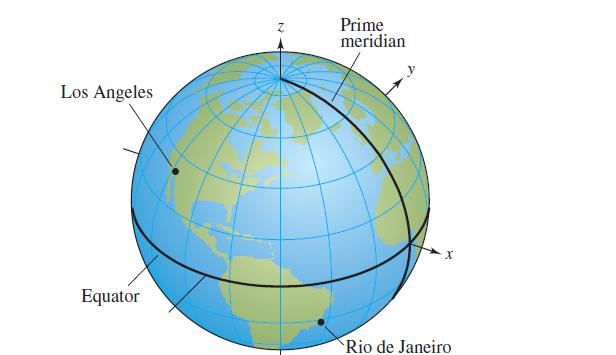
Los Angeles is located at 34.05° North latitude and 118.24° West longitude, and Rio de Janeiro, Brazil, is located at 22.90° South latitude and 43.23° West longitude (see figure). Assume that Earth is spherical and has a radius of 4000 miles.(a) Find the spherical coordinates for the location
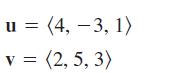
Find a unit vector that is orthogonal to both u and v. (4, -3, 1) u V v = (2, 5, 3)
Use the alternative form of the dot product to find u . v. |||u|| = 8, ||v|| = 5, and the angle between u and v is 77/3.
Determine the location of a point (x, y, z) that satisfies the condition(s).X > 0
Find a unit vector in the direction of u = (2, 3, 5).
Classify and sketch the quadric surface. Use a computer algebra system or a graphing utility to confirm your sketch.- 8x² + 18y² + 18z² = 2
Find an equation in cylindrical coordinates for the equation given in rectangular coordinates.z = x² + y² - 11
Find the vector v of magnitude 8 in the direction (6,-3, 2).
Find a set of parametric equations of the line.The line passes through the point (-4, 5, 2) and is perpendicula to the plane given by -x + 2y + z = 5.
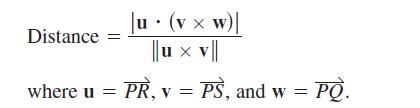
Consider the plane that passes through the points P, R, and S. Show that the distance from a point Q to this plane is |u (v x w)| ||ux v|| where u = PR, v = PS, and w = PQ. Distance
Use the alternative form of the dot product to find u . v. ||u|| = 40, ||v|| = 25, and the angle between u and v is 57/6.
Classify and sketch the quadric surface. Use a computer algebra system or a graphing utility to confirm your sketch.4x² - y² - z² = 1
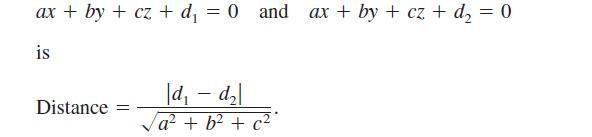
Show that the distance between the parallel planes ax + by + cz +d₁ = 0 and ax + by + cz + d₂ = 0 is Distance = |d₁ - d₂| √a² + b² + c²
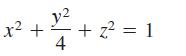
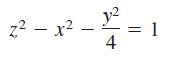
Classify and sketch the quadric surface. Use a computer algebra system or a graphing utility to confirm your sketch. y2 z2 - x2 = 1 4
Find an equation in cylindrical coordinates for the equation given in rectangular coordinates.y = x²
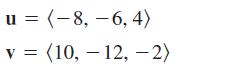
Find a unit vector that is orthogonal to both u and v. u = = (-8, v (10, V = -6, 4) 12, -2)
Determine whether u and v are orthogonal, parallel, or neither. u = (4, 3), v = (1, -3)
Find a set of parametric equations of the line.The line passes through the point (5, -3, -4) and is parallel to v = (2, -1, 3).
Let u = PQ̅ and v = PR̅, and find (a) The component forms of u and v(b) u . v(c) v . v P = (5, 0, 0), Q = (4, 4, 0), R = (2,0, 6)
Find an equation in cylindrical coordinates for the equation given in rectangular coordinates.x² + y² = 8x
Find a set of parametric equations of the line.The line passes through the point (-1, 4, -3) and is parallel to v = 5i - j.
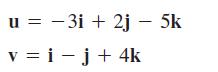
Find a unit vector that is orthogonal to both u and v. u = −3i + 2j - 5k v=i- j + 4k
Determine whether u and v are orthogonal, parallel, or neither. u = -(i-2j), v = 2i - 4j
Classify and sketch the quadric surface. Use a computer algebra system or a graphing utility to confirm your sketch.x2 - y + z2 = 0
Let u = PQ̅ and v = PR̅, and find(a) The component forms of u and v(b) u . v(c) v . v P = (2, 1, 3), Q = (0, 5, 1), R = (5, 5, 0)
Find an equation in cylindrical coordinates for the equation given in rectangular coordinates.y² = 10 - z2
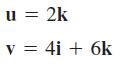
Find a unit vector that is orthogonal to both u and v. u = 2k V = 4i + 6k
Find a set of parametric equations of the line.The line passes through the point (2, 1, 2) and is parallel to the line x = -t, y = 1 + t, z = 2 + t.
Show that the curve of intersection of the plane z = 2y and the cylinder x² + y² = 1 is an ellipse.
Classify and sketch the quadric surface. Use a computer algebra system or a graphing utility to confirm your sketch.z = x² + 4y²
Find an equation in cylindrical coordinates for the equation given in rectangular coordinates.x² + y² + z² - 3z = 0
Find a set of parametric equations of the line. The line passes through the point (-6, 0, 8) and is parallel to the line x = 5 - 2t, y = −4 + 2t, z = 0.
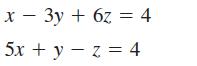
In Exercises determine whether the planes are parallel, orthogonal, or neither. If they are neither parallel nor orthogonal, find the angle of intersection. x - 3y + 6z = 4 5x + y - z = 4
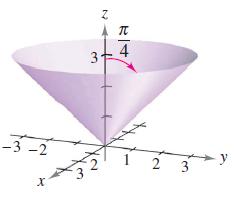
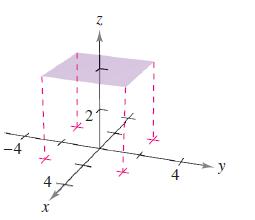
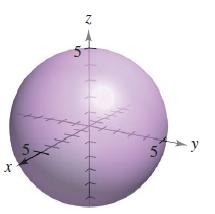
In Exercises match the equation (written in terms of cylindrical or spherical coordinates) with its graph. [The graphs are labeled (a), (b), (c), (d), (e), and (f).](a)(b)(c)(d)(e)(f)p = 5 -3-2 X Z 3+ 2 3 元 4 23 y
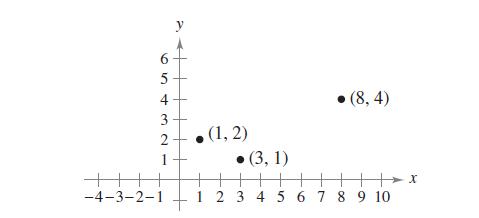
Three vertices of a parallelogram are (1, 2), (3, 1), and (8, 4). Find the three possible fourth vertices (see figure). 654321 6 2 +111 -4-3-2-1 . (1, 2) . (3, 1) . (8,4) + H 1 2 3 4 5 6 7 8 9 10 X
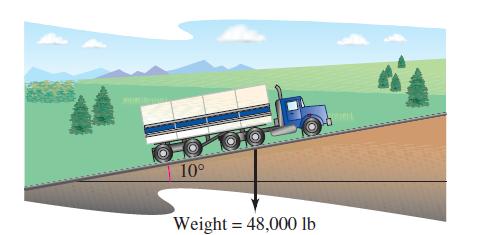
A 48,000-pound truck is parked on a 10° slope (see figure). Assume the only force to overcome is that due to gravity. Find (a) The force required to keep the truckfrom rolling down the hill (b) The force perpendicular tothe hill. 10⁰ Weight = 48,000 lb
In Exercises match the equation (written in terms of cylindrical or spherical coordinates) with its graph. [The graphs are labeled (a), (b), (c), (d), (e), and (f).](a)(b)(c)(d)(e)(f) -3-2 X Z 3+ 2 3 元 4 23 y
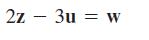
In Exercises find the vector z, given that u = (1, 2, 3), v = (2, 2, -1), and w = (4, 0, -4). 2z - 3u = w
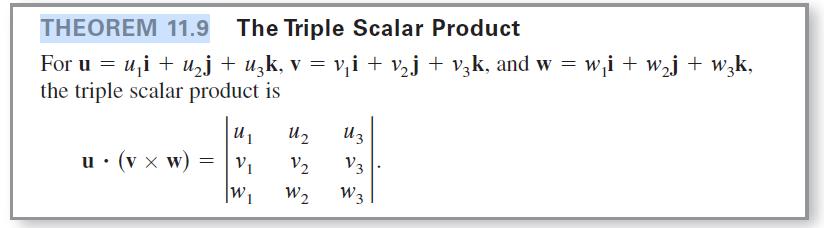
Prove Theorem 11.9 THEOREM 11.9 The Triple Scalar Product For u = u₁i + u₂j + Uzk, v = v₁i + v₂j + v3k, and w = w₁i + wêj + w3k, the triple scalar product is u. (V x W) = U₁ U2 V₁ V2 W₁ W2 Uz V3 W3
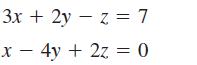
In Exercises determine whether the planes are parallel, orthogonal, or neither. If they are neither parallel nor orthogonal, find the angle of intersection. 3x + 2y - z = 7 x - 4y + 2z = 0
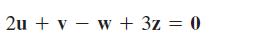
In Exercises find the vector z, given that u = (1, 2, 3), v = (2, 2, -1), and w = (4, 0, -4). 2u + vw + 3z = 0
In Exercises match the equation (written in terms of cylindrical or spherical coordinates) with its graph. [The graphs are labeled (a), (b), (c), (d), (e), and (f).](a)(b)(c)(d)(e)(f)r2 = z -3-2 X Z 3+ 2 3 元 4 23 y
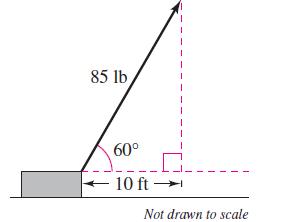
An object is pulled 10 feet across a floor, using a force of 85 pounds. The direction of the force is 60° above the horizontal (see figure). Find the work done. 85 lb 60° - 10 ft- Not drawn to scale
In Exercises match the equation (written in terms of cylindrical or spherical coordinates) with its graph. [The graphs are labeled (a), (b), (c), (d), (e), and (f).](a)(b)(c)(d)(e)(f)p = 4 sec Ø -3-2 X Z 3+ 2 3 元 4 23 y
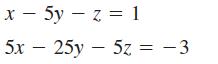
In Exercises determine whether the planes are parallel, orthogonal, or neither. If they are neither parallel nor orthogonal, find the angle of intersection. x - 5y z = 1 5x 25y5z = -3 -
A 5400-pound sport utility vehicle is parked on an 18° slope. Assume the only force to overcome is that due to gravity. Find (a) The force required to keep thevehicle from rolling down the hill (b) The forceperpendicular to the hill.
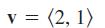
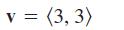
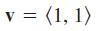
In Exercises find a and b such that v = au + bw, where u = 〈 1, 2〉 and w =〈1, -1〉. v = (2, 1) V
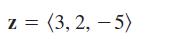
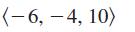
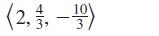
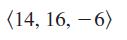
In Exercises determine which of the vectors is (are) parallel to z. Use a graphing utility to confirm your results.(a)(b)(c)(d) z = (3,2,-5)
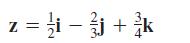
In Exercises determine which of the vectors is (are) parallel to z. Use a graphing utility to confirm your results.(a)(b)(c)(d) z = i − j + k
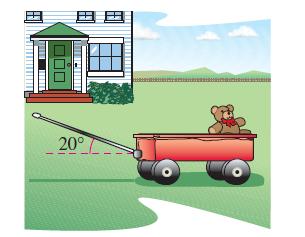
A toy wagon is pulled by exerting a force of 25 pounds on a handle that makes a 20° angle with the horizontal (see figure). Find the work done in pulling the wagon 50 feet. 20°
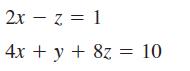
In Exercises determine whether the planes are parallel, orthogonal, or neither. If they are neither parallel nor orthogonal, find the angle of intersection. 2x z = 1 4x + y + 8z = 10
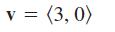
In Exercises find a and b such that v = au + bw, where u = 〈 1, 2〉 and w =〈1, -1〉. v = (3, 0)
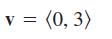
In Exercises find a and b such that v = au + bw, where u = 〈 1, 2〉 and w =〈1, -1〉. v = (0, 3) V
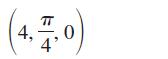
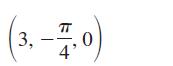
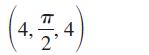
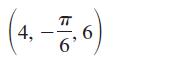
In Exercises convert the point from cylindrical coordinates to spherical coordinates. 4, 4'
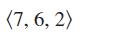
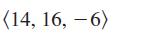
In Exercises determine which of the vectors is (are) parallel to z. Use a graphing utility to confirm your results.z has initial point (1,-1, 3) and terminal point (-2, 3, 5).(a)(b) (7, 6, 2)
In Exercises convert the point from cylindrical coordinates to spherical coordinates. (3)
A car is towed using a force of 1600 newtons. The chain used to pull the car makes a 25° angle with the horizontal. Find the work done in towing the car 2 kilometers.
In Exercises find a and b such that v = au + bw, where u = 〈 1, 2〉 and w =〈1, -1〉. = (3, 3) V =
In Exercises determine which of the vectors is (are) parallel to z. Use a graphing utility to confirm your results.z has initial point (5, 4, 1) and terminal point (-2, -4, 4). (a)(b) (7, 6, 2)
In Exercises convert the point from cylindrical coordinates to spherical coordinates. 4, 4. 4 2
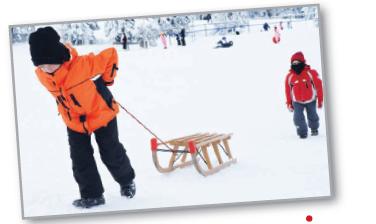
A sled is pulled by exerting a force of 100 newtons on a rope that makes a 25° angle with the horizontal. Find the work done in pulling the sled 40 meters.
In Exercises sketch a graph of the plane and label any intercepts.4x + 2y + 6z = 12
In Exercises determine whether the statement is true or false. If it is false, explain why or give an example that shows it is false. If u. v = u. w and u # 0, then v = w.
In Exercises convert the point from cylindrical coordinates to spherical coordinates. 2, 21 3 -2
In Exercises find a and b such that v = au + bw, where u = 〈 1, 2〉 and w =〈1, -1〉. v = (1, 1)
In Exercises sketch a graph of the plane and label any intercepts.3x + бу + 2z = 6
In Exercises use vectors to determine whether the points are collinear. (0, -2,-5), (3, 4, 4), (2, 2, 1)
In Exercises use vectors to determine whether the points are collinear. (4, -2, 7), (-2, 0, 3), (7, -3, 9)
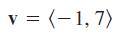
In Exercises find a and b such that v = au + bw, where u = 〈 1, 2〉 and w =〈1, -1〉. v = (-1,7)
In Exercises sketch a graph of the plane and label any intercepts.2x - y + 3z = 4
In Exercises sketch a graph of the plane and label any intercepts.2x - y + z = 4
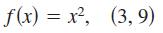
In Exercises find a unit vector(a) parallel to (b) perpendicular to the graph of ƒ at the given point. Then sketch the graph of ƒ and sketch the vectorsat the given point. f(x) = x², (3,9)
In Exercises convert the point from cylindrical coordinates to spherical coordinates. 4, 6
In Exercises use vectors to determine whether the points are collinear. (1, 2, 4), (2, 5, 0), (0, 1, 5)
In Exercises(a) Findall points of intersection of the graphs of the two equations(b) Find the unit tangent vectors to each curve at their points ofintersection(c) Find the angles (0° ≤ θ ≤ 90°) between thecurves at their points of intersection. y = x², y = x¹/3
In Exercises use vectors to determine whether the points are collinear. (0, 0, 0), (1, 3, -2), (2, -6,4)
Showing 3000 - 3100
of 9867
First
24
25
26
27
28
29
30
31
32
33
34
35
36
37
38
Last
Step by Step Answers

 Get 50% OFF
Claim Now
Get 50% OFF
Claim Now