New Semester
Started
Get
50% OFF
Study Help!
--h --m --s
Claim Now
Question Answers
Textbooks
Find textbooks, questions and answers
Oops, something went wrong!
Change your search query and then try again
S
Books
FREE
Study Help
Expert Questions
Accounting
General Management
Mathematics
Finance
Organizational Behaviour
Law
Physics
Operating System
Management Leadership
Sociology
Programming
Marketing
Database
Computer Network
Economics
Textbooks Solutions
Accounting
Managerial Accounting
Management Leadership
Cost Accounting
Statistics
Business Law
Corporate Finance
Finance
Economics
Auditing
Tutors
Online Tutors
Find a Tutor
Hire a Tutor
Become a Tutor
AI Tutor
AI Study Planner
NEW
Sell Books
Search
Search
Sign In
Register
study help
mathematics
calculus 10th edition
Calculus 10th Edition Ron Larson, Bruce H. Edwards - Solutions
In Exercises convert the polar equation to rectangular form and sketch its graph.r = θ
In Exercises eliminate the parameter and obtain the standard form of the rectangular equation.
In Exercises determine any differences between the curves of the parametric equations. Are the graphs the same? Are the orientations the same? Are the curves smooth? Explain.(a)(b) x = t + 1, y = 1³
Write a short paragraph describing how the graphs of curves represented by different sets of parametric equations can differ even though eliminating the parameter from each yields the same rectangular equation.
In Exercises find all points (if any) of horizontal and vertical tangency to the curve. Use a graphing utility to confirm your results.x = 4 cos² θ, y = 2 sin θ
In Exercises use a graphing utility to graph the polar equations. Find the area of the given region analytically.Common interior of r = 2(1 + cos θ) and r = 2(1 cos θ)
In Exercises convert the polar equation to rectangular form and sketch its graph.r = 5 cos θ
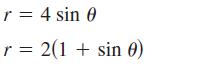
In Exercises use a graphing utility to graph the polar equations and approximate the points of intersection of the graphs. Watch the graphs as they are traced in the viewing window. Explain why the pole is not a point of intersection obtained by solving the equations simultaneously. r = 4 sin 0 r =
In Exercises find all points (if any) of horizontal and vertical tangency to the curve. Use a graphing utility to confirm your results. x = 5 + 3 cos θ, y = −2+ sin θ
In Exercises use a graphing utility to graph the polar equations. Find the area of the given region analytically.Common interior of r = 4 sin 2θ and r = 2
In Exercises convert the polar equation to rectangular form and sketch its graph.r = 3 sin θ
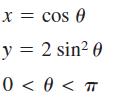
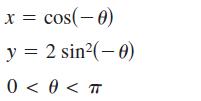
In Exercises determine any differences between the curves of the parametric equations. Are the graphs the same? Are the orientations the same? Are the curves smooth? Explain.(a)(b) x = cos 0 y = 2 sin² 0 0 < 0 < T
In Exercises find all points (if any) of horizontal and vertical tangency to the curve. Use a graphing utility to confirm your results.x = cos θ, y = 2 sin 2θ
In Exercises convert the polar equation to rectangular form and sketch its graph.r = -5
In Exercises find all points (if any) of horizontal and vertical tangency to the curve. Use a graphing utility to confirm your results.x = 3 cos θ, y = 3 sin θ
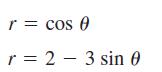
In Exercises use a graphing utility to graph the polar equations and approximate the points of intersection of the graphs. Watch the graphs as they are traced in the viewing window. Explain why the pole is not a point of intersection obtained by solving the equations simultaneously. r = cos 0 r =
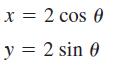
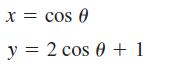
In Exercises determine any differences between the curves of the parametric equations. Are the graphs the same? Are the orientations the same? Are the curves smooth? Explain.(a)(b)(c)(d) x = 2 cos 0 y = 2 sin 0
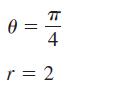
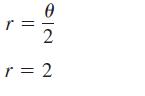
In Exercises find the points of intersection of the graphs of the equations. 0 || 4 2 r=2
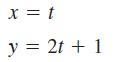
In Exercises determine any differences between the curves of the parametric equations. Are the graphs the same? Are the orientations the same? Are the curves smooth? Explain.(a)(b)(c)(d) x = t y = 2t + 1
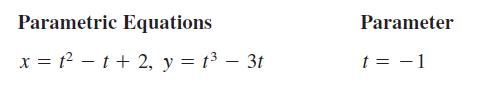
In Exercises find all points (if any) of horizontal and vertical tangency to the curve. Use a graphing utility to confirm your results.x = t² - t + 2, y = t³ - 3t
In Exercises find the points of intersection of the graphs of the equations. || r = 2
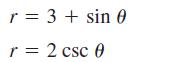
In Exercises find the points of intersection of the graphs of the equations. r = 3 + sin 0 r = 2 csc 0
In Exercises convert the rectangular equation to polar form and sketch its graph.(x2 + y2)2 – 9(x2 – y2) = 0
In Exercises find all points (if any) of horizontal and vertical tangency to the curve. Use a graphing utility to confirm your results.x = t + 4, y = t³ - 3t
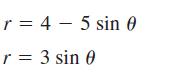
In Exercises find the points of intersection of the graphs of the equations. r = 45 sin 0 r = 3 sin 0
In Exercises convert the rectangular equation to polar form and sketch its graph.y² = 9x
In Exercises use a graphing utility to graph the curve represented by the parametric equations (indicate the orientation of the curve). Eliminate the parameter and write the corresponding rectangular equation.x = e²t, y = et
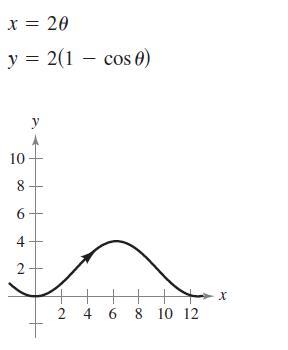
In Exercises find all points (if any) of horizontal and vertical tangency to the portion of the curve shown. x = 20 y = 2(1 cos 0) - 10- 8 6 4 2 2 46 8 10 12 X
In Exercises find all points (if any) of horizontal and vertical tangency to the curve. Use a graphing utility to confirm your results.x = t + 1, y = t² + 3t
In Exercises convert the rectangular equation to polar form and sketch its graph.xy = 4
In Exercises use a graphing utility to graph the curve represented by the parametric equations (indicate the orientation of the curve). Eliminate the parameter and write the corresponding rectangular equation.x = e-t, y = e³t
In Exercises find all points (if any) of horizontal and vertical tangency to the curve. Use a graphing utility to confirm your results.x = 4 - t, y = t²
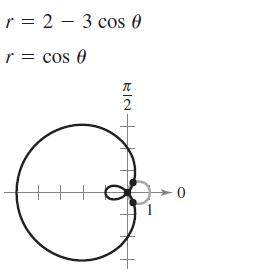
In Exercises find the points of intersection of the graphs of the equations. r = 23 cos ( r = cos 0 RIN+ 0
In Exercises convert the rectangular equation to polar form and sketch its graph.3x - y + 2 = 0
In Exercises use a graphing utility to graph the curve represented by the parametric equations (indicate the orientation of the curve). Eliminate the parameter and write the corresponding rectangular equation.x = ln 2t, y = t²
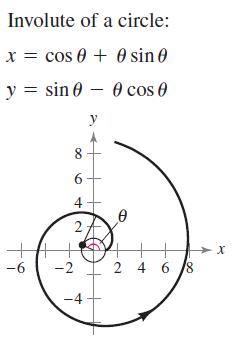
In Exercises find all points (if any) of horizontal and vertical tangency to the portion of the curve shown. Involute of a circle: x = cos 0 + 0 sin 0 y sin cos 0 -6 8 6 4 2 -2 -4 y LO 2 4 6 8 X
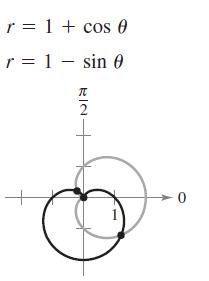
In Exercises find the points of intersection of the graphs of the equations. r = 1 + cos 0 r 1 sin 0 T RIN 0
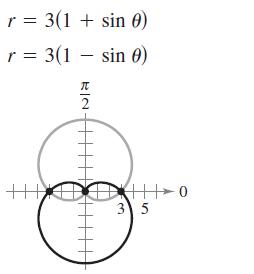
In Exercises find the points of intersection of the graphs of the equations. r = 3(1 + sin 0) r = 3(1 - sin 0) RIN 2 3 5 -0
In Exercises convert the rectangular equation to polar form and sketch its graph.x = 12
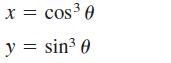
In Exercises use a graphing utility to graph the curve represented by the parametric equations (indicate the orientation of the curve). Eliminate the parameter and write the corresponding rectangular equation. x = cos ³ 0 y = sin³ 0
In Exercises use a graphing utility to graph the curve represented by the parametric equations (indicate the orientation of the curve). Eliminate the parameter and write the corresponding rectangular equation.x = t³, y = 3 In t
In Exercises find the equations of the tangent lines at the point where the curve crosses itself. x = t³ - 6t, y = 1²
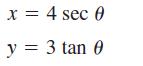
In Exercises use a graphing utility to graph the curve represented by the parametric equations (indicate the orientation of the curve). Eliminate the parameter and write the corresponding rectangular equation. x = 4 sec 0 y = 3 tan 0
In Exercises convert the rectangular equation to polar form and sketch its graph.y = 8
In Exercises find the equations of the tangent lines at the point where the curve crosses itself. x = 1² t, y = t³ - 3t - 1
In Exercises find the equations of the tangent lines at the point where the curve crosses itself. x = 2 = π cost, y = 2t sin t TT -
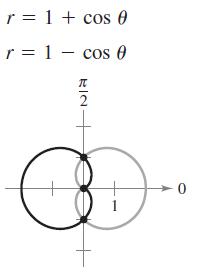
In Exercises find the points of intersection of the graphs of the equations. r = 1 + cos 0 r = 1 - cos 0 RIN a 0
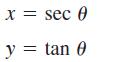
In Exercises use a graphing utility to graph the curve represented by the parametric equations (indicate the orientation of the curve). Eliminate the parameter and write the corresponding rectangular equation. x = sec 0 y = tan 0
In Exercises convert the rectangular equation to polar form and sketch its graph.x2 + y2 - 2ax = 0
In Exercises find the equations of the tangent lines at the point where the curve crosses itself. x = 2 sin 2t, y = 3 sin t
In Exercises convert the rectangular equation to polar form and sketch its graph.x² + y² = a²
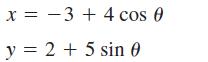
In Exercises use a graphing utility to graph the curve represented by the parametric equations (indicate the orientation of the curve). Eliminate the parameter and write the corresponding rectangular equation. x = y = 2 + 5 sin 0 3 + 4 cos 0
In Exercises use a graphing utility to graph the polar equation. Find the area of the given region analytically.Between the loops of r = 1/2 + cos θ
In Exercises convert the rectangular equation to polar form and sketch its graph.x² - y² = 9
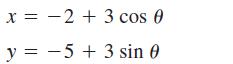
In Exercises use a graphing utility to graph the curve represented by the parametric equations (indicate the orientation of the curve). Eliminate the parameter and write the corresponding rectangular equation. x = −2+3 cos 0 y = -5 + 3 sin 0
In Exercises(a) Use a graphing utility to graph the curve represented by the parametric equations(b) Use a graphing utility to find dx/dt, dy/dt, and dy/dx at the given value of the parameter(c) Find an equation of the tangent line to the curve at the given value of the parameter(d) Use a graphing
In Exercises use a graphing utility to graph the polar equation. Find the area of the given region analytically.Between the loops of r = 3 - 6 sin θ
In Exercises convert the rectangular equation to polar form and sketch its graph.x² + y² = 9
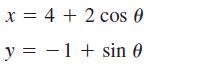
In Exercises use a graphing utility to graph the curve represented by the parametric equations (indicate the orientation of the curve). Eliminate the parameter and write the corresponding rectangular equation. x = 4 + 2 cos 0 -1 + sin 0 y =
In Exercises(a) Use a graphing utility to graph the curve represented by the parametric equations(b) Use a graphing utility to find dx/dt, dy/dt, and dy/dx at the given value of the parameter(c) Find an equation of the tangent line to the curve at the given value of the parameter(d) Use a graphing
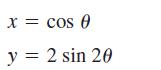
In Exercises use a graphing utility to graph the curve represented by the parametric equations (indicate the orientation of the curve). Eliminate the parameter and write the corresponding rectangular equation. x = cos 0 y = 2 sin 20
In Exercises use a graphing utility to graph the polar equation. Find the area of the given region analytically.Between the loops of r = 2(1 + 2 sin θ)
(a) Set the window format of a graphing utility to rectangular coordinates and locate the cursor at any position off the axes. Move the cursor horizontally and vertically. Describe any changes in the displayed coordinates of the points.(b) Set the window format of a graphing utility to polar
In Exercises(a) Use a graphing utility to graph the curve represented by the parametric equations(b) Use a graphing utility to find dx/dt, dy/dt, and dy/dx at the given value of the parameter(c) Find an equation of the tangent line to the curve at the given value of the parameter(d) Use a graphing
In Exercises use a graphing utility to graph the polar equation. Find the area of the given region analytically.Between the loops of r = 1 + 2 cos θ
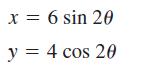
In Exercises use a graphing utility to graph the curve represented by the parametric equations (indicate the orientation of the curve). Eliminate the parameter and write the corresponding rectangular equation. x = 6 sin 20 y = 4 cos 20
Plot the point (4, 3.5) when the point is given in(a) Rectangular coordinates.(b) Polar coordinates.
In Exercises(a) Use a graphing utility to graph the curve representedby the parametric equations(b) Use a graphing utility to finddx/dt, dy/dt, and dy/dx at the given value of the parameter(c) Find an equation of the tangent line to the curve at the givenvalue of the parameter(d) Use a graphing
In Exercises use a graphing utility to graph the polar equation. Find the area of the given region analytically.Inner loop of r = 4 - 6 sin θ
In Exercises the rectangular coordinates of a point are given. Plot the point and find two sets of polar coordinates for the point for 0 ≤ 0 < 2π. (3,9) 4:
In Exercises find an equation of the tangent line at each given point on the curve. x = 14 + 2, y = ³ + t, (2, 0), (3, 2), (18, 10)
In Exercises the rectangular coordinates of a point are given. Plot the point and find two sets of polar coordinates for the point for 0 ≤ 0 < 2π.(0, -5)
In Exercises use a graphing utility to graph the polar equation. Find the area of the given region analytically.Inner loop of r = 1 + 2 sin θ
In Exercises sketch the curve represented by the parametric equations (indicate the orientation of the curve), and write the corresponding rectangular equation by eliminating the parameter.x = 3 cos θ, y = 7 sin θ
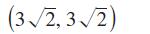
In Exercises the rectangular coordinates of a point are given. Plot the point and find two sets of polar coordinates for the point for 0 ≤ 0 < 2π. (3√2,3√2)
In Exercises find an equation of the tangent line at each given point on the curve. x = 1² = 4, y = ²2t, (0, 0), (-3,-1), (-3, 3)
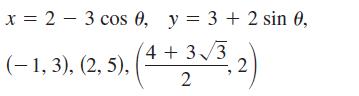
In Exercises find an equation of the tangent line at each given point on the curve. x = 23 cos 0, y = 3 + 2 sin 0, (-1,3), (2, 5), 3. (2., 5). (4+ 3√3, 2) 2
In Exercises use a graphing utility to graph the polar equation. Find the area of the given region analytically.Inner loop of r = 2 - 4 cos θ
In Exercises sketch the curve represented by the parametric equations (indicate the orientation of the curve), and write the corresponding rectangular equation by eliminating the parameter.x = 8 cos θ, y = 8 sin θ
In Exercises use a graphing utility to graph the polar equation. Find the area of the given region analytically.Inner loop of r = 1 + 2 cos θ
In Exercises the rectangular coordinates of a point are given. Plot the point and find two sets of polar coordinates for the point for 0 ≤ 0 < 2π.(3, -2)
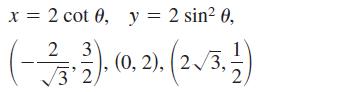
In Exercises find an equation of the tangent line at each given point on the curve. x = 2 cot 0, y = 2 sin² 0, 2 (-33-3). (0.2). (2√3.2) 3,
In Exercises sketch the curve represented by the parametric equations (indicate the orientation of the curve), and write the corresponding rectangular equation by eliminating the parameter.x = tan²θ, y = sec²θ
In Exercises find the area of the region.Interior of r² = 6 sin 2θ
In Exercises find dy/dx and d²y/dx2, and find the slope and concavity (if possible) at the given value of the parameter. Parametric Equations x = 0 - sin 0, y = 1 - cos 0 Parameter 0 = = T
In Exercises the rectangular coordinates of a point are given. Plot the point and find two sets of polar coordinates for the point for 0 ≤ 0 < 2π.(3, -√3)
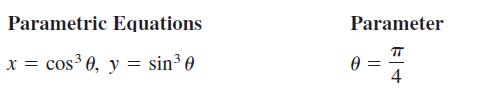
In Exercises find dy/dx and d²y/dx2, and find the slope and concavity (if possible) at the given value of the parameter. Parametric Equations x = cos³ 0, y = sin³0 Parameter 0 4
In Exercises sketch the curve represented by the parametric equations (indicate the orientation of the curve), and write the corresponding rectangular equation by eliminating the parameter.x = sec θ, y = cos θ, 0 ≤ θ < π/2, π/2 < θ ≤ π
In Exercises find the area of the region.Interior of r² = 4 cos 2θ
In Exercises the rectangular coordinates of a point are given. Plot the point and find two sets of polar coordinates for the point for 0 ≤ 0 < 2π.(-1, -√3)
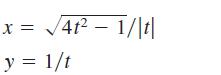
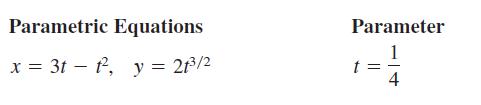
In Exercises find dy/dx and d²y/dx2, and find the slope and concavity (if possible) at the given value of the parameter. Parametric Equations x = √t, y = √√t - 1 Parameter t = 2
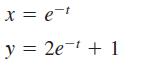
In Exercises sketch the curve represented by the parametric equations (indicate the orientation of the curve), and write the corresponding rectangular equation by eliminating the parameter.x = e-t, y = e²t - 1
In Exercises find the area of the region.Interior of r = 4 - 4 cos θ
In Exercises the rectangular coordinates of a point are given. Plot the point and find two sets of polar coordinates for the point for 0 ≤ 0 < 2π.(4, -2)
In Exercises sketch the curve represented by the parametric equations (indicate the orientation of the curve), and write the corresponding rectangular equation by eliminating the parameter.x = et, y = e³t + 1
In Exercises find dy/dx and d²y/dx2, and find the slope and concavity (if possible) at the given value of the parameter. Parametric Equations x = cos 0, y = 3 sin 0 Parameter 0 = 0
In Exercises find the area of the region.Interior of r = 5 + 2 sin θ
In Exercises find dy/dx and d²y/dx2, and find the slope and concavity (if possible) at the given value of the parameter. Parametric Equations x = 2 + sec 0, y = 1 + 2 tan 0 Parameter πT 6 0 =
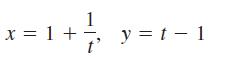
In Exercises sketch the curve represented by the parametric equations (indicate the orientation of the curve), and write the corresponding rectangular equation by eliminating the parameter. x = 1 + y = t - 1
In Exercises the rectangular coordinates of a point are given. Plot the point and find two sets of polar coordinates for the point for 0 ≤ 0 < 2π.(-3, 4)
Showing 3700 - 3800
of 9867
First
31
32
33
34
35
36
37
38
39
40
41
42
43
44
45
Last
Step by Step Answers

 Get 50% OFF
Claim Now
Get 50% OFF
Claim Now