New Semester
Started
Get
50% OFF
Study Help!
--h --m --s
Claim Now
Question Answers
Textbooks
Find textbooks, questions and answers
Oops, something went wrong!
Change your search query and then try again
S
Books
FREE
Study Help
Expert Questions
Accounting
General Management
Mathematics
Finance
Organizational Behaviour
Law
Physics
Operating System
Management Leadership
Sociology
Programming
Marketing
Database
Computer Network
Economics
Textbooks Solutions
Accounting
Managerial Accounting
Management Leadership
Cost Accounting
Statistics
Business Law
Corporate Finance
Finance
Economics
Auditing
Tutors
Online Tutors
Find a Tutor
Hire a Tutor
Become a Tutor
AI Tutor
AI Study Planner
NEW
Sell Books
Search
Search
Sign In
Register
study help
mathematics
calculus 10th edition
Calculus 10th Edition Ron Larson, Bruce H. Edwards - Solutions
In Exercises a model for a power cable suspended between two towers is given. (a) Graph the model(b) Find the heights of the cable at the towers and at the midpoint between the towers(c) Find the slope of the model at the point where the cable meets the right-hand tower. y 18 + 25 cosh 25' -25
In Exercises find an equation of the tangent line to the graph of the function at the given point.ƒ(x) = ex-4, (4,1)
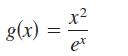
In Exercises find the derivative of the function. g(x) = et
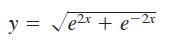
In Exercises find the derivative of the function. y = √e²x + e- 2x
In Exercises find an equation of the tangent line to the graph of the function at the given point.ƒ(x) = e6x, (0, 1)
In Exercises find the derivative of the function.y = 3e-3/t
In Exercises find any relative extrema of the function. Use a graphing utility to confirm your result.h(x) = 2 tanh x − x
In Exercises find the derivative of the function.h(z) = e-z²/2
In Exercises find any relative extrema of the function. Use a graphing utility to confirm your result.g(x) = x sech x
In Exercises find any relative extrema of the function. Use a graphing utility to confirm your result.ƒ(x) = x sinh(x - 1) - cosh(x - 1)
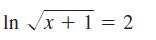
In Exercises solve for x accurate to three decimal places. In √x + 1 = 2
In Exercises find any relative extrema of the function. Use a graphing utility to confirm your result.ƒ(x)= sin x sinh x-cos x cosh x, -4 ≤ x ≤ 4
In Exercises find the derivative of the function.g(t) = t²et
In Exercises verify that f has an inverse. Then use the function f and the given real number a to find (ƒ-¹)'(a). f(x) = cos x, 0≤x≤ TT, a = 0
In Exercises find an equation of the tangent line to the graph of the function at the given point.y = esinh x (0, 1)
In Exercises solve for x accurate to three decimal places.In x + In(x − 3) = 0
In Exercises find an equation of the tangent line to the graph of the function at the given point.y = (cosh x − sinh x)2, (0, 1)
In Exercises find an equation of the tangent line to the graph of the function at the given point.y = ycoshx, (1, 1)
In Exercises verify that f has an inverse. Then use the function f and the given real number a to find (ƒ-¹)'(a). f(x)=x√√x - 3, a = 4
In Exercises solve for x accurate to three decimal places.-4 + 3e-2х = 6
In Exercises verify that f has an inverse. Then use the function f and the given real number a to find (ƒ-¹)'(a). f(x) = tan x, TT 4 x² = 3³ a 4 ≤x≤
In Exercises find an equation of the tangent line to the graph of the function at the given point.y = sinh(1 − x2), (1,0)
In Exercises verify that f has an inverse. Then use the function f and the given real number a to find (ƒ-¹)'(a). f(x) = x³ + 2, a = −1 -
In Exercises solve for x accurate to three decimal places.e3x = 30
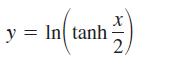
In Exercises find the derivative of the function. y = In| tanh X
In Exercises find the derivative of the function.g(x) = sech² 3x
In Exercises(a) Find the inverse function of ƒ,(b) Graph ƒ and ƒ-1 on the same set of coordinate axes, (c) Verify that ƒ-¹(ƒ(x)): ƒ(ƒ-¹(x)) = x, and (d) State the domains and ranges of ƒ and ƒ-¹. f(x) = x² = 5, x ≥ 0
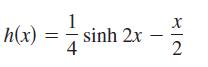
In Exercises find the derivative of the function. h(x) 1 4 - sinh 2x X 2
In Exercises find the derivative of the function.ƒ(t) = arctan(sinh t)
In Exercises find the derivative of the function.y = x cosh x − sinh x
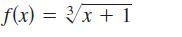
In Exercises(a) Find the inverse function of ƒ,(b) Graph ƒ and ƒ-1 on the same set of coordinate axes, (c) Verify that ƒ-¹(ƒ(x)): ƒ(ƒ-¹(x)) = x, and (d) State the domains and ranges of ƒ and ƒ-¹. f(x) = 3√x + 1
In Exercises(a) Find the inverse function of ƒ,(b) Graph ƒ and ƒ-1 on the same set of coordinate axes, (c) Verify that ƒ-¹(ƒ(x)): ƒ(ƒ-¹(x)) = x, and (d) State the domains and ranges of ƒ and ƒ-¹. f(x) = x³ + 2
In Exercises(a) Find the inverse function of ƒ,(b) Graph ƒ and ƒ-1 on the same set of coordinate axes, (c) Verify that ƒ-¹(ƒ(x)): ƒ(ƒ-¹(x)) = x, and (d) State the domains and ranges of ƒ and ƒ-¹. f(x)=√x + 1
In Exercises find the derivative of the function.ƒ(x) = ln(sinh x)
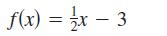
In Exercises(a) Find the inverse function of ƒ,(b) Graph ƒ and ƒ-1 on the same set of coordinate axes, (c) Verify that ƒ-¹(ƒ(x)): ƒ(ƒ-¹(x)) = x, and (d) State the domains and ranges of ƒ and ƒ-¹. f(x) = x - 3
In Exercises(a) Find the inverse function of ƒ,(b) Graph ƒ and ƒ-1 on the same set of coordinate axes, (c) Verify that ƒ-¹(ƒ(x)): ƒ(ƒ-¹(x)) = x, and (d) State the domains and ranges of ƒ and ƒ-¹. f(x) = 5x - 7
In Exercises find the derivative of the function.ƒ(x) = tanh(4x² + 3x)
In Exercises find the derivative of the function.y = sech(5x²)
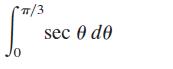
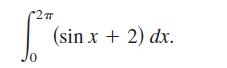
In Exercises evaluate the definite integral. 41/3 sec Ꮎ dᎾ
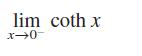
In Exercises find the limit. lim coth x x-0-
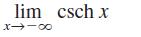
In Exercises find the limit. lim csch x 811x
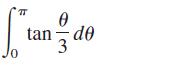
In Exercises evaluate the definite integral. TT 0 tan de
In Exercises find the derivative of the function.ƒ(x) = cosh(8x + 1)
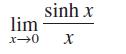
In Exercises find the limit. lim x-0 sinh x X
In Exercises find the derivative of the function.ƒ(x) = sinh 3x
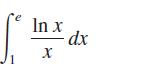
In Exercises evaluate the definite integral. In x X dx
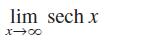
In Exercises find the limit. lim sech x x-x
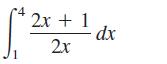
In Exercises evaluate the definite integral. 2x + 1 2x dx
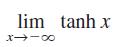
In Exercises find the limit. lim tanhx X1-00
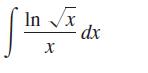
In Exercises find the indefinite integral. In √√x X dx
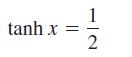
In Exercises use the value of the given hyperbolic function to find the values of the other hyperbolic functions at x. tanh x 1 2
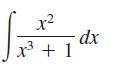
In Exercises find the indefinite integral. x² x³ + 1 dx
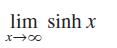
In Exercises find the limit. lim sinh x 00←x
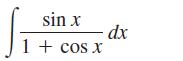
In Exercises find the indefinite integral. sin x 1 + cos x dx
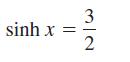
In Exercises use the value of the given hyperbolic function to find the values of the other hyperbolic functions at x. sinh x = 3 2
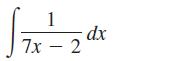
In Exercises find the indefinite integral. 1 7x - 2 dx
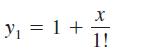
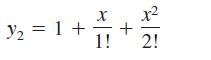
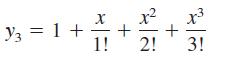
(a) Use a graphing utility to compare the graph of the function y = ex with the graph of each given function.(i)(ii)(iii)(b) Identify the pattern of successive polynomials in part (a), extend the pattern one more term, and compare the graph of the resulting polynomial function with the graph of y =
In Exercises verify the identity. x + y cosh x + cosh y = 2 cosh - 2 cosh x - y 2
In Exercises find an equation of the tangent line to the graph of the function at the given point. y = 2x² + In x², (1, 2)
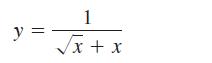
Use integration by substitution to find the area under the curvebetween x = 1 and x = 4. y = 1 √x + x
Use integration by substitution to find the area under the curvebetween x = 0 and x = π/4. y 1 sin² x + 4 cos² x
In Exercises find an equation of the tangent line to the graph of the function at the given point. y = ln(2 + x) + 2 2 + x² (-1,2)
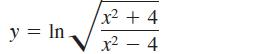
In Exercises find the derivative of the function. y = In x² + 4 2-4
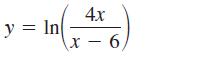
In Exercises find the derivative of the function. y = In 4x x-6)
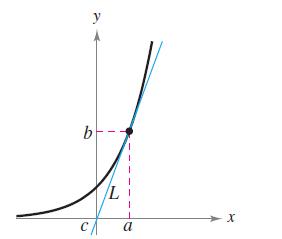
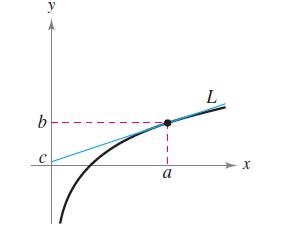
Let L be the tangent line to the graph of the function y = ex at the point (a, b). Show that the distance between a and c is always equal to 1. y b C L a - X
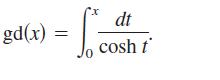
The Gudermannian function of x is gd(x) = arctan(sinh x).(a) Graph gd using a graphing utility.(b) Show that gd is an odd function.(c) Show that gd is monotonic and therefore has an inverse.(d) Find the inflection point of gd.(e) Verify that gd(x) = arctan(sinh x).(f) Verify that gd(x) = So dt cosh
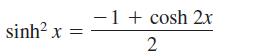
In Exercises verify the identity. sinh? x = -1 + cosh 2x 2
In Exercises verify the identity.sinh (x + y) = sinh x cosh y + cosh x sinh y
Let L be the tangent line to the graph of the function y = In x at the point (a, b). Show that the distance between b and c is always equal to 1. y b C a L X
In Exercises verify the identity.e2x = sinh 2x + cosh 2x
In Exercises find the derivative of the function. f(x)=x√In x
In Exercises find the derivative of the function. f(x) = [In(2x)]³
In Exercises verify the identity.sinh 2x = 2 sinh x cosh x
In Exercises verify the identity. cosh²x = 1 + cosh 2x 2
In Exercises find the derivative of the function. f(x) = ln(3x² + 2x)
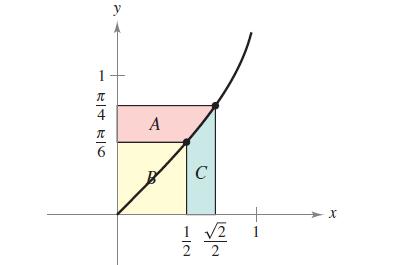
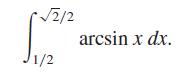
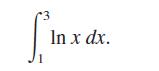
Consider the three regions A, B, and C determined by the graph of ƒ(x) = arcsin x, as shown in the figure.(a) Calculate the areas of regions A and B.(b) Use your answers in part (a) to evaluate the integral(c) Use the methods in part (a) to evaluate the integral(d) Use the methods in part (a) to
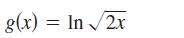
In Exercises find the derivative of the function. g(x) = In √2x
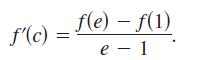
Apply the Mean Value Theorem to the function ƒ(x) = In x on the closed interval [1, e]. Find the value of c in the open interval (1, e) such that f'(c) = f(e) - f(1) e-1
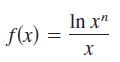
Show thatis a decreasing function for x > e and n > 0. f(x) In xn X
In Exercises verify the identity.coth²x - csch² x = 1
In Exercises write the expression as the logarithm of a single quantity. In 3+ln(4x²) - ln x
In Exercises write the expression as the logarithm of a single quantity. 3[In x 2 In(x² + 1)] + 2 In 5
In Exercises verify the identity.tanh²x + sech² x = 1
In Exercises use the properties of logarithms to expand the logarithmic expression. In[(x² + 1)(x - 1)]
In Exercises evaluate the function. If the value is not a rational number, round your answer to three decimal places.(a) csch-¹ 2(b) coth-¹ 3
In Exercises evaluate the function. If the value is not a rational number, round your answer to three decimal places.(a) cosh-1 2(b) sech-¹ 2/3
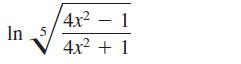
In Exercises use the properties of logarithms to expand the logarithmic expression. In 5, 2 4x² - 1 4x² + 1
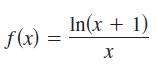
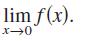
(a) Use a graphing utility to graphon theinterval [-1, 1].(b) Use the graph to estimate(c) Use the definition of derivative to prove your answer to part (b). f(x) = In(x + 1) Xx
Graph the exponential function y = ax for a = 0.5, 1.2, and 2.0. Which of these curves intersects the line y = x? Determine all positive numbers a for which the curve y = ax intersects the line y = x.
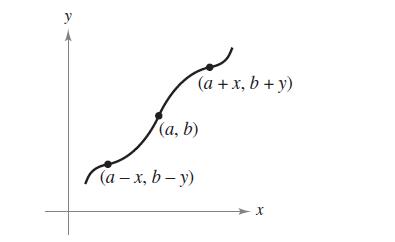
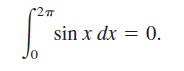
Recall that the graph of a function y = ƒ(x) issymmetric with respect to the origin if, whenever (x, y) is apoint on the graph, (-x, -y) is also a point on the graph. Thegraph of the function y = ƒ(x) is symmetric with respect tothe point (a, b) if, whenever (a - x, b - y) is a point on thegraph,
In Exercises evaluate the function. If the value is not a rational number, round your answer to three decimal places.(a) sinh-1 0(b) tanh-1 0)
In Exercises evaluate the function. If the value is not a rational number, round your answer to three decimal places.(a) csch(In 2)(b) coth(In 5)
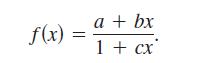
To approximate ex, you can use a functionof the form(This function is known as a Padé approximation.) The values of ƒ(0), ƒ'(0), and ƒ"(0) are equal to the corresponding values ofex. Show that these values are equal to 1 and find the valuesof a, b, and c such that ƒ(0) = ƒ'(0) = ƒ"(0) = 1.
In Exercises evaluate the function. If the value is not a rational number, round your answer to three decimal places.(a) cosh 0(b) sech 1
In Exercises sketch the graph of the function and state its domain.ƒ(x) = ln(x + 3)
In Exercises evaluate the function. If the value is not a rational number, round your answer to three decimal places.(a) sinh 3(b) tanh(−2)
In Exercises sketch the graph of the function and state its domain.ƒ(x) = ln x - 3
Prove or disprove: there is at least one straight line normal to the graph of y = cosh x at a point (a, cosh a) and also normal to the graph of y = sinh x at a point (c, sinh c). [At a point on a graph, the normal line is the perpendicularto the tangent at that point. Also, cosh x =
From the vertex (0, c) of the catenary y = c cosh(x/c) a line L is drawn perpendicular to the tangent to the catenary at point P. Prove that the length of L intercepted by the axes is equal to the ordinate y of the point P.
Show thatarctan(sinh x) = arcsin(tanh x).
Showing 6700 - 6800
of 9867
First
61
62
63
64
65
66
67
68
69
70
71
72
73
74
75
Last
Step by Step Answers

 Get 50% OFF
Claim Now
Get 50% OFF
Claim Now