New Semester
Started
Get
50% OFF
Study Help!
--h --m --s
Claim Now
Question Answers
Textbooks
Find textbooks, questions and answers
Oops, something went wrong!
Change your search query and then try again
S
Books
FREE
Study Help
Expert Questions
Accounting
General Management
Mathematics
Finance
Organizational Behaviour
Law
Physics
Operating System
Management Leadership
Sociology
Programming
Marketing
Database
Computer Network
Economics
Textbooks Solutions
Accounting
Managerial Accounting
Management Leadership
Cost Accounting
Statistics
Business Law
Corporate Finance
Finance
Economics
Auditing
Tutors
Online Tutors
Find a Tutor
Hire a Tutor
Become a Tutor
AI Tutor
AI Study Planner
NEW
Sell Books
Search
Search
Sign In
Register
study help
mathematics
calculus 10th edition
Calculus 10th Edition Ron Larson, Bruce H. Edwards - Solutions
In Exercises determine whether the statement is true or false. If it is false, explain why or give an example that shows it is false.If ƒ(x)=g(x)ex, then the only zeros of ƒ are the zeros of g.
(a) Show that (2³)² ≠ 2(³²).(b) Are ƒ(x) = (xx)x and g(x) = x(xx) the same function? Why or why not?(c) Find ƒ'(x) and g'(x).
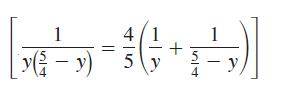
Show that solving the logistic differential equationresults in the logistic growth function dy 8 5 25. dt 4 || y(0) = 1
Given the exponential function ƒ(x) = ax, show that(a) ƒ(u + v) = ƒ(u) • ƒ(v).(b) ƒ(2x) = [ƒ(x)]².
Which is greaterwhere n > 8? (√n)√n+1 or (√n + 1)√n
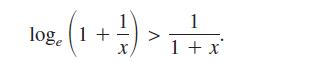
Show that if x is positive, then 1 lug. (1+²) > 1 + x loge
In Exercises find an equation of the tangent line to the graph of the function at the given point. y = x²ex - 2xe* + 2e*, (1, e)
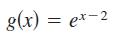
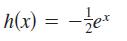
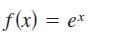
Use a graphing utility to graph ƒ(x) = ex and the given function in the same viewing window. How are the two graphs related?(a)(b)(c) g(x) = ex-2
Verify that the functionincreases at a maximum rate when y = L/2. y L 1 + ae-x/b> a> 0, b>0, L> 0
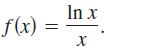
Let(a) Graph fon (0, ∞) and show that ƒ is strictly decreasing on (e, ∞).(b) Show that if e ≤ A < B, then AB > BA.(c) Use part (b) to show that eπ > πe. In x f(x) = - X
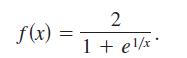
Consider the function(a) Use a graphing utility to graph ƒ.(b) Write a short paragraph explaining why the graph hasa horizontal asymptote at y = 1 and why the functionhas a nonremovable discontinuity at x = 0. f(x) = 2 1 + el/x*
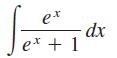
Without integrating, state the integration formula you can use to integrate each of the following.(a)(b) Ser ex ex + 1 dx
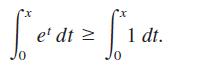
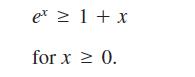
Given ex ≥ 1 for x ≥ 0, it follows thatPerform this integration to derive the inequality 1 dt. x₂ up, a 0 S
The position function of a particle moving along the x-axis is x(t) = Aekt + Be-kt, where A, B,and k are positive constants.(a) During what times is the particle closest to the origin?(b) Show that the acceleration of the particle is proportional to the position of the particle. What is the
Find, to three decimal places, the value of x such that e-x = x. (Use Newton's Method or the zero or root feature of a graphing utility.)
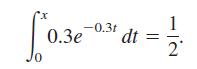
The median waiting time (in minutes) for people waiting for service in a convenience store is given by the solution of the equationWhat is the median waiting time? Jo -0.3t 0.3e dt = - 2
In your own words, state the properties of the natural exponential function.
Is there a function ƒ such that ƒ(x) = ƒ'(x)? If so, identify it.
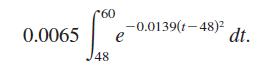
A car battery has an average lifetime of 48 months with a standard deviation of 6 months. The battery lives are normally distributed. The probability that a given battery will last between 48 months and 60 months isUse the integration capabilities of a graphing utility to approximate the integral.
In Exercises find the area of the region bounded by the graphs of the equations. Use a graphing utility to graph the region and verify your result. y = e- 2x + 2, y = 0, x = 0, x = 2
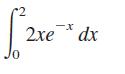
In Exercises approximate the integral using the Midpoint Rule, the Trapezoidal Rule, and Simpson's Rule with n = 12. Use a graphing utility to verify your results. S²³ 2xe* dx
Find the value of a such that the area bounded by y = e-x, the x-axis, x = -a, andx = a is 8/3.
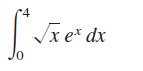
In Exercises approximate the integral using the Midpoint Rule, the Trapezoidal Rule, and Simpson's Rule with n = 12. Use a graphing utility to verify your results. So √x ex dx 10
In Exercises find the area of the region bounded by the graphs of the equations. Use a graphing utility to graph the region and verify your result. y = e, y = 0, x = 0, x = 5
In Exercises find the area of the region bounded by the graphs of the equations. Use a graphing utility to graph the region and verify your result. y = xe−x/4, y = 0, x = 0, x = V6
In Exercises find the area of the region bounded by the graphs of the equations. Use a graphing utility to graph the region and verify your result. y=e-2x, y = 0, x = -1, x = 3
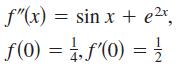
In Exercises find the particular solution that satisfies the initial conditions. f"(x) = sin x + ²x, ƒ(0) = 1,ƒ'(0) = 1/2
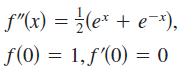
In Exercises find the particular solution that satisfies the initial conditions. f"(x) = ²/1 (ex + e¯x), f(0) = 1, f'(0) = 0
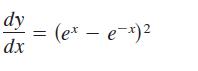
In Exercises solve the differential equation. dy dx = (ex - e-x)²
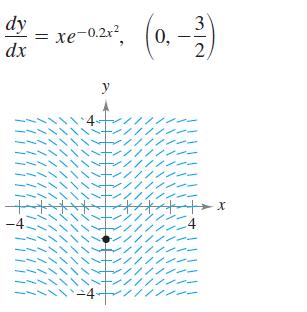
In Exercises a differential equation, a point, and a slope field are given. (a) Sketch two approximate solutions of the differential equation on the slope field, one of which passes through the given point. (b) Use integration to find the particular solution of the differential equation
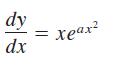
In Exercises solve the differential equation. dy dx = xeax²
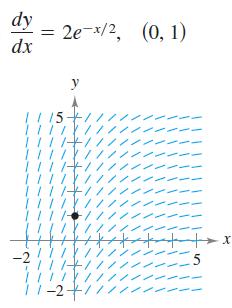
In Exercises a differential equation, a point, and a slope field are given. (a) Sketch two approximate solutions of the differential equation on the slope field, one of which passes through the given point. (b) Use integration to find the particular solution of the differential equation
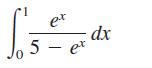
In Exercises evaluate the definite integral. Use a graphing utility to verify your result. et 5 et dx
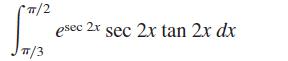
In Exercises evaluate the definite integral. Use a graphing utility to verify your result. π/2 Jπ/3 esec 2x sec 2x tan 2x dx
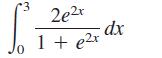
In Exercises evaluate the definite integral. Use a graphing utility to verify your result. 3 2e2x 1 + e²x dx
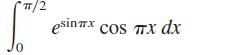
In Exercises evaluate the definite integral. Use a graphing utility to verify your result. TT/2 0 esinx cos Tx dx
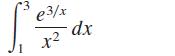
In Exercises evaluate the definite integral. Use a graphing utility to verify your result. z-X xp. e3/x نرا
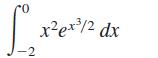
In Exercises evaluate the definite integral. Use a graphing utility to verify your result. L -2 x²ex²³/2 dx
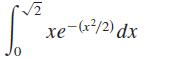
In Exercises evaluate the definite integral. Use a graphing utility to verify your result. √√2 0 xe-(3/2) dx
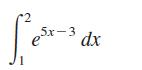
In Exercises evaluate the definite integral. Use a graphing utility to verify your result. 2 ၂။ 1 esx-3 dx
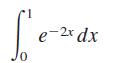
In Exercises evaluate the definite integral. Use a graphing utility to verify your result. So 0 e-2x dx
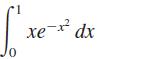
In Exercises evaluate the definite integral. Use a graphing utility to verify your result. S xe-x dx
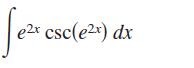
In Exercises find the indefinite integral. Sear e2x csc(e²x) dx
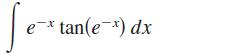
In Exercises find the indefinite integral. S ex tan(ex) dx
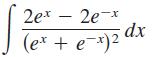
In Exercises find the indefinite integral. 2ex - 2e-x (ex + e-x)2' dx
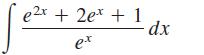
In Exercises find the indefinite integral. e2x + 2ex + 1 ex dx
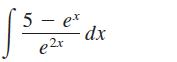
In Exercises find the indefinite integral. ex 5 - et e2x dx
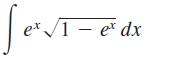
In Exercises find the indefinite integral. S₁²√T ex√√1 - ex dx
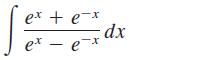
In Exercises find the indefinite integral. ex + ex ex ex dx
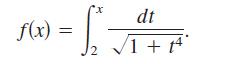
Let Find (f ¹)'(0). f(x) = "x S₁² dt 2 √1+14*
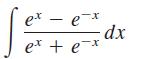
In Exercises find the indefinite integral. ex - ex ex + ex dx
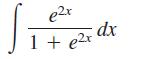
In Exercises find the indefinite integral. S₁ e2x 1 + ²x dx
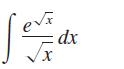
In Exercises find the indefinite integral. e√x X dx
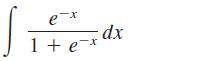
In Exercises find the indefinite integral. S e-x 1 + e* dx
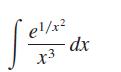
In Exercises find the indefinite integral. e¹/x² x3 dx
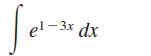
In Exercises find the indefinite integral. Sel el-3x dx
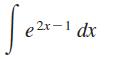
In Exercises find the indefinite integral. Sez e2x-1 dx
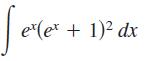
In Exercises find the indefinite integral. [e ex(ex + 1)² dx
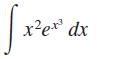
In Exercises find the indefinite integral. [x²e= x²ex³ dx
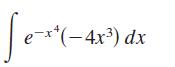
In Exercises find the indefinite integral. fext e-x*(-4x³) dx
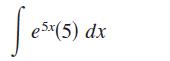
In Exercises find the indefinite integral. Ses e5x (5) dx
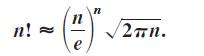
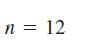
In Exercises approximate find the exact value of n!, and then n! using Stirling's Formula.For large values of n,can be approximated by Stirling’s Formula, n! = 1·2·3·4··· (n − 1) n .
In Exercises approximate find the exact value of n!, and then n! using Stirling's Formula.For large values of n,can be approximated by Stirling’s Formula, n! = 1·2·3·4··· (n − 1) n .
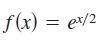
In Exercises use a graphing utility to graph the function. Then graphin the same viewing window. Compare the values of ƒ, P?, P2, and their first derivatives at x = 0. P₁(x) = f(0) + f'(0)(x - 0) and P₂(x) = f(0) + f'(0)(x − 0) + ½ƒ"(0)(x − 0)² - -
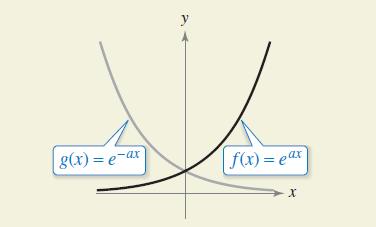
The figure shows the graphs of ƒ and g, where a is a positive real number. Identify the open interval(s) on which the graphs of ƒ and g are (a) Increasing or decreasin(b) Concave upward or concave downward g(x)=e-ax f(x)= eax X
In Exercises use a graphing utility to graph the function. Then graphin the same viewing window. Compare the values of ƒ, P?, P2,and their first derivatives at x = 0. P₁(x) = f(0) + f'(0)(x - 0) and P₂(x) = f(0) + ƒ'(0)(x −0) + f(0)(x −0)²
The displacement from equilibrium of a mass oscillating on the end of a spring suspended from a ceiling is y = 1.56e-0.22t cos 4.9t, where y is the displacement (in feet) and t is the time (in seconds). Use a graphing utility to graph the displacement function on the interval [0, 10]. Find a value
Find a point on the graph of the function ƒ(x) = e2x such that the tangent line to the graph at that point passes through the origin. Use a graphing utility to graph ƒ and the tangent line in the same viewing window.
The value V of an item t years after it is purchased is V = 15,000e-0.6286, 0≤ t ≤ 10.(a) Use a graphing utility to graph the function.(b) Find the rates of change of V with respect to t when t = 1 and t = 5.(c) Use a graphing utility to graph the tangent lines to thefunction when t = 1 and t =
In Exercises find the extrema and the points of inflection (if any exist) of the function. Use a graphing utility to graph the function and confirm your results. f(x) = −2+ e³x(4- 2x)
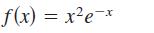
In Exercises find the extrema and the points of inflection (if any exist) of the function. Use a graphing utility to graph the function and confirm your results. f(x) = x²e-x
In Exercises find the extrema and the points of inflection (if any exist) of the function. Use a graphing utility to graph the function and confirm your results. g(t) = 1 + (2 + t)e-t
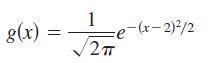
In Exercises find the extrema and the points of inflection (if any exist) of the function. Use a graphing utility to graph the function and confirm your results. 8(x) = 1 :e-(x-2)2/2 12元
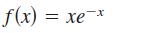
In Exercises find the extrema and the points of inflection (if any exist) of the function. Use a graphing utility to graph the function and confirm your results. f(x) = xe-x
Find the area of the largest rectangle that can be inscribed under the curve y = e-x² in the first and secondquadrants.
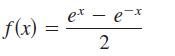
In Exercises find the extrema and the points of inflection (if any exist) of the function. Use a graphing utility to graph the function and confirm your results. f(x): = ex ex 2
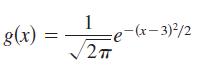
In Exercises find the extrema and the points of inflection (if any exist) of the function. Use a graphing utility to graph the function and confirm your results. 1 = g(x): =e √2TT 2π -(x-3)²/2
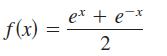
In Exercises find the extrema and the points of inflection (if any exist) of the function. Use a graphing utility to graph the function and confirm your results. f(x) = ex + ex 2
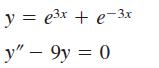
In Exercises show that the function y = ƒ(x) is a solution of the differential equation. y = e³x + e-3x y" 9y0
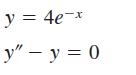
In Exercises show that the function y = ƒ(x) is a solution of the differential equation. y = 4e-x y" - y = 0
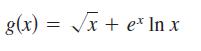
In Exercises find the second derivative of the function. g(x) = √√√x + e* In x
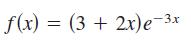
In Exercises find the second derivative of the function. f(x) (3 + 2x)e-3x =
In Exercises find an equation of the tangent line to the graph of the function at the given point. 1 + In xy = ex-y, (1, 1)
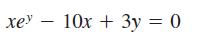
In Exercises use implicit differentiation to find dy/dx. xe - 10x + 3y = 0
In Exercises find an equation of the tangent line to the graph of the function at the given point. y = xex - ex, (1, 0)
In Exercises find an equation of the tangent line to the graph of the function at the given point. xeyye* = 1, (0, 1)
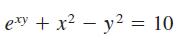
In Exercises use implicit differentiation to find dy/dx. exy + x² - y² = 10
In Exercises find an equation of the tangent line to the graph of the function at the given point. ex + ex 2 y = In- (0, 0)
In Exercises find an equation of the tangent line to the graph of the function at the given point. f(x) = e¹-x, (1, 1)
In Exercises find an equation of the tangent line to the graph of the function at the given point. f(x)=e-2x, (0, 1)
In Exercises find an equation of the tangent line to the graph of the function at the given point. f(x) = e Inx, (1,0)
In Exercises find an equation of the tangent line to the graph of the function at the given point. y=e-2x+x², (2, 1)
In Exercises decide whether the function has an inverse function. If so, what is the inverse function?h(t) is the height of the tide t hours after midnight, where 0 ≤ t < 24.
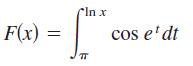
In Exercises find the derivative. F(x) = clnx S TT cos e¹dt
In Exercises find an equation of the tangent line to the graph of the function at the given point. f(x) = e³x, (0, 1)
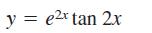
In Exercises find the derivative. y = e²x tan 2x
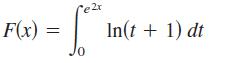
In Exercises find the derivative. F(x) = e2x So 0 In(t + 1) dt
In Exercises find the derivative. y ex(sin x + cos x) =
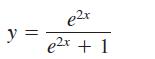
In Exercises find the derivative. У e2x e2x + 1
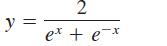
In Exercises find the derivative. У 2 ex + ex
Showing 7100 - 7200
of 9867
First
65
66
67
68
69
70
71
72
73
74
75
76
77
78
79
Last
Step by Step Answers

 Get 50% OFF
Claim Now
Get 50% OFF
Claim Now