New Semester
Started
Get
50% OFF
Study Help!
--h --m --s
Claim Now
Question Answers
Textbooks
Find textbooks, questions and answers
Oops, something went wrong!
Change your search query and then try again
S
Books
FREE
Study Help
Expert Questions
Accounting
General Management
Mathematics
Finance
Organizational Behaviour
Law
Physics
Operating System
Management Leadership
Sociology
Programming
Marketing
Database
Computer Network
Economics
Textbooks Solutions
Accounting
Managerial Accounting
Management Leadership
Cost Accounting
Statistics
Business Law
Corporate Finance
Finance
Economics
Auditing
Tutors
Online Tutors
Find a Tutor
Hire a Tutor
Become a Tutor
AI Tutor
AI Study Planner
NEW
Sell Books
Search
Search
Sign In
Register
study help
mathematics
calculus 10th edition
Calculus 10th Edition Ron Larson, Bruce H. Edwards - Solutions
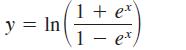
In Exercises find the derivative. y = In 1 + ex 1 ex,
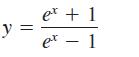
In Exercises find the derivative. y = et + 1 et - 1
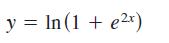
In Exercises find the derivative. y In (1e2x) =
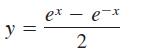
In Exercises find the derivative. У ex - e-x - 2
In Exercises find the derivative. g(t) = e-3/1²
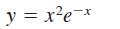
In Exercises find the derivative. y = x²e-x
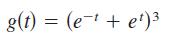
In Exercises find the derivative. g(t) = (et + e¹)³
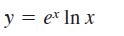
In Exercises find the derivative. y = ex ln x
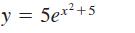
In Exercises find the derivative. y = ex² +5
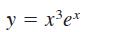
In Exercises find the derivative. y = x³ ex
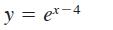
In Exercises find the derivative. y = ex-4
In Exercises find the derivative. y = xe4x
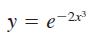
In Exercises find the derivative. y = e-2r³
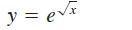
In Exercises find the derivative. y = e√x
In Exercises find the derivative. y = e-8x
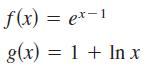
In Exercises illustrate that the functions are inverses of each other by graphing both functions on the same set of coordinate axes. f(x) = ex-1 g(x) = 1 + In x
In Exercises show that ƒ is strictly monotonic on the given interval and therefore has an inverse function on that interval. f(x) = cos x, [0, π]
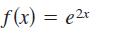
In Exercises find the derivative. f(x) = ²x 2x
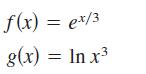
In Exercises illustrate that the functions are inverses of each other by graphing both functions on the same set of coordinate axes. f(x) = ex/3 g(x) = ln x³
In Exercises show that ƒ is strictly monotonic on the given interval and therefore has an inverse function on that interval. f(x) = cotx, (0, TT)
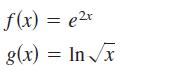
In Exercises illustrate that the functions are inverses of each other by graphing both functions on the same set of coordinate axes. f(x) = ²x g(x) = In√√x
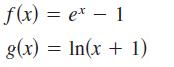
In Exercises illustrate that the functions are inverses of each other by graphing both functions on the same set of coordinate axes. f(x) = ex - 1 g(x) = In(x + 1)
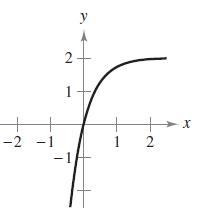
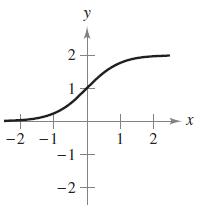
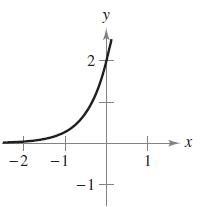
In Exercises match the equation with the correct graph. Assume that a and C are positive real numbers. [The graphs are labeled (a), (b), (c), and (d).](a)(b)(c)(d) -2 -1 2 1 -1, y 1 2
In Exercises match the equation with the correct graph. Assume that a and C are positive real numbers. [The graphs are labeled (a), (b), (c), and (d).](a)(b)(c)(d) -2 -1 2 1 -1, y 1 2
In Exercises match the equation with the correct graph. Assume that a and C are positive real numbers. [The graphs are labeled (a), (b), (c), and (d).](a)(b)(c)(d) -2 -1 2 1 -1, y 1 2
In Exercises match the equation with the correct graph. Assume that a and C are positive real numbers. [The graphs are labeled (a), (b), (c), and (d).](a)(b)(c)(d) -2 -1 2 1 -1, y 1 2
In Exercises sketch the graph of the function. y = e-x²
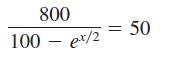
In Exercises solve for x accurate to three decimal places. 800 100-ex/2 = 50
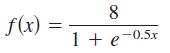
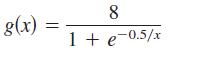
Use a graphing utility to graph the function. Use the graph to determine any asymptotes of the function.(a)(b) f(x) = 8 1 + e-0.5x
In Exercises sketch the graph of the function. y = ex-1
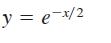
In Exercises sketch the graph of the function. y = e = x/2
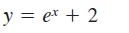
In Exercises sketch the graph of the function. y = ex + 2
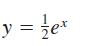
In Exercises sketch the graph of the function. y = //ex
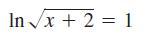
In Exercises solve for x accurate to three decimal places. In√x + 2 = 1
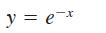
In Exercises sketch the graph of the function. y = ex
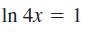
In Exercises solve for x accurate to three decimal places. In 4x = 1
In Exercises solve for x accurate to three decimal places. In(x - 2)² = 12
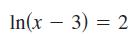
In Exercises solve for x accurate to three decimal places. In(x 3) = 2
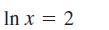
In Exercises solve for x accurate to three decimal places. In x = 2
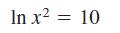
In Exercises solve for x accurate to three decimal places. In x² = 10
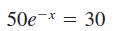
In Exercises solve for x accurate to three decimal places. 50e-x = 30
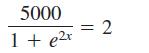
In Exercises solve for x accurate to three decimal places. 5000 1 + 2x 2
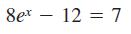
In Exercises solve for x accurate to three decimal places. 8ex - 12 = 7
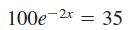
In Exercises solve for x accurate to three decimal places. 100e-2x = 35
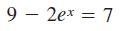
In Exercises solve for x accurate to three decimal places. 92ex = 7
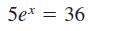
In Exercises solve for x accurate to three decimal places. 5e* = 36
In Exercises solve for x accurate to three decimal places. ex = 12
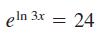
In Exercises solve for x accurate to three decimal places. eln 3x = 24
In Exercises solve for x accurate to three decimal places. elnx = 4
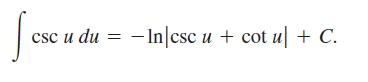
Prove that so csc u du = - In|csc u + cot u + C.
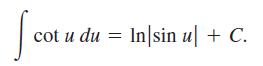
Prove that S cot u du = ln sin u + C.
Prove that if a function has an inverse function, then the inverse function is unique.
In Exercises show that ƒ is strictly monotonic on the given interval and therefore has an inverse function on that interval. f(x) = x + 2], [-2,00)
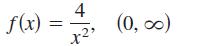
In Exercises show that ƒ is strictly monotonic on the given interval and therefore has an inverse function on that interval. f(x) حاب x2' (0,00)
In Exercises show that ƒ is strictly monotonic on the giveninterval and therefore has an inverse function on that interval. f(x) = (x-4)², [4,00)
In Exercises show that ƒ and g are inverse functions (a) Analytically (b) Graphically. f(x) = 5x + 1, g(x) = x - 1 5
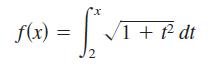
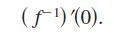
Show thatis one-to-one and find f(x) = J2 √1 + 1² dt
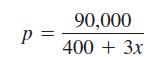
The demand equation for a product is where p is the price (in dollars) and x is the number (in thousands). Find the average price p on the interval 40 ≤ x ≤ 50. P || 90,000 400 + 3x
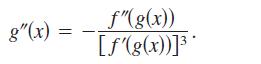
Let ƒ be twice-differentiable and one-to-one on an open interval I. Show that its inverse function g satisfiesWhen ƒ is increasing and concave downward, what is the concavity of ƒ-1 = g? g"(x) = f"(g(x)) [f'(g(x))]³*
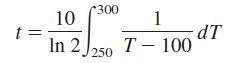
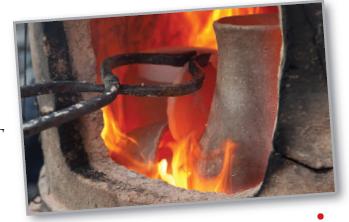
Find the time required for an object to cool from 300°F to 250°F by evaluatingwhere t is time in minutes. *300 1902 190 250 t= In 1 T - 100 dT
Is the converse of the second part of Theorem 5.7 true? That is, if a function is one-to-one (and therefore has an inverse function), then must the function be strictly monotonic? If so, prove it. If not, give a counterexample.Data from in Theorem 5.7 THEOREM 5.7 The Existence of an Inverse
The rate of change in sales S is inversely proportional to time t (t > 1), measured in weeks. Find S as a function of t when the sales after 2 and 4 weeks are 200 units and 300 units, respectively.
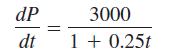
A population of bacteria P is changing at a rate ofwhere t is the time in days. The initial population (when t = 0) is 1000. Write an equation that gives the population at any time t. Then find the population when t = 3 days. dP dt 3000 1 + 0.25t
Prove that a function has an inverse function if and only if it is one-to-one.
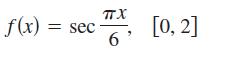
In Exercises find the average value of the function over the given interval. f(x) = = sec π.χ. 6 [0, 2]
Prove that if ƒ has an inverse function, then (ƒ-¹)-¹ = ƒ.
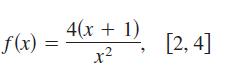
In Exercises find the average value of the function over the given interval. f(x) = 4(x + 1) x² [2, 4]
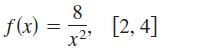
In Exercises find the average value of the function over the given interval. f(x) = 8 x25 [2, 4]
Let ƒ and g be one-to-one functions. Prove that(a) ƒ º g is one-to-one.(b) (ƒ º g)-¹ (x) = (g-¹ º ƒ-¹)(x).
(a) Show that ƒ(x) = 2x³ + 3x² − 36x is not one-to-one on (-∞, ∞).(b) Determine the greatest value c such that ƒ is one-to-oneon (-c, c).
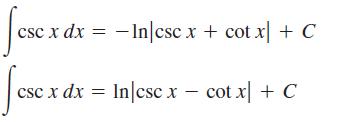
In Exercises show that the two formulas are equivalent. csc x dx = - In|csc x + cotx] + C csc x dx = In|cse x – cot .x| + C
In Exercises determine whether the statement is true or false. If it is false, explain why or give an example that shows it is false.There exists no function ƒ such that ƒ = ƒ-¹.
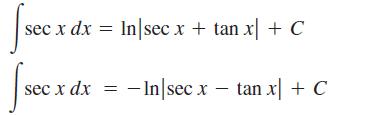
In Exercises show that the two formulas are equivalent. sec x dx = In secx + tan x + C sec x dx = - In secx - tan x] + C
In Exercises determine whether the statement is true or false. If it is false, explain why or give an example that shows it is false.If ƒ(x) = x", where n is odd, then ƒ-¹ exists.
In Exercises determine whether the statement is true or false. If it is false, explain why or give an example that shows it is false.If the inverse function of ƒ exists, then the y-intercept of ƒ isan x-intercept of ƒ-¹.
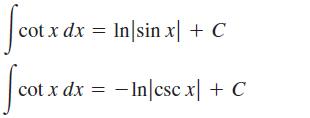
In Exercises show that the two formulas are equivalent. [cotx dx cot x dx = In|sin x + C cot x dx = - In|csc x| + C
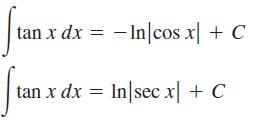
In Exercises show that the two formulas are equivalent. tan x dx = - In cos x + C tan x dx = In|sec x] + C
In Exercises determine whether the statement is true or false. If it is false, explain why or give an example that shows it is false.If ƒ is an even function, then ƒ-1 exists.
The function ƒ(x) = k(2 - x - x³) is one-to-one and ƒ-¹(3) = -2. Find k.
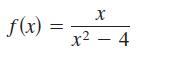
In Exercises the derivative of the function has the same sign for all x in its domain, but the function is not one-to-one. Explain. f(x) = X x² - 4
Find a value of x such thatis equal to (a) ln 5 (b) 1 x - dt
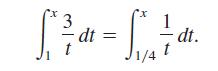
Find a value of x such that 3 1 [₁²³ a₁ = [₁,₂²7 a ₁. - dt - dt. t 1/4
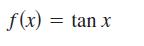
In Exercises the derivative of the function has the same sign for all x in its domain, but the function is not one-to-one. Explain. f(x) = tan x
Describe the relationship between the graph of a function and the graph of its inverse function.
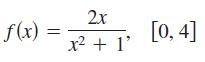
In Exercises determine which value best approximates the area of the region between the x-axis and the graph of the function over the given interval. (Make your selection on the basis of a sketch of the region, not by performing any calculations.)(a) 3(b) 7(c) -2(d) 5(e) 1 f(x) 2x x² +
In Exercises determine which value best approximates the area of the region between the x-axis and the graph of the function over the given interval. (Make your selection on the basis of a sketch of the region, not by performing any calculations.)(a) 6(b) -6(c) 1/2(d) 1.25(e) 3 f(x) = sec x, [0, 1]
Describe how to find the inverse function of a one-to-one function given by an equation in x and y. Give an example.
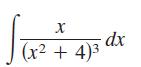
In Exercises state the integration formula you would use to perform the integration. Do not integrate. X (x² + 4)³ - dx
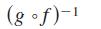
In Exercises use the functions ƒ(x) = x + 4 and g(x) = 2x - 5 to find the given function. (gof)-1
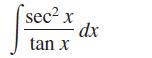
In Exercises state the integration formula you would use to perform the integration. Do not integrate. sec² x tan x dx
In Exercises use the functions ƒ(x) = x + 4 and g(x) = 2x - 5 to find the given function. (fog)-1
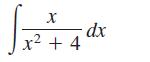
In Exercises state the integration formula you would use to perform the integration. Do not integrate. √₁² X x² + 4 dx
In Exercises use the functions ƒ(x) = x + 4 and g(x) = 2x - 5 to find the given function. 1 f-log-¹
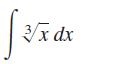
In Exercises state the integration formula you would use to perform the integration. Do not integrate. [³ 3√/x dx
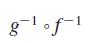
In Exercises use the functions ƒ(x) = x + 4 and g(x) = 2x - 5 tofind the given function. g-1 of 1
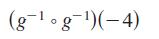
In Exercises use the functions ƒ(x) = 1/8x − 3 and g(x) = x³ to find the given value. (g-¹g-¹)(-4)
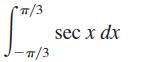
In Exercises use the Trapezoidal Rule and Simpson's Rule to approximate the value of the definite integral. Let n = 4 and round your answer to four decimal places. Use a graphing utility to verify your result. π/3 J-T/3 sec x dx
In Exercises use the functions ƒ(x) = 1/8x − 3 and g(x) = x³ to find the given value. (g-¹g-¹)(-4)
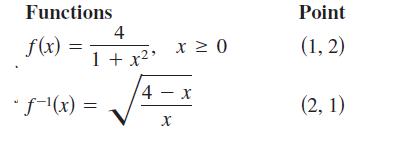
In Exercises (a) Find the domains of ƒ and ƒ-¹(b) Find the ranges of ƒ and ƒ-¹ (c) Graph ƒ and ƒ-¹(d) Show that the slopes of the graphs of ƒ and ƒ-¹ are reciprocals at the given points. Functions f(x)= 4 1 + x²⁹ • f-¹(x) = x ≥ 0 4- x X Point (1, 2) (2, 1)
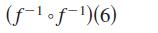
In Exercises use the functions ƒ(x) = 1/8x − 3 and g(x) = x³ to find the given value. (f-¹ of ¹)(6)
Showing 7200 - 7300
of 9867
First
66
67
68
69
70
71
72
73
74
75
76
77
78
79
80
Last
Step by Step Answers

 Get 50% OFF
Claim Now
Get 50% OFF
Claim Now