New Semester
Started
Get
50% OFF
Study Help!
--h --m --s
Claim Now
Question Answers
Textbooks
Find textbooks, questions and answers
Oops, something went wrong!
Change your search query and then try again
S
Books
FREE
Study Help
Expert Questions
Accounting
General Management
Mathematics
Finance
Organizational Behaviour
Law
Physics
Operating System
Management Leadership
Sociology
Programming
Marketing
Database
Computer Network
Economics
Textbooks Solutions
Accounting
Managerial Accounting
Management Leadership
Cost Accounting
Statistics
Business Law
Corporate Finance
Finance
Economics
Auditing
Tutors
Online Tutors
Find a Tutor
Hire a Tutor
Become a Tutor
AI Tutor
AI Study Planner
NEW
Sell Books
Search
Search
Sign In
Register
study help
mathematics
calculus 4th
Calculus 4th Edition Jon Rogawski, Colin Adams, Robert Franzosa - Solutions
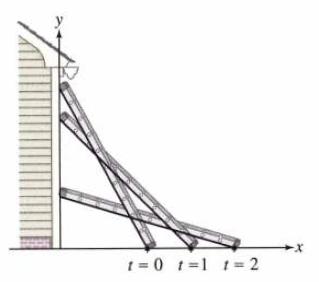
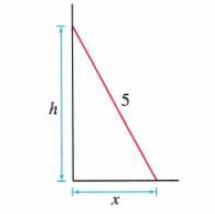
Refer to a 5-m ladder sliding down a wall, as in Figures 5 and 6. The variable h is the height of the ladder’s top at time t, and x is the distance from the wall to the ladder’s bottom.Figure 5Figure 6Assume the bottom slides away from the wall at a rate of 0.8 m/s. Find the velocity of the top
Calculate the derivative with respect to x of the other variable appearing in the equation.3y3 + x2 = 5
Let ƒ(x) = (2x2 − 5)2. Compute ƒ'(x) three different ways: 1. Multiplying out and then differentiating, 2. using the Product Rule, and 3. using the Chain Rule. Show that the results coincide.
Compute the derivative.ƒ(θ) = tan θ sec θ
Calculate y" and y"'.y = θ2(2θ + 7)
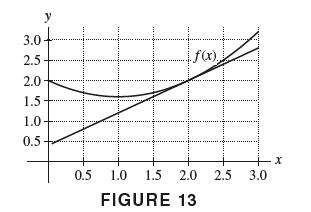
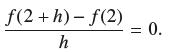
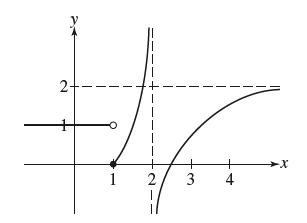
In Exercises 9–12, refer to Figure 13.Find a value of h for which 3.0 2.5 2.0 1.5 1.0 0.5 y 0.5 1.0 f(x). 1.5 2.0 2.5 3.0 FIGURE 13 ·x
Compute dy/dx using the limit definition.y = 1/(x − 1)2
Calculate the derivative with respect to x of the other variable appearing in the equation.y4 − 2y = 4x3 + x
Let ƒ(x) = (x + sin x)−1. Compute ƒ'(x) separately using the Quotient Rule and the Chain Rule. Show that the results coincide.
Compute the derivative.k(θ) = θ2 sin2 θ
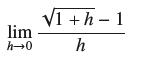
Express the limit as a derivative. lim h→0 √1+h-1 h
Suppose that the top is sliding down the wall at a rate of 1.2 m/s. Calculate dx/dt when h = 3 m.
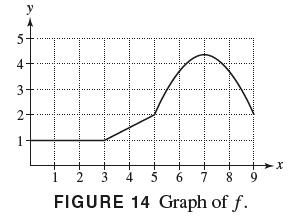
In Exercises 13–16, refer to Figure 14.Determine ƒ'(a) for a = 1, 2, 4, 7. 4 3 2. 1 2 4 5 6 7 8 9 FIGURE 14 Graph of f. 1 3 X
Suppose that h(0) = 4 and the top slides down the wall at a rate of 1.2 m/s. Calculate x and dx/dt at t = 2 s.
Calculate the derivative with respect to x of the other variable appearing in the equation.x2y + 2x3y = x + y
Compute the derivative using derivative rules that have been introduced so far.y = (x4 + 5)3
Compute the derivative.ƒ(x) = (2x4 − 4x−1) sec x
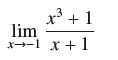
Express the limit as a derivative. x³ + 1 X² 3 lim x1 x + 1
Calculate y" and y"'.y = x − 4/x
In Exercises 13–16, refer to Figure 14.For which values of x is ƒ'(x) 4 3 2. 1 2 4 5 6 7 8 9 FIGURE 14 Graph of f. 1 3 X
What is the relation between h and x at the moment when the top and bottom of the ladder move at the same speed?
Compute the derivative using derivative rules that have been introduced so far.y = (8x4 + 5)3
Calculate the derivative with respect to x of the other variable appearing in the equation.xy2 + x2y5 − x3 = 3
Compute the derivative.ƒ(z) = z tan z
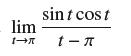
Express the limit as a derivative. lim 1- sint cost t-π
Calculate y" and y"'.y = 1/1 − x
In Exercises 15–18, compute ƒ'(x) and find an equation of the tangent line to the graph at x = a.ƒ(x) = x4, a = 2
In Exercises 13–16, refer to Figure 14.Which is larger, ƒ'(5.5) or ƒ'(6.5)? 4 3 2. 1 2 4 5 6 7 8 9 FIGURE 14 Graph of f. 1 3 X
The radius r and height h of a circular cone change at a rate of 2 cm/s. How fast is the volume of the cone increasing when r = 10 and h = 20?
Compute the derivative. y = sec 0 0
Compute the derivative using derivative rules that have been introduced so far.y = √7x − 3
Calculate the derivative with respect to x of the other variable appearing in the equation.x3R5 = 1
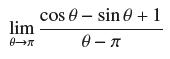
Express the limit as a derivative. lim 0→ cos sin 0 +1 0-л
Calculate y" and y"'.y = s−1/2(s + 1)
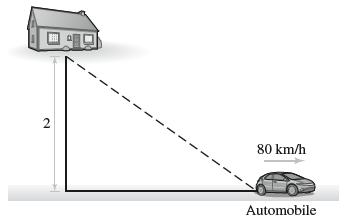
A road perpendicular to a highway leads to a farmhouse located 2 km away (Figure 9). An automobile travels past the farmhouse at a speed of 80 km/h. How fast is the distance between the automobile and the farmhouse increasing when the automobile is 6 km past the intersection of the highway and the
In Exercises 15–18, compute ƒ'(x) and find an equation of the tangent line to the graph at x = a.ƒ(x) = x−2, a = 5
In Exercises 13–16, refer to Figure 14.Show that ƒ'(3) does not exist. 4 3 2. 1 2 4 5 6 7 8 9 FIGURE 14 Graph of f. 1 3 X
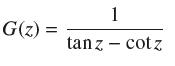
Compute the derivative. G(z) = 1 tanz - cotz
Compute the derivative using derivative rules that have been introduced so far.y = (4 − 2x − 3x2)5
Calculate the derivative with respect to x of the other variable appearing in the equation.x4 + z4 = 1
Calculate y" and y"'.y = (r1/2 + r)(1 − r)
Find ƒ(4) and ƒ'(4) if the tangent line to the graph of ƒ at x = 4 has equation y = 3x − 14.
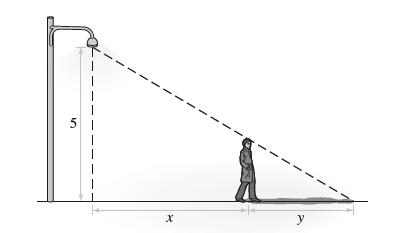
A man of height 1.8 m walks away from a 5-m lamppost at a speed of 1.2 m/s (Figure 10). Find the rate at which his shadow is increasing in length. 5 X У
In Exercises 15–18, compute ƒ'(x) and find an equation of the tangent line to the graph at x = a.ƒ(x) = 5x − 32√x, a = 4
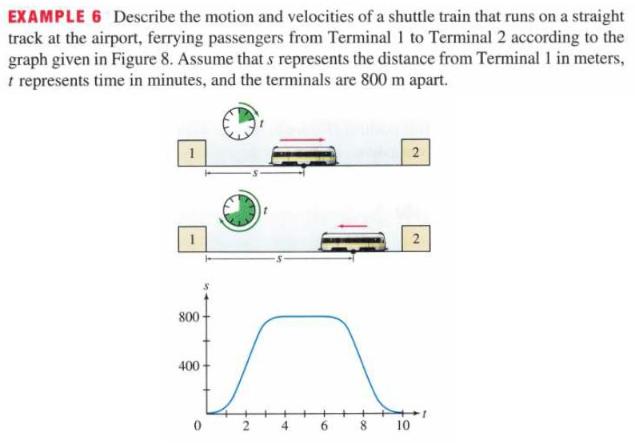
Sketch a graph of velocity as a function of time for the shuttle train in Example 6.Example 6 EXAMPLE 6 Describe the motion and velocities of a shuttle train that runs on a straight track at the airport, ferrying passengers from Terminal 1 to Terminal 2 according to the graph given in Figure 8.
In Exercises 17–20, use the limit definition to calculate the derivative of the linear function.ƒ(x) = 7x − 9
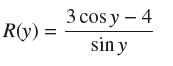
Compute the derivative. R(y) = 3 cos y - 4 sin y
Compute the derivative using derivative rules that have been introduced so far.y = (x2 + 9x)−2
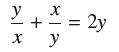
Calculate the derivative with respect to x of the other variable appearing in the equation. y X + = У : 2y
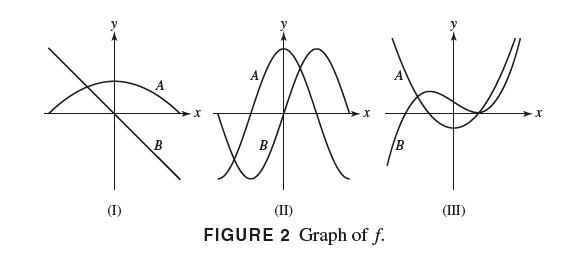
Each graph in Figure 2 shows the graph of a function ƒ and its derivative ƒ'. Determine which is the function and which is the derivative. (1) A B ^ (II) FIGURE 2 Graph of f. (III) X
Calculate the derivative indicated.g"'(−1), g(t) = −4t−5
As Claudia walks away from a 264-cm lamppost, the tip of her shadow moves twice as fast as she does. What is Claudia’s height?
Compute the derivative using derivative rules that have been introduced so far.y = (2 cos θ + 5 sinθ)9
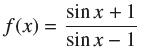
Compute the derivative. f(x) = sin x sin x + 1 1
Calculate the derivative with respect to x of the other variable appearing in the equation.sin(xt) = t
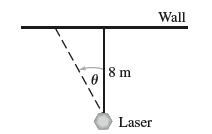
A laser pointer is placed on a platform that rotates at a rate of 20 revolutions per minute. The beam hits a wall 8 m away, producing a dot of light that moves horizontally along the wall. Let θ be the angle between the beam and the line through the searchlight perpendicular to the wall (Figure
Let N(t) be the percentage of a state population infected with a flu virus on week t of an epidemic. What percentage is likely to be infected in week 4 if N(3) = 8 and N'(3) = 1.2?
Find ƒ(3) and ƒ'(3), assuming that the tangent line to y = ƒ(x) at a = 3 has equation y = 5x + 2.
Compute the derivative using derivative rules that have been introduced so far.y = √9 + x + sin x
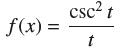
Compute the derivative. f(x) = csc² t t
In Exercises 15–18, compute ƒ'(x) and find an equation of the tangent line to the graph at x = a.ƒ(x) = 3√x, a = 8
In Exercises 17–20, use the limit definition to calculate the derivative of the linear function.ƒ(x) = 12
Compute the derivative using derivative rules that have been introduced so far.y = (x3 + 3x + 9)−4/3
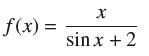
Compute the derivative. f(x) = X sin x + 2
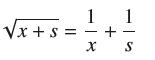
Calculate the derivative with respect to x of the other variable appearing in the equation. √x + s 1 X + 1 S
In the setting of Exercise 19, let θ be the angle that the line through the radar station and the plane makes with the horizontal. How fast is θ changing 12 min after the plane passes over the radar station?Data From Exercise 19At a given moment, a plane passes directly above a radar station at
Compute the derivative using derivative rules that have been introduced so far.y = cos(9θ + 41)
Compute the derivative.ƒ(θ) = θ tan θ sec θ
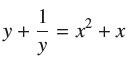
Calculate the derivative with respect to x of the other variable appearing in the equation. у+ У 12 + x
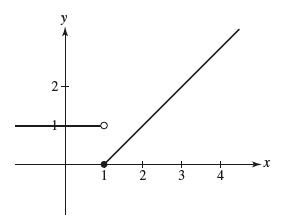
Sketch the graph of a continuous function ƒ if the graph of ƒ' appears as in Figure 5 and ƒ(0) = 0. 2 2 + 3 + 4 →X
A hot air balloon rising vertically is tracked by an observer located 4 km from the lift-off point. At a certain moment, the angle between the observer’s line of sight and the horizontal is π/5, and it is changing at a rate of 0.2 rad/min. How fast is the balloon rising at this moment?
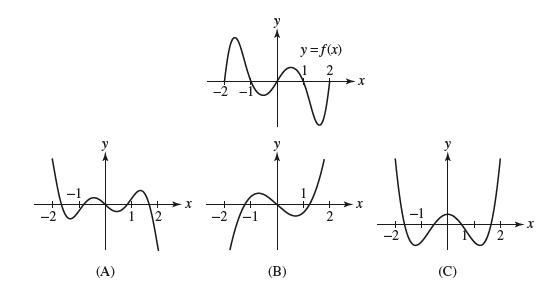
Is (A), (B), or (C) the graph of the derivative of the function ƒ shown in Figure 3? them (A) A (B) y = f(x) 2 X LAV (C) -x
Fred X has to make a book delivery from his warehouse, 15 mi north of the city, to the Amazing Book Store 10 mi south of the city. Traffic is usually congested within 5 mi of the city. He leaves at noon, traveling due south through the city, and arrives the store at 12:50. After 15 min at the
At a given moment, a plane passes directly above a radar station at an altitude of 6 km.(a) The plane’s speed is 800 km/h. How fast is the distance between the plane and the station changing half a minute later?(b) How fast is the distance between the plane and the station changing when the plane
Calculate the derivative with respect to x of the other variable appearing in the equation.x1/2 + y2/3 = −4y
Sketch the graph of ƒ' if the graph of ƒ appears as in Figure 4. 2- 1 | 2 3 نیا 4
Find a point on the graph of y = √x where the tangent line has slope 10.
In Exercises 17–20, use the limit definition to calculate the derivative of the linear function.g(t) = 8 − 3t
Calculate the derivative with respect to x of the other variable appearing in the equation.y−2/3 + x3/2 = 1
Compute the derivative using derivative rules that have been introduced so far.y = cos4 θ
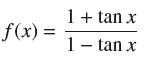
Compute the derivative. f(x) = 1 + tan x 1 - tan x
At the start of the 27th century, the population of Zosania was approximately 40 million. Early-century prosperity saw the population nearly double in the first three decades, but the growth slowed in the 30s and 40s and then leveled off completely during the war years in the 50s. A postwar boom
In Exercises 17–20, use the limit definition to calculate the derivative of the linear function.k(z) = 14z + 12
Find an equation of the tangent line at x = 3, assuming that ƒ(3) = 5 and ƒ'(3) = 2.
Calculate the derivative indicated.ƒ'''(4), ƒ(t) = 2t2 − t
Calculate the derivative with respect to x of the other variable appearing in the equation.sin(x + y) = x + cos y
Calculate the derivative with respect to x of the other variable appearing in the equation.tan(x2y) = (x + y)3
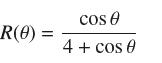
Compute the derivative. R(0) = cos 4 + cos 0
Compute the derivative using derivative rules that have been introduced so far.y = sin (√x2 + 2x + 9)
Describe the tangent line at an arbitrary point on the graph of y = 2x + 8.
A girl’s height h(t) (in centimeters) is measured at time t (in years) for 0 ≤ t ≤ 14:(a) What is the average growth rate over the 14-yr period?(b) Is the average growth rate larger over the first half or the second half of this period?(c) Estimate h'(t) (in cm/yr) for t = 3, 8. 52, 75.1,
A rocket travels vertically at a speed of 1200 km/h. The rocket is tracked through a telescope by an observer located 16 km from the launching pad. Find the rate at which the angle between the telescope and the ground is increasing 3 min after liftoff.
Suppose that ƒ(2 + h) − ƒ(2) = 3h2 + 5h. Calculate:(a) The slope of the secant line through (2, ƒ (2)) and (6, ƒ (6))(b) ƒ'(2)
Compute the derivative using derivative rules that have been introduced so far.y = tan(4 − 3x) sec(3 − 4x)
Using a telescope, you track a rocket that was launched 4 km away, recording the angle θ between the telescope and the ground at half-second intervals. Estimate the velocity of the rocket if θ(10) = 0.205 and θ(10.5) = 0.225.
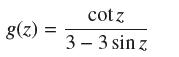
Compute the derivative. g(z) = cot z 3-3 sin z
Calculate the derivative with respect to x of the other variable appearing in the equation.tan(x + y) = tan x + tan y
Use the following table of values for the number A(t) of automobiles (in millions) manufactured in the United States in year t.What is the interpretation of A(t)? Estimate A(1971). Does A(1974) appear to be positive or negative? t A(t) 1970 1971 1972 1973 1974 1975 1976 6.55 8.58
Compute the derivative of ƒ ∘ g.ƒ(u) = sin u, g(x) = 2x + 1
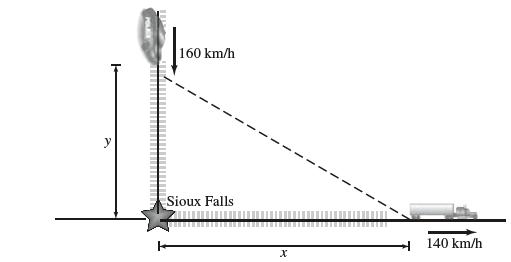
A police car traveling south toward Sioux Falls, Iowa, at 160 km/h pursues a truck traveling east away from Sioux Falls at 140 km/h (Figure 12). At time t = 0, the police car is 20 km north and the truck is 30 km east of Sioux Falls. Calculate the rate at which the distance between the vehicles is
Showing 6900 - 7000
of 8339
First
63
64
65
66
67
68
69
70
71
72
73
74
75
76
77
Last
Step by Step Answers

 Get 50% OFF
Claim Now
Get 50% OFF
Claim Now