New Semester
Started
Get
50% OFF
Study Help!
--h --m --s
Claim Now
Question Answers
Textbooks
Find textbooks, questions and answers
Oops, something went wrong!
Change your search query and then try again
S
Books
FREE
Study Help
Expert Questions
Accounting
General Management
Mathematics
Finance
Organizational Behaviour
Law
Physics
Operating System
Management Leadership
Sociology
Programming
Marketing
Database
Computer Network
Economics
Textbooks Solutions
Accounting
Managerial Accounting
Management Leadership
Cost Accounting
Statistics
Business Law
Corporate Finance
Finance
Economics
Auditing
Tutors
Online Tutors
Find a Tutor
Hire a Tutor
Become a Tutor
AI Tutor
AI Study Planner
NEW
Sell Books
Search
Search
Sign In
Register
study help
mathematics
calculus 4th
Calculus 4th Edition Jon Rogawski, Colin Adams, Robert Franzosa - Solutions
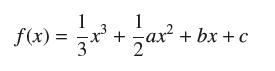
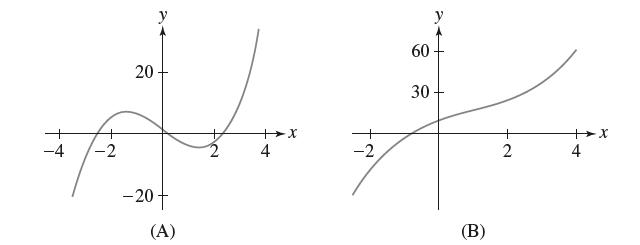
A cubic polynomial may have a local min and max, or it may have neither (Figure 27). Find conditions on the coefficients a and b ofthat ensure f has neither a local min nor a local max. 1 f(x) x) = {√ x² + √@x²+bx+c 1
Show that if the quadratic polynomial ƒ(x) = x2 + rx + s takes on both positive and negative values, then its minimum value occurs at the midpoint between the two roots.
Find the min and max of ƒ(x) = xp(1 − x)q on [0, 1] where p, q > 0.
Compute dy/dx.y = sin(x + y)
Find the derivative using the appropriate rule or combination of rules. y = (9 − (5 − 2x4)7)3
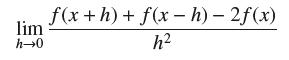
Computefor the following functions:(a) ƒ(x) = x (b) ƒ(x) = x2 (c) ƒ(x) = x3Based on these examples, what do you think the limit represents? lim h→0 f(x+h) + f(x-h) - 2f(x) h²
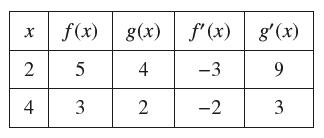
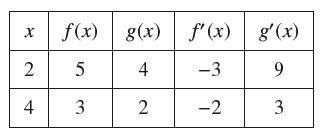
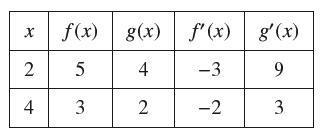
Use the following table of values to calculate the derivative of the given function at x = 2:H(x) = ƒ(x)g(x) X f(x) g(x) 4 2 2 5 4 3 f'(x) -3 -2 g'(x) 9 3
The height at time t (in seconds) of a mass, oscillating at the end of a spring, is s(t) = 300 + 40 sin t cm. Find the velocity and acceleration at t = π/3 s.
Plot the derivative of ƒ(x) = x/(x2 + 1) over [−4, 4]. Use the graph to determine the intervals on which ƒ'(x) > 0 and f'(x) < 0. Then plot ƒ and describe how the sign of ƒ'(x) is reflected in the graph of ƒ.
Use a computer algebra system to plot y2 = x3 − 4x for x and y between −4 and 4. Show that if dx/dy = 0, then y = 0. Conclude that the tangent line is vertical at the points where the curve intersects the x-axis. Does your plot confirm this conclusion?
Use the following table of values to calculate the derivative of the given function at x = 2: x f(x) g(x) 4 2 2 5 4 3 f'(x) -3 -2 g'(x) 9 3
Find the derivative using the appropriate rule or combination of rules.y = (cos 6x + sin x2)1/2
A projectile is launched from ground level with an initial velocity ν0 at an angle θ, where 0 ≤ θ ≤ π/2. Its horizontal range is R = (2v20/g) sinθ cos θ, where g = 32 ft/s2 with ν0 in ft/s, and g = 9.8 m/s2 with ν0 in m/s. Calculate dR/dθ. The maximum range occurs where dR/dθ = 0.
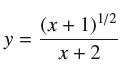
Find the derivative using the appropriate rule or combination of rules. y = (x + 1)¹/2 x + 2
Plot ƒ(x) = x/(x2 − 1) (in a suitably bounded viewing box). Use the plot to determine whether ƒ'(x) is positive or negative on its domain {x : x ≠ ± 1}. Then compute ƒ'(x) and confirm your conclusion algebraically.
Use the following table of values to calculate the derivative of the given function at x = 2:G(x) = ƒ(g(x)) x f(x) g(x) 4 2 2 5 4 3 f(x) -3 -2 g'(x) 9 3
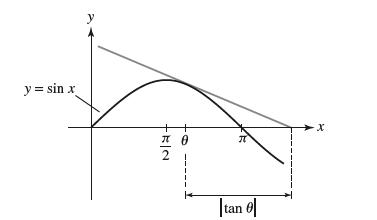
The graph of y = sin x is shown in Figure 5, along with a tangent line at x = θ. Show that if π/2 y = sin x y -KIN tan e -X
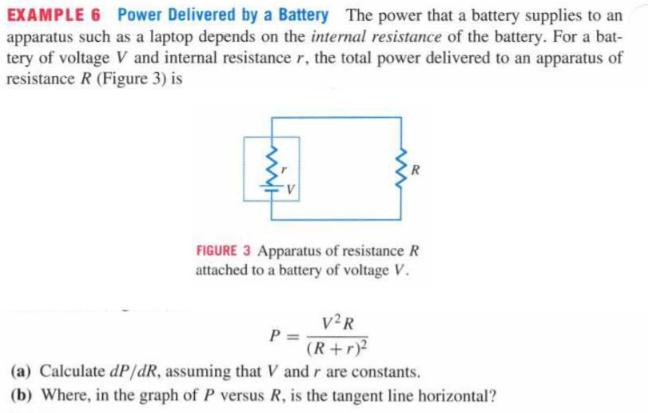
Let P = V2R/(R + r)2 as in Example 6. Calculate dP/dr, assuming that r is variable and R is constant. EXAMPLE 6 Power Delivered by a Battery The power that a battery supplies to an apparatus such as a laptop depends on the internal resistance of the battery. For a bat- tery of voltage V and
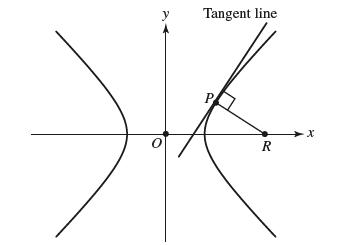
Show that for all points P on the graph in Figure 12, the segments O̅P̅ and P̅R̅ have equal length. y 0 Tangent line P R X
First compute y' and y" by implicit differentiation. Then solve the given equation for y, and compute y' and y" by direct differentiation. Finally, show that the results obtained by each approach are the same.xy = y − 2
Find the derivative using the appropriate rule or combination of rules.y = tan3 x + tan(x3)
Use the following table of values to calculate the derivative of the given function at x = 2:F(x) = ƒ(g(2x)) x f(x) g(x) 4 2 2 5 4 3 f'(x) -3 -2 g'(x) 9 3
Use the limit definition of the derivative and the addition law for the cosine function to prove that (cos x)'= − sin x.
Determine a and b such that p(x) = x2 + ax + b satisfies p(1) = 0 and p'(1) = 4.
First compute y' and y" by implicit differentiation. Then solve the given equation for y, and compute y'and y"by direct differentiation. Finally, show that the results obtained by each approach are the same.xy3 = 8
Use the following table of values to calculate the derivative of the given function at x = 2:K(x) = ƒ(x2) x f(x) g(x) 4 2 2 5 4 3 f'(x) -3 -2 g'(x) 9 3
Find the derivative using the appropriate rule or combination of rules.y =√4 − 3 cos x
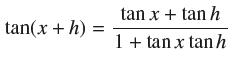
Use the addition formula for the tangentto compute (tan x) directly as a limit of the difference quotients. You will also need to show that tan(x + h) = tan x + tan h 1 + tan x tan h
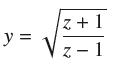
Find the derivative using the appropriate rule or combination of rules. y = z+1 z-1 N
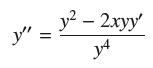
Use implicit differentiation to calculate higher derivatives.Consider the equation y3 − 3/2 x2 = 1.(a) Show that y'= x/y2 and differentiate again to show that(b) Express y" in terms of x and y using part (a). J y² - 2xyy 14
Use the following table of values to calculate the derivative of the given function at x = 2:Find the points on the graph of ƒ(x) = x3 − 3x2 + x + 4 where the tangent line has slope 10. x f(x) g(x) 4 2 2 5 4 3 f(x) -3 -2 g'(x) 9 3
Verify the following identity and use it to give another proof of the formula (sin x)' = cos x:Use the addition formula for sine to prove that sin(a + b) − sin(a − b) = 2 cos a sin b. 2 cos (x + h) sin( sin(x + h) sin x = 2 cos
Let ƒ(x) = x3 − 3x + 1. Show that ƒ'(x) ≥ −3 for all x and that, for every m > −3, there are precisely two points where ƒ'(x) = m. Indicate the position of these points and the corresponding tangent lines for one value of m in a sketch of the graph of ƒ.
Find the derivative using the appropriate rule or combination of rules.y = (cos3 x + 3 cos x + 7)9
Show that the tangent lines to y = 1/3 x3 − x2 at x = a and at x = b are parallel if a = b or a + b = 2.
Use the method of the previous exercise to show that y"= −y−3 on the circle x2 + y2 = 1.
Find the points on the graph of x2/3 + y2/3 = 1 where the tangent line has slope 1.
Show that a nonzero polynomial function y = ƒ(x) cannot satisfy the equation y'= −y. Use this to prove that neither ƒ(x) = sin x nor ƒ(x) = cos x is a polynomial. Can you think of another way to reach this conclusion by considering limits as x→∞?
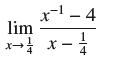
In Exercises 57–62, each limit represents a derivative ƒ'(a). Find ƒ(x) and a. -1-4 x lim 1 x-
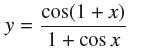
Find the derivative using the appropriate rule or combination of rules. y = cos(1 + x) 1 + cos x
Use implicit differentiation to calculate higher derivatives.Calculate y" at the point (1, 1) on the curve xy2 + y − 2 = 0 by the following steps:(a) Find y' by implicit differentiation and calculate y' at the point (1, 1).(b) Differentiate the expression for y' found in (a). Then compute y" at
Find a such that the tangent lines to y = x3 − 2x2 + x + 1 at x = a and x = a + 1 are parallel.
Let ƒ(x) = x sin x and g(x) = x cos x.(a) Show that ƒ(x) = g(x) + sin x and g'(x) = −ƒ(x) + cos x.(b) Verify that ƒ'(x) = −ƒ(x) + 2 cos x and g'(x) = −g(x) − 2 sin x.(c) By further experimentation, try to find formulas for all higher derivatives of ƒ and g. The kth derivative depends
Find the derivative using the appropriate rule or combination of rules.y = sec(√t2 − 9)
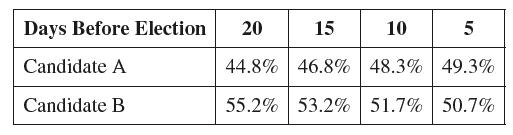
Use the table to compute the average rate of change of candidate A’s percentage of votes over the intervals from day 20 to day 15, day 15 to day 10, and day 10 to day 5. If this trend continues over the last 5 days before the election, will candidate A win? Days Before Election 20 Candidate
Use implicit differentiation to calculate higher derivatives.Use the method of the previous exercise to compute y" at the point (1, 1) on the curve x3 + y3 = 3x + y − 2.Data From Exercise 61Calculate y" at the point (1, 1) on the curve xy2 + y − 2 = 0 by the following steps:(a) Find y' by
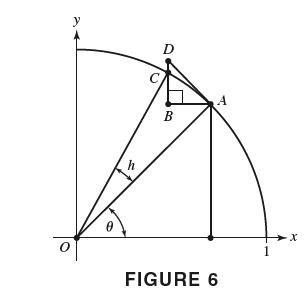
Figure 6 shows the geometry behind the derivative formula (sin θ)= cos θ. Segments BA and BD are parallel to the x- and y-axes. Let Δ sin θ = sin(θ + h) − sin θ. Verify the following statements:(a) Δ sin θ = BC(b) ∠BDA = θ Hint: O̅A̅ ⊥ AD.(c) BD = (cos θ)ADNow explain the
Let ƒ(x) = g(x) = x. Show that (ƒ /g)' ≠ ƒ' /g'.
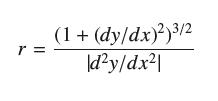
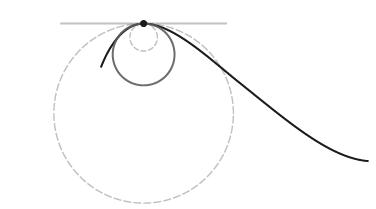
Explore the radius of curvature of curves. There can be many circles that are tangent to a curve at a particular point, but there is one that provides a “best fit” (Figure 13). This circle is called an osculating circle of the curve. We define it formally in Section 13.4. The radius of the
Find the derivative using the appropriate rule or combination of rules.y = cot7(x5)
Calculate y".y = 12x3 − 5x2 + 3x
Use the Product Rule to show that (ƒ2) = 2ƒƒ'.
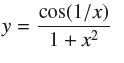
Find the derivative using the appropriate rule or combination of rules. y = cos(1/x) 1 + x²
Explore the radius of curvature of curves. There can be many circles that are tangent to a curve at a particular point, but there is one that provides a “best fit” (Figure 13). This circle is called an osculating circle of the curve. We define it formally in Section 13.4. The radius of the
Calculate y".y = x−2/5
Show that (ƒ3)'= 3 ƒ2 ƒ'.
Find the derivative using the appropriate rule or combination of rules.y = (1 + cot5(x4 + 1))9
The brightness b of the sun (in watts per square meter) at a distance of d meters from the sun is expressed as an inverse-square law in the form b = L/4πd2, where L is the luminosity of the sun and equals 3.9 × 1026 watts. What is the derivative of b with respect to d at the earth's distance from
Calculate y".y = √2x + 3
Let ƒ, g, h be differentiable functions. Show that (ƒ gh)'(x) is equal toWrite ƒ gh as ƒ (gh). f'(x)g(x)h(x) + f(x)g'(x)h(x) + f(x)g(x)h'(x)
Find the derivative using the appropriate rule or combination of rules.y = √cos 2x + sin 4x
x and y are functions of a variable t. Use implicit differentiation to express dy/dt in terms of dx/dt, x, and y.x3 − 6xy2 = x
Calculate y".y = 4x/x + 1
Find the derivative using the appropriate rule or combination of rules.y = (1 − csc2(1 − x3))6
x and y are functions of a variable t. Use implicit differentiation to express dy/dt in terms of dx/dt, x, and y.y4 + 2x2 = xy
Calculate y".y = tan(x2)
Find the derivative using the appropriate rule or combination of rules.y = sin(√sin θ + 1)
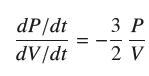
The volume V and pressure P of gas in a piston (which vary in time t) satisfy PV3/2 = C, where C is a constant. Prove thatThe ratio of the derivatives is negative. Could you have predicted this from the relation PV3/2 = C? dp/dt dv/dt || ستان 3 P 2 V
Calculate y".y = sin2(4x + 9)
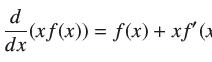
Use the limit definition of the derivative to prove the following special case of the Product Rule: d dx -(xf(x)) = f(x) + xf'(x
Find the derivative using the appropriate rule or combination of rules.y = (x + 1/x)−1/2
Show that if P lies on the intersection of the two curves x2 − y2 = c and xy = d (c, d constants), then the tangents to the curves at P are perpendicular.
Compute dy/dx.x3 − y3 = 4
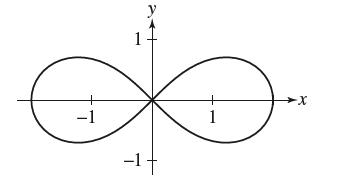
The lemniscate curve (x2 + y2)2 = 4(x2 − y2) was discovered by Jacob Bernoulli in 1694, who noted that it is “shaped like a figure 8, or a knot, or the bow of a ribbon.” Find the coordinates of the four points at which the tangent line is horizontal (Figure 14). 1 -1 + 1
Find the derivative using the appropriate rule or combination of rules.y = sec(1 + (4 + x)−3/2)
Compute dy/dx.4x2 − 9y2 = 36
The vapor pressure of water at temperature T (in kelvins) is the atmospheric pressure P at which no net evaporation takes place. Use the following table to estimate the indicated derivatives using the difference quotient approximation.Estimate P'(T) for T = 293, 313, 333. (Include proper units on
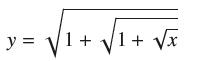
Find the derivative using the appropriate rule or combination of rules. y = 1 + 1 + √√x
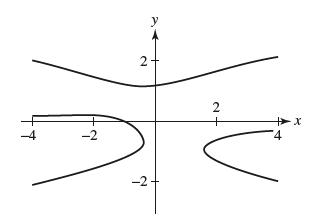
Divide the curve in Figure 15 into five branches, each of which is the graph of a function. Sketch the branches. N. 2 -2 y 2 +x 4
Compute dy/dx.y = xy2 + 2x2
Compute dy/dx.y/x = x + y
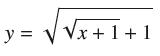
Find the derivative using the appropriate rule or combination of rules. y = √x+1+1
Exercises 72 and 73: A basic fact of algebra states that c is a root of a polynomial ƒ if and only if ƒ(x) = (x − c)g(x) for some polynomial g. We say that c is a multiple root if ƒ(x) = (x − c)2h(x), where h is a polynomial.Show that c is a multiple root of ƒ if and only if c is a root of
Exercises 72 and 73: A basic fact of algebra states that c is a root of a polynomial f if and only if ƒ(x) = (x − c)g(x) for some polynomial g. We say that c is a multiple root if ƒ(x) = (x − c)2h(x), where h is a polynomial.Use Exercise 72 to determine whether c = −1 is a multiple root.(a)
Find the derivative using the appropriate rule or combination of rules.y = (kx + b)−1/3; k and b any constants
Sketch the graph of ƒ(x) = x |x|. Then show that ƒ'(0) exists.
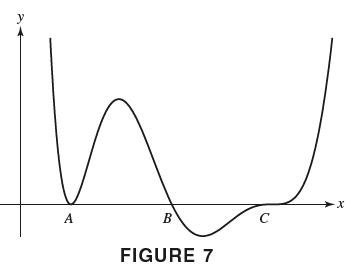
Figure 7 is the graph of a polynomial with roots at A, B, and C. Which of these is a multiple root? Explain your reasoning using Exercise 72.Data From Exercise 72Exercises 72 and 73: A basic fact of algebra states that c is a root of a polynomial ƒ if and only if ƒ(x) = (x − c)g(x) for some
Compute dy/dx.tan(x + y) = xy
Find the derivative using the appropriate rule or combination of rules. y = 1 Vkt + b =;k,b constants, not both zero
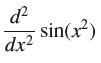
Compute the higher derivative. d² dx² -sin(x²)
Compute dy/dx and d2y/dx2 .x2 − 4y2 = 8
Compute dy/dx and d2y/dx2 .6xy + y2 = 10
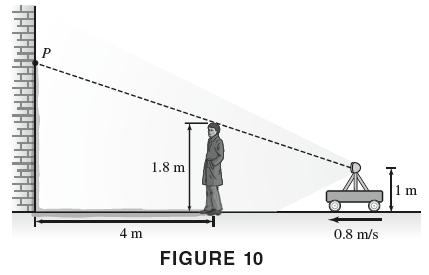
A light moving at 0.8 m/s approaches a man standing 4 m from a wall (Figure 10). The light is 1 m above the ground. How fast is the tip P of the man’s shadow moving when the light is 7 m from the wall? Hodot P 4 m 1.8 m FIGURE 10 0.8 m/s 1 m
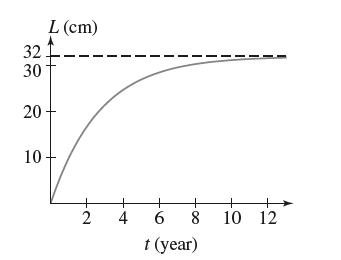
From a 2005 study by the Fisheries Research Services in Aberdeen, Scotland, we infer that the average length in centimeters of the species Clupea harengus (Atlantic herring) as a function of age t (in years) can be modeled by the functionfor 0 ≤ t ≤ 13. See Figure 1.(a) How fast is the average
The function L(t) = 12 + 3.4 sin( 2π/365 t) models the length of a day from sunrise to sunset in Sapporo, Japan, where t is the day in the year after the spring equinox on March 21. Determine L'(t), and use it to calculate the rate that the length of the days are changing on December 1, January 1,
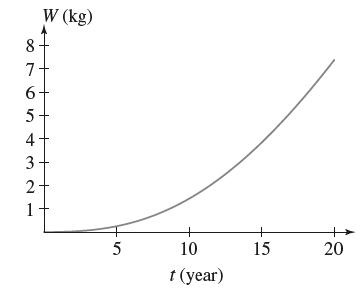
According to a 1999 study by Starkey and Scarnecchia, the average weight (in kilograms) at age t (in years) for channel catfish in the Lower Yellowstone River (Figure 2) is approximated by the functionW(t) = (0.14 + 0.115t − 0.002t2 + 0.000023t3)3.4Find the rate at which average weight is
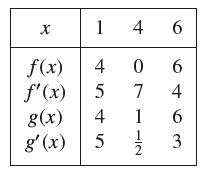
Use the table of values to calculate the derivative of the function at the given point.g(√x), x = 16 1 4 f(x) f'(x) 5 g(x) g'(x) 545 4 6 0 6 7 4 16 3
The price (in dollars) of a computer component is P = 2C − 18C−1, where C is the manufacturer’s cost to produce it. Assume that cost at time t (in years) is C = 9 + 3t−1. Determine the rate of change of price with respect to time at t = 3.
Plot the “astroid” y = (4 − x2/3)3/2 for 0 ≤ x ≤ 8. Show that the part of every tangent line in the first quadrant has a constant length 8.
According to the U.S. standard atmospheric model, developed by the National Oceanic and Atmospheric Administration for use in aircraft and rocket design, atmospheric temperature T (in degrees Celsius), pressure P (kPa = 1000 pascals), and altitude h (in meters) are related by these formulas (valid
Showing 6700 - 6800
of 8339
First
61
62
63
64
65
66
67
68
69
70
71
72
73
74
75
Last
Step by Step Answers

 Get 50% OFF
Claim Now
Get 50% OFF
Claim Now