New Semester
Started
Get
50% OFF
Study Help!
--h --m --s
Claim Now
Question Answers
Textbooks
Find textbooks, questions and answers
Oops, something went wrong!
Change your search query and then try again
S
Books
FREE
Study Help
Expert Questions
Accounting
General Management
Mathematics
Finance
Organizational Behaviour
Law
Physics
Operating System
Management Leadership
Sociology
Programming
Marketing
Database
Computer Network
Economics
Textbooks Solutions
Accounting
Managerial Accounting
Management Leadership
Cost Accounting
Statistics
Business Law
Corporate Finance
Finance
Economics
Auditing
Tutors
Online Tutors
Find a Tutor
Hire a Tutor
Become a Tutor
AI Tutor
AI Study Planner
NEW
Sell Books
Search
Search
Sign In
Register
study help
mathematics
calculus early transcendentals 9th
Calculus Early Transcendentals 9th Edition James Stewart, Daniel K. Clegg, Saleem Watson, Lothar Redlin - Solutions
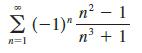
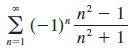
Test the series for convergence or divergence. n² - 1 3 n=1n²³ +1 00
List the first five terms of the sequence.an = cos nπ
Find the radius of convergence and interval of convergence of the power series. .n στ Σ n=jn3n X
Determine whether the statement is true or false. If it is true, explain why. If it is false, explain why or give an example that disproves the statement.If 0 ≤ an ≤ bn and Σbn diverges, then Σan diverges.
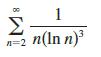
Use the Integral Test to determine whether the series is convergent or divergent. στ Σ A=2 1 n(In n)3
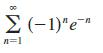
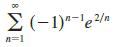
Test the series for convergence or divergence. Σ (−1)"e=" n=1
Use the Ratio Test to determine whether the series is convergent or divergent. 00 Σ H=I n! 100"
Determine whether the series converges or diverges. 00 n - 1 Σ w=in* +1 3
Test the series for convergence or divergence. 00 n - 1 Σ m=in* +1 3 ζ
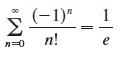
Determine whether the statement is true or false. If it is true, explain why. If it is false, explain why or give an example that disproves the statement. Σ n=0 (-1)" n! 1 e
List the first five terms of the sequence.an = 1 + (−1)n
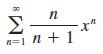
Find the radius of convergence and interval of convergence of the power series. Η Σ n=1 n + 1 IM ΜΕ
Show that limn→∞ n4e–n = 0 and use a graph to find the smallest value of N that corresponds to ε = 0.1 in the precise definition of a limit.
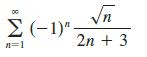
Test the series for convergence or divergence. √n 2n + 3 Σ (−1)".
Use the Integral Test to determine whether the series is convergent or divergent. 00 M tan'n 1 + n²
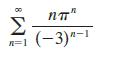
Use the Ratio Test to determine whether the series is convergent or divergent. 00 Σ n=1 ηπ (-3)^-1 Π
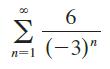
Find at least 10 partial sums of the series. Graph both the sequence of terms and the sequence of partial sums on the same screen. Does it appear that the series is convergent or divergent? If it is convergent, find the sum. If it is divergent, explain why. n=1 6 (-3)"
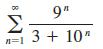
Determine whether the series converges or diverges. DG -1 9" 3 + 10"
Test the series for convergence or divergence. Σ (-1)*. n=1 n² - 1 n³ + 1 3
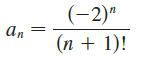
List the first five terms of the sequence. an (-2)" (n + 1)!
Determine whether the statement is true or false. If it is true, explain why. If it is false, explain why or give an example that disproves the statement.If –1 < α < 1, then limn→∞ αn = 0.
Determine whether the series is convergent or divergent. 00 Η Σ *in* +1 3
Find the radius of convergence and interval of convergence of the power series. 00 n=1 x" 2n - 1
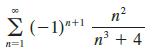
Test the series for convergence or divergence. Σ (−1)"+1 ne η3 + 4
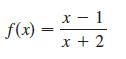
Find a power series representation for the function and determine the interval of convergence. f(x) x-1 x + 2
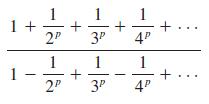
If p > 1, evaluate the expression 1 + 1 k 2P 1 2P + + + 3P 4P 1 4P |-|8 3P +
Test the series for convergence or divergence. 00 - n’ – 1 Σ (−1)". 2 n? + 1 n=1
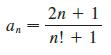
List the first five terms of the sequence. an 2n + 1 n n! + 1
Find the radius of convergence and interval of convergence of the power series. Σ n=1 (−1)"x" 2 n'
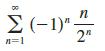
Test the series for convergence or divergence. 0 ∑ (-1)" - n=1 n 2"
Determine whether the statement is true or false. If it is true, explain why. If it is false, explain why or give an example that disproves the statement.If Σan is divergent, then Σ|an| is divergent.
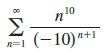
Use the Ratio Test to determine whether the series is convergent or divergent. 00 Σ n=1 10 n' (-10)"+¹
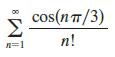
Use the Ratio Test to determine whether the series is convergent or divergent. απ Σ cos(nπ/3) n!
Determine whether the series converges or diverges. Σ H=9 1 Inn
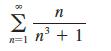
Test the series for convergence or divergence. 00 Σ n=1 n
List the first five terms of the sequence.a1 = 1, an+1 = 2an + 1
Find the radius of convergence and interval of convergence of the power series. Π X Σ n=on!
Find at least 10 partial sums of the series. Graph both the sequence of terms and the sequence of partial sums on the same screen. Does it appear that the series is convergent or divergent? If it is convergent, find the sum. If it is divergent, explain why.123 n=1 7n+1 10"
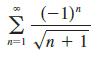
Determine whether the series is convergent or divergent. 00 (-1)" Σ n=1 vn + 1 +1
Determine whether the statement is true or false. If it is true, explain why. If it is false, explain why or give an example that disproves the statement.If f(x) = 2x – x2 + 1/3 x3 – ∙ ∙ ∙ converges for all x, then f'"(0) = 2.
Test the series for convergence or divergence. 200 Σ(-1)-¹2/ #=1
Use the Ratio Test to determine whether the series is convergent or divergent. 00 #=1 n! n n
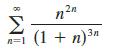
Test the series for convergence or divergence. 00 Σ n=1 20 n (1 + n)3"
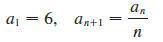
List the first five terms of the sequence. aj = 6, an+1 а = an n
Determine whether the statement is true or false. If it is true, explain why. If it is false, explain why or give an example that disproves the statement.If {an} and {bn} are divergent, then {an + bn} is divergent.
Find the radius of convergence and interval of convergence of the power series. X Л u 1=v 00
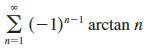
Test the series for convergence or divergence. Σ (-1)"-1 arctan n n=1
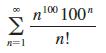
Use the Ratio Test to determine whether the series is convergent or divergent. 00 ζ Π Σ n! x=1 100 100 Π
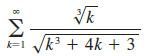
Determine whether the series converges or diverges. VE Σ k=1 = √k³ + 4k + 3
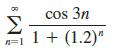
Determine whether the series is convergent or divergent. 09 WI Σ cos 3n 1 + (1.2)"
Use the Ratio Test to determine whether the series is convergent or divergent. 2 3 + 2.5 3.5 + 2.5.8 3.5.7 + 2.5.8.11 3.5.7.9
Determine whether the series is convergent or divergent. 00 Σ n=2 1 n√In n
Find the radius of convergence and interval of convergence of the power series. Π Χ Σ n=1 n²4"
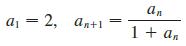
List the first five terms of the sequence. a = 2, an+1 ал 1 + an
Find the Maclaurin series for f(x) using the definition of a Maclaurin series. [Assume that f has a power series expansion. Do not show that Rn(x) → 0.] Also find the associated radius of convergence.f(x) = 2x4 − 3x2 + 3
Determine whether the statement is true or false. If it is true, explain why. If it is false, explain why or give an example that disproves the statement.If {an} and {bn} are divergent, then {anbn} is divergent.
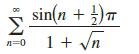
Test the series for convergence or divergence. IM sin(n+1) 1 + √n n=0 1
Use the Ratio Test to determine whether the series is convergent or divergent. 00 (2n)! (n!)²
Determine whether the series is convergent or divergent. - = + = =+=+=+ 3 1 15 19
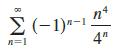
Test the series for convergence or divergence. n 4" Σ (−1)"-1. n=1
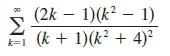
Determine whether the series converges or diverges. k=1 (2k-1)(k² - 1) (k + 1)(k² + 4)²2
List the first five terms of the sequence.a1 = 2, a2 = 1, an+1 = an − an−1
Determine whether the statement is true or false. If it is true, explain why. If it is false, explain why or give an example that disproves the statement.If {an} is decreasing and an > 0 for all n, then {an} is convergent.
Find the radius of convergence and interval of convergence of the power series. το Σ 2"n?x" n=l
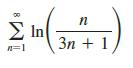
Determine whether the series is convergent or divergent. Σ in n=1 n 3n + 1
Find the Maclaurin series for f(x) using the definition of a Maclaurin series. [Assume that f has a power series expansion. Do not show that Rn(x) → 0.] Also find the associated radius of convergence.f(x) = sin 3x
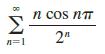
Test the series for convergence or divergence. 00 WI Σ n=1 n cos nπ 2"
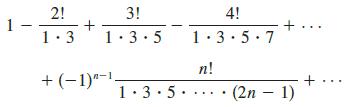
Use the Ratio Test to determine whether the series is convergent or divergent. 2! 1.3 + 3! 1.3.5 +(-1)-¹- 1.3.5. 4! 1.3.5.7 n! .. (2n-1)
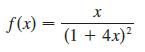
Find a power series representation for the function and determine the radius of convergence. f(x) = X (1 + 4x)²
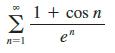
Determine whether the series converges or diverges. Σ x=1 1 + cos n en
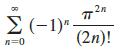
Test the series for convergence or divergence. 2n T (2η)! Σ (−1)". n=0
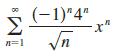
Find the radius of convergence and interval of convergence of the power series. 00 n=1 (-1)"4" √n n
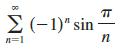
Test the series for convergence or divergence. TT Σ (-1)" sin - n=1 n
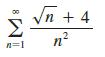
Determine whether the series is convergent or divergent. 00 νη +4 δη n² 2 Σ
Carry out the following steps to show that(a) Use the formula for the sum of a finite geometric series (11.2.3) to get an expression for1 – x + x2 – x3 + ∙ ∙ ∙ + x2n–2 – x2n–1(b) Integrate the result of part (a) from 0 to 1 to get an expression foras an integral.(c) Deduce from part
Find a power series representation for the function and determine the radius of convergence. f(x) = X 2-x 3
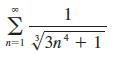
Determine whether the series converges or diverges. 00 n=1 1 4 √√3n¹ + 1
Test the series for convergence or divergence. Ente-n3 n=1
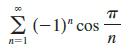
Test the series for convergence or divergence. Do ∑ (-1)" cos. 1 ㅠ n
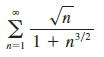
Determine whether the series is convergent or divergent. 00 n=1 √n 1 + n² 13/2
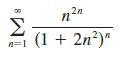
Determine whether the series is convergent or divergent. Σ 20 nt (1 + 2n²)"
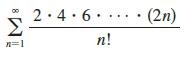
Use the Ratio Test to determine whether the series is convergent or divergent. Σ n=1 2.4.6 n! (2n) ·
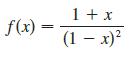
Find a power series representation for the function and determine the radius of convergence. f(x)= = 1 + x z(x - 1)
Determine whether the series converges or diverges. Σ H=I 4"+1 3" - 2
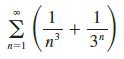
Test the series for convergence or divergence. 1 Σ + n=1 M 3"
Determine whether the statement is true or false. If it is true, explain why. If it is false, explain why or give an example that disproves the statement.0.99999 . . . = 1
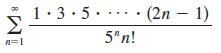
Determine whether the series is convergent or divergent. Σ n=1 1.3.5. 5"n! · (2n – 1)
Find the Maclaurin series for f(x) using the definition of a Maclaurin series. [Assume that f has a power series expansion. Do not show that Rn(x) → 0.] Also find the associated radius of convergence.f(x) = sinh x
Find the radius of convergence and interval of convergence of the power series. n=1 n 5x² 2" (n² + 1)
Determine whether the series is convergent or divergent. 00 1 Σ n=1n² + 4
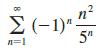
Test the series for convergence or divergence. 00 Σ (-1) n=1 Μ 5"
Use the Ratio Test to determine whether the series is convergent or divergent. 2*n! Σ (−1)". 5 8 11. . n=l · (3n + 2)
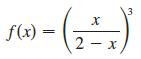
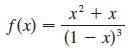
Find a power series representation for the function and determine the radius of convergence. f(x) = x² + x (1-x)³ 3
Determine whether the series converges or diverges. Σ n=1 n
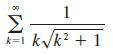
Test the series for convergence or divergence. 00 Σ k=1 1 2 kýk? + 1
Determine whether the statement is true or false. If it is true, explain why. If it is false, explain why or give an example that disproves the statement.If lim an = 2, then lim (an+3 n→∞ n→.00 an) = 0.
Determine whether the series is convergent or divergent. (-5) 2n n²9⁰
Find the radius of convergence and interval of convergence of the power series. 00 n=1 1-2n x n!
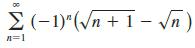
Test the series for convergence or divergence. 00 Σ (-1)"(Vn + 1 -(n)
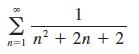
Determine whether the series is convergent or divergent. 1 Σ 2 n=1 m=i n’ + 2n + 2
Showing 400 - 500
of 4932
1
2
3
4
5
6
7
8
9
10
11
12
13
14
15
Last
Step by Step Answers

 Get 50% OFF
Claim Now
Get 50% OFF
Claim Now