New Semester
Started
Get
50% OFF
Study Help!
--h --m --s
Claim Now
Question Answers
Textbooks
Find textbooks, questions and answers
Oops, something went wrong!
Change your search query and then try again
S
Books
FREE
Study Help
Expert Questions
Accounting
General Management
Mathematics
Finance
Organizational Behaviour
Law
Physics
Operating System
Management Leadership
Sociology
Programming
Marketing
Database
Computer Network
Economics
Textbooks Solutions
Accounting
Managerial Accounting
Management Leadership
Cost Accounting
Statistics
Business Law
Corporate Finance
Finance
Economics
Auditing
Tutors
Online Tutors
Find a Tutor
Hire a Tutor
Become a Tutor
AI Tutor
AI Study Planner
NEW
Sell Books
Search
Search
Sign In
Register
study help
mathematics
calculus early transcendentals 9th
Physics For Scientists And Engineers A Strategic Approach With Modern Physics 3rd Edition Randall D. Knight - Solutions
A toy train is pushed forward and released at x0 = 2.0 m with a speed of 2.0 m/s. It rolls at a steady speed for 2.0 s, then one wheel begins to stick. The train comes to a stop 6.0 m from the point at which it was released. What is the magnitude of the train’s acceleration after its wheel begins
A car accelerates at 2.0 m/s2 along a straight road. It passes two marks that are 30 m apart at times t = 4.0 s and t = 5.0 s. What was the car’s velocity at t = 0 s?
When jumping, a flea accelerates at an astounding 1000 m/s2, but over only the very short distance of 0.50 mm. If a flea jumps straight up, and if air resistance is neglected (a rather poor approximation in this situation), how high does the flea go?
The minimum stopping distance for a car traveling at a speed of 30 m/s is 60 m, including the distance traveled during the driver’s reaction time of 0.50 s.a. What is the minimum stopping distance for the same car traveling at a speed of 40 m/s?b. Draw a position-versus-time graph for the motion
a. Suppose you are driving at speed v0 when a sudden obstacle in the road forces you to make a quick stop. If your reaction time before applying the brakes is tR, what constant deceleration (absolute value of ax) do you need to stop in distance d? Assume that d is larger than the car travels during
An object starts from rest at x = 0 m at time t = 0 s. Five seconds later, at t = 5.0 s, the object is observed to be at x = 40 m and to have velocity vx = 11 m/s.a. Was the object’s acceleration uniform or nonuniform? Explain your reasoning.b. Sketch the velocity-versus-time graph implied by
A particle’s position on the x-axis is given by the functionx = (t2 - 4t + 2) m, where t is in s.a. Make a position-versus-time graph for the interval 0 s ≤ t ≤ 5 s. Do this by calculating and plotting x every 0.5 s from 0 s to 5 s, then drawing a smooth curve through the points.b. Determine
A particle moving along the x-axis has its position described by the function x = (2t2 - t + 1) m, where t is in s. At t = 2s what are the particle’s(a) Position(b) Velocity(c) Acceleration?
A ball is thrown vertically upward with a speed of 19.6 m/s.a. What is the ball’s velocity and its height after 1.0, 2.0, 3.0, and 4.0 s?b. Draw the ball’s velocity-versus-time graph. Give both axes an appropriate numerical scale.
Ball bearings are made by letting spherical drops of molten metal fall inside a tall tower—called a shot tower—and solidify as they fall.a. If a bearing needs 4.0 s to solidify enough for impact, how high must the tower be?b. What is the bearing’s impact velocity?
A rubber ball dropped from a height of 2 m bounces back to a height of 1 m. Draw the ball’s position, velocity, and acceleration graphs, stacked vertically, from the instant you release it until it returns to its maximum bounce height. Pay close attention to the time the ball is in contact with
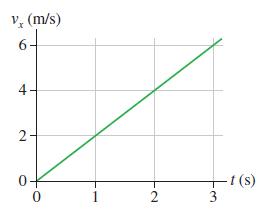
Shows the velocity graph of a particle moving along the x-axis. Its initial position is x0 = 2.0 m at t0 = 0 s. At t = 2.0 s, what are the particle’s(a) Position(b) Velocity(c) Acceleration? v, (m/s) 64 4. t (s) 3 0- 1 2 2.
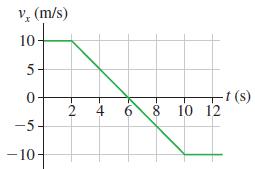
Shows the velocity graph for a particle having initial position x0 = 0 m at t0 = 0 s.a. At what time or times is the particle found at x = 35 m? Work with the geometry of the graph, not with kinematic equations.b. Draw a motion diagram for the particle. v, (m/s) 10 5- 1(s) 6 8 10 12 -5- - 10- 4,
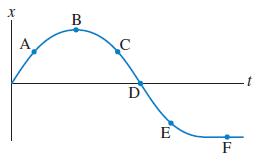
shows the position-versus-time graph for a moving object. At which lettered point or points:a. Is the object moving the fastest?b. Is the object moving to the left?c. Is the object speeding up?d. Is the object turning around? B A C D E F
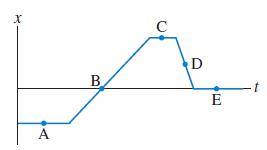
Shows the position-versus-time graph for a moving object. At which lettered point or points:a. Is the object moving the slowest?b. Is the object moving the fastest?c. Is the object at rest?d. Is the object moving to the left? C D B E A
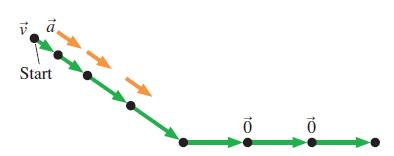
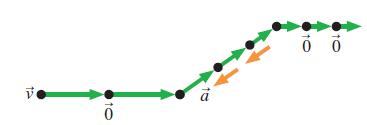
Show a motion diagram. For each of these problems, write a one or two sentence “story” about a real object that has this motion diagram. Your stories should talk about people or objects by name and say what they are doing. Problems 34 through 43 are examples of motion short stories. Start
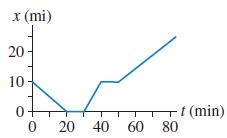
Interpret the position graph given in each figure by writing a very short “story” of what is happening. Be creative! Have characters and situations! Simply saying that “a car moves 100 meters to the right” doesn’t qualify as a story. Your stories should make specific reference to
The quantity called mass density is the mass per unit volume of a substance. Express the following mass densities in SI units.a. Aluminum, 2.7 × 10⁻³ kg/cm3b. Alcohol, 0.81 g/cm3
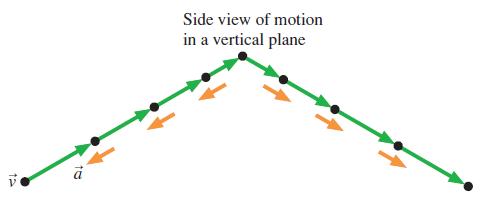
Show a motion diagram. For each of these problems, write a one or two sentence “story” about a real object that has this motion diagram. Your stories should talk about people or objects by name and say what they are doing. Side view of motion in a vertical plane to
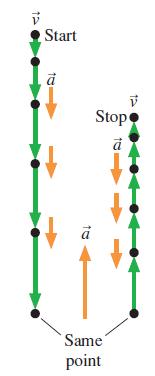
Show a motion diagram. For each of these problems, write a one or two sentence “story” about a real object that has this motion diagram. Your stories should talk about people or objects by name and say what they are doing. Start Stope Same point
Show a motion diagram. For each of these problems, write a one or two sentence “story” about a real object that has this motion diagram. Your stories should talk about people or objects by name and say what they are doing. a 10
Show a motion diagram. For each of these problems, write a one or two sentence “story” about a real object that has this motion diagram. Your stories should talk about people or objects by name and say what they are doing. Start Stop
Compute the following numbers, applying the significant figure rule adopted in this textbook.a. 12.53b. 12.5 × 5.21c. √12.5 - 1.2d. 12.5-1
Using the approximate conversion factors in Table 1.5, convert the following to SI units without using your calculator.a. 20 ftb. 60 mic. 60 mph d. 8 in
Convert the following to SI unitsa. 3 hoursb. 2 daysc. 1 yeard. 215 ft/s
Convert the following to SI units:a. 6.15 msb. 27.2 kmc. 112 km/hd. 72 μm/ms
A toy car rolls down a ramp, then across a smooth, horizontal floor. Draw a complete motion diagram of the toy car.
A child is sledding on a smooth, level patch of snow. She encounters a rocky patch and slows to a stop. Draw a complete motion diagram of the child and her sled.
A softball player hits the ball and starts running toward first base. Use the particle model to draw a motion diagram showing her position and her average velocity vectors during the first few seconds of her run.
You’re driving along the highway at 60 mph until you enter a town where the speed limit is 30 mph. You slow quickly, but not instantly, to 30 mph. Draw a basic motion diagram of your car, using images from the movie, from 30 s before reaching the city limit until 30 s afterward.
How many significant figures does each of the following numbers have?a. 310b. 0.00310 c. 1.031 d. 3.10 × 10⁵
How many significant figures does each of the following numbers have?a. 53.2 b. 0.53 c. 5.320 d. 0.0532
Showing 4900 - 5000
of 4932
First
36
37
38
39
40
41
42
43
44
45
46
47
48
49
50
Step by Step Answers

 Get 50% OFF
Claim Now
Get 50% OFF
Claim Now