New Semester
Started
Get
50% OFF
Study Help!
--h --m --s
Claim Now
Question Answers
Textbooks
Find textbooks, questions and answers
Oops, something went wrong!
Change your search query and then try again
S
Books
FREE
Study Help
Expert Questions
Accounting
General Management
Mathematics
Finance
Organizational Behaviour
Law
Physics
Operating System
Management Leadership
Sociology
Programming
Marketing
Database
Computer Network
Economics
Textbooks Solutions
Accounting
Managerial Accounting
Management Leadership
Cost Accounting
Statistics
Business Law
Corporate Finance
Finance
Economics
Auditing
Tutors
Online Tutors
Find a Tutor
Hire a Tutor
Become a Tutor
AI Tutor
AI Study Planner
NEW
Sell Books
Search
Search
Sign In
Register
study help
mathematics
calculus early transcendentals 9th
Calculus Early Transcendentals 9th Edition James Stewart, Daniel K. Clegg, Saleem Watson, Lothar Redlin - Solutions
Use the guidelines of this section to sketch the curve.y = x(x – 4)3
Find the most general antiderivative of the function. (Check your answer by differentiation.)f(x) = 4x + 7
Produce graphs of f that reveal all the important aspects of the curve. In particular, you should use graphs of f' and f" to estimate the intervals of increase and decrease, extreme values, intervals of concavity, and inflection points.f(x) = 6 sin x – x2, –5 ≤ x ≤ 3
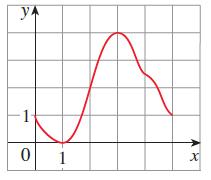
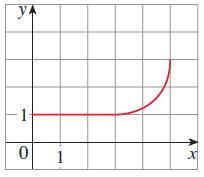
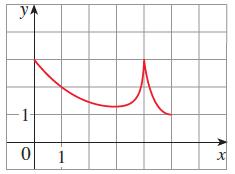
The graph of a function f is shown. Does f satisfy the hypotheses of the Mean Value Theorem on the interval [0, 5]? If so, find a value c that satisfies the conclusion of the Mean Value Theorem on that interval. YA 1 0 1 x
Determine whether the statement is true or false. If it is true, explain why. If it is false, explain why or give an example that disproves the statement.If f"(2) = 0, then (2, f(2)) is an inflection point of the curve y = f(x).
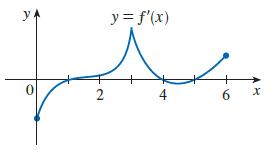
The graph of the derivative f' of a function f is shown.(a) On what intervals is f increasing? Decreasing?(b) At what values of x does f have a local maximum? Local minimum? y 0 2 y = f'(x) 4 6 X
Use the guidelines of this section to sketch the curve.y = x5 – 5x
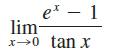
Evaluate the limit. et - 1 tan x lim- x→0
Find the most general antiderivative of the function. (Check your answer by differentiation.)f(x) = x2 – 3x + 2
Produce graphs of f that reveal all the important aspects of the curve. In particular, you should use graphs of f' and f" to estimate the intervals of increase and decrease, extreme values, intervals of concavity, and inflection points.f(x) = 6 sin x + cot x, –π ≤ x ≤ π
The graph of a function f is shown. Does f satisfy the hypotheses of the Mean Value Theorem on the interval [0, 5]? If so, find a value c that satisfies the conclusion of the Mean Value Theorem on that interval. у 1 0 1 X
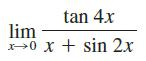
Evaluate the limit. tan 4x lim x0 x sin 2x
Determine whether the statement is true or false. If it is true, explain why. If it is false, explain why or give an example that disproves the statement.If f'(x) = g'(x) for 0 < x < 1, then f(x) = g(x) for 0 < x < 1.
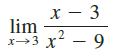
Find the limit. Use l’Hospital’s Rule where appropriate. If there is a more elementary method, consider using it. If l’Hospital’s Rule doesn’t apply, explain why. x - 3 lim x3x²9
The graph of a function f is shown. Does f satisfy the hypotheses of the Mean Value Theorem on the interval [0, 5]? If so, find a value c that satisfies the conclusion of the Mean Value Theorem on that interval. y YA -1- 0 1 x
Produce graphs of f that reveal all the important aspects of the curve. In particular, you should use graphs of f' and f" to estimate the intervals of increase and decrease, extreme values, intervals of concavity, and inflection points.f(x) = ex – 0.186x4
Determine whether the statement is true or false. If it is true, explain why. If it is false, explain why or give an example that disproves the statement.There exists a function f such that f(1) = –2, f(3) = 0, and f'(x) > 1 for all x.
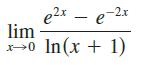
Evaluate the limit. e²x e-2x lim x>0 In(x + 1) -
Use Newton’s method with the specified initial approximation x1 to find x3, the third approximation to the solution of the given equation. (Give your answer to four decimal places.)x5 = x2 + 1, x1 = 1
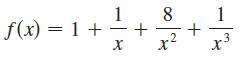
Produce graphs of f that reveal all the important aspects of the curve. Estimate the intervals of increase and decrease and intervals of concavity, and use calculus to find these intervals exactly. 1 f(x) = 1 + = + 10/00 +2 + 1 3 X
Find the most general antiderivative of the function. (Check your answer by differentiation.)f(x) = x(12x + 8)
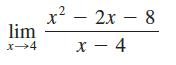
Find the limit. Use l’Hospital’s Rule where appropriate. If there is a more elementary method, consider using it. If l’Hospital’s Rule doesn’t apply, explain why. lim x-4 x²2x8 x - 4
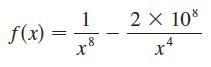
Produce graphs of f that reveal all the important aspects of the curve. Estimate the intervals of increase and decrease and intervals of concavity, and use calculus to find these intervals exactly. f(x)= -1° x8 2 X 108 x4
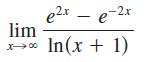
Evaluate the limit. e²x-e-2x lim x→∞0 In(x + 1)
Determine whether the statement is true or false. If it is true, explain why. If it is false, explain why or give an example that disproves the statement.There exists a function f such that f(x) > 0, f'(x) < 0, and f"(x) > 0 for all x.
Find the intervals on which f is increasing or decreasing, and find the local maximum and minimum values of f .f(x) = 2x3 – 15x2 + 24x – 5
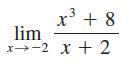
Find the limit. Use l’Hospital’s Rule where appropriate. If there is a more elementary method, consider using it. If l’Hospital’s Rule doesn’t apply, explain why. lim x →→2 x³ +8 X x + 2
Find the most general antiderivative of the function. (Check your answer by differentiation.)f(x) = (x – 5)2
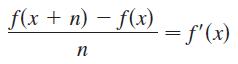
Show that if f is a differentiable function that satisfiesfor all real numbers x and all positive integers n, then f is a linear function. f(x + n) - f(x) n = f'(x)
Determine whether the statement is true or false. If it is true, explain why. If it is false, explain why or give an example that disproves the statement.There exists a function f such that f(x) < 0, f'(x) < 0, and f"(x) > 0 for all x.
Find the intervals on which f is increasing or decreasing, and find the local maximum and minimum values of f .f(x) = x3 – 6x2 – 135x
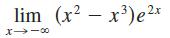
Evaluate the limit. lim (x²x³)e2x x110
Find the most general antiderivative of the function. (Check your answer by differentiation.)g(x) = 4x–2/3 – 2x5/3
(a) Graph the function.(b) Use l’Hospital’s Rule to explain the behavior as x → 0.(c) Estimate the minimum value and intervals of concavity. Then use calculus to find the exact values.f(x) = x2 ln x
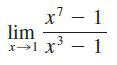
Find the limit. Use l’Hospital’s Rule where appropriate. If there is a more elementary method, consider using it. If l’Hospital’s Rule doesn’t apply, explain why. 7 x² - 1 lim x1 x³ - 1 .3 X
Verify that the function satisfies the three hypotheses of Rolle’s Theorem on the given interval. Then find all numbers c that satisfy the conclusion of Rolle’s Theorem.f(x) = sin(x/2), [π/2, 3π/2]
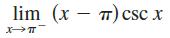
Evaluate the limit. lim (x-7) csc x X-T
Determine whether the statement is true or false. If it is true, explain why. If it is false, explain why or give an example that disproves the statement.If f and g are increasing on an interval I, then f + g is increasing on I.
Find the intervals on which f is increasing or decreasing, and find the local maximum and minimum values of f .f(x) = 6x4 – 16x3 + 1
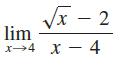
Find the limit. Use l’Hospital’s Rule where appropriate. If there is a more elementary method, consider using it. If l’Hospital’s Rule doesn’t apply, explain why. √x lim x 4 x - 4 - 2
Find the most general antiderivative of the function. (Check your answer by differentiation.)h(z) = 3z0.8 + z–2.5
Determine whether the statement is true or false. If it is true, explain why. If it is false, explain why or give an example that disproves the statement.If f and g are increasing on an interval I, then f – g is increasing on I.
Find the intervals on which f is increasing or decreasing, and find the local maximum and minimum values of f .f(x) = x2/3(x – 3)
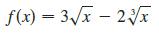
Find the most general antiderivative of the function. (Check your answer by differentiation.) f(x) = 3√x - 2√x
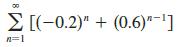
Determine whether the series is convergent or divergent. If it is convergent, find its sum. Σ-0.2)" + (0.6)*-] n=1
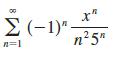
Find the radius of convergence and interval of convergence of the series. x" E(-1)"- n25" n=1
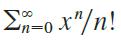
(a) Show thatconverges for all x.(b) Deduce thatfor all x. E-o x"/n! 00
Test the series for convergence or divergence. 5* Σ 3* + 4*
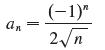
Determine whether the sequence converges or diverges. If it converges, find the limit. (-1)" an 2/n
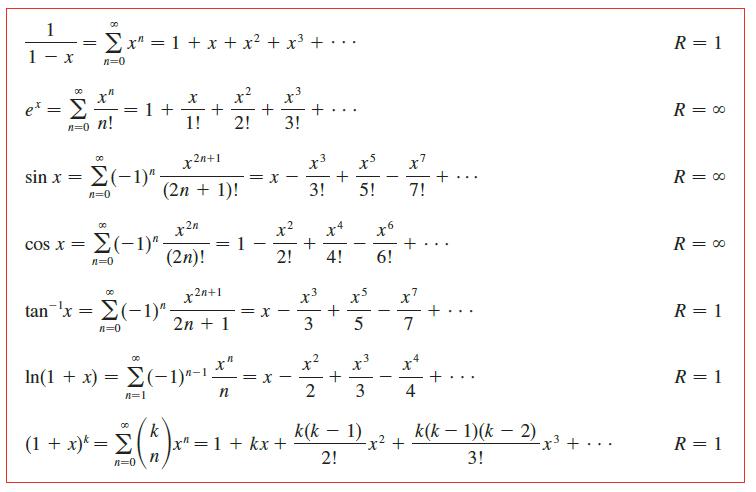
Use a Maclaurin series in Table 1 to obtain the Maclaurin series for the given function.Table 1f(x) = x cos 2x 1 2x" = 1 + x + x? + x + ... R = 1 n=0 00 x" e* = E- n=0 n! 1 + 1! R = 0 2! + 3! x2n+1 E(-1)" - x7 sin x = R = 00 ... (2n + 1)! 3! 5! 7! n=0 x? x* 00 E(-1)*. = 1 + 6! R = 0 cos x = (2n)!
Find the radius of convergence and interval of convergence of the series. (x + 2)" n=1 n4"
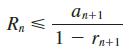
Let Σan be a series with positive terms and let rn = an+1/an . Suppose that limn→∞ rn = L < 1, so Σan converges by the Ratio Test. As usual, we let Rn be the remainder after n terms, that is,Rn = an+1 + an+2 + an+3 + ∙ ∙ ∙(a) If {rn} is a decreasing sequence and rn+1< 1, show, by
Test the series for convergence or divergence. (n!)" 4n n=1
Determine whether the series is convergent or divergent. If it is convergent, find its sum. 2" + 4" Σ e々
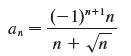
Determine whether the sequence converges or diverges. If it converges, find the limit. (-1)"*'n an n+1 n + yn
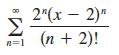
Find the radius of convergence and interval of convergence of the series. 2"(x – 2)" Σ (n + 2)! n=1
Graph the first several partial sums sn(x) of the seriestogether with the sum function f(x) = 1/(1 – x), on a common screen. On what interval do these partial sums appear to be converging to f(x)? E-o x", 00 un
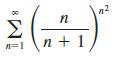
Test the series for convergence or divergence. n Σ п+1 n=1
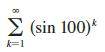
Determine whether the series is convergent or divergent. If it is convergent, find its sum. 00 E (sin 100)* IS k=1
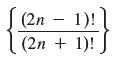
Determine whether the sequence converges or diverges. If it converges, find the limit. (2n – 1)! (2n + 1)!
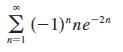
Approximate the sum of the series correct to four decimal places. E (-1)"ne-2n n=1
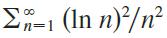
(a) Show that the seriesis convergent.(b) Find an upper bound for the error in the approximation s ≈ sn .(c) What is the smallest value of n such that this upper bound is less than 0.05 ?(d) Find sn for this value of n. E-1 (In n)*/n? 00 n=1
Use the sum of the first 10 terms to approximate the sum of the seriesUse Exercise 42 to estimate the error.Data From Exercise 42:Let Σan be a series with positive terms and let rn = an+1/an . Suppose that limn→∞ rn = L < 1, so Σan converges by the Ratio Test. As usual, we let Rn be
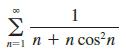
Test the series for convergence or divergence. 1 Σ n=1 n + n cos'n
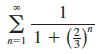
Determine whether the series is convergent or divergent. If it is convergent, find its sum. 1 Σ 1 + n=1
Determine whether the sequence converges or diverges. If it converges, find the limit. In n In(2n)
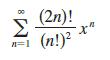
Find the radius of convergence of the series (2n)! Σ (n!)? 00
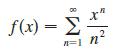
LetFind the intervals of convergence for f , f', and f". x" f(x) = E 00 ,2 n=1
Test the series for convergence or divergence. 1 Σ 1+1/n
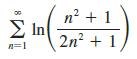
Determine whether the series is convergent or divergent. If it is convergent, find its sum. n? + 1 2 In 2n2 + 1 n=1
Determine whether the sequence converges or diverges. If it converges, find the limit.{sin n}
Use a Maclaurin series in Table 1 to obtain the Maclaurin series for the given function.Table 1 1 2x" = 1 + x + x? + x + ... R = 1 n=0 00 x" e* = E- n=0 n! 1 + 1! R = 0 2! + 3! x2n+1 E(-1)" - x7 sin x = R = 00 ... (2n + 1)! 3! 5! 7! n=0 x? x* 00 E(-1)*. = 1 + 6! R = 0 cos x = (2n)! 2! 4! n=0 .5 x'
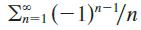
Is the 50th partial sum s50 of the alternating seriesan overestimate or an underestimate of the total sum? Explain. (-1)"-/n
Use the following steps to show that the sequencehas a limit. (The value of the limit is denoted by γ and is called Euler’s constant.)(a) Draw a picture like Figure 6 with f(x) = 1/x and interpret tn as an area [or use (5)] to show that tn > 0 for all n.(b) Interpretas a difference of areas
Around 1910, the Indian mathematician Srinivasa Ramanujan discovered the formulaWilliam Gosper used this series in 1985 to compute the first 17 million digits of π.(a) Verify that the series is convergent.(b) How many correct decimal places of π do you get if you use just the first term of the
(a) Starting with the geometric seriesfind the sum of the series(b) Find the sum of each of the following series.(c) Find the sum of each of the following series. E-o x", 100
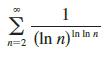
Test the series for convergence or divergence. 1 Σ (In n)n n n=2
Determine whether the series is convergent or divergent. If it is convergent, find its sum. Σ E (/2) * k=0
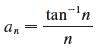
Determine whether the sequence converges or diverges. If it converges, find the limit. tan-'n an n
Use a Maclaurin series in Table 1 to obtain the Maclaurin series for the given function.Table 1 1 2x" = 1 + x + x? + x + ... R = 1 n=0 00 x" e* = E- n=0 n! 1 + 1! R = 0 2! + 3! x2n+1 E(-1)" - x7 sin x = R = 00 ... (2n + 1)! 3! 5! 7! n=0 x? x* 00 E(-1)*. = 1 + 6! R = 0 cos x = (2n)! 2! 4! n=0 .5 x'
Find the Taylor series of f(x) = cos x at a = π/3.
For what values of p is each series convergent? (-1)"-1 –1)*- Σ nº
If f(x) = 1/(1 – x), find a power series representation for h(x) = xf'(x) + x2f "(x) and determine the radius of convergence. Use this to show that n? 2" n=1
Show thatdiverges. 1 Σ (In n) la ln n 00 R=2
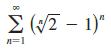
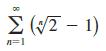
Test the series for convergence or divergence. E (/7 – 1)"
Determine whether the series is convergent or divergent. If it is convergent, find its sum. 2 arctan n n=1
Determine whether the sequence converges or diverges. If it converges, find the limit.{n2e−n}
Use a Maclaurin series in Table 1 to obtain the Maclaurin series for the given function.Table 1f(x) = sin2x 1 2x" = 1 + x + x? + x + ... R = 1 n=0 00 x" e* = E- n=0 n! 1 + 1! R = 0 2! + 3! x2n+1 E(-1)" - x7 sin x = R = 00 ... (2n + 1)! 3! 5! 7! n=0 x? x* 00 E(-1)*. = 1 + 6! R = 0 cos x = (2n)! 2!
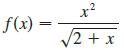
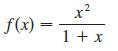
Find the Maclaurin series for f and the associated radius of convergence. You may use either the direct method (definition of a Maclaurin series) or the Maclaurin series listed in Table 11.10.1. x? f(x) 1 + x 2.
For what values of p is each series convergent? (-1)" –1)" n=1 n + P
Use the power series representation of f(x) = 1/(1 – x)2 and the fact that 9801 = 992 to show that 1/9801 is a repeating decimal that contains every two digit number in order, except for 98, as shown. 1 0.00 01 02 03... 96 97 99 %3| 9801
Test the series for convergence or divergence. E (7 – 1)
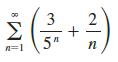
Determine whether the series is convergent or divergent. If it is convergent, find its sum. 3 Σ 5" 2 n=1
Determine whether the sequence converges or diverges. If it converges, find the limit.an = ln(n + 1) − ln n
Use a Maclaurin series in Table 1 to obtain the Maclaurin series for the given function.Table 1 1 2x" = 1 + x + x? + x + ... R = 1 n=0 00 x" e* = E- n=0 n! 1 + 1! R = 0 2! + 3! x2n+1 E(-1)" - x7 sin x = R = 00 ... (2n + 1)! 3! 5! 7! n=0 x? x* 00 E(-1)*. = 1 + 6! R = 0 cos x = (2n)! 2! 4! n=0 .5 x'
Find the Maclaurin series for f and the associated radius of convergence. You may use either the direct method (definition of a Maclaurin series) or the Maclaurin series listed in Table 11.10.1.f(x) = tan–1(x2)
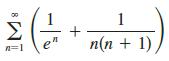
Determine whether the series is convergent or divergent. If it is convergent, find its sum. 1 e n(n + 1) n=1
Determine whether the sequence converges or diverges. If it converges, find the limit. 2. cos'n an 2"
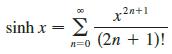
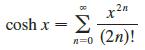
Use the definitionsand the Maclaurin series for ex to show thata.b. e* - e* e* + e* sinh x cosh x
Find the Maclaurin series for f and the associated radius of convergence. You may use either the direct method (definition of a Maclaurin series) or the Maclaurin series listed in Table 11.10.1.f(x) = ln(4 – x)
Showing 1100 - 1200
of 4932
First
5
6
7
8
9
10
11
12
13
14
15
16
17
18
19
Last
Step by Step Answers

 Get 50% OFF
Claim Now
Get 50% OFF
Claim Now