New Semester
Started
Get
50% OFF
Study Help!
--h --m --s
Claim Now
Question Answers
Textbooks
Find textbooks, questions and answers
Oops, something went wrong!
Change your search query and then try again
S
Books
FREE
Study Help
Expert Questions
Accounting
General Management
Mathematics
Finance
Organizational Behaviour
Law
Physics
Operating System
Management Leadership
Sociology
Programming
Marketing
Database
Computer Network
Economics
Textbooks Solutions
Accounting
Managerial Accounting
Management Leadership
Cost Accounting
Statistics
Business Law
Corporate Finance
Finance
Economics
Auditing
Tutors
Online Tutors
Find a Tutor
Hire a Tutor
Become a Tutor
AI Tutor
AI Study Planner
NEW
Sell Books
Search
Search
Sign In
Register
study help
mathematics
calculus early transcendentals 9th
Calculus Early Transcendentals 9th Edition James Stewart, Daniel K. Clegg, Saleem Watson, Lothar Redlin - Solutions
Show that the equation has exactly one real solution. 2x + cos x = 0
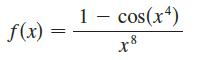
Graph the function using as many viewing rectangles as you need to depict the true nature of the function. f(x) = 1 - cos(x¹) x8
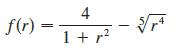
Find the most general antiderivative of the function. (Check your answer by differentiation.) f(r) = 4 1+r²
Use Newton’s method to find all solutions of the equation correct to six decimal places.x3 = 5x –3
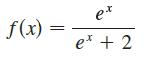
Find the intervals on which f is concave upward or concave downward, and find the inflection points of f . f(x) ex et + 2
Rework Exercise 21 assuming the container has a lid that is made from the same material as the sides.Data From Exercise 21:A rectangular storage container without a lid is to have a volume of 10 m3. The length of its base is twice the width. Material for the base costs $10 per square
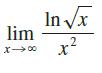
Find the limit. Use l’Hospital’s Rule where appropriate. If there is a more elementary method, consider using it. If l’Hospital’s Rule doesn’t apply, explain why. lim X-∞ In√√x x²
Let f(x) = 2 – |2x – 1|. Show that there is no value of c such that f(3) – f (0) = f'(c)(3 – 0). Why does this not contradict the Mean Value Theorem?
Find the most general antiderivative of the function. (Check your answer by differentiation.)h(x) = sec2x + π cos x
Use Newton’s method to find all solutions of the equation correct to six decimal places.arctan x = x2 – 3
Find the intervals on which f is concave upward or concave downward, and find the inflection points of f .f(x) = ln(x2 + 5)
Determine whether the statement is true or false. If it is true, explain why. If it is false, explain why or give an example that disproves the statement. x lim x-o ex
(a) Write an equation that defines the exponential function with base b > 0.(b) What is the domain of this function?(c) If b ≠ 1, what is the range of this function?(d) Sketch the general shape of the graph of the exponential function for each of the following
In this section we discussed examples of ordinary, everyday functions: population is a function of time, postage cost is a function of package weight, water temperature is a function of time. Give three other examples of functions from everyday life that are described verbally. What can you say
Make a rough sketch by hand of the graph of the function. Use the graphs given in Figures 3 and 15 and, if necessary, the transformations of Section 1.3.y = e|ϰ|
Find(a) f + t,(b) f - t,(c) fg, and(d) f/g and state their domains. f(x) = 1 x - l' g(x) = X - 2
Find the functions(a) f ° t,(b) t ° f ,(c) f ° f, (d) t ° t and their domains.f(x) = x3 + 5, g(x) = 3√x
Find the functions(a) f ° t,(b) t ° f ,(c) f ° f, (d) t ° t and their domains.f(x) = 1/x, g(x) = 2x + 1
Find the functions(a) f ° t,(b) t ° f ,(c) f ° f, (d) t ° t and their domains.f(x) = 1/√x, g(x) = x + 1
Find a formula for the function whose graph is the given curve.The bottom half of the parabola ϰ + (y - 1)2 = 0
A right circular cylinder has volume 25 in3. Express the radius of the cylinder as a function of the height.Find a formula for the described function and state its domain.
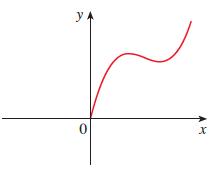
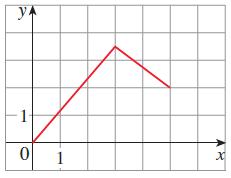
The graph of a function defined for ϰ > 0 is given. Complete the graph for x, 0 to make (a) An even function (b) An odd function. У4 0 X
The graph of a function defined for ϰ > 0 is given. Complete the graph for ϰ, 0 to make (a) An even function and(b) An odd function. У4 0 x
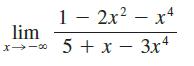
Find the limit. lim 8118 1 - 2x²x4 5 + x - 3x4
Discontinuities at 0 and 3, but continuous from the right at 0 and from the left at 3Sketch the graph of a function f that is defined on R and continuous except for the stated discontinuities.
If f is continuous at 5 and f(5) = 2 and f(4) = 3, then limx→2 f(4x2 - 11) = 2.Determine whether the statement is true or false. If it is true, explain why. If it is false, explain why or give an example that disproves the statement.
f(x) = √4x + 1 , a = 6Use Definition 4 to find f'(a) at the given number a.
If f'(r) exist, then limx→r f(x) = f(r).Determine whether the statement is true or false. If it is true, explain why. If it is false, explain why or give an example that disproves the statement.
Find the derivative of the function using the definition of derivative. State the domain of the function and the domain of its derivative. f(x) = 1/x2 - 4
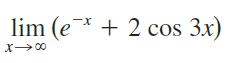
Find the limit or show that it does not exist. do lim (ex + 2 cos 3x) x →∞0
If t is a differentiable function, find an expression for the derivative of each of the following functions.(a). y = ϰg(ϰ)(b). y = ϰ/g(ϰ)
(a) If F(ϰ) = f (ϰ) g(ϰ), where f and g have derivatives of all orders, show that F" = f" g + 2f'g' + f g".(b) Find similar formulas for F"' and F(4).(c) Guess a formula for F(n).
Produce graphs of f that reveal all the important aspects of the curve. In particular, you should use graphs of f' and f" to estimate the intervals of increase and decrease, extreme values, intervals of concavity, and inflection points.f(x) = x5 – 5x4 – x3 + 28x2 – 2x
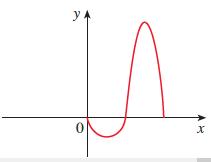
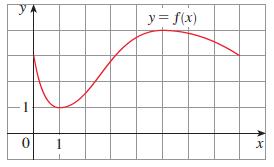
The graph of a function f is shown. Verify that f satisfies the hypotheses of Rolle’s Theorem on the interval [0, 8]. Then estimate the value(s) of c that satisfy the conclusion of Rolle’s Theorem on that interval. 1 0 1 y = f(x) X
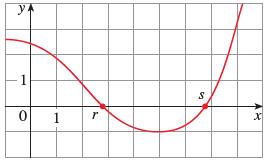
The figure shows the graph of a function f . Suppose that Newton’s method is used to approximate the solution s of the equation f(x) = 0 with initial approximation x1 = 6.(a) Draw the tangent lines that are used to find x2 and x3, and estimate the numerical values of x2 and x3.(b) Would x1 = 8 be
Find an antiderivative of the function.(a) f(x) = 6(b) g(t) = 3t2
Produce graphs of f that reveal all the important aspects of the curve. In particular, you should use graphs of f' and f" to estimate the intervals of increase and decrease, extreme values, intervals of concavity, and inflection points.f(x) = –2x6 + 5x5 + 140x3 – 110x2
Find an antiderivative of the function.(a) f(x) = 2x(b) g(x) = –1/x2
Produce graphs of f that reveal all the important aspects of the curve. In particular, you should use graphs of f' and f" to estimate the intervals of increase and decrease, extreme values, intervals of concavity, and inflection points.f(x) = x6 – 5x5 + 25x3 – 6x2 – 48x
Determine whether the statement is true or false. If it is true, explain why. If it is false, explain why or give an example that disproves the statement.If f is continuous on (a, b), then f attains an absolute maximum value f(c) and an absolute minimum value f(d) at some numbers c and d in (a, b).
Use the guidelines of this section to sketch the curve.y = x4 – 4x
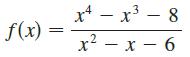
Produce graphs of f that reveal all the important aspects of the curve. In particular, you should use graphs of f' and f" to estimate the intervals of increase and decrease, extreme values, intervals of concavity, and inflection points. f(x)= +4 r4 – r3 – 8 - x² - x - 6 2
Draw the graph of a function that is continuous on [0, 8] where f(0) = 1 and f(8) = 4 and that does not satisfy the conclusion of the Mean Value Theorem on [0, 8].
Determine whether the statement is true or false. If it is true, explain why. If it is false, explain why or give an example that disproves the statement.If f is differentiable and f(–1) = f(1), then there is a number c such that |c| < 1 and f'(c) = 0.
Use the guidelines of this section to sketch the curve.y = x4 – 8x2 + 8
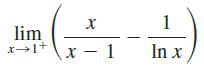
Evaluate the limit. X -1. lim x →>>1+ x-1 In x
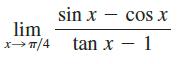
Find the limit. Use l’Hospital’s Rule where appropriate. If there is a more elementary method, consider using it. If l’Hospital’s Rule doesn’t apply, explain why. lim x→ π/4 sin x - cos x tan x - 1
Determine whether the statement is true or false. If it is true, explain why. If it is false, explain why or give an example that disproves the statement.If f and g are increasing on an interval I, then f g is increasing on I.
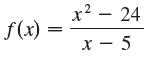
Find the intervals on which f is increasing or decreasing, and find the local maximum and minimum values of f. f(x) = x² - 24 x-5
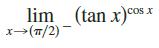
Evaluate the limit. lim (tan x)cos x x-> (π/2)-
Find the most general antiderivative of the function. (Check your answer by differentiation.)g(x) = √x (2 – x + 6x2)
Let f(x) = tan x. Show that f(0) − f(π) but there is no number c in (0, π) such that f'(c) = 0. Why does this not contradict Rolle’s Theorem?
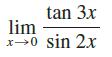
Find the limit. Use l’Hospital’s Rule where appropriate. If there is a more elementary method, consider using it. If l’Hospital’s Rule doesn’t apply, explain why. tan 3x lim x→0 sin 2x
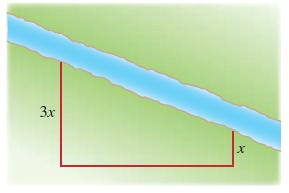
A farmer has 1200 ft of fencing for enclosing a trapezoidal field along a river as shown. One of the parallel sides is three times longer than the other. No fencing is needed along the river. Find the largest area the farmer can enclose. 3x X
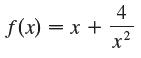
Find the intervals on which f is increasing or decreasing, and find the local maximum and minimum values of f . f(x) = x + 4 2 X
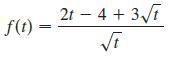
Find the most general antiderivative of the function. (Check your answer by differentiation.) f(t)= 2t - 4 + 3√t √t
Sketch the graph of a function that satisfies the given conditions.f(0) = 0, f'(–2) = f'(1) = f'(9) = 0,f'(x) < 0 on (–∞, –2), (1, 6), and (9, ∞),f'(x) > 0 on (–2, 1) and (6, 9),f"(x) > 0 on (–∞ , 0) and (12, ∞),f"(x) < 0 on (0, 6) and (6, 12) lim f(x) = 0, lim f(x) =
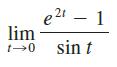
Find the limit. Use l’Hospital’s Rule where appropriate. If there is a more elementary method, consider using it. If l’Hospital’s Rule doesn’t apply, explain why. lim 1-0 e21 e²t - 1 sin t
Determine whether the statement is true or false. If it is true, explain why. If it is false, explain why or give an example that disproves the statement.If f is increasing and f(x) > 0 on I, then g(x) = 1/f sxd is decreasing on I.
Find the intervals on which f is increasing or decreasing, and find the local maximum and minimum values of f.f(x) = sin x + cos x, 0 ≤ x ≤ 2π
Use Newton’s method to approximate the indicated solution of the equation correct to six decimal places.The negative solution of cos x = x2 – 4
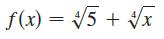
Find the most general antiderivative of the function. (Check your answer by differentiation.) f(x) = √√5 + √√x
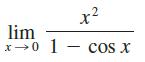
Find the limit. Use l’Hospital’s Rule where appropriate. If there is a more elementary method, consider using it. If l’Hospital’s Rule doesn’t apply, explain why. x² lim x-0 1- cos x
Sketch the graph of a function that satisfies the given conditions.f(0) = 0, f is continuous and even,f'(x) = 2x if 0 < x < 1, f'(x) = –1 if 1 < x < 3,f'(x) = 1 if x > 3
Determine whether the statement is true or false. If it is true, explain why. If it is false, explain why or give an example that disproves the statement.If f is even, then f' is even.
Find the intervals on which f is increasing or decreasing, and find the local maximum and minimum values of f .f(x) = x4e–x
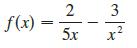
Find the most general antiderivative of the function. (Check your answer by differentiation.) f(x) = 2 3 5x 2 X
Use Newton’s method to approximate the indicated solution of the equation correct to six decimal places.The positive solution of e2x = x + 3
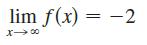
Sketch the graph of a function that satisfies the given conditions.f is odd, f'(x) < 0 for 0 < x < 2,f'(x) > 0 for x > 2, f"(x) > 0 for 0 < x < 3,f"(x) < 0 for x > 3, lim f(x) = -2 x10
Verify that the function satisfies the hypotheses of the Mean Value Theorem on the given interval. Then find all numbers c that satisfy the conclusion of the Mean Value Theorem.f(x) = ln x, [1, 4]
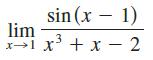
Find the limit. Use l’Hospital’s Rule where appropriate. If there is a more elementary method, consider using it. If l’Hospital’s Rule doesn’t apply, explain why. sin (x - 1) lim x1 x³ + x2
Determine whether the statement is true or false. If it is true, explain why. If it is false, explain why or give an example that disproves the statement.If f is periodic, then f' is periodic.
Find the intervals on which f is concave upward or concave downward, and find the inflection points of f.f(x) = x3 – 3x2 – 9x + 4
Use Newton’s method to find all solutions of the equation correct to six decimal places.sin x = x – 1
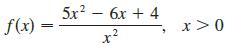
Find the most general antiderivative of the function. (Check your answer by differentiation.) f(x)= 5x² - 6x + 4 x² x > 0
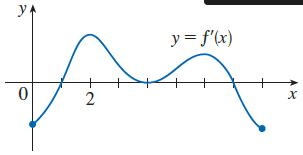
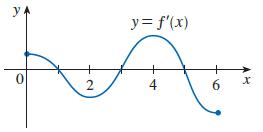
The figure shows the graph of the derivative f' of a function f.(a) On what intervals is f increasing or decreasing?(b) For what values of x does f have a local maximum or minimum?(c) Sketch the graph of f".(d) Sketch a possible graph of f. у 0 2 y = f'(x) X
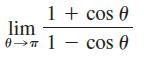
Find the limit. Use l’Hospital’s Rule where appropriate. If there is a more elementary method, consider using it. If l’Hospital’s Rule doesn’t apply, explain why. lim 0→T 1 + cos 0 1 - cos 0
Verify that the function satisfies the hypotheses of the Mean Value Theorem on the given interval. Then find all numbers c that satisfy the conclusion of the Mean Value Theorem.f(x) = 1/x, (1, 3)
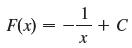
Determine whether the statement is true or false. If it is true, explain why. If it is false, explain why or give an example that disproves the statement.The most general antiderivative of f(x) = x–2 is F(x) = 1 ____+C X
Find the intervals on which f is concave upward or concave downward, and find the inflection points of f .f(x) = 2x3 – 9x2 + 12x – 3
Use Newton’s method to find all solutions of the equation correct to six decimal places.cos 2x = x3
Find the most general antiderivative of the function. (Check your answer by differentiation.)g(t) = 7et – e3
Sketch the curve.y = 2 – 2x – x3
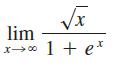
Find the limit. Use l’Hospital’s Rule where appropriate. If there is a more elementary method, consider using it. If l’Hospital’s Rule doesn’t apply, explain why. √x lim x→∞ 1 + e* ·00
Find the intervals on which f is concave upward or concave downward, and find the inflection points of f .f(x) = sin2x – cos 2x, 0 ≤ x ≤ π
Let f(x) = a1 sin x + a2 sin 2x + ∙ ∙ ∙ + an sin nx, where a1, a2 , . . . , an are real numbers and n is a positive integer. If it is given that |f(x)| ≤ |sin x| for all x, show that|a1 + 2a2 + ∙ ∙ ∙ + nan | ≤ 1
Use Newton’s method to find all solutions of the equation correct to six decimal places.2x = 2 – x2
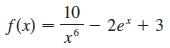
Find the most general antiderivative of the function. (Check your answer by differentiation.) f(x)= 10 .6 2e + 3
Use a computer algebra system to graph f and to find f' and f". Use graphs of these derivatives to estimate the intervals of increase and decrease, extreme values, intervals of concavity, and inflection points of f.f(x) = x – tan–1(x2)
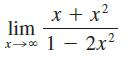
Find the limit. Use l’Hospital’s Rule where appropriate. If there is a more elementary method, consider using it. If l’Hospital’s Rule doesn’t apply, explain why. lim x →∞ x + x² 1 1 - 2x²
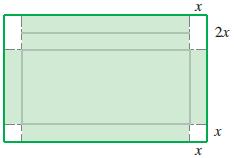
A box with an open top is to be constructed from a 4 ft by 3 ft rectangular piece of cardboard by cutting out squares or rectangles from each of the four corners, as shown in the figure, and bending up the sides. One of the longer sides of the box is to have a double layer of cardboard, which is
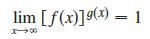
Determine whether the statement is true or false. If it is true, explain why. If it is false, explain why or give an example that disproves the statement.Ifthen lim f(x) = 1 and lim g(x) = ∞,
Find the intervals on which f is concave upward or concave downward, and find the inflection points of f .f(x) = ln(2 + sin x), 0 ≤ x ≤ 2π
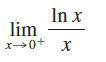
Find the limit. Use l’Hospital’s Rule where appropriate. If there is a more elementary method, consider using it. If l’Hospital’s Rule doesn’t apply, explain why. lim x-0+ In x X
Find the most general antiderivative of the function. (Check your answer by differentiation.)f(θ) = 2 sin θ – 3 sec θ tan θ
Find an antiderivative of the function.(a) g(t) = 1/t(b) r(θ) = sec2θ
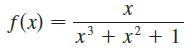
Produce graphs of f that reveal all the important aspects of the curve. In particular, you should use graphs of f' and f" to estimate the intervals of increase and decrease, extreme values, intervals of concavity, and inflection points. f(x) X x³ + x² + 1
The graph of a function f is shown. Does f satisfy the hypotheses of the Mean Value Theorem on the interval [0, 5]? If so, find a value c that satisfies the conclusion of the Mean Value Theorem on that interval. ya 1 0 1 bc X
The graph of the derivative f' of a function f is shown.(a) On what intervals is f increasing? Decreasing?(b) At what values of x does f have a local maximum? Local minimum? y 0 2 y = f'(x) 4 6 X
Determine whether the statement is true or false. If it is true, explain why. If it is false, explain why or give an example that disproves the statement.If f'(x) < 0 for 1 < x < 6, then f is decreasing on (1, 6).
Showing 1000 - 1100
of 4932
First
4
5
6
7
8
9
10
11
12
13
14
15
16
17
18
Last
Step by Step Answers

 Get 50% OFF
Claim Now
Get 50% OFF
Claim Now