New Semester
Started
Get
50% OFF
Study Help!
--h --m --s
Claim Now
Question Answers
Textbooks
Find textbooks, questions and answers
Oops, something went wrong!
Change your search query and then try again
S
Books
FREE
Study Help
Expert Questions
Accounting
General Management
Mathematics
Finance
Organizational Behaviour
Law
Physics
Operating System
Management Leadership
Sociology
Programming
Marketing
Database
Computer Network
Economics
Textbooks Solutions
Accounting
Managerial Accounting
Management Leadership
Cost Accounting
Statistics
Business Law
Corporate Finance
Finance
Economics
Auditing
Tutors
Online Tutors
Find a Tutor
Hire a Tutor
Become a Tutor
AI Tutor
AI Study Planner
NEW
Sell Books
Search
Search
Sign In
Register
study help
mathematics
calculus with applications
Calculus With Applications 12th Edition Margaret L. Lial - Solutions
Find each function value without using a calculator.sin 60°
Find the derivatives of the functions defined as follows.y = cos(ln|2x3|)
Find the values of the six trigonometric functions for the angles in standard position having the points in Exercises on their terminal sides.(-12, -5)
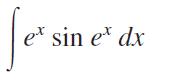
Find each integral. Je et sin ex dx
In quadrant I, x, y, and r are all positive, so that all six trigonometric functions have positive values. In quadrant II, x is negative and y is positive (r is always positive). Thus, in quadrant II, sine is positive, cosine is negative, and so on. For Exercises, complete the following table of
Find the values of the six trigonometric functions for the angles in standard position having the points in Exercises on their terminal sides.(7, -24)
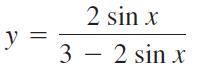
Find the derivatives of the functions defined as follows. y 2 sin x 3 - 2 sin x
Find the derivatives of the functions defined as follows.y = ln |sin x2|
Find each function value without using a calculator.tan 120°
Find the values of the six trigonometric functions for the angles in standard position having the points in Exercises on their terminal sides.(20, 15)
Find the derivatives of the functions defined as follows.y = ln |tan2x|
Find each function value without using a calculator.cos(-45°)
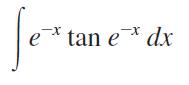
Find each integral. fexta -X e tan e dx
Find each function value without using a calculator.sec 150°
In quadrant I, x, y, and r are all positive, so that all six trigonometric functions have positive values. In quadrant II, x is negative and y is positive (r is always positive). Thus, in quadrant II, sine is positive, cosine is negative, and so on. For Exercises, complete the following table of
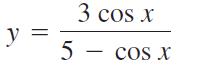
Find the derivatives of the functions defined as follows. y 3 cos x 5 - cos x
In quadrant I, x, y, and r are all positive, so that all six trigonometric functions have positive values. In quadrant II, x is negative and y is positive (r is always positive). Thus, in quadrant II, sine is positive, cosine is negative, and so on. For Exercises, complete the following table of
Find each function value without using a calculator.csc 120°
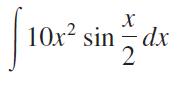
Find each integral. J X 10x² sin - dx zdx
The revenue received from the sale of electric fans is seasonal, with maximum revenue in the summer. Let the revenue (in dollars) received from the sale of fans be approximated by R(t) = 120 cos 2πt + 150, where t is time in years, measured from July 1.(a) Find R′(t).(b) Find R′(t) for August
Convert the following radian measures to degrees.3π/4
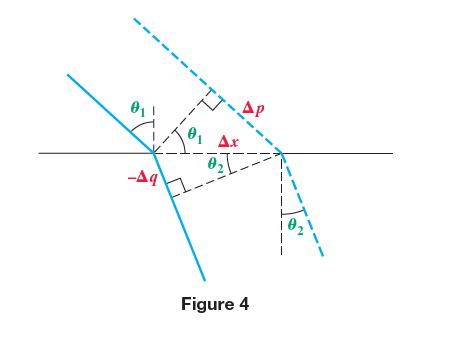
1. In Figure 4, we drew the two rays coming from point A as if they were nearly parallel. Why can’t they be parallel? If they were parallel, how would you prove that the two angles labeled 01 are equal? How could you make the rays more nearly parallel?2. In Figure 4, we claim that the segment
The function ƒ(x) = cos x is periodic with a period of π.Determine whether each of the following statements is true or false, and explain why.
An angle of 180°or π radians represents one complete rotation around a circle.Determine whether each statement is true or false, and explain why.
As x approaches 0, (sin x)/x also approaches 0.Determine whether each statement is true or false, and explain why.
All six of the basic trigonometric functions are periodic.Determine whether each of the following statements is true or false, and explain why.
The sine and cosine function take on all real values between -1 and 1.Determine whether each statement is true or false, and explain why.
Dx(sin2x + cos2x) = 0Determine whether each statement is true or false, and explain why.
It is reasonable to expect that the Dow Jones Industrial Average is periodic and can be modeled using a sine function.Determine whether each of the following statements is true or false, and explain why.
The integral of tan x can be derived using substitution and the fact that tan x = sin x/cos x.Determine whether each statement is true or false, and explain why.
The values of the six trigonometric functions can be found at π/6, π/4, and π/3 without a calculator.Determine whether each statement is true or false, and explain why.
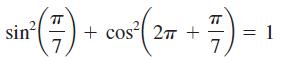
Determine whether each of the following statements is true or false, and explain why. sin² (7) + cos² (2π + 7) = 1
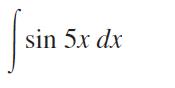
Find each integral. [si sin 5x dx
At points where the sine function has its maximum, the cosine function equals 0.Determine whether each statement is true or false, and explain why.
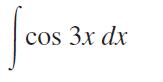
Find each integral. Ico cos 3x dx
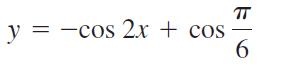
Find the derivatives of the functions defined as follows. y = -cos 2x + cos TT 6
cos(a + b) = cos a + cos bDetermine whether each of the following statements is true or false, and explain why.
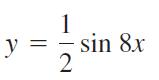
Find the derivatives of the functions defined as follows. y −2 sin 8x
The period of a sine or cosine function is the reciprocal of the frequency.Determine whether each statement is true or false, and explain why.
Once the derivative of the sine function is known, the derivative of the cosine function can be found using the chain rule.Determine whether each statement is true or false, and explain why.
Convert the following degree measures to radians. Leave answers as multiples of π.60°
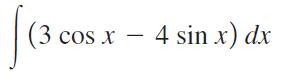
Find each integral. J (3 cos x - 4 sin x) dx
Determine whether each of the following statements is true or false, and explain why.Dx tan(x2) = sec2(x2)
Convert the following degree measures to radians. Leave answers as multiples of π.90°
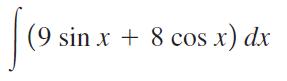
Find each integral. fo (9 sin x + 8 cos x) dx
The cosine function has an infinite number of critical points where an absolute minimum occurs.Determine whether each of the following statements is true or false, and explain why.
Convert the following degree measures to radians. Leave answers as multiples of π.125°
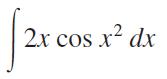
Find each integral. 2x cos x² dx
Find the derivatives of the functions defined as follows.y = 12 tan(9x + 1)
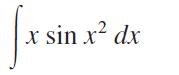
Find each integral. x sin x² dx
The secant function has an infinite number of critical points where an absolute maximum occurs.Determine whether each of the following statements is true or false, and explain why.
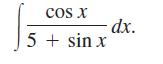
The method of integration by parts should be used to determine COS X 5+ sin x dx.
Convert the following degree measures to radians. Leave answers as multiples of π.135°
Find the derivatives of the functions defined as follows.y = -4 cos(7x2 - 4)
The area between the x-axis and the curve y = sin x on the interval [0, 2π] is given by the definite integral ∫02π sin x dx.Determine whether each of the following statements is true or false, and explain why.
Convert the following degree measures to radians. Leave answers as multiples of π.270°
Find the derivatives of the functions defined as follows.y = cos4 x
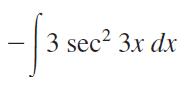
Find each integral. J 1 3 sec² 3x dx
Convert the following degree measures to radians. Leave answers as multiples of π.320°
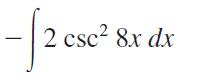
Find each integral. 2 csc² 8x dx
Find the derivatives of the functions defined as follows.y = -9 sin5 x
What is the relationship between the degree measure and the radian measure of an angle?
Convert the following degree measures to radians. Leave answers as multiples of π.495°
Find the derivatives of the functions defined as follows.y = tan8 x
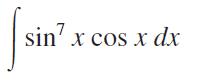
Find each integral. sin x cos x dx
Under what circumstances should radian measure be used instead of degree measure? Degree measure instead of radian measure?
Convert the following radian measures to degrees. 5 п 4
Convert the following degree measures to radians. Leave answers as multiples of π.510°
Find the derivatives of the functions defined as follows.y = 3 cot5 x
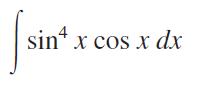
Find each integral. Is sin x cos x dx
Describe in words how each of the six trigonometric functions is defined.
Convert the following radian measures to degrees. 2 3 200
Find the derivatives of the functions defined as follows.y = -6x sin 2x
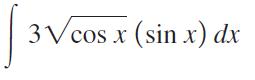
Find each integral. J 3Vcos x (sin x) dx
At what angles (given as rational multiples of π) can you determine the exact values for the trigonometric functions?
Find the derivatives of the functions defined as follows.y = 2x sec 4x
Convert the following degree measures to radians. Leave answers as multiples of π.90°
Convert the following radian measures to degrees. 13п 6
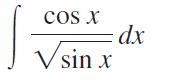
Find each integral. COS X Vsin x dx
Convert the following radian measures to degrees. 4
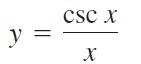
Find the derivatives of the functions defined as follows. y CSC X X
Convert the following radian measures to degrees. ∞ 5
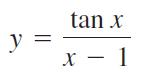
Find the derivatives of the functions defined as follows. || y= tan x 1 x -
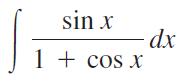
Find each integral. sin x 1 + cos X COS dx
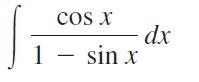
Find each integral. COS X 1 - sin x dx
Convert the following degree measures to radians. Leave answers as multiples of π.160°
Convert the following radian measures to degrees. 5 п 9
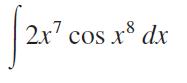
Find each integral. √2x² 2x7 cos x³ dx
Convert the following degree measures to radians. Leave answers as multiples of π.225°
Find the derivatives of the functions defined as follows.y = sin e4x
Convert the following radian measures to degrees. 7 п 12
Convert the following degree measures to radians. Leave answers as multiples of π.270°
Find the derivatives of the functions defined as follows.y = cos(4e2x)
Convert the following radian measures to degrees.5π
Find the derivatives of the functions defined as follows.y = ecos x
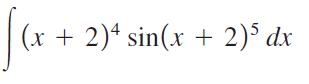
Find each integral. f (x (x + 2) sin(x + 2)5 dx
For Exercises, complete the following table. Use the 30°–60°–90° and 45°–45° –90° triangles. Do not use a calculator. 0 30° sin 0 1/2 cos ( √312 tan 0 cot 0 sec 0 2√3/3 csc 0
Find each function value without using a calculator. 7T cos 3
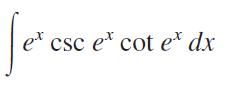
Find each integral. Je et csc et cot ex dx
Find the derivatives of the functions defined as follows. y = 3 tan = 4 X + 4 cot 2x - 5 csc x + e-2x
Showing 4200 - 4300
of 8662
First
36
37
38
39
40
41
42
43
44
45
46
47
48
49
50
Last
Step by Step Answers

 Get 50% OFF
Claim Now
Get 50% OFF
Claim Now