New Semester
Started
Get
50% OFF
Study Help!
--h --m --s
Claim Now
Question Answers
Textbooks
Find textbooks, questions and answers
Oops, something went wrong!
Change your search query and then try again
S
Books
FREE
Study Help
Expert Questions
Accounting
General Management
Mathematics
Finance
Organizational Behaviour
Law
Physics
Operating System
Management Leadership
Sociology
Programming
Marketing
Database
Computer Network
Economics
Textbooks Solutions
Accounting
Managerial Accounting
Management Leadership
Cost Accounting
Statistics
Business Law
Corporate Finance
Finance
Economics
Auditing
Tutors
Online Tutors
Find a Tutor
Hire a Tutor
Become a Tutor
AI Tutor
AI Study Planner
NEW
Sell Books
Search
Search
Sign In
Register
study help
mathematics
calculus with applications
Calculus With Applications 12th Edition Margaret L. Lial - Solutions
Convert the following radian measures to degrees.5π
Find the derivatives of the functions defined as follows.y = -2ecot x
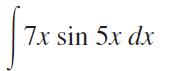
Find each integral. 7x sin 5x dx
For Exercises, complete the following table. Use the 30°–60°–90° and 45°–45° –90° triangles. Do not use a calculator. 0 45° sin 0 cos ( tan 0 1 cot 0 1 sec 0 csc (
Find the derivatives of the functions defined as follows.y = [sin 3x + cot(x3)]8
Find each function value without using a calculator. sec 5 T 3
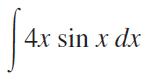
Find each integral. 4x sin x dx
For Exercises, complete the following table. Use the 30°–60°–90° and 45°–45° –90° triangles. Do not use a calculator. 0 60° sin 0 cos ( 1/2 tan 0 √3 cot 0 sec 0 2 csc (
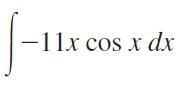
Find each integral. -11x cos x dx
For Exercises, complete the following table. Use the 30°–60°–90° and 45°–45° –90° triangles. Do not use a calculator. 0 120° sin 0 √3/2 cos ( tan 0 -√3 cot 0 sec 0 csc 0 2√3/3
Find each function value without using a calculator. CSC 7 п 3
In Exercises, recall that the slope of the tangent line to a graph is given by the derivative of the function. Find the slope of the tangent line to the graph of each equation at the given point. You may wish to use a graphing calculator to support your answers.y = sin x; x = 0
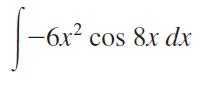
Find each integral. 1-6₁² -6x² cos 8x dx
For Exercises, complete the following table. Use the 30°–60°–90° and 45°–45° –90° triangles. Do not use a calculator. 135⁰ sin 0 √2/2 cos ( -√2/2 tan 0 cot 0 sec 0 -√2 csc ( V2
In Exercises, recall that the slope of the tangent line to a graph is given by the derivative of the function. Find the slope of the tangent line to the graph of each equation at the given point. You may wish to use a graphing calculator to support your answers.y = sin x; x = π/4
Find each function value.tan 115°
In Exercises, recall that the slope of the tangent line to a graph is given by the derivative of the function. Find the slope of the tangent line to the graph of each equation at the given point. You may wish to use a graphing calculator to support your answers.y = cos x; x = -5π/6
Find each function value.sin(-123°)
For Exercises, complete the following table. Use the 30°–60°–90° and 45°–45° –90° triangles. Do not use a calculator. 0 150° sin 0 cos ( tan 0 -√3/2 -√3/3 cot 0 sec 0 csc 0 2
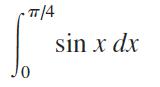
Evaluate each definite integral. Use the integration feature of a graphing calculator, if you wish, to support your answers. π/4 sin x dx
For Exercises, complete the following table. Use the 30°–60°–90° and 45°–45° –90° triangles. Do not use a calculator. 0 210° sin 0 -1/2 cos ( tan 0 cot 0 √3/3 √3 sec 0 csc 0 -2
In Exercises, recall that the slope of the tangent line to a graph is given by the derivative of the function. Find the slope of the tangent line to the graph of each equation at the given point. You may wish to use a graphing calculator to support your answers.y = cos x; x = -π/4
Find each function value.sin 2.3581
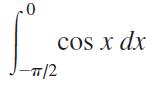
Evaluate each definite integral. Use the integration feature of a graphing calculator, if you wish, to support your answers. -0 cos x dx J-TT/2
For Exercises, complete the following table. Use the 30°–60°–90° and 45°–45° –90° triangles. Do not use a calculator. 0 240° sin 0 -√3/2 cos 0 -1/2 tan 0 cot 0 sec 0 csc 0 -2 -2√3/3
In Exercises, recall that the slope of the tangent line to a graph is given by the derivative of the function. Find the slope of the tangent line to the graph of each equation at the given point. You may wish to use a graphing calculator to support your answers.y = tan x; x = 0
Find each function value.cos 0.8215
In Exercises, recall that the slope of the tangent line to a graph is given by the derivative of the function. Find the slope of the tangent line to the graph of each equation at the given point. You may wish to use a graphing calculator to support your answers.y = cot x; x = π/4 -2
Graph one period of each function.y = 4 cos x
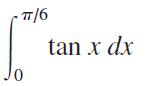
Evaluate each definite integral. Use the integration feature of a graphing calculator, if you wish, to support your answers. TT/6 tan x dx
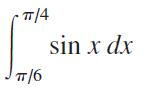
Evaluate each definite integral. Use the integration feature of a graphing calculator, if you wish, to support your answers. -π/4 TT/6 sin x dx
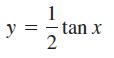
Graph one period of each function. 1 y = -tan x 2
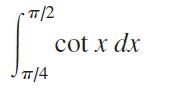
Evaluate each definite integral. Use the integration feature of a graphing calculator, if you wish, to support your answers. TT/2 Jπ/4 cot x dx
Find the following function values without using a calculator. TT sin 3
Find the following function values without using a calculator. COS ㅠ TT 6
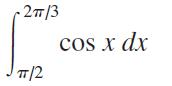
Evaluate each definite integral. Use the integration feature of a graphing calculator, if you wish, to support your answers. - 2π/3 TT/2 cos x dx
Find the derivative of cot x by using the quotient rule and the fact that cot x = cos x/sin x.
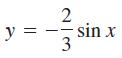
Graph one period of each function. y = 2 ن انت sin x
Find the following function values without using a calculator. E| + tan
Verify that the derivative of sec x is sec x tan x.
Graph one period of each function.y = -tan x
Find the following function values without using a calculator. 77 cot 3
Verify that the derivative of csc x is -csc x cot x.
In the discussion of the limit of the quotient (sin x)/x, explain why the calculator gave ERROR for the value of (sin x)/x when x = 0.
Find the x-coordinates of all points on the graph of ƒ(x) = x + 2 cos x in the interval [0, π] at which the tangent line is horizontal.
For Exercises, use the integration feature on a graphing calculator and successively larger values of b to estimate ∫0∞f(x) dx. b ex cos x dx
Find the following function values without using a calculator. sin Зп 2
For each function, find (a) The critical numbers; (b) The open intervals where the function is increasing; and (c) The open intervals where the function is decreasing.y = 5 tan x
Find the derivative of each function.y = 2 tan 5x
Use the definite integral to find the area between the x-axis and f(x) over the indicated interval. Check first to see if the graph crosses the x-axis in the given interval.ƒ(x) = sin x; [0, 3π/2]
Find the following function values without using a calculator.cos 3π
Find the x-value of all points where the following functions have any relative extrema. Find the value(s) of any relative extrema.ƒ(x) = sin(πx)
Find the derivative of each function.y = -4 sin 7x
Use the definite integral to find the area between the x-axis and f(x) over the indicated interval. Check first to see if the graph crosses the x-axis in the given interval.ƒ(x) = tan x; [-π/4, π/3]
Find the following function values without using a calculator.sec π
Find the following function values without using a calculator. sin 7π 4
Find the x-value of all points where the following functions have any relative extrema. Find the value(s) of any relative extrema.ƒ(x) = cos(2x)
Find the derivative of each function.y = cot(6 - 3x2)
Find the area between the two curves.x = 0, x = π/4, y = cos x, y = sin x
Find the following function values without using a calculator. tan 5T 2
Find f″(x) for each function. Then find f″(0) and f″(2).ƒ(x) = cos(x3)
Find the derivative of each function.y = tan(4x2 + 3)
Find the area between the two curves.x = 0, x = π/4, y = sec2 x, y = sin 2x
Find f″(x) for each function. Then find f″(0) and f″(2).ƒ(x) = cos3(x)
Find the derivative of each function.y = 2 sin4(4x2)
Find the following function values without using a calculator. sec 5T 4
Find the area between the two curves.x = 0, x = π/4, y = tan x, y = sin x
Because the derivative of y = sin x is dy/dx = cos x, the slope of y = sin x varies from ____________ to ____________.
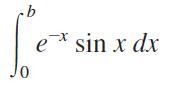
For Exercises, use the integration feature on a graphing calculator and successively larger values of b to estimate ∫0∞f(x) dx. .b ex sin x dx
Find the following function values without using a calculator. TT CSC 6
For each function, find (a) The critical numbers; (b) The open intervals where the function is increasing; and (c) The open intervals where the function is decreasing.y = sin x
Find f″(x) for each function. Then find f″(0) and f″(2).For ƒ(x) = sin x, find ƒ′(x), ƒ′′(x), ƒ′′′(x), and f(4)(x). What is f(4n)(x) when n is a nonnegative integer?
Find the derivative of each function.y = 2 cos5 x
Find the area between the two curves.x = 0, x = π, y = sin x, y = 1 - sin x
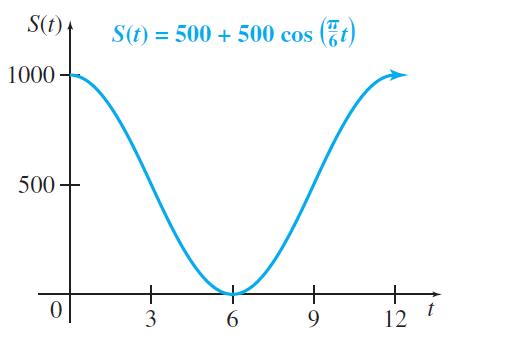
Sales of snowblowers are seasonal. Suppose the sales of snowblowers in one region of the country are approximated bywhere t is time (in months), with t = 0 corresponding to November. The figure below shows a graph of S. Use a definite integral to find total sales over a year. S(t) = 500+ 500 cos 6
Find the following function values without using a calculator. cot - Зп 4
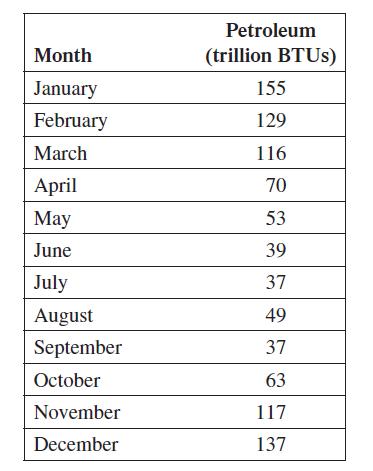
The monthly residential consumption of petroleum (in trillions of BTUs) in the United States for 2019 is found in the table on the next page.(a) Plot the data, letting t = 1 correspond to January, t = 2 correspond to February, and so on. Is it reasonable to assume that petroleum consumption is
Find the following function values without using a calculator.cos 5π
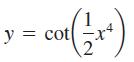
Find the derivative of each function. ( 1²x4) 2 y = cot
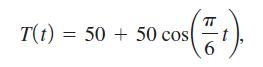
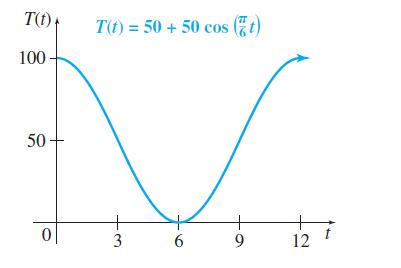
The number of migratory animals (in hundreds) counted at a certain checkpoint is given bywhere t is time in months, with t = 0 corresponding to July. The figure below shows a graph of T. Use a definite integral to find the number of animals passing the checkpoint in a year. T(t) = 50+ 50 cos
Find f″(x) for each function. Then find f″(0) and f″(2).For ƒ(x) = cos x, find ƒ′(x), ƒ′′(x), ƒ′′′(x), and f(4)(x). What is f(4n)(x) when n is a nonnegative integer?
Find the derivative of each function.y = cos(1 + x2)
Find the following function values without using a calculator. tan 5T 6
Find the following function values without using a calculator. sin - 7π 6
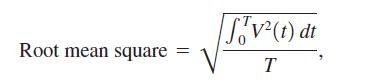
The electrical voltage from a standard wall outlet is given as a function of time t by V(t) = 170 sin(120πt). This is an example of alternating current, which is electricity that reverses direction at regular intervals. The common method for measuring the level of voltage from an alternating
Find the open intervals where the functions are concave upward or concave downward. Find any inflection points.ƒ(x) = sin(2x)
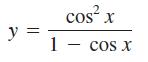
Find the derivative of each function. y || cos² x 1 - cos x
Find the open intervals where the functions are concave upward or concave downward. Find any inflection points.ƒ(x) = tan(πx)
Find the following function values without using a calculator. COS TT 6
Find the derivative of each function.y = e-2x sin x
Graph each function, considering the domain, critical points, symmetry, regions where the function is increasing or decreasing, inflection points, regions where the function is concave upward or concave downward, and intercepts where possible.ƒ(x) = x + cos x
Find the derivative of each function.y = x2 csc x
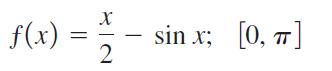
Find the absolute extrema if they exist, as well as all values of x where they occur, for each function and specified domain. If you have a graphing calculator, use it to verify your answers. f(x) = X 2 sin x; [0, π]
Find the absolute extrema if they exist, as well as all values of x where they occur, for each function and specified domain. If you have a graphing calculator, use it to verify your answers. f(x) = tan x 2x; [0, π/3]
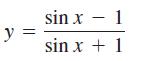
Find the derivative of each function. y = sin x 1 sin x + 1
Graph each function, considering the domain, critical points, symmetry, regions where the function is increasing or decreasing, inflection points, regions where the function is concave upward or concave downward, and intercepts where possible.ƒ(x) = x + sin x
The following function can be used to estimate the number of minutes of daylight in Boston for any given day of the year. N(t) = 183.549 sin(0.0172t - 1.329) + 728.124, where t is the day of the year. Use this function to estimate the total amount of daylight in a year and compare it to the total
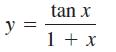
Find the derivative of each function. y tan x 1 + x
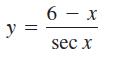
Find the derivative of each function. y = X - 9 sec x
The problems in Exercises, are called self-answering problems because the answers are embedded in the question. For example, how many ways can you arrange the letters in the word “six”? The answer is six.At time t = 0, water begins pouring into an empty sink so that the volume of water is
Showing 4300 - 4400
of 8662
First
37
38
39
40
41
42
43
44
45
46
47
48
49
50
51
Last
Step by Step Answers

 Get 50% OFF
Claim Now
Get 50% OFF
Claim Now