New Semester
Started
Get
50% OFF
Study Help!
--h --m --s
Claim Now
Question Answers
Textbooks
Find textbooks, questions and answers
Oops, something went wrong!
Change your search query and then try again
S
Books
FREE
Study Help
Expert Questions
Accounting
General Management
Mathematics
Finance
Organizational Behaviour
Law
Physics
Operating System
Management Leadership
Sociology
Programming
Marketing
Database
Computer Network
Economics
Textbooks Solutions
Accounting
Managerial Accounting
Management Leadership
Cost Accounting
Statistics
Business Law
Corporate Finance
Finance
Economics
Auditing
Tutors
Online Tutors
Find a Tutor
Hire a Tutor
Become a Tutor
AI Tutor
AI Study Planner
NEW
Sell Books
Search
Search
Sign In
Register
study help
mathematics
calculus with applications
Calculus With Applications 12th Edition Margaret L. Lial - Solutions
In a uniform distribution, the probability density function of a random variable remains constant over the sample space.Determine whether each statement is true or false, and explain why.
Numerical methods can give approximate solutions to differential equations that are neither linear nor separable.Determine whether each statement is true or false, and explain why.
A differential equation can be both linear and separable.Determine whether each statement is true or false, and explain why.
The probability of an event can be larger than 1 provided that you are absolutely sure that the event will occur.Determine whether each statement is true or false, and explain why.
The differential equation describing continuous deposits is linear.Determine whether each statement is true or false, and explain why.
The differential equation dy/dx = g(y) can be solved by integrating both sides of the equation.Determine whether each statement is true or false, and explain why.
To determine a particular solution to a differential equation, you first must find a general solution to the differential equation.Determine whether each of the following statements is true or false, and explain why.
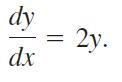
The function y = e2x + 5 satisfies the differential equationDetermine whether each of the following statements is true or false, and explain why. dy dx = 2y.
The standard deviation of a continuous random variable X can be negative.Determine whether each statement is true or false, and explain why.
The mean and standard deviation of an exponential distribution are the same value.Determine whether each statement is true or false, and explain why.
Numerical methods cannot be used on differential equations that are linear or separable.Determine whether each statement is true or false, and explain why.
An integrating factor turns a linear differential equation into one that can be solved by integrating both sides of the equation.Determine whether each statement is true or false, and explain why.
A probability density function can take on negative values.Determine whether each statement is true or false, and explain why.
The Lotka-Volterra equations are a system of differential equations describing how the fluctuations of populations of a predator and its prey affect each other.Determine whether each statement is true or false, and explain why.
An initial value problem is a differential equation with an initial condition.Determine whether each statement is true or false, and explain why.
The expected value (mean) of a random variable X with a probability density function defined on the interval [a, b] is m = (a + b)/2.Determine whether each statement is true or false, and explain why.
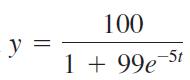
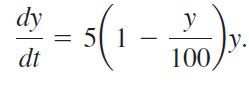
The functionsatisfies the differential equationDetermine whether each of the following statements is true or false, and explain why. y 100 1 +99e-St
Z-scores are used to convert a normal distribution with mean μ and standard deviation σ to a standard normal distribution with mean 0 and standard deviation 1.Determine whether each statement is true or false, and explain why.
In Euler’s method, differentials are used to approximate the solution by the tangent line over a series of short distances.Determine whether each statement is true or false, and explain why.
A differential equation of the form dy/dx + P(x)y = y2 is linear.Determine whether each statement is true or false, and explain why.
A continuous random variable on the interval [0, 4] could take on the value π.Determine whether each statement is true or false, and explain why.
The logistic equation can be used to model the spread of an epidemic.Determine whether each statement is true or false, and explain why.
A differential equation of the form dy/dx = p(x) + q(y) is separable.Determine whether each statement is true or false, and explain why.
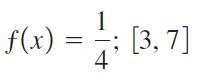
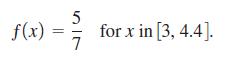
In Exercises, a probability density function of a random variable is defined. Find the expected value, the variance, and the standard deviation. Round answers to the nearest hundredth. f(x) = [3,7] 4
The median of a random variable X with probability density function ƒ on 3a, b4 can be determined by finding the number m such that ∫mbƒ(x) dx = 1/2.Determine whether each statement is true or false, and explain why.
The graph of a normal distribution with a larger value of σ has more values being near the mean than a normal distribution with a smaller value of σ.Determine whether each statement is true or false, and explain why.
In Exercises, find (a) The mean of the distribution, (b) The standard deviation of the distribution, and (c) The probability that the random variable is between the mean and 1 standard deviation above the mean.The length (in centimeters) of the leaf of a certain plant is a continuous
To use Euler’s method, the value of y(x0) must be known.Determine whether each statement is true or false, and explain why.
Use Euler’s method to approximate the indicated function value to 3 decimal places, using h = 0.1. dy dx = = x² + y²; y(0) = 2; find y(0.5)
A differential equation of the form dy/dx + P(x) = Q(x)y is linear.Determine whether each statement is true or false, and explain why.
The probability P(a ≤ X ≤ b) is equal to P(X = b) - P(X = a).Determine whether each statement is true or false, and explain why.
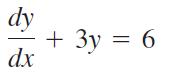
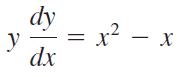
Find the general solution for each differential equation. dy dx + 3y = 6
If y represents the number of individuals affected by an epidemic at time t, the infection rate is at a maximum when dy/dt = 0.Determine whether each statement is true or false, and explain why.
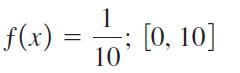
In Exercises, a probability density function of a random variable is defined. Find the expected value, the variance, and the standard deviation. Round answers to the nearest hundredth. f(x) = 1 10 :[0, 10]
A solution y(t) to the logistic equation can grow infinitely large as t goes to infinity.Determine whether each statement is true or false, and explain why.
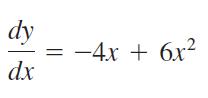
Find the general solution for each differential equation. Verify that each solution satisfies the original differential equation. dy dx || -4x + 6x²
The probability P(-∞ < X < ∞) is equal to 1.Determine whether each statement is true or false, and explain why.
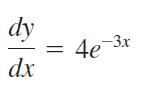
Find the general solution for each differential equation. Verify that each solution satisfies the original differential equation. dy dx = 40-3x
Use Euler’s method to approximate the indicated function value to 3 decimal places, using h = 0.1. dy dx xy + 4; y(0) = 0; find y(0.5)
Patricia deposits $5000 in an IRA at 6% interest compounded continuously for her retirement in 10 years. She intends to make continuous deposits at the rate of $3000 a year until she retires. How much will she have accumulated at that time?
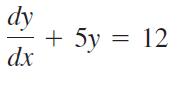
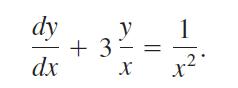
Find the general solution for each differential equation. dy dx + 5y = 12
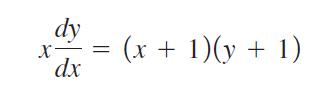
It is possible to solve the following differential equation using the method of separation of variables.Determine whether each of the following statements is true or false, and explain why. dy X- dx = (x + 1)(y + 1)
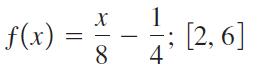
In Exercises, a probability density function of a random variable is defined. Find the expected value, the variance, and the standard deviation. Round answers to the nearest hundredth. f(x) || X 8 4 [2,6]
Every differential equation is either separable or linear.Determine whether each of the following statements is true or false, and explain why.
In Exercises, find (a) The mean of the distribution, (b) The standard deviation of the distribution, and (c) The probability that the random variable is between the mean and 1 standard deviation above the mean.The price of an item (in hundreds of dollars) is a continuous random
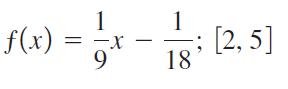
Decide whether the functions defined as follows are probability density functions on the indicated intervals. If not, tell why. 1 √(x)=√x – 18:[2,5] 9
The cumulative distribution function F(x) gives the probability that the variable takes a value less than or equal to x.Determine whether each statement is true or false, and explain why.
Use Euler’s method to approximate the indicated function value to 3 decimal places, using h = 0.1. dy dx = 1+ y; y(0) = 2; find y(0.6)
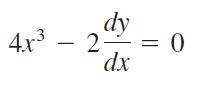
Find the general solution for each differential equation. Verify that each solution satisfies the original differential equation. 4x³ dy 2- = 0 dx
Use Euler’s method to approximate the indicated function value to 3 decimal places, using h = 0.1. dy dx = 0; y(0) = 0; find y(0.6) = x + y²; y(0)
In Exercises, find (a) The mean of the distribution, (b) The standard deviation of the distribution, and (c) The probability that the random variable is between the mean and 1 standard deviation above the mean.The length of time (in years) until a particular radioactive particle
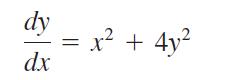
It is possible to solve the following differential equation using the method of separation of variables.Determine whether each of the following statements is true or false, and explain why. dy dx || 2 x² + 4y²
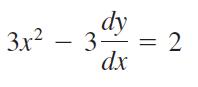
Find the general solution for each differential equation. Verify that each solution satisfies the original differential equation. 3x² dy 3- = 2 dx
The function I(x) = x3 can be used as an integrating factor for the differential equationDetermine whether each of the following statements is true or false, and explain why. dy dx +3 X || 1 X²
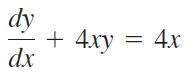
Find the general solution for each differential equation. dy dx + 4xy = 4x
To provide for a future expansion, a company plans to make continuous deposits to a savings account at the rate of $50,000 per year, with no initial deposit. The managers want to accumulate $500,000. How long will it take if the account earns 10% interest compounded continuously?
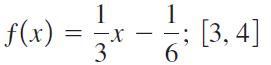
Decide whether the functions defined as follows are probability density functions on the indicated intervals. If not, tell why. f(x) = x - -—; [3,4] 1 3 6
In Exercises, a probability density function of a random variable is defined. Find the expected value, the variance, and the standard deviation. Round answers to the nearest hundredth.ƒ(x) = 2(1 - x); [0, 1]
In Exercises, find (a) The mean of the distribution, (b) The standard deviation of the distribution, and (c) The probability that the random variable is between the mean and 1 standard deviation above the mean.The length of time (in years) that a seedling tree survives is a random
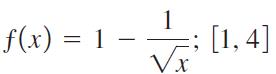
In Exercises, a probability density function of a random variable is defined. Find the expected value, the variance, and the standard deviation. Round answers to the nearest hundredth. f(x) = 1 - Vx [1,4]
In Exercises, find (a) The mean of the distribution, (b) The standard deviation of the distribution, and (c) The probability that the random variable is between the mean and 1 standard deviation above the mean.The length of time (in days) required to learn a certain task is a random
Suppose the company in Exercise 7 wants to accumulate $500,000 in 3 years. Find the approximate yearly deposit that will be required.Exercise 7To provide for a future expansion, a company plans to make continuous deposits to a savings account at the rate of $50,000 per year, with no initial
Use Euler’s method to approximate the indicated function value to 3 decimal places, using h = 0.1. dy = x + dx Vy; y(0) = 1; find y(0.4)
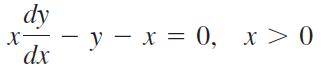
Find the general solution for each differential equation. dy X- dx y x = 0, x > 0
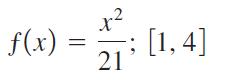
Decide whether the functions defined as follows are probability density functions on the indicated intervals. If not, tell why. f(x) || x² X 21 [1,4]
An investor deposits $8000 into an account that pays 6% compounded continuously and then begins to withdraw from the account continuously at a rate of $1200 per year.(a) Write a differential equation to describe the situation.(b) How much will be left in the account after 2 years?(c) When will the
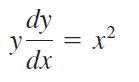
Find the general solution for each differential equation. Verify that each solution satisfies the original differential equation. dy y- dx || x² 2
The function I(x) = e5x can be used as an integrating factor for the differential equationDetermine whether each of the following statements is true or false, and explain why. 2x dy x + 5y = ²x dx
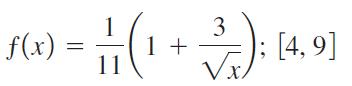
In Exercises, a probability density function of a random variable is defined. Find the expected value, the variance, and the standard deviation. Round answers to the nearest hundredth. 3 F(x) = + ( 1 + ³); [4, ² 11
Euler’s method can be used to find the general solution to a differential equation.Determine whether each of the following statements is true or false, and explain why.
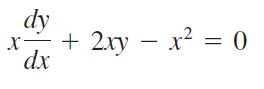
Find the general solution for each differential equation. dy dx -X + 2xy = x² = 0 -
Use Euler’s method to approximate the indicated function value to 3 decimal places, using h = 0.1. dy dx = 1 + y X y(1) = 0; find y(1.4)
In Exercises, find (a) The mean of the distribution, (b) The standard deviation of the distribution, and (c) The probability that the random variable is between the mean and 1 standard deviation above the mean.The distance (in meters) that seeds are dispersed from a certain kind of
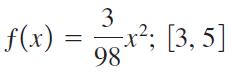
Decide whether the functions defined as follows are probability density functions on the indicated intervals. If not, tell why. f(x) = 3 2. -x2; [3, 5] | 98
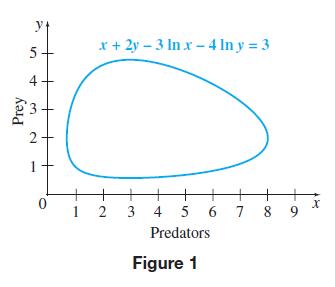
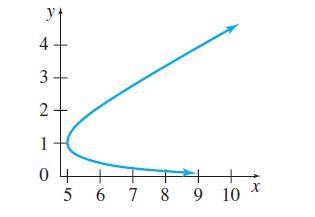
Explain in your own words why the solution (x, y) must move clockwise on the curve in Figure 1.Figure 1 Prey y 5 4 2 1 0 x+2y-3 lnx-4lny = 3 12 + + + + 45 Predators 34 56 7 8 Figure 1 9 X
Find the general solution for each differential equation. Verify that each solution satisfies the original differential equation. X - zr = dx y dy
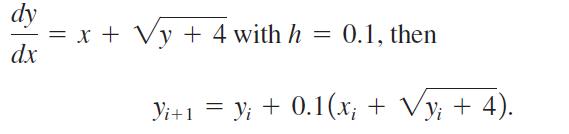
If Euler’s method is being used to solve the differential equationDetermine whether each of the following statements is true or false, and explain why. dy dx = x + Vy + 4 with h = 0.1, then Yi+1=Yi+ 0.1(x; + Vy; + 4).
In Exercises, a probability density function of a random variable is defined. Find the expected value, the variance, and the standard deviation. Round answers to the nearest hundredth.ƒ(x) = 4x-5; [1, ∞)
Find the proportion of observations of a standard normal distribution that are between the mean and the given number of standard deviations above the mean.3.50
Use Euler’s method to approximate the indicated function value to 3 decimal places, using h = 0.1. dy dx = 2xV1 + y²; y(1) = 2; find y(1.5)
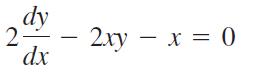
Find the general solution for each differential equation. dy 2- dx - 2xy - x = 0
Decide whether the functions defined as follows are probability density functions on the indicated intervals. If not, tell why.ƒ(x) = 4x3; [0, 3]
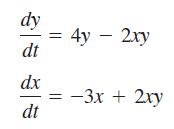
The system of equationsdescribes the influence of the populations (in thousands) of two competing species on their growth rates.(a) Following Example 2, find an equation relating x and y, assuming y = 1 when x = 1.(b) Find values of x and y so that both populations are constant. dy dt dx dt || 4y -
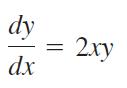
Find the general solution for each differential equation. Verify that each solution satisfies the original differential equation. dy dx = 2xy
The differential equation describing continuous deposits is separable.Determine whether each of the following statements is true or false, and explain why.
In Exercises, a probability density function of a random variable is defined. Find the expected value, the variance, and the standard deviation. Round answers to the nearest hundredth.ƒ(x) = 3x-4; (1, ∞)
Find the proportion of observations of a standard normal distribution that are between the mean and the given number of standard deviations above the mean.1.68
Use Euler’s method to approximate the indicated function value to 3 decimal places, using h = 0.1. dy dx = e +e; y(1) = 1; find y(1.5)
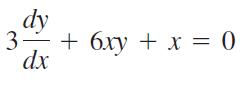
Find the general solution for each differential equation. dy 3 dx + 6xy + x = 0
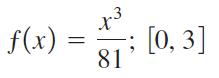
Decide whether the functions defined as follows are probability density functions on the indicated intervals. If not, tell why. f(x) = = x³ 81 [0, 3]
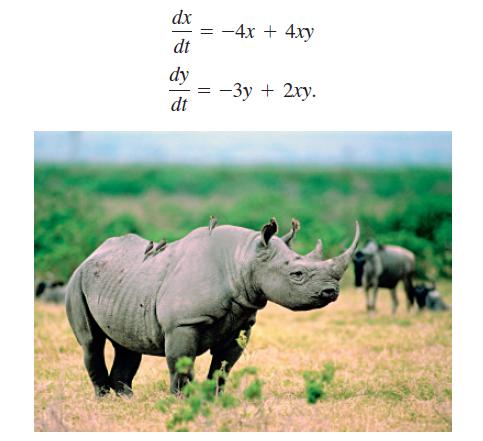
When two species, such as the rhinoceros and birds pictured below, coexist in a symbiotic (dependent) relationship, they either increase together or decrease together. Typical equations for the growth rates of two such species might be(a) Find an equation relating x and y if x = 5 when y = 1.(b)
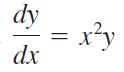
Find the general solution for each differential equation. Verify that each solution satisfies the original differential equation. dy dx xy
What is a differential equation? What is it used for?
What information does the mean (expected value) of a continuous random variable give?
Find the proportion of observations of a standard normal distribution that are between the given z-scores.1.28 and 2.05
In Exercises, use Euler’s method to approximate the indicated function value to 3 decimal places, using h = 0.1. Next, solve the differential equation and find the indicated function value to 3 decimal places. Compare the result with the approximation. dy dx = y(0) = 1; find y(0.4) -4 + x; y(0)
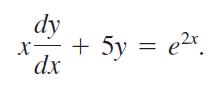
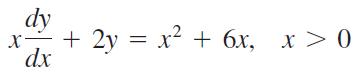
Find the general solution for each differential equation. dy X- x = +2y = x2 + 6x, x > 0 dx
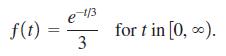
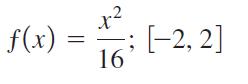
Decide whether the functions defined as follows are probability density functions on the indicated intervals. If not, tell why. f(x) = 16 [-2,2]
The native Hawaiians lived for centuriesin isolation from other peoples. When foreigners finally came to the islands they brought with them diseases such as measles, whooping cough, and smallpox, which decimated thepopulation. Suppose such an island has a native population of 5000, and a sailor
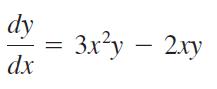
Find the general solution for each differential equation. Verify that each solution satisfies the original differential equation. dy dx = 3.xy - 2xy
Showing 5000 - 5100
of 8662
First
44
45
46
47
48
49
50
51
52
53
54
55
56
57
58
Last
Step by Step Answers

 Get 50% OFF
Claim Now
Get 50% OFF
Claim Now