New Semester
Started
Get
50% OFF
Study Help!
--h --m --s
Claim Now
Question Answers
Textbooks
Find textbooks, questions and answers
Oops, something went wrong!
Change your search query and then try again
S
Books
FREE
Study Help
Expert Questions
Accounting
General Management
Mathematics
Finance
Organizational Behaviour
Law
Physics
Operating System
Management Leadership
Sociology
Programming
Marketing
Database
Computer Network
Economics
Textbooks Solutions
Accounting
Managerial Accounting
Management Leadership
Cost Accounting
Statistics
Business Law
Corporate Finance
Finance
Economics
Auditing
Tutors
Online Tutors
Find a Tutor
Hire a Tutor
Become a Tutor
AI Tutor
AI Study Planner
NEW
Sell Books
Search
Search
Sign In
Register
study help
mathematics
calculus with applications
Calculus With Applications 12th Edition Margaret L. Lial - Solutions
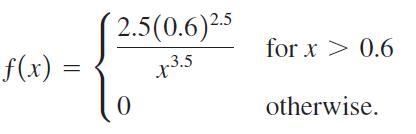
Find a value of k that will make f a probability density function on the indicated interval.ƒ(x) = kx2; [0, 5]
Solve each differential equation, subject to the given initial condition. dy dx 4x = 0; y(1) = 20 2xy - 4x
In Exercises, use Euler’s method to approximate the indicated function value to 3 decimal places, using h = 0.1. Next, solve the differential equation and find the indicated function value to 3 decimal places. Compare the result with the approximation. dy dx = = ye*; y(0) = 2; find y(0.4)
Describe the standard normal distribution. What are its characteristics?
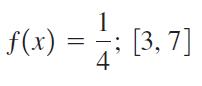
For Exercises, (a) Find the median of the random variable with the probability density function given, and (b) Find the probability that the random variable is between the expected value (mean) and the median. f(x) = 1 4 [3,7]
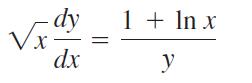
Classify each equation as separable, linear, both, or neither. dx = 1 + ln x y
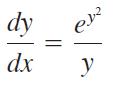
Find the general solution for each differential equation. Verify that each solution satisfies the original differential equation. dy [ dx = y
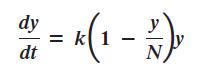
The equation developed in the text for the spread of an epidemic also can be used to describe diffusion of information. In a population of size N, let y be the number who have heard a particular piece of information. Thenfor a positive constant k. Use this model in Exercises.Suppose a rumor starts
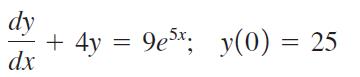
Solve each differential equation, subject to the given initial condition. dy dx + 4y = 9e5x; y(0) = 25
Find a value of k that will make f a probability density function on the indicated interval.ƒ(x) = kx3/2; [4, 9]
In Exercises, use Euler’s method to approximate the indicated function value to 3 decimal places, using h = 0.1. Next, solve the differential equation and find the indicated function value to 3 decimal places. Compare the result with the approximation. dy dx = x²y; y(0) = 1; find y(0.6)
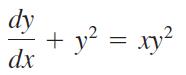
Classify each equation as separable, linear, both, or neither. dy dx + - y2 = xy2
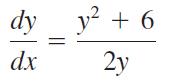
Find the general solution for each differential equation. Verify that each solution satisfies the original differential equation. dy dx || y2 + 6 2
In Exercises, the probability density function of a random variable is defined.(a) Find the expected value to the nearest hundredth.(b) Find the variance to the nearest hundredth.(c) Find the standard deviation. Round to the nearest hundredth.(d) Find the probability that the random variable has a
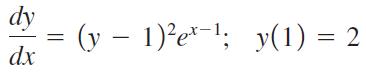
Find the particular solution for each initial value problem. dy dx = = (y-1)2ex-l;y(1) = 2
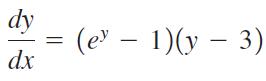
Find all equilibrium points and determine their stability. dy dx (ex - 1)(y - 3)
In your own words, define a random variable.
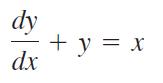
Find the general solution for each differential equation. dy dx +y=x
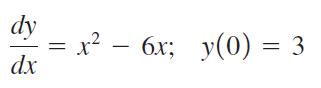
Find the particular solution for each initial value problem. (Some solutions may give y implicitly.) dy dx = x² 6x; y(0) = 3
The length (in centimeters) of a petal on a certain flower is a random variable with probability density function defined by(a) Find the expected petal length.(b) Find the standard deviation.(c) Find the probability that a petal selected at random has a length more than 2 standard deviations above
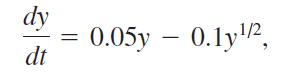
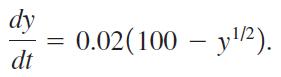
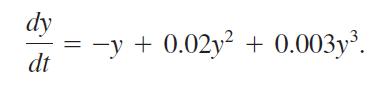
A population of insects, y, living in a circular colony grows at a ratewhere t is time in weeks. If there were 60 insects initially, use Euler’s method with h = 1 week to approximate the number of insects after 6 weeks. dy dt = 0.05y-0.1y12,
Show that each function defined as follows is a probability density function on the given interval; then find the indicated probabilities. (Round probabilities to 4 decimal places.)ƒ(x) = e-x; [0, ∞)(a) P(0 ≤ X ≤ 1) (b) P(1 ≤ X ≤ 2)(c) P(X ≤ 2)
A probability density function has been developed to estimate the abundance of the flour beetle, Tribolium castaneum. The density function, which is a member of the gamma distribution, is ƒ(x) = 1.185 * 10-9x4.5222e-0.049846x, where x is the size of the population. Calculate the expected size of a
An insurance policy is written to cover a loss, X, where X has a uniform distribution on 30, 10004. At what level must a deductible be set in order for the expected payment to be 25% of what it would be with no deductible? Choose one of the following.(a) 250 (b) 375 (c) 500 (d)
Suppose that 0 < z < 1 for all z. Solve the logistic Equation (6) as in Exercise 39. Verify that b = ekx0 , where x0 is the time at which z = 1/2.Equation (6)A certain nature reserve can support no more than 4000 mountain goats. Assume that the rate of growth is proportional to how close the
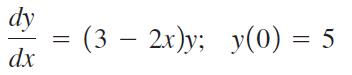
Find the particular solution for each initial value problem. (Some solutions may give y implicitly.) dy dx = (32x)y; y(0) = 5
The life (in months) of a certain electronic computer part has a probability density function defined byFind the probability that a randomly selected component will last the following lengths of time.(a) At most 12 months(b) Between 12 and 20 months(c) Find the cumulative distribution function for
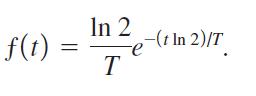
We saw that for a radioactive substance with half-life equal to T, the amount of the substance at time t is given by A(t) = A0ekt, where k = -ln(2/T).(a) Show that the probability that a radioactive particle decays after time t is given by(b) The book Atomic Adventures mentions that the mean life
A swarm of bees is released from a certain point. The proportion of the swarm located at least 2 m from the point of release after 1 hour is a random variable that is exponentially distributed with a = 2.(a) Find the expected proportion under the given conditions.(b) Find the probability that fewer
When is Euler’s method useful?
The annual rainfall in a remote Middle Eastern country varies from 0 to 5 in. and is a random variable with probability density function defined byFind the following probabilities for the annual rainfall in a randomly selected year.(a) The probability that the annual rainfall is greater than 3
Suppose someone initially weighing 180 lb adopts a diet of 2500 calories per day.(a) Write the weight function for this individual.(b) Graph the weight function on the window [0, 300] by [120, 200]. What is the asymptote? This value of w is the equilibrium weight weq. According to the model, can a
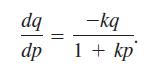
One model of the quantity of health services performed (q) as a function of the proportion of health care services that an individual pays (p) is called the uniform induction hypothesis. Let 0 ≤ p ≤ 1 and scale q so that q(0) = 1. The cost of health care to the consumer, in appropriate units,
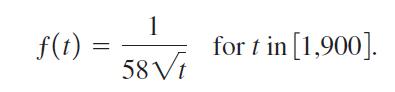
The life (in hours) of a certain kind of light bulb is a random variable with probability density function defined by(a) What is the expected life of such a bulb?(b) Find σ.(c) Find the probability that one of these bulbs lasts longer than 1 standard deviation above the mean.(d) Find the median
Solve the glucose level example (Example 4) using separation of variables.Example 4Suppose glucose is infused into a patient’s bloodstream at a constant rate of a grams per minute. At the same time, glucose is removed from the bloodstream at a rate proportional to the amount of glucose present.
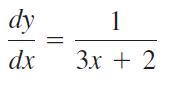
Find the general solution for each differential equation. dy dx || 1 3x + 2
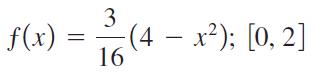
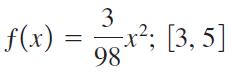
Find the cumulative distribution function for the probability density function in each of the following exercises.Exercise 10Decide whether the functions defined as follows are probability density functions on the indicated intervals. If not, tell why. f(x) = 3 2. -x2; [3, 5] | 98
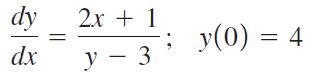
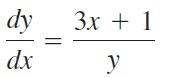
Find the particular solution for each initial value problem. dy dx = 2.x + 1 y-3 y(0) = 4
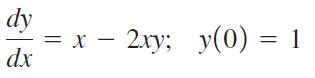
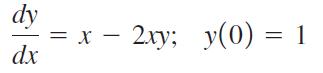
Use Method 2 or 3 in Example 1 to construct a table like the ones in the examples for 0 ≤ x ≤ 1, with h = 0.2. dy dx = x - 2xy; y(0) = 1
Find the general solution for each differential equation. dy dx || 3x + 1 y
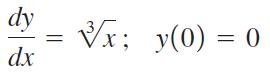
In Exercises, solve each differential equation and graph the function y = f(x) and the polygonal approximation on the same axes. dy dx = √x; y(0) = 0
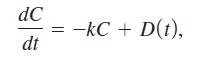
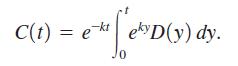
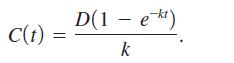
The rate of change in the concentration of a drug with respect to time in a user’s blood is given bywhere D(t) is dosage at time t and k is the rate that the drug leaves the bloodstream.(a) Solve this linear equation to show that, if C(0) = 0, then(b) Show that if D(y) is a constant D, then
The life (in years) of a certain machine is a random variable with probability density function defined by(a) Find the mean life of this machine.(b) Find the standard deviation of the distribution.(c) Find the probability that a particular machine of this kind will last longer than the mean number
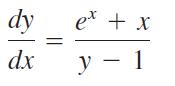
Find the general solution for each differential equation. dy dx = et + x y - 1
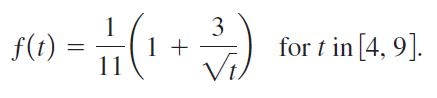
The life span of a certain automobile part (in months) is a random variable with probability density function defined by(a) Find the expected life of this part.(b) Find the standard deviation of the distribution.(c) Find the probability that one of these parts lasts less than the mean number of
A prankster puts 4 lb of soap in a fountain that contains 200 gal of water. To clean up the mess a city crew runs clear water into the fountain at the rate of 8 gal per minute, allowing the excess solution to drain off at the same rate. How long will it be before the amount of soap in the mixture
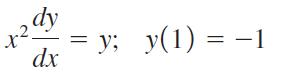
Find the particular solution for each initial value problem. x². dy dx = = y; y(1) = -1
Use Simpson’s rule with n = 40, or the integration feature on a graphing calculator, to approximate the following for the standard normal probability distribution. Use limits of -6 and 6 in place of -∞ and ∞.(a) The mean (b) The standard deviation
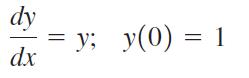
In Exercises, solve each differential equation and graph the function y = f(x) and the polygonal approximation on the same axes. dy dx = y; y(0) = 1
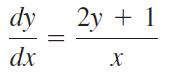
Find the general solution for each differential equation. dy dx 2y + 1 X
A manufacturer’s annual losses follow a distribution with density functionTo cover its losses, the manufacturer purchases an insurance policy with an annual deductible of 2. What is the mean of the manufacturer’s annual losses not paid by the insurance policy? Choose one of the following.(a)
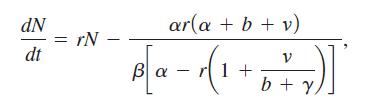
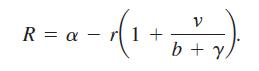
A model for the spread of an infectious disease among mice iswhere N is the size of the population of mice, a is the mortality rate due to infection, b is the mortality rate due to natural causes for infected mice, β is a transmission coefficient for the rate that infected mice infect susceptible
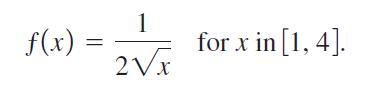
Find the cumulative distribution function for the probability density function in each of the following exercises.Exercise 17Find a value of k that will make f a probability density function on the indicated interval.ƒ(x) = kx1/2; [1, 4]
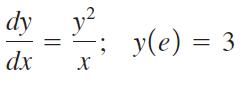
Find the particular solution for each initial value problem. dy dx X y(e) = 3
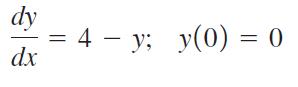
In Exercises, solve each differential equation and graph the function y = f(x) and the polygonal approximation on the same axes. dy 小 dx 4-y; y(0) = 0
The Hodgkin-Huxley model for excitable nerve cells is a set of four differential equations, three of the formwhere y is a variable between 0 and 1 related to potassium channel activation, sodium channel activation, or sodium channel inactivation in the cells, and a and b are rate constants.(a)
A very important distribution for analyzing the reliability of manufactured goods is the Weibull distribution, whose probability density function is defined by ƒ(x) = abxb-1e-axb for x in [0, ∞), where a and b are constants. Notice that when b = 1, this reduces to the exponential distribution.
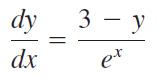
Find the general solution for each differential equation. dy dx || 3- ex y
Find the cumulative distribution function for the probability density function in each of the following exercises.Exercise 18Find a value of k that will make f a probability density function on the indicated interval.ƒ(x) = kx3/2; [4, 9]
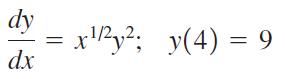
Find the particular solution for each initial value problem. dy dx x¹/2y²; y(4) = 9
In Exercises, solve each differential equation and graph the function y = f(x) and the polygonal approximation on the same axes. dy dx 2xy; y(0) = 1 = x - 2xy;
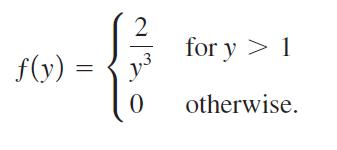
An insurance policy reimburses a loss up to a benefit limit of 10. The policyholder’s loss, Y, follows a distribution with density function:What is the expected value of the benefit paid under the insurance policy? Choose one of the following.(a) 1.0(b) 1.3(c) 1.8(d) 1.9(e) 2.0 f(y) = 2 J 0 for y
Determine the cumulative distribution function for the uniform distribution.
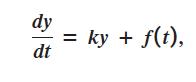
If population is changed either by immigration or emigration, the exponential growth model discussed in Section 1 is modified towhere y is the population at time t and f(t) is some (other) function of t that describes the net effect of the emigration/ immigration. Assume k = 0.02 and y(0) = 10,000.
The total area under the graph of a probability density function always equals____________.
Determine the cumulative distribution function for the exponential distribution.
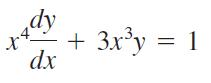
Find the general solution for each differential equation. dx + 3x³y = 1
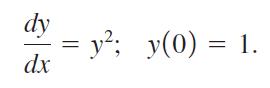
(a) Use Euler’s method with h = 0.2 to approximate ƒ(1), where ƒ(x) is the solution to the differential equation(b) Solve the differential equation in part (a) using separation of variables, and discuss what happens to ƒ(x) as x approaches 1. dy dx = y²; y(0) = 1.
If population is changed either by immigration or emigration, the exponential growth model discussed in Section 1 is modified towhere y is the population at time t and f(t) is some (other) function of t that describes the net effect of the emigration/ immigration. Assume k = 0.02 and y(0) = 10,000.
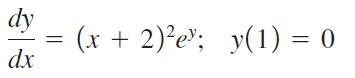
Find the particular solution for each initial value problem. dy dx = (x + 2); y(1) = 0
If population is changed either by immigration or emigration, the exponential growth model discussed in Section 1 is modified towhere y is the population at time t and f(t) is some (other) function of t that describes the net effect of the emigration/ immigration. Assume k = 0.02 and y(0) = 10,000.
An insurance company’s monthly claims are modeled by a continuous, positive random variable X, whose probability density function is proportional to (1 + x)-4, where 0 < x < ∞. Determine the company’s expected monthly claims. Choose one of the following.(a) 1/6(b) 1/3(c) 1/2(d) 1(e) 3
An insurance policy reimburses dental expense, X, up to a maximum benefit of 250. The probability density function for X iswhere c is a constant. Calculate the median benefit for this policy. Choose one of the following.(a) 161 (b) 165 (c) 173 (d) 182 (e) 250 f(x)
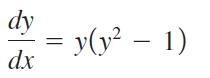
Find all equilibrium points and determine their stability. dy dx y(y² - 1)
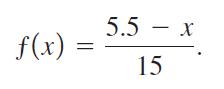
The amount of insurance (in thousands of dollars) sold in a day by a particular agent is uniformly distributed over the interval [10, 85].(a) What amount of insurance does the agent sell on an average day?(b) Find the probability that the agent sells more than $50,000 of insurance on a particular
The clotting time of blood (in seconds) is a random variable with probability density function defined by(a) Find the mean clotting time.(b) Find the standard deviation.(c) Find the probability that a person’s blood clotting time is within 1 standard deviation of the mean.(d) Find the median
What is the difference between a discrete probability function and a probability density function?
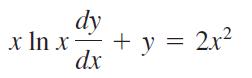
Find the general solution for each differential equation. x ln x dy dx + y = 2x²
If population is changed either by immigration or emigration, the exponential growth model discussed in Section 1 is modified towhere y is the population at time t and f(t) is some (other) function of t that describes the net effect of the emigration/ immigration. Assume k = 0.02 and y(0) = 10,000.
Suppose 125 small business firms are threatened by bankruptcy. If y is the number bankrupt by time t, then 125 - y is the number not yet bankrupt by time t. The rate of change of y is proportional to the product of y and 125 - y. Let 2015 correspond to t = 0. Assume 20 firms are bankrupt at t =
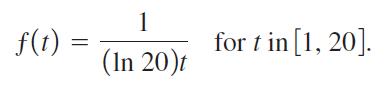
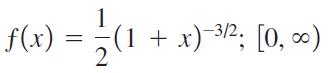
Show that each function defined as follows is a probability density function on the given interval; then find the indicated probabilities. (Round probabilities to 4 decimal places.)(a) P(0 ≤ X ≤ 2)(b) P(1 ≤ X ≤ 3)(c) P(X ≥ 5) + 10²2 - (x) (1 + x)-3/2; [0, ∞)
The number of new fast-food outlets opening during June in a certain city is exponentially distributed, with a mean of 5.(a) Give the probability density function for this distribution.(b) What is the probability that the number of outlets opening is between 2 and 6?
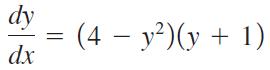
Find all equilibrium points and determine their stability. dy dx = (4 − y²)(y + 1)
Why is P(X = c) = 0 for any number c in the domain of a probability density function?
An island is colonized by immigration from the mainland, where there are 100 species. Let the number of species on the island at time t (in years) equal y, where y = ƒ(t). Suppose the rate at which new species immigrate to the island isUse Euler’s method with h = 0.5 years to approximate y when
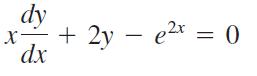
Find the general solution for each differential equation. dy x + 2y - e²x = 0 dx
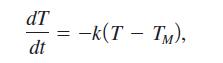
In Exercises 65–68 in the previous section, we saw that Newton’s Law of Cooling states that the rate of change of the temperature of an object is proportional to the difference in temperature between the object and the surrounding medium. This leads to the differential equationwhere T is the
The phosphate compounds found in many detergents are highly water soluble and are excellent fertilizers for algae. Assume that there are 5000 algae present at time t = 0, where t is the time in days, and conditions will support at most 500,000 algae. Assume that the rate of growth of algae, in the
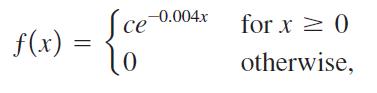
A salesperson’s monthly expenses (in thousands of dollars) are exponentially distributed, with an average of 4.25 (thousand dollars).(a) Give the probability density function for the expenses. (b) Find the probability that the expenses are more than $10,000.
Researchers investigating the SARS (severe acute respiratory syndrome) epidemic in Hong Kong in 2003 found that the probability distribution of the time from infection to onset of the disease could be described by ƒ(t) = 0.07599t1.43e-t/2.62 for t 7 0, where t is the time in days.(a) Find the mean
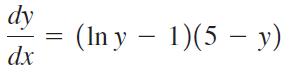
Find all equilibrium points and determine their stability. dy dx = (In y − 1)(5 - y)
In Exercises, assume a normal distribution.A machine that fills quart bottles with apple juice averages 32.8 oz per bottle, with a standard deviation of 1.1 oz. What are the probabilities that the amount of juice in a bottle is as follows? (Recall that 1 quart is 32 oz.)(a) Less than 1 qt (b)
Under certain conditions, a population may exhibit a polynomial growth rate function. A population of blue whales is growing according to the functionHere y is the population in thousands and t is measured in years. Use Euler’s method with h = 1 year to approximate the population in 4 years if
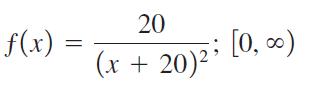
Show that each function defined as follows is a probability density function on the given interval; then find the indicated probabilities. (Round probabilities to 4 decimal places.)(a) P(0 ≤ X ≤ 1) (b) P(1 ≤ X ≤ 5)(c) P(X ≥ 5) f(x) = 20 (x + 20)²¹ [0,00)
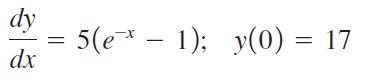
Find the particular solution for each initial value problem. (Some solutions may give y implicitly.) dy dx = 5(e* 1); y(0) = 17 -
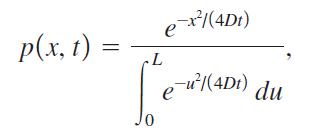
The probability that a marked flea beetle, Phyllotreta cruciferae or Phyllotreta striolata, will be recaptured within a certain distance and time after release can be calculated from the probability density functionwhere t is the time (in hours) after release, x is the distance (in meters) from the
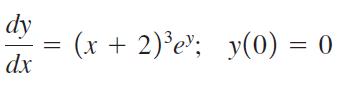
Find the particular solution for each initial value problem. (Some solutions may give y implicitly.) dy dx = (x + 2)³e³; y(0) = 0
In Exercises, assume a normal distribution.A machine produces screws with a mean length of 2.5 cm and a standard deviation of 0.2 cm. Find the probabilities that a screw produced by this machine has lengths as follows.(a) Greater than 2.7 cm(b) Within 1.2 standard deviations of the mean
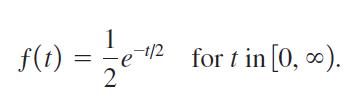
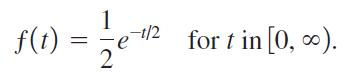
Show that each function defined as follows is a probability density function on the given interval; then find the indicated probabilities. (Round probabilities to 4 decimal places.)ƒ(x) = (1/2)e-x/2; [0, ∞)(a) P(0 ≤ X ≤ 1) (b) P(1 ≤ X ≤ 3)(c) P(X ≥ 2)
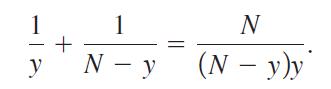
(a) Solve the logistic Equation (4) in this section by observing that(b) Assume 0 < y < N. Verify that b = (N - y0)/y0 in Equation (5), where y0 is the initial population size.(c) Assume 0 < N < y for all y. Verify that b = (y0 - N)/y0. 1 y + 1 N - Y N (N - y)y
Showing 5200 - 5300
of 8662
First
46
47
48
49
50
51
52
53
54
55
56
57
58
59
60
Last
Step by Step Answers

 Get 50% OFF
Claim Now
Get 50% OFF
Claim Now