New Semester
Started
Get
50% OFF
Study Help!
--h --m --s
Claim Now
Question Answers
Textbooks
Find textbooks, questions and answers
Oops, something went wrong!
Change your search query and then try again
S
Books
FREE
Study Help
Expert Questions
Accounting
General Management
Mathematics
Finance
Organizational Behaviour
Law
Physics
Operating System
Management Leadership
Sociology
Programming
Marketing
Database
Computer Network
Economics
Textbooks Solutions
Accounting
Managerial Accounting
Management Leadership
Cost Accounting
Statistics
Business Law
Corporate Finance
Finance
Economics
Auditing
Tutors
Online Tutors
Find a Tutor
Hire a Tutor
Become a Tutor
AI Tutor
AI Study Planner
NEW
Sell Books
Search
Search
Sign In
Register
study help
mathematics
contemporary mathematics
Contemporary Mathematics 1st Edition OpenStax - Solutions
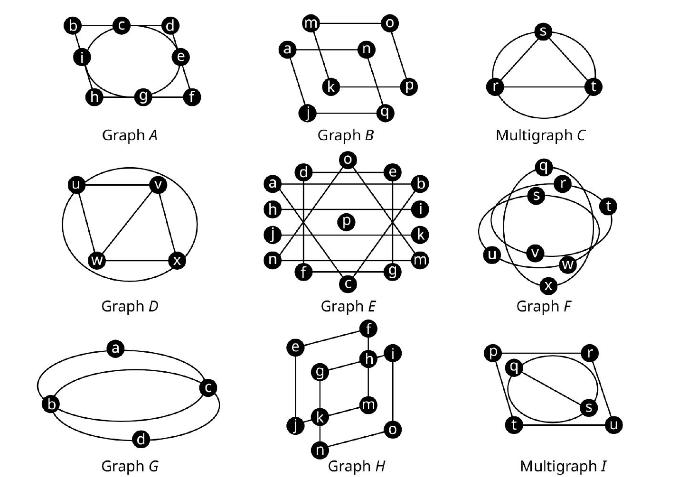
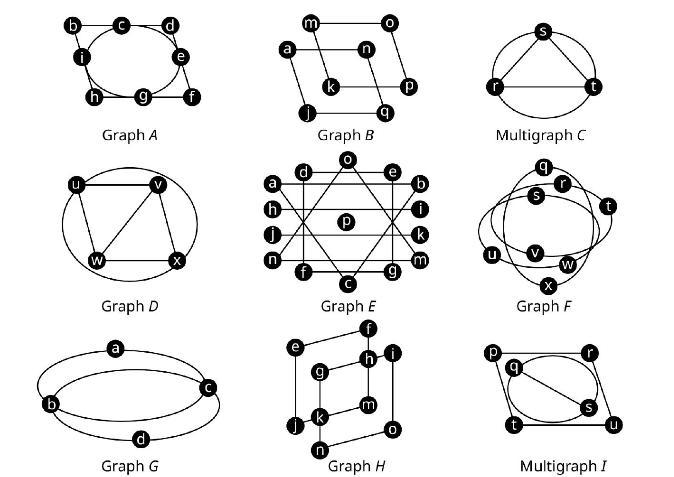
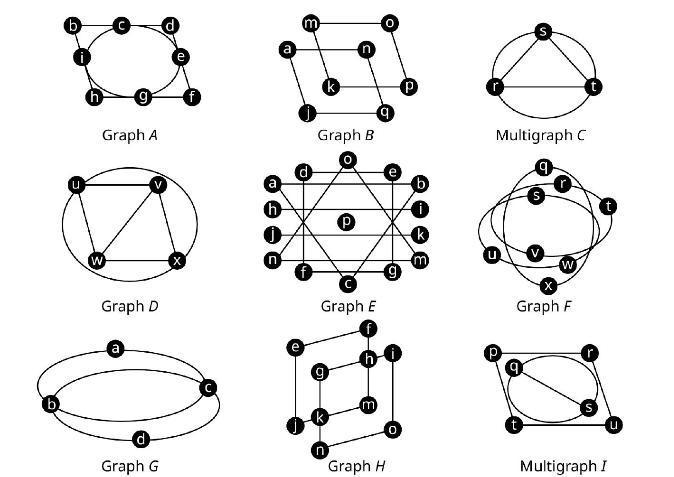
Exactly five components Use Graphs \(A, B, C, D, E, F, G, H\), and \(I\) to answer the following exercises. Identify any graph or graphs with the given characteristics or indicate that none do. b h g Graph A W Graph D a k P Graph B b h P k e C Graph E (m) d Graph G n Graph H Multigraph C t Graph F
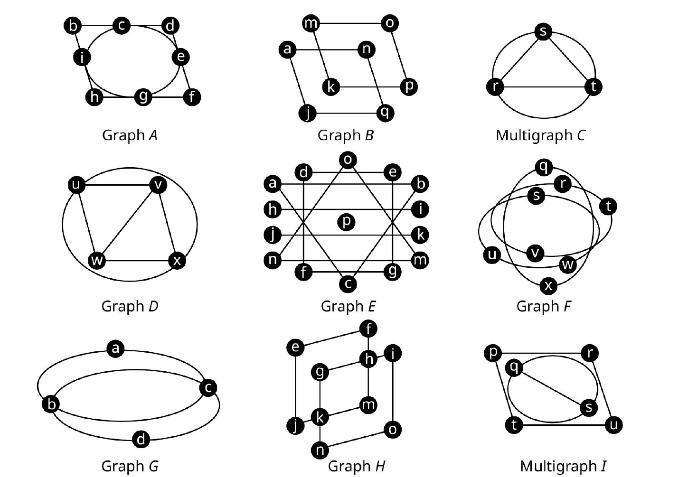
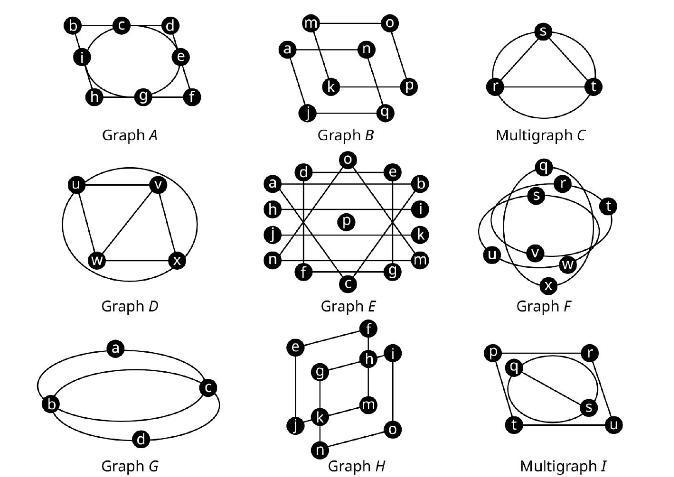
At least one vertex of odd degree Use Graphs \(A, B, C, D, E, F, G, H\), and \(I\) to answer the following exercises. Identify any graph or graphs with the given characteristics or indicate that none do. b h g Graph A W Graph D a k P Graph B b h P k e C Graph E (m) d Graph G n Graph H Multigraph C
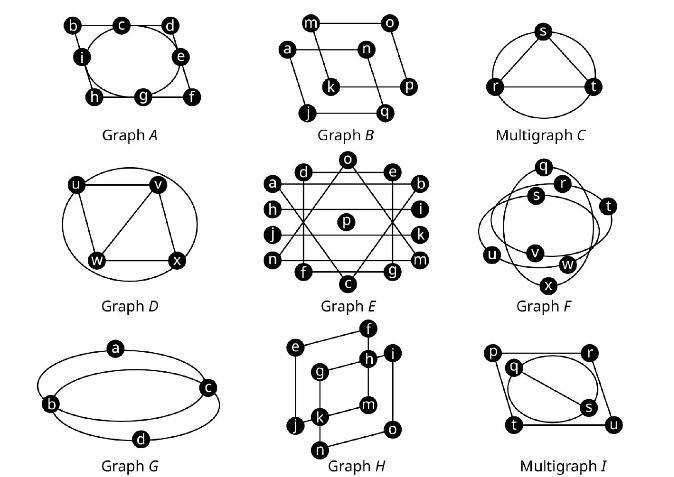
All vertices of even degree Use Graphs \(A, B, C, D, E, F, G, H\), and \(I\) to answer the following exercises. Identify any graph or graphs with the given characteristics or indicate that none do. b h g Graph A W Graph D a k P Graph B b h P k e C Graph E (m) d Graph G n Graph H Multigraph C t
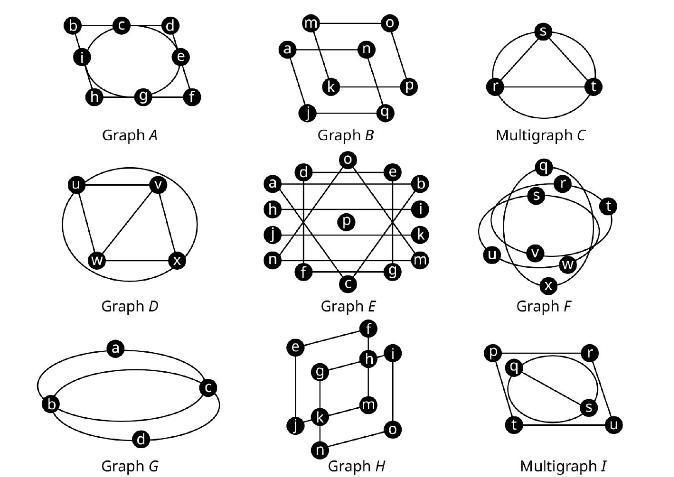
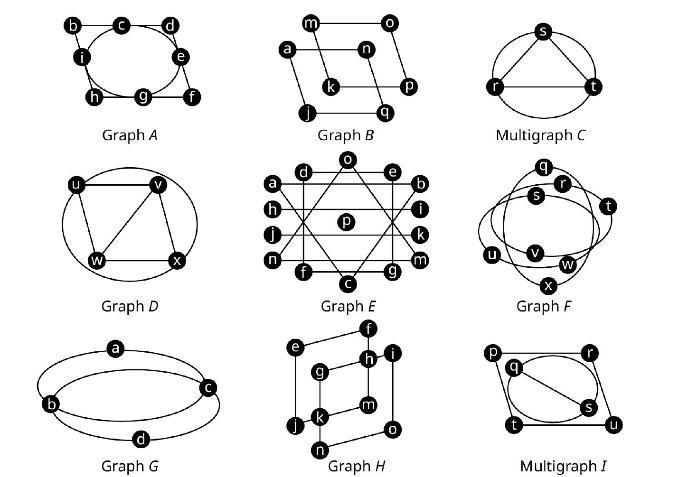
An Euler circuit Use Graphs \(A, B, C, D, E, F, G, H\), and \(I\) to answer the following exercises. Identify any graph or graphs with the given characteristics or indicate that none do. b h g Graph A W Graph D a k P Graph B b h P k e C Graph E (m) d Graph G n Graph H Multigraph C t Graph F
A path between vertex \(j\) and each other vertex on the same graph Use Graphs \(A, B, C, D, E, F, G, H\), and \(I\) to answer the following exercises. Identify any graph or graphs with the given characteristics or indicate that none do. b h g Graph A W Graph D a k P Graph B b h P k e C Graph E (m)
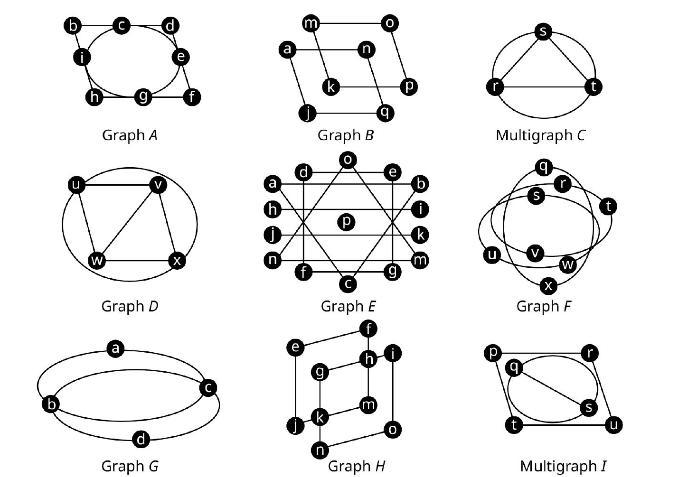
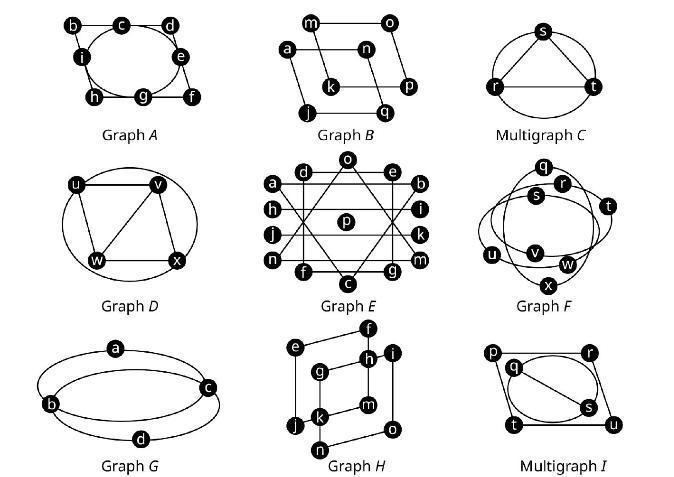
Graph \(B\)Use the graphs in the previous exercise to answer the following exercises. For each exercise, list the set of vertices for each component in the given graph. b h 9 Graph A W Graph D h a e Graph B P Multigraph C b i P k Graph E (m) d Graph G n Graph H t Graph F Multigraph I u
Graph \(E\)Use the graphs in the previous exercise to answer the following exercises. For each exercise, list the set of vertices for each component in the given graph. b h 9 Graph A W Graph D h a e Graph B P Multigraph C b i P k Graph E (m) d Graph G n Graph H t Graph F Multigraph I u
Graph \(F\)Use the graphs in the previous exercise to answer the following exercises. For each exercise, list the set of vertices for each component in the given graph. b h 9 Graph A W Graph D h a e Graph B P Multigraph C b i P k Graph E (m) d Graph G n Graph H t Graph F Multigraph I u
Multigraph \(I\)Use the graphs in the previous exercise to answer the following exercises. For each exercise, list the set of vertices for each component in the given graph. b h 9 Graph A W Graph D h a e Graph B P Multigraph C b i P k Graph E (m) d Graph G n Graph H t Graph F Multigraph I u
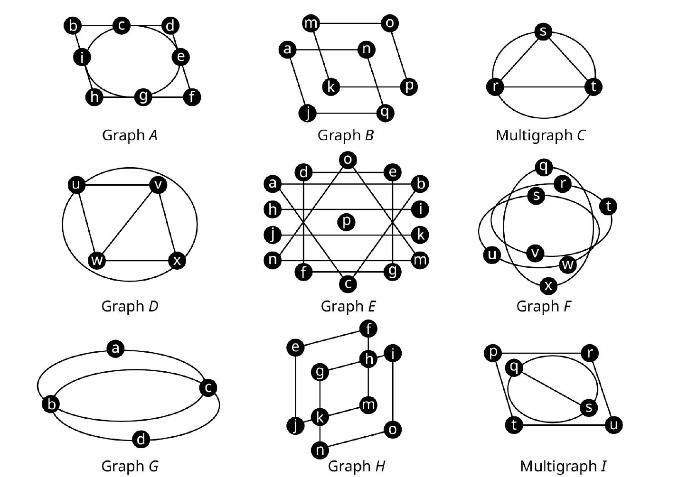
Graph \(A\), vertex \(c\).Use the graphs in the initial exercise to answer the following exercises. For each exercise, a graph and a vertex on the graph are given. Find a path between the given vertex and each other vertex on the graph. If this is not possible, indicate that it is not. b h g Graph
Graph \(B\), vertex \(m\).Use the graphs in the initial exercise to answer the following exercises. For each exercise, a graph and a vertex on the graph are given. Find a path between the given vertex and each other vertex on the graph. If this is not possible, indicate that it is not. b h g Graph
Graph \(D\), vertex \(x\).Use the graphs in the initial exercise to answer the following exercises. For each exercise, a graph and a vertex on the graph are given. Find a path between the given vertex and each other vertex on the graph. If this is not possible, indicate that it is not. b h g Graph
Graph \(F\), vertex \(w\).Use the graphs in the initial exercise to answer the following exercises. For each exercise, a graph and a vertex on the graph are given. Find a path between the given vertex and each other vertex on the graph. If this is not possible, indicate that it is not.' b h g Graph
Graph \(G\), vertex \(a\).Use the graphs in the initial exercise to answer the following exercises. For each exercise, a graph and a vertex on the graph are given. Find a path between the given vertex and each other vertex on the graph. If this is not possible, indicate that it is not. b h g Graph
Graph \(H\), vertex \(e\).Use the graphs in the initial exercise to answer the following exercises. For each exercise, a graph and a vertex on the graph are given. Find a path between the given vertex and each other vertex on the graph. If this is not possible, indicate that it is not. b h g Graph
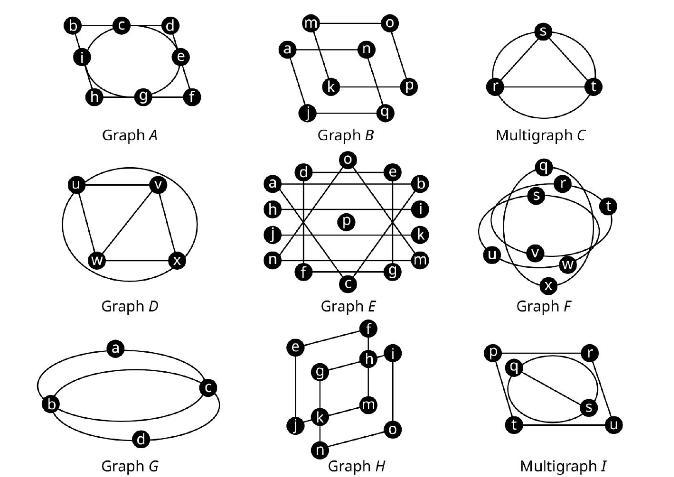
Graph \(A\), vertex \(c\).Use the graphs in the initial exercise to answer the following exercises. For each exercise, a graph and a vertex on the graph are given. Find an Euler circuit beginning and ending at the given vertex if one exists. If no Euler circuits exist, explain how you know that
Graph \(B\), vertex \(k\).Use the graphs in the initial exercise to answer the following exercises. For each exercise, a graph and a vertex on the graph are given. Find an Euler circuit beginning and ending at the given vertex if one exists. If no Euler circuits exist, explain how you know that
Graph \(D\), vertex \(w\).Use the graphs in the initial exercise to answer the following exercises. For each exercise, a graph and a vertex on the graph are given. Find an Euler circuit beginning and ending at the given vertex if one exists. If no Euler circuits exist, explain how you know that
Graph \(G\), vertex \(b\).Use the graphs in the initial exercise to answer the following exercises. For each exercise, a graph and a vertex on the graph are given. Find an Euler circuit beginning and ending at the given vertex if one exists. If no Euler circuits exist, explain how you know that
Graph \(H\), vertex 0 .Use the graphs in the initial exercise to answer the following exercises. For each exercise, a graph and a vertex on the graph are given. Find an Euler circuit beginning and ending at the given vertex if one exists. If no Euler circuits exist, explain how you know that they
Multigraph \(I\), vertex \(p\).Use the graphs in the initial exercise to answer the following exercises. For each exercise, a graph and a vertex on the graph are given. Find an Euler circuit beginning and ending at the given vertex if one exists. If no Euler circuits exist, explain how you know
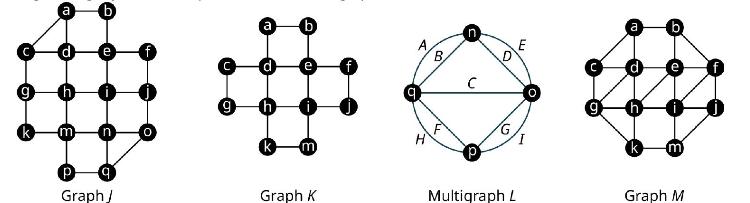
Graph \(J\)For the following exercises, use the connected graphs. In each exercise, a graph is indicated. Determine if the graph is Eulerian or not and explain how you know. If it is Eulerian, give an example of an Euler circuit. If it is not, state which edge or edges you would duplicate to
\(G\) Gaph \(K\)For the following exercises, use the connected graphs. In each exercise, a graph is indicated. Determine if the graph is Eulerian or not and explain how you know. If it is Eulerian, give an example of an Euler circuit. If it is not, state which edge or edges you would duplicate to
Multigraph \(L\)For the following exercises, use the connected graphs. In each exercise, a graph is indicated. Determine if the graph is Eulerian or not and explain how you know. If it is Eulerian, give an example of an Euler circuit. If it is not, state which edge or edges you would duplicate to
Graph \(M\)For the following exercises, use the connected graphs. In each exercise, a graph is indicated. Determine if the graph is Eulerian or not and explain how you know. If it is Eulerian, give an example of an Euler circuit. If it is not, state which edge or edges you would duplicate to
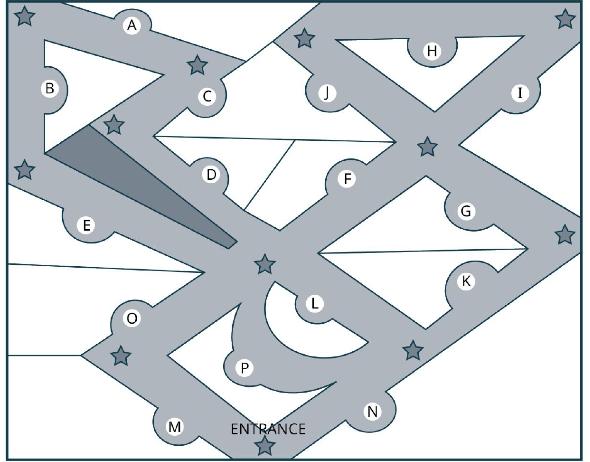
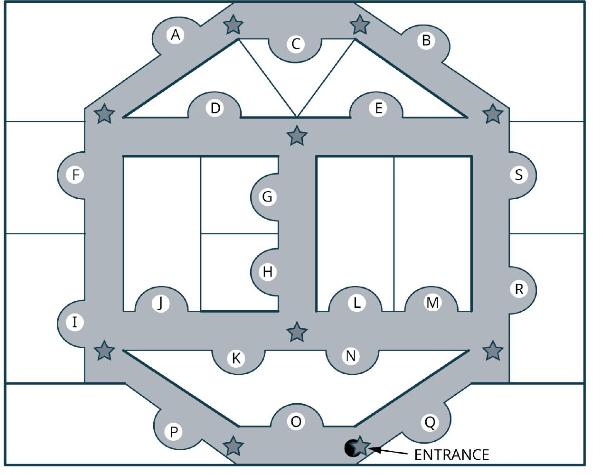
The figure shows a map of zoo exhibits \(A\) through \(P\) with walkways shown in gray. Draw a graph, or multigraph, to represent the routes through the zoo in which the edges represent walkways and the vertices represent turns and intersections, which are each marked with a star. Notice that there
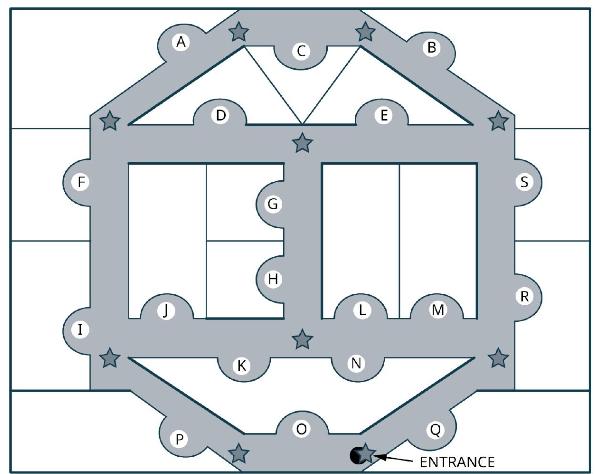
Use the Euler circuit theorem and a graph in which the edges represent hallways and the vertices represent turns and intersections to explain why a visitor to the aquarium cannot start at the entrance, visit every exhibit exactly once, and return to the entrance. F I A C B P H K N E R M ENTRANCE
Use an eulerization of the graph you found to determine the least amount of backtracking necessary to allow a visitor to begin at the entrance, see every exhibit at least once, and return to the entrance. How many hallways must be covered twice? Explain your reasoning.The map of the states of
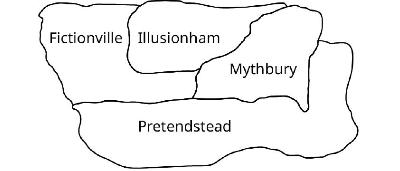
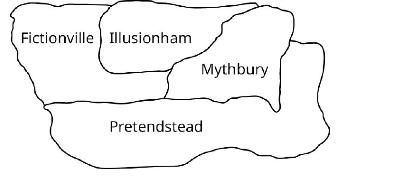
Use a graph to determine if it is possible to travel through Imaginaria crossing each the border between each pair of states exactly once, and returning to the state in which you started. Fictionville Illusionham Mythbury Pretendstead
Use an eulerization of the graph you found to determine the fewest borders that must be covered twice in order to cross each border at least once and return to the state in which you started. Explain your reasoning.
Connected Use the figure to answer the following exercises. Identify the graph(s) with the given characteristics, if any. a d a e e Graph T Graph U Graph V h 9 Graph W m
All vertices of even degree Use the figure to answer the following exercises. Identify the graph(s) with the given characteristics, if any. a d a e e Graph T Graph U Graph V h 9 Graph W m
Exactly two vertices of odd degree Use the figure to answer the following exercises. Identify the graph(s) with the given characteristics, if any. a d a e e Graph T Graph U Graph V h 9 Graph W m
Has an Euler trail Use the figure to answer the following exercises. Identify the graph(s) with the given characteristics, if any. a d a e e Graph T Graph U Graph V h 9 Graph W m
Has an Euler circuit Use the figure to answer the following exercises. Identify the graph(s) with the given characteristics, if any. a d a e e Graph T Graph U Graph V h 9 Graph W m
Has neither an Euler trail nor an Euler circuit Use the figure to answer the following exercises. Identify the graph(s) with the given characteristics, if any. a d a e e Graph T Graph U Graph V h 9 Graph W m
\(a b\) is a bridge Use the figure to answer the following exercises. Identify the graph(s) with the given characteristics, if any. a d a e e Graph T Graph U Graph V h 9 Graph W m
ef is a bridge Use the figure to answer the following exercises. Identify the graph(s) with the given characteristics, if any. a d a e e Graph T Graph U Graph V h 9 Graph W m
\(a b\) is a local bridge Use the figure to answer the following exercises. Identify the graph(s) with the given characteristics, if any. a d a e e Graph T Graph U Graph V h 9 Graph W m
ef is a local bridge Use the figure to answer the following exercises. Identify the graph(s) with the given characteristics, if any. a d a e e Graph T Graph U Graph V h 9 Graph W m
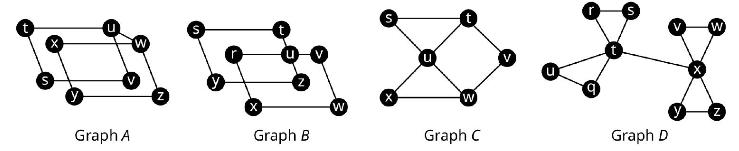
Graph \(A, w \rightarrow x \rightarrow y \rightarrow z \rightarrow w \rightarrow u \rightarrow t \rightarrow s \rightarrow v \rightarrow u\)Use the figure to answer the following exercises. In each exercise, a graph and a sequence of vertices are given. Determine whether each sequence of vertices
Graph \(A, u \rightarrow v \rightarrow s \rightarrow t \rightarrow u \rightarrow w \rightarrow z \rightarrow y \rightarrow x \rightarrow w\)Use the figure to answer the following exercises. In each exercise, a graph and a sequence of vertices are given. Determine whether each sequence of vertices
Graph \(A, s \rightarrow t \rightarrow u \rightarrow v \rightarrow u \rightarrow w \rightarrow z \rightarrow y \rightarrow x \rightarrow w\)Use the figure to answer the following exercises. In each exercise, a graph and a sequence of vertices are given. Determine whether each sequence of vertices
Graph \(A, w \rightarrow x \rightarrow y \rightarrow z \rightarrow w \rightarrow v \rightarrow u \rightarrow t \rightarrow s \rightarrow v\)Use the figure to answer the following exercises. In each exercise, a graph and a sequence of vertices are given. Determine whether each sequence of vertices
Graph \(B, u \rightarrow v \rightarrow w \rightarrow x \rightarrow r \rightarrow u \rightarrow t \rightarrow s \rightarrow y \rightarrow z \rightarrow u\)Use the figure to answer the following exercises. In each exercise, a graph and a sequence of vertices are given. Determine whether each sequence
Graph \(B, v \rightarrow w \rightarrow x \rightarrow r \rightarrow u \rightarrow z \rightarrow y \rightarrow s \rightarrow t \rightarrow u\)Use the figure to answer the following exercises. In each exercise, a graph and a sequence of vertices are given. Determine whether each sequence of vertices
Graph \(C, s \rightarrow t \rightarrow u \rightarrow v \rightarrow w \rightarrow x \rightarrow s\)Use the figure to answer the following exercises. In each exercise, a graph and a sequence of vertices are given. Determine whether each sequence of vertices is an Euler trail, an Euler circuit, or
Graph \(C, t \rightarrow u \rightarrow x \rightarrow w \rightarrow u \rightarrow s \rightarrow t \rightarrow v \rightarrow w\)Use the figure to answer the following exercises. In each exercise, a graph and a sequence of vertices are given. Determine whether each sequence of vertices is an Euler
Graph \(D, t \rightarrow r \rightarrow s \rightarrow t \rightarrow u \rightarrow v \rightarrow t \rightarrow x \rightarrow v \rightarrow w \rightarrow x \rightarrow y \rightarrow z \rightarrow x\)Use the figure to answer the following exercises. In each exercise, a graph and a sequence of vertices
Graph \(D, x \rightarrow v \rightarrow w \rightarrow x \rightarrow y \rightarrow z \rightarrow x \rightarrow t \rightarrow r \rightarrow s \rightarrow t \rightarrow u \rightarrow v \rightarrow t\)Use the figure to answer the following exercises. In each exercise, a graph and a sequence of vertices
Graph \(A\)Use the figure to answer the following exercises. For each graph, identify a bridge if one exists. If it does not, state so. If it does, identify any components that are created when the bridge is removed. W Graph A Graph B S X W u Graph C Graph D V W
Graph \(B\)Use the figure to answer the following exercises. For each graph, identify a bridge if one exists. If it does not, state so. If it does, identify any components that are created when the bridge is removed. W Graph A Graph B S X W u Graph C Graph D V W
\(G r a p h ~ C\)Use the figure to answer the following exercises. For each graph, identify a bridge if one exists. If it does not, state so. If it does, identify any components that are created when the bridge is removed. W Graph A Graph B S X W u Graph C Graph D V W
Graph \(D\)Use the figure to answer the following exercises. For each graph, identify a bridge if one exists. If it does not, state so. If it does, identify any components that are created when the bridge is removed. W Graph A Graph B S X W u Graph C Graph D V W
Graph \(A\)Use the figuree to answer the following exercises. For each graph, identify a local bridge if one exists. If it does not, state so. If it does, find a shortest path between the vertices of the local bridge if the local bridge is removed. Graph A W W X Graph B Graph C Graph D y W
Graph \(B\)Use the figuree to answer the following exercises. For each graph, identify a local bridge if one exists. If it does not, state so. If it does, find a shortest path between the vertices of the local bridge if the local bridge is removed. Graph A W W X Graph B Graph C Graph D y W
Graph \(C\)Use the figuree to answer the following exercises. For each graph, identify a local bridge if one exists. If it does not, state so. If it does, find a shortest path between the vertices of the local bridge if the local bridge is removed. Graph A W W X Graph B Graph C Graph D y W
Graph \(D\)Use the figuree to answer the following exercises. For each graph, identify a local bridge if one exists. If it does not, state so. If it does, find a shortest path between the vertices of the local bridge if the local bridge is removed. Graph A W W X Graph B Graph C Graph D y W
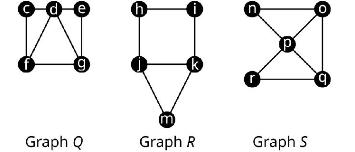
Graph \(Q\)Use the graphs to answer the following exercises. In each exercise, a graph is given. Find two Euler trails in each graph using Fleury's algorithm. de g i n Graph Q Graph R Graph S
Graph \(R\)Use the graphs to answer the following exercises. In each exercise, a graph is given. Find two Euler trails in each graph using Fleury's algorithm. de g i n Graph Q Graph R Graph S
Graph \(S\)Use the graphs to answer the following exercises. In each exercise, a graph is given. Find two Euler trails in each graph using Fleury's algorithm. de g i n Graph Q Graph R Graph S
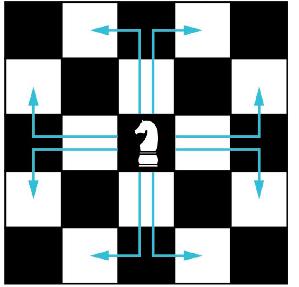
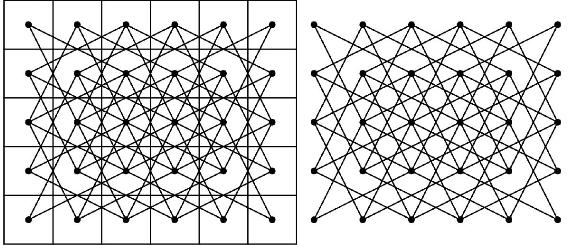
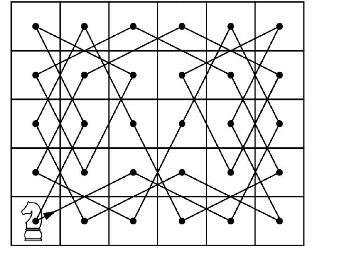
In chess, a knight can move in any direction, but it must move two spaces then turn and move one more space. The eight possible moves a knight can make from a given space are shown in the figure.A graph in which each vertex represents a space on a five-by-six game board and each edge represents a
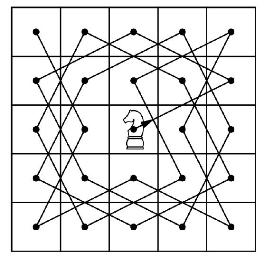
Determine if the open knight's tour in the figure is most accurately described as a trail, a circuit, an Euler trail, or an Euler circuit of the graph of all possible knight moves on a five-by-five game board. Explain your reasoning.
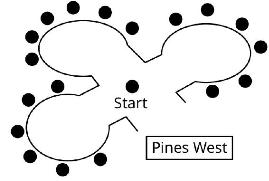
The neighborhood of Pines West has three cul-de-sacs that meet at an intersection as shown in the figure. A postal delivery person starts at the intersection and visits each house in a cul-de-sac once, returns to the intersection, visits each house in the next cul-de-sac, and so on, returning to
Recall that the bridges of Konigsberg can be represented as a multigraph as shown in the figure. We have seen that no route through Konigsberg passes over each bridge exactly once and returns to the starting point. Is there a route that passes over each bridge exactly once but does not begin and
The figure shows the map of the exhibits at an indoor aquarium. Use a graph in which the edges represent hallways and the vertices represent turns and intersections to explain why a visitor to the aquarium cannot start at one of the turns or intersections, passes by every exhibit exactly once, and
The map of the states of Imaginaria is given. Use a graph to determine if it is possible to begin in one state, travel through Imaginaria crossing the border between each pair of states exactly once, and end in a different state. If it is possible, find such a route. If it is not, explain why.
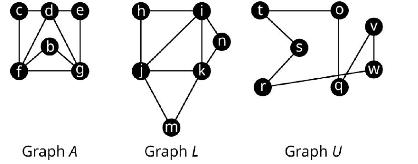
Graph \(A: f \rightarrow b \rightarrow g \rightarrow e \rightarrow d \rightarrow c \rightarrow f\)Use the figure to determine whether the sequence of vertices in the given graph is a Hamilton cycle, an Euler circuit, both, or neither. de f 9 h m r S W Graph A Graph L Graph U
Graph \(A: g \rightarrow b \rightarrow f \rightarrow c \rightarrow d \rightarrow e \rightarrow g\)Use the figure to determine whether the sequence of vertices in the given graph is a Hamilton cycle, an Euler circuit, both, or neither. de f 9 h m r S W Graph A Graph L Graph U
Graph \(A: d \rightarrow e \rightarrow g \rightarrow d \rightarrow f \rightarrow b \rightarrow g \rightarrow f \rightarrow c \rightarrow d\)Use the figure to determine whether the sequence of vertices in the given graph is a Hamilton cycle, an Euler circuit, both, or neither. de f 9 h m r S W
Graph \(L: h \rightarrow i \rightarrow k \rightarrow n \rightarrow j \rightarrow h\)Use the figure to determine whether the sequence of vertices in the given graph is a Hamilton cycle, an Euler circuit, both, or neither. de f 9 h m r S W Graph A Graph L Graph U
Graph \(L: n \rightarrow i \rightarrow h \rightarrow j \rightarrow m \rightarrow k \rightarrow n\)Use the figure to determine whether the sequence of vertices in the given graph is a Hamilton cycle, an Euler circuit, both, or neither. de f 9 h m r S W Graph A Graph L Graph U
Graph \(L: j \rightarrow i \rightarrow n \rightarrow k \rightarrow i \rightarrow j \rightarrow k \rightarrow m \rightarrow j\)Use the figure to determine whether the sequence of vertices in the given graph is a Hamilton cycle, an Euler circuit, both, or neither. de f 9 h m r S W Graph A Graph L
Graph \(U: v \rightarrow w \rightarrow r \rightarrow s \rightarrow t \rightarrow 0 \rightarrow q \rightarrow v\)Use the figure to determine whether the sequence of vertices in the given graph is a Hamilton cycle, an Euler circuit, both, or neither. de f 9 h m r S W Graph A Graph L Graph U
Graph \(U: w \rightarrow q \rightarrow r \rightarrow s \rightarrow t \rightarrow o \rightarrow v \rightarrow w\)Use the figure to determine whether the sequence of vertices in the given graph is a Hamilton cycle, an Euler circuit, both, or neither. de f 9 h m r S W Graph A Graph L Graph U
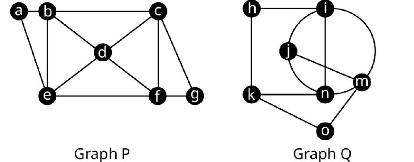
A Hamilton cycle in Graph \(P\) that begins at vertex \(c\).Use the figure to find a circuit that fits the description. a b h e n Graph P Graph Q m
An Euler circuit in Graph \(P\) that begins at vertex \(c\).Use the figure to find a circuit that fits the description. a b h e n Graph P Graph Q m
A directed cycle in Graph \(P\) that is NOT a Hamilton cycle, and explain why it is not a Hamilton cycle.Use the figure to find a circuit that fits the description. a b h e n Graph P Graph Q m
A directed circuit in Graph \(P\) that is NOT an Euler circuit, and explain why it is not an Euler circuit.Use the figure to find a circuit that fits the description. a b h e n Graph P Graph Q m
A Hamilton cycle in Graph \(Q\) that begins at vertex \(n\).Use the figure to find a circuit that fits the description. a b h e n Graph P Graph Q m
An Euler circuit in Graph \(Q\) that begins at vertex \(n\).Use the figure to find a circuit that fits the description. a b h e n Graph P Graph Q m
A directed cycle in Graph \(Q\) that is NOT a Hamilton cycle, and explain why it is not a Hamilton cycle.Use the figure to find a circuit that fits the description. a b h e n Graph P Graph Q m
A directed circuit in Graph \(Q\) that is NOT an Euler circuit, and explain why it is not an Euler circuit.Use the figure to find a circuit that fits the description. a b h e n Graph P Graph Q m
Use the results of Exercises 9-16 to make an observation about which tends to involve a longer sequence of vertices, Hamilton cycles or Euler circuits. Explain why you think this is.
\(n!, n=10\)Evaluate the factorial expression for the given value of \(n\).
\(n!, n=11\)Evaluate the factorial expression for the given value of \(n\).
\((n-1)!, n=10\)Evaluate the factorial expression for the given value of \(n\).
\((n-1)!, n=11\)Evaluate the factorial expression for the given value of \(n\).
have Find the number of arrangements letters in the given word.
teamwork Find the number of arrangements letters in the given word.
anime Find the number of arrangements letters in the given word.
making Find the number of arrangements letters in the given word.
12 vertices Find the number of Hamilton cycles in a complete graph with the given number of vertices.
13 vertices Find the number of Hamilton cycles in a complete graph with the given number of vertices.
9 vertices Find the number of Hamilton cycles in a complete graph with the given number of vertices.
8 vertices Find the number of Hamilton cycles in a complete graph with the given number of vertices.
\(x\) vertices Find the number of Hamilton cycles in a complete graph with the given number of vertices.
\(5!=120\) Hamilton cycles Given the number of Hamilton cycles in a complete graph, determine the number of vertices.
\(6!=720\) Hamilton cycles Given the number of Hamilton cycles in a complete graph, determine the number of vertices.
\(7!=5040\) Hamilton cycles Given the number of Hamilton cycles in a complete graph, determine the number of vertices.
Showing 500 - 600
of 6887
1
2
3
4
5
6
7
8
9
10
11
12
13
14
15
Last
Step by Step Answers

 Get 50% OFF
Claim Now
Get 50% OFF
Claim Now