New Semester
Started
Get
50% OFF
Study Help!
--h --m --s
Claim Now
Question Answers
Textbooks
Find textbooks, questions and answers
Oops, something went wrong!
Change your search query and then try again
S
Books
FREE
Study Help
Expert Questions
Accounting
General Management
Mathematics
Finance
Organizational Behaviour
Law
Physics
Operating System
Management Leadership
Sociology
Programming
Marketing
Database
Computer Network
Economics
Textbooks Solutions
Accounting
Managerial Accounting
Management Leadership
Cost Accounting
Statistics
Business Law
Corporate Finance
Finance
Economics
Auditing
Tutors
Online Tutors
Find a Tutor
Hire a Tutor
Become a Tutor
AI Tutor
AI Study Planner
NEW
Sell Books
Search
Search
Sign In
Register
study help
mathematics
contemporary mathematics
Contemporary Mathematics 1st Edition OpenStax - Solutions
\(x\) ! Hamilton cycles Given the number of Hamilton cycles in a complete graph, determine the number of vertices.
1. \(b \rightarrow a \rightarrow c \rightarrow d \rightarrow b\)2. \(b \rightarrow a \rightarrow d \rightarrow c \rightarrow b\)3. \(b \rightarrow c \rightarrow a \rightarrow d \rightarrow b\)4. \(b \rightarrow c \rightarrow d \rightarrow a \rightarrow b\)5. \(b \rightarrow d \rightarrow a
1. \(i \rightarrow f \rightarrow g \rightarrow h \rightarrow e \rightarrow i\)2. \(i \rightarrow f \rightarrow g \rightarrow e \rightarrow h \rightarrow i\)3. \(i \rightarrow f \rightarrow h \rightarrow g \rightarrow e \rightarrow i\)4. \(i \rightarrow f \rightarrow h \rightarrow e \rightarrow g
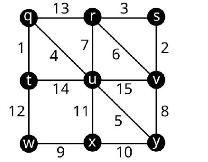
\(q \rightarrow r \rightarrow s \rightarrow v \rightarrow y \rightarrow x \rightarrow w \rightarrow t \rightarrow u \rightarrow q\)Use the figure to find the weight of the given Hamilton cycle. 13 3 S 7 2 4 6 t u V 14 15 12 11 8 5 W X 9 10
\(u \rightarrow y \rightarrow x \rightarrow w \rightarrow t \rightarrow q \rightarrow r \rightarrow s \rightarrow v \rightarrow u\)Use the figure to find the weight of the given Hamilton cycle. 13 3 S 7 2 4 6 t u V 14 15 12 11 8 5 W X 9 10
\(y \rightarrow v \rightarrow s \rightarrow r \rightarrow u \rightarrow q \rightarrow t \rightarrow w \rightarrow x \rightarrow y\)Use the figure to find the weight of the given Hamilton cycle. 13 3 S 7 2 4 6 t u V 14 15 12 11 8 5 W X 9 10
\(u \rightarrow v \rightarrow s \rightarrow r \rightarrow q \rightarrow t \rightarrow w \rightarrow x \rightarrow y \rightarrow u\)Use the figure to find the weight of the given Hamilton cycle. 13 3 S 7 2 4 6 t u V 14 15 12 11 8 5 W X 9 10
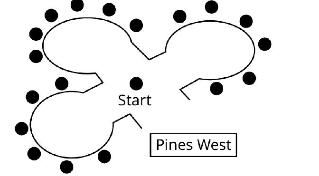
The neighborhood of Pines West has three cul-de-sacs that meet at an intersection as shown. A postal delivery person starts at the intersection and visits each house in a cul-de-sac once, returns to the intersection, visits each house in the next cul-de-sac, and so on, returning to the intersection
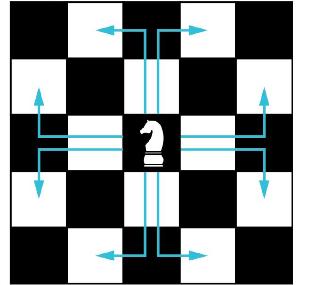
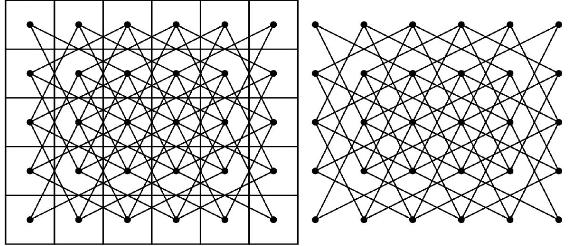
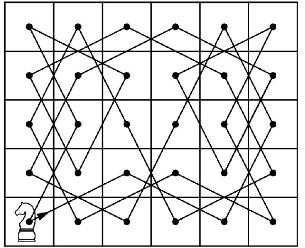
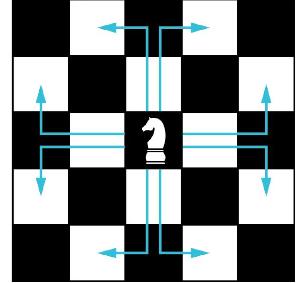
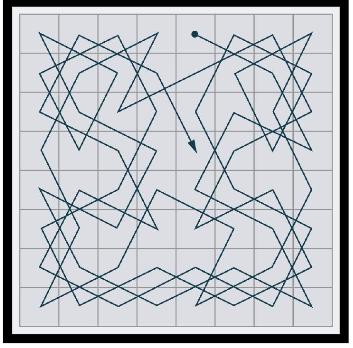
In chess, a knight can move in any direction, but it must move two spaces then turn and move one more space. The 8 possible moves a knight can make from a given space are shown in the figure.A graph in which each vertex represents a space on a five-by-six game board and each edge represents a move
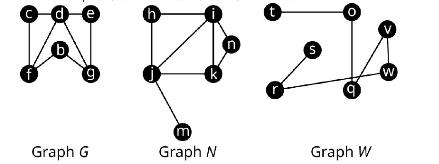
Graph \(G: f \rightarrow b \rightarrow g \rightarrow e \rightarrow d \rightarrow c\)Use the figure to determine whether the sequence of vertices in the given graph is a Hamilton path, an Euler trail, both, or neither. e h f 9 (m) r S W Graph G Graph N Graph W
Graph \(G: g \rightarrow b \rightarrow f \rightarrow c \rightarrow d \rightarrow e\)Use the figure to determine whether the sequence of vertices in the given graph is a Hamilton path, an Euler trail, both, or neither. e h f 9 (m) r S W Graph G Graph N Graph W
Graph \(G: f \rightarrow b \rightarrow g \rightarrow d \rightarrow f \rightarrow c \rightarrow d \rightarrow e \rightarrow g\)Use the figure to determine whether the sequence of vertices in the given graph is a Hamilton path, an Euler trail, both, or neither. e h f 9 (m) r S W Graph G Graph N Graph
Graph \(W: v \rightarrow w \rightarrow r \rightarrow s \rightarrow t \rightarrow o \rightarrow q\)Use the figure to determine whether the sequence of vertices in the given graph is a Hamilton path, an Euler trail, both, or neither. e h f 9 (m) r S W Graph G Graph N Graph W
Graph \(W: s \rightarrow r \rightarrow w \rightarrow v \rightarrow q \rightarrow o \rightarrow t\)Use the figure to determine whether the sequence of vertices in the given graph is a Hamilton path, an Euler trail, both, or neither. e h f 9 (m) r S W Graph G Graph N Graph W
Graph \(N: h \rightarrow i \rightarrow k \rightarrow n \rightarrow j \rightarrow h\)Use the figure to determine whether the sequence of vertices in the given graph is a Hamilton path, an Euler trail, both, or neither. e h f 9 (m) r S W Graph G Graph N Graph W
Graph \(N: n \rightarrow i \rightarrow h \rightarrow j \rightarrow m\)Use the figure to determine whether the sequence of vertices in the given graph is a Hamilton path, an Euler trail, both, or neither. e h f 9 (m) r S W Graph G Graph N Graph W
Graph \(N: m \rightarrow j \rightarrow h \rightarrow i \rightarrow k \rightarrow n \rightarrow i \rightarrow j \rightarrow k\)Use the figure to determine whether the sequence of vertices in the given graph is a Hamilton path, an Euler trail, both, or neither. e h f 9 (m) r S W Graph G Graph N Graph
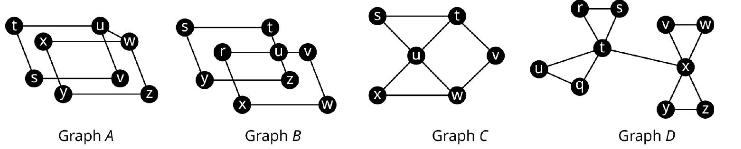
Graph \(A: t \rightarrow s \rightarrow v \rightarrow u \rightarrow x \rightarrow w \rightarrow y \rightarrow z\)Use the figure to explain why the given sequence of vertices does not represent a Hamilton path. W Graph A X Graph B W S W Graph C 9 y Graph D W
Graph \(B: w \rightarrow x \rightarrow r \rightarrow u \rightarrow z \rightarrow y \rightarrow s \rightarrow t \rightarrow u \rightarrow v\)Use the figure to explain why the given sequence of vertices does not represent a Hamilton path. W Graph A X Graph B W S W Graph C 9 y Graph D W
Graph \(C: s \rightarrow u \rightarrow w \rightarrow v \rightarrow t\)Use the figure to explain why the given sequence of vertices does not represent a Hamilton path. W Graph A X Graph B W S W Graph C 9 y Graph D W
Graph \(D: r \rightarrow \rightarrow t q \rightarrow u \rightarrow t \rightarrow x \rightarrow v \rightarrow w \rightarrow x \rightarrow z \rightarrow y\)Use the figure to explain why the given sequence of vertices does not represent a Hamilton path. W Graph A X Graph B W S W Graph C 9 y Graph D W
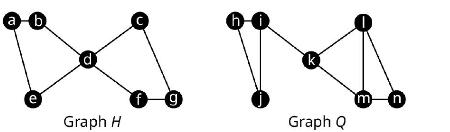
A Hamilton path in Graph \(H\) that begins at vertex \(c\) and ends at vertex \(e\).Use the figure to find a path that fits the description or indicate which scenario from the figure makes it impossible. a C e Graph H Graph Q mn
A Hamilton path in Graph \(Q\) that begins at vertex \(n\) and ends at vertex \(h\).Use the figure to find a path that fits the description or indicate which scenario from the figure makes it impossible. a C e Graph H Graph Q mn
A Hamilton path in Graph \(H\) that begins at vertex \(c\) and ends at vertex \(g\).Use the figure to find a path that fits the description or indicate which scenario from the figure makes it impossible. a C e Graph H Graph Q mn
A Hamilton path in Graph \(Q\) that begins at vertex \(m\) and ends at vertex \(j\).Use the figure to find a path that fits the description or indicate which scenario from the figure makes it impossible. a C e Graph H Graph Q mn
A Hamilton path in Graph \(H\) that begins at vertex \(g\).Use the figure to find a path that fits the description or indicate which scenario from the figure makes it impossible. a C e Graph H Graph Q mn
A Hamilton path in Graph \(Q\) that begins at vertex \(i\).Use the figure to find a path that fits the description or indicate which scenario from the figure makes it impossible. a C e Graph H Graph Q mn
A path between \(n\) and \(j\) in Graph \(Q\) that is NOT a Hamilton path, and explain why it is not a Hamilton path.Use the figure to find a path that fits the description or indicate which scenario from the figure makes it impossible. a C e Graph H Graph Q mn
A path between \(a\) and \(c\) in Graph \(H\) that is NOT a Hamilton path, and explain why it is not a Hamilton path.Use the figure to find a path that fits the description or indicate which scenario from the figure makes it impossible. a C e Graph H Graph Q mn
In chess, a knight can move in any direction, but it must move two spaces then turn and move one more space. The eight possible moves a knight can make from a given space are shown in the figure.A knight's tour is a sequence of moves by a knight on a chessboard (of any size) such that the knight
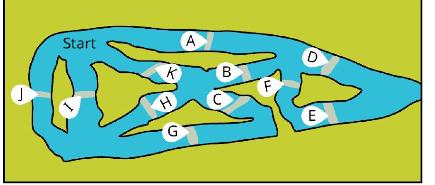
Draw a graph in which the vertices represent checkpoints, and an edge indicates that it is possible to travel from one checkpoint to the next without passing through another checkpoint.
Find a Hamilton path beginning at vertex \(A\) and ending at vertex \(E\).
What does this Hamilton path represent in the context of the race?
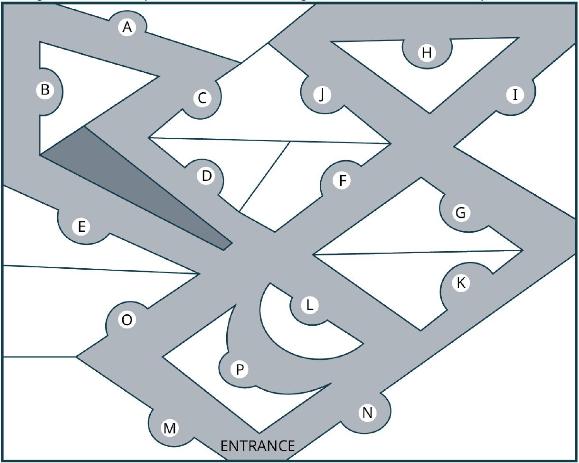
Draw a graph to represent the routes through the zoo in which the edges represent walkways and the vertices represent exhibits. Two vertices are connected if a person can walk between the exhibits they represent without passing another exhibit.The figure shows a map of zoo exhibits \(A\) through
Use the graph you created to find a route that begins at exhibit \(M\), ends at exhibit \(J\), and visits each exhibit exactly once.The figure shows a map of zoo exhibits \(A\) through \(P\). Use it to answer each question. B E A P M ENTRANCE H F G K I
The algorithm for creating graph colorings in the section Navigating Graphs involved coloring the vertex of highest degree first, coloring as many other vertices as possible each color from highest to lowest degree, then repeating this process for the remaining vertices.Determine whether the
Pallets of goods are to be transported on 10 flatbed trucks which have weight limits. To determine which goods will be shipped together, all the possible ways to divide the goods into 10 groups is listed and the total weight of each group is calculated.Determine whether the algorithm described is a
A wedding planner is creating a seating arrangement for the reception dinner. The couple has provided a list of which guests must be seated together. The wedding planner prefers to use the fewest tables possible so that there is more space to mingle at the reception. The planner creates a list of
Packages must be loaded into freight cars to be transported by train. It is preferred to use the fewest freight cars possible to keep the costs down. As each freight car is packed, the package with the largest girth that will fit in the freight car is loaded and this is repeated until the freight
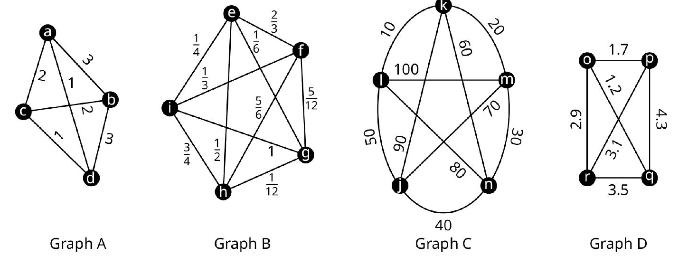
Graph \(A\), vertex \(a\)Use the figure to calculate the number of distinct Hamilton cycles beginning at the given vertex in the given graph. How many of those could possibly result in a different weight? 2 3 12 3 12 100 80 40 50 1.7 70 n q 3.5 Graph A Graph B Graph C Graph D
Graph \(B\), vertex \(e\)Use the figure to calculate the number of distinct Hamilton cycles beginning at the given vertex in the given graph. How many of those could possibly result in a different weight? 2 3 12 3 12 100 80 40 50 1.7 70 n q 3.5 Graph A Graph B Graph C Graph D
Graph \(C\), vertex \(k\)Use the figure to calculate the number of distinct Hamilton cycles beginning at the given vertex in the given graph. How many of those could possibly result in a different weight? 2 3 12 3 12 100 80 40 50 1.7 70 n q 3.5 Graph A Graph B Graph C Graph D
Graph \(D\), vertex 0 Use the figure to calculate the number of distinct Hamilton cycles beginning at the given vertex in the given graph. How many of those could possibly result in a different weight? 2 3 12 3 12 100 80 40 50 1.7 70 n q 3.5 Graph A Graph B Graph C Graph D
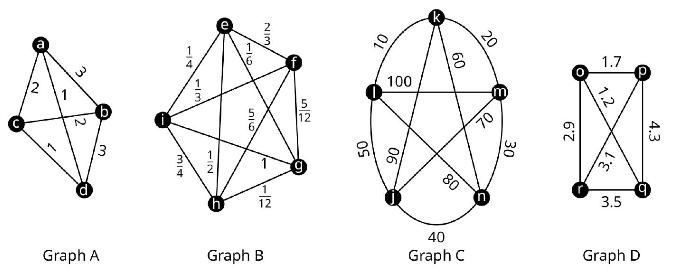
Graph \(A\), vertex \(a\)Use the figure to list all the distinct Hamilton cycles beginning at the given vertex in the given graph. Indicate which pairs of Hamilton cycles are reverses of each other. - 2 13 1 12 100 20 70 80 40 1.7 3.5 Graph A Graph B Graph C Graph D
Graph \(B\), vertex \(e\)Use the figure to list all the distinct Hamilton cycles beginning at the given vertex in the given graph. Indicate which pairs of Hamilton cycles are reverses of each other. - 2 13 1 12 100 20 70 80 40 1.7 3.5 Graph A Graph B Graph C Graph D
Graph \(C\), vertex \(k\)Use the figure to list all the distinct Hamilton cycles beginning at the given vertex in the given graph. Indicate which pairs of Hamilton cycles are reverses of each other. - 2 13 1 12 100 20 70 80 40 1.7 3.5 Graph A Graph B Graph C Graph D
Graph \(D\), vertex 0 Use the figure to list all the distinct Hamilton cycles beginning at the given vertex in the given graph. Indicate which pairs of Hamilton cycles are reverses of each other. - 2 13 1 12 100 20 70 80 40 1.7 3.5 Graph A Graph B Graph C Graph D
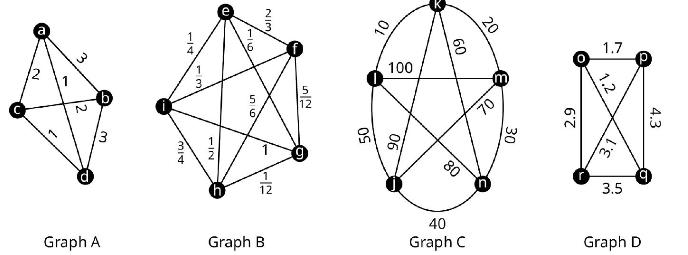
Graph \(A\), vertex \(a\)Use the figure to find a Hamilton cycle of least weight for the given graph, beginning at the given vertex, and using the brute force method. What is the weight of the cycle? 12 m 1 6 100 5 6 1- 9 99 20 1.7 P 3.5 40 Graph A Graph B Graph C Graph D
Graph \(B\), vertex \(e\)Use the figure to find a Hamilton cycle of least weight for the given graph, beginning at the given vertex, and using the brute force method. What is the weight of the cycle? 12 m 1 6 100 5 6 1- 9 99 20 1.7 P 3.5 40 Graph A Graph B Graph C Graph D
Graph \(C\), vertex \(k\)Use the figure to find a Hamilton cycle of least weight for the given graph, beginning at the given vertex, and using the brute force method. What is the weight of the cycle? 12 m 1 6 100 5 6 1- 9 99 20 1.7 P 3.5 40 Graph A Graph B Graph C Graph D
Graph \(D\), vertex 0 Use the figure to find a Hamilton cycle of least weight for the given graph, beginning at the given vertex, and using the brute force method. What is the weight of the cycle? 12 m 1 6 100 5 6 1- 9 99 20 1.7 P 3.5 40 Graph A Graph B Graph C Graph D
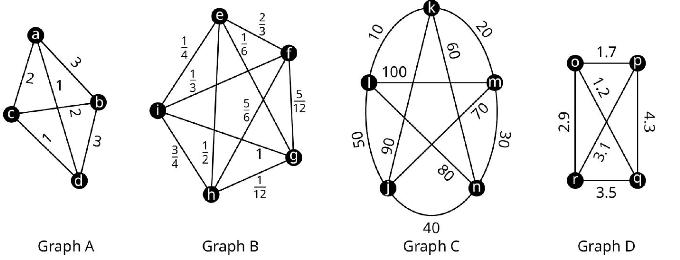
Graph \(A\), vertex \(a\)Use the figure to find a Hamilton cycle of low weight for the given graph, beginning at the given vertex, and using the nearest neighbor method. What is the weight of the cycle? P 2 1 2 10 NIM 116 -14 52 56 3 100 20 60 50 06 70 80 30 1.7 4.3 1.2 2.9 3.1 3.5 40 Graph A Graph
Graph \(B\), vertex \(e\)Use the figure to find a Hamilton cycle of low weight for the given graph, beginning at the given vertex, and using the nearest neighbor method. What is the weight of the cycle? P 2 1 2 10 NIM 116 -14 52 56 3 100 20 60 50 06 70 80 30 1.7 4.3 1.2 2.9 3.1 3.5 40 Graph A Graph
Graph \(C\), vertex \(k\)Use the figure to find a Hamilton cycle of low weight for the given graph, beginning at the given vertex, and using the nearest neighbor method. What is the weight of the cycle? P 2 1 2 10 NIM 116 -14 52 56 3 100 20 60 50 06 70 80 30 1.7 4.3 1.2 2.9 3.1 3.5 40 Graph A Graph
Graph \(D\), vertex \(o\)Use the figure to find a Hamilton cycle of low weight for the given graph, beginning at the given vertex, and using the nearest neighbor method. What is the weight of the cycle? P 2 1 2 10 NIM 116 -14 52 56 3 100 20 60 50 06 70 80 30 1.7 4.3 1.2 2.9 3.1 3.5 40 Graph A Graph
Graph \(A\), vertex a Use your solutions to Exercises 13-20 to compare the results of the brute force method to the results of the nearest neighbor method for each graph. Indicate whether the Hamilton cycle was the same or different and whether the weights were the same or different. If the weights
Graph \(B\), vertex \(e\)Use your solutions to Exercises 13-20 to compare the results of the brute force method to the results of the nearest neighbor method for each graph. Indicate whether the Hamilton cycle was the same or different and whether the weights were the same or different. If the
Graph \(C\), vertex \(k\)Use your solutions to Exercises 13-20 to compare the results of the brute force method to the results of the nearest neighbor method for each graph. Indicate whether the Hamilton cycle was the same or different and whether the weights were the same or different. If the
Graph \(D\), vertex \(o\)Use your solutions to Exercises 13-20 to compare the results of the brute force method to the results of the nearest neighbor method for each graph. Indicate whether the Hamilton cycle was the same or different and whether the weights were the same or different. If the
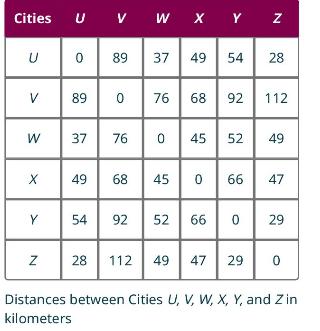
\(U, V, W, X\)Use the table to create a complete weighted graph in which the vertices are the given cities, and the weights are the distances between them. Cities U V W X Y Z U 0 89 37 49 44 54 28 28 89 0 76 68 92 112 W 37 76 0 45 52 52 49 X 49 49 68 45 066 47 Y 54 22 92 52 66 029 Z 28 112 49 47
\(U, W, Y, Z\)Use the table to create a complete weighted graph in which the vertices are the given cities, and the weights are the distances between them. Cities U V W X Y Z U 0 89 37 49 44 54 28 28 89 0 76 68 92 112 W 37 76 0 45 52 52 49 X 49 49 68 45 066 47 Y 54 22 92 52 66 029 Z 28 112 49 47
\(U, X, Y, Z\)Use the table to create a complete weighted graph in which the vertices are the given cities, and the weights are the distances between them. Cities U V W X Y Z U 0 89 37 49 44 54 28 28 89 0 76 68 92 112 W 37 76 0 45 52 52 49 X 49 49 68 45 066 47 Y 54 22 92 52 66 029 Z 28 112 49 47
\(U, V, W, X, Y\)Use the table to create a complete weighted graph in which the vertices are the given cities, and the weights are the distances between them. Cities U V W X Y Z U 0 89 37 49 44 54 28 28 89 0 76 68 92 112 W 37 76 0 45 52 52 49 X 49 49 68 45 066 47 Y 54 22 92 52 66 029 Z 28 112 49
\(U, W, X, Y, Z\)Use the table to create a complete weighted graph in which the vertices are the given cities, and the weights are the distances between them. Cities U V W X Y Z U 0 89 37 49 44 54 28 28 89 0 76 68 92 112 W 37 76 0 45 52 52 49 X 49 49 68 45 066 47 Y 54 22 92 52 66 029 Z 28 112 49
\(U, V, W, X, Y, Z\)Use the table to create a complete weighted graph in which the vertices are the given cities, and the weights are the distances between them. Cities U V W X Y Z U 0 89 37 49 44 54 28 28 89 0 76 68 92 112 W 37 76 0 45 52 52 49 X 49 49 68 45 066 47 Y 54 22 92 52 66 029 Z 28 112
\(U, V, W, X\)Use your solutions to Exercises 25-30 and the nearest neighbor method to find a Hamilton cycle to solve the traveling salesperson problem of finding a reasonably short route to leave from city \(U\), visit each of the other cities listed and return to city \(U\). Indicate the distance
\(U, W, Y, Z\)Use your solutions to Exercises 25-30 and the nearest neighbor method to find a Hamilton cycle to solve the traveling salesperson problem of finding a reasonably short route to leave from city \(U\), visit each of the other cities listed and return to city \(U\). Indicate the distance
\(U, X, Y, Z\)Use your solutions to Exercises 25-30 and the nearest neighbor method to find a Hamilton cycle to solve the traveling salesperson problem of finding a reasonably short route to leave from city \(U\), visit each of the other cities listed and return to city \(U\). Indicate the distance
\(U, V, W, X, Y\)Use your solutions to Exercises 25-30 and the nearest neighbor method to find a Hamilton cycle to solve the traveling salesperson problem of finding a reasonably short route to leave from city \(U\), visit each of the other cities listed and return to city \(U\). Indicate the
\(U, W, X, Y, Z\)Use your solutions to Exercises 25-30 and the nearest neighbor method to find a Hamilton cycle to solve the traveling salesperson problem of finding a reasonably short route to leave from city \(U\), visit each of the other cities listed and return to city \(U\). Indicate the
\(U, V, W, X, Y, Z\)Use your solutions to Exercises 25-30 and the nearest neighbor method to find a Hamilton cycle to solve the traveling salesperson problem of finding a reasonably short route to leave from city \(U\), visit each of the other cities listed and return to city \(U\). Indicate the
\(U, V, W, X\)Use your solutions to Exercises \(25-30\) and the brute force method to find a Hamilton cycle of lowest weight to solve the traveling salesperson problem of finding a shortest route to leave from city \(U\), visit each of the other cities listed and return to city \(U\). Indicate the
\(U, W, Y, Z\)Use your solutions to Exercises \(25-30\) and the brute force method to find a Hamilton cycle of lowest weight to solve the traveling salesperson problem of finding a shortest route to leave from city \(U\), visit each of the other cities listed and return to city \(U\). Indicate the
\(U, X, Y, Z\)Use your solutions to Exercises \(25-30\) and the brute force method to find a Hamilton cycle of lowest weight to solve the traveling salesperson problem of finding a shortest route to leave from city \(U\), visit each of the other cities listed and return to city \(U\). Indicate the
\(U, V, W, X, Y\)Use your solutions to Exercises \(25-30\) and the brute force method to find a Hamilton cycle of lowest weight to solve the traveling salesperson problem of finding a shortest route to leave from city \(U\), visit each of the other cities listed and return to city \(U\). Indicate
\(U, W, X, Y, Z\)Use your solutions to Exercises \(25-30\) and the brute force method to find a Hamilton cycle of lowest weight to solve the traveling salesperson problem of finding a shortest route to leave from city \(U\), visit each of the other cities listed and return to city \(U\). Indicate
Exercises 32 and \(38: U, W, Y, Z\)Use your solutions to the indicated exercises to compare the results of the brute force method to the results of the nearest neighbor method for each traveling salesman problem of finding a reasonably short route to leave from city \(U\), visit each of the other
Exercises 31 and \(37: U, V, W, X\)Use your solutions to the indicated exercises to compare the results of the brute force method to the results of the nearest neighbor method for each traveling salesman problem of finding a reasonably short route to leave from city \(U\), visit each of the other
Exercises 34 and \(40: U, V, W, X, Y\)Use your solutions to the indicated exercises to compare the results of the brute force method to the results of the nearest neighbor method for each traveling salesman problem of finding a reasonably short route to leave from city \(U\), visit each of the
Exercises 35 and \(41: U, W, X, Y, Z\)Use your solutions to the indicated exercises to compare the results of the brute force method to the results of the nearest neighbor method for each traveling salesman problem of finding a reasonably short route to leave from city \(U\), visit each of the
Exercises 33 and \(39: U, X, Y, Z\)Use your solutions to the indicated exercises to compare the results of the brute force method to the results of the nearest neighbor method for each traveling salesman problem of finding a reasonably short route to leave from city \(U\), visit each of the other
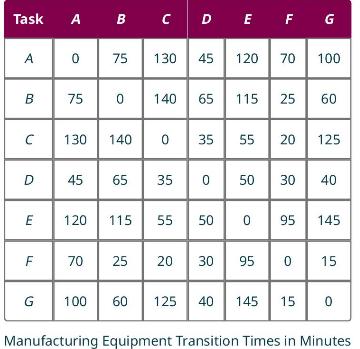
\(A, C, D, F, G\)The products at a particular factory are manufactured in phases. The same equipment is utilized for each phase, but it must be formatted differently to accomplish different tasks. The transition time to convert between a format for one task and another task varies. The times are
\(B, D, E, F, G\)The products at a particular factory are manufactured in phases. The same equipment is utilized for each phase, but it must be formatted differently to accomplish different tasks. The transition time to convert between a format for one task and another task varies. The times are
\(A, B, C, D, E, F\)The products at a particular factory are manufactured in phases. The same equipment is utilized for each phase, but it must be formatted differently to accomplish different tasks. The transition time to convert between a format for one task and another task varies. The times are
\(B, C, D, E, F, G\)The products at a particular factory are manufactured in phases. The same equipment is utilized for each phase, but it must be formatted differently to accomplish different tasks. The transition time to convert between a format for one task and another task varies. The times are
\(A, B, C, D, E, F, G\)The products at a particular factory are manufactured in phases. The same equipment is utilized for each phase, but it must be formatted differently to accomplish different tasks. The transition time to convert between a format for one task and another task varies. The times
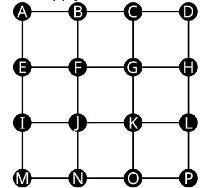
\(A \rightarrow B \rightarrow F \rightarrow G \rightarrow K \rightarrow J \rightarrow F \rightarrow B\)Identify each sequence of vertices from the figure as a walk, trail, and/or path. Select all that apply. A B D E F G H I K L M N O P
\(G \rightarrow K \rightarrow O \rightarrow N \rightarrow J \rightarrow K \rightarrow L\)Identify each sequence of vertices from the figure as a walk, trail, and/or path. Select all that apply. A B D E F G H I K L M N O P
\(F \rightarrow J \rightarrow K \rightarrow G \rightarrow B \rightarrow A\)Identify each sequence of vertices from the figure as a walk, trail, and/or path. Select all that apply. A B D E F G H I K L M N O P
\(I \rightarrow J \rightarrow K \rightarrow L \rightarrow K \rightarrow J \rightarrow N\)Identify each sequence of vertices from the figure as a walk, trail, and/or path. Select all that apply. A B D E F G H I K L M N O P
\(M \rightarrow N \rightarrow O \rightarrow K \rightarrow L \rightarrow H\)Identify each sequence of vertices from the figure as a walk, trail, and/or path. Select all that apply. A B D E F G H I K L M N O P
\(A \rightarrow F \rightarrow K \rightarrow P\)Identify each sequence of vertices from the figure as a walk, trail, and/or path. Select all that apply. A B D E F G H I K L M N O P
\(N \rightarrow J \rightarrow F \rightarrow B \rightarrow C \rightarrow G \rightarrow F \rightarrow E\)Identify each sequence of vertices from the figure as a walk, trail, and/or path. Select all that apply. A B D E F G H I K L M N O P
\(E \rightarrow F \rightarrow J \rightarrow I \rightarrow E\)Identify each sequence of vertices from the figure as a walk, trail, and/or path. Select all that apply. A B D E F G H I K L M N O P
\(A \rightarrow B \rightarrow F \rightarrow G \rightarrow K \rightarrow J \rightarrow F \rightarrow B \rightarrow A\)Identify each sequence of vertices from Figure 12.134 as a closed walk, circuit (closed trail), and/or directed cycle (closed path). Select all that apply.
\(G \rightarrow K \rightarrow O \rightarrow N \rightarrow J \rightarrow K \rightarrow L\)Identify each sequence of vertices from Figure 12.134 as a closed walk, circuit (closed trail), and/or directed cycle (closed path). Select all that apply.
\(F \rightarrow J \rightarrow N \rightarrow O \rightarrow K \rightarrow J \rightarrow I \rightarrow E \rightarrow F\)Identify each sequence of vertices from Figure 12.134 as a closed walk, circuit (closed trail), and/or directed cycle (closed path). Select all that apply.
\(I \rightarrow J \rightarrow K \rightarrow G \rightarrow F \rightarrow E \rightarrow I\)Identify each sequence of vertices from Figure 12.134 as a closed walk, circuit (closed trail), and/or directed cycle (closed path). Select all that apply.
\(M \rightarrow N \rightarrow O \rightarrow K \rightarrow J \rightarrow I \rightarrow M\)Identify each sequence of vertices from Figure 12.134 as a closed walk, circuit (closed trail), and/or directed cycle (closed path). Select all that apply.
\(N \rightarrow J \rightarrow F \rightarrow B \rightarrow C \rightarrow G \rightarrow F \rightarrow J \rightarrow N\)Identify each sequence of vertices from Figure 12.134 as a closed walk, circuit (closed trail), and/or directed cycle (closed path). Select all that apply.
Showing 600 - 700
of 6887
1
2
3
4
5
6
7
8
9
10
11
12
13
14
15
Last
Step by Step Answers

 Get 50% OFF
Claim Now
Get 50% OFF
Claim Now