New Semester
Started
Get
50% OFF
Study Help!
--h --m --s
Claim Now
Question Answers
Textbooks
Find textbooks, questions and answers
Oops, something went wrong!
Change your search query and then try again
S
Books
FREE
Study Help
Expert Questions
Accounting
General Management
Mathematics
Finance
Organizational Behaviour
Law
Physics
Operating System
Management Leadership
Sociology
Programming
Marketing
Database
Computer Network
Economics
Textbooks Solutions
Accounting
Managerial Accounting
Management Leadership
Cost Accounting
Statistics
Business Law
Corporate Finance
Finance
Economics
Auditing
Tutors
Online Tutors
Find a Tutor
Hire a Tutor
Become a Tutor
AI Tutor
AI Study Planner
NEW
Sell Books
Search
Search
Sign In
Register
study help
mathematics
contemporary mathematics
Contemporary Mathematics 1st Edition OpenStax - Solutions
Name the vertices in Graph \(U\).Use the given figure. a Graph S e d b Graph T Graph U e Graph V a e Graph W e
Identify any pairs of vertices in Graph \(S\) that are not adjacent.Use the given figure. a Graph S e d b Graph T Graph U e Graph V a e Graph W e
Which graphs only has vertices of degree \(2 ?\)Use the given figure. a Graph S e d b Graph T Graph U e Graph V a e Graph W e
Identify the graph in which the sum of the degrees of the vertices is 16 .Use the given figure. a Graph S e d b Graph T Graph U e Graph V a e Graph W e
Amazon.com has a network of warehouses that are used to move packages around the United States. Delivery trucks from warehouse deliver packages to other locations. These mail trucks also pick up packages to bring back to their home warehouse. Explain how a graph or multigraph might be drawn to
Eduardo has two groups of four friends, group A and group B. Within each group, each of the members of the group are friends with each other but not with those in the other group. The individuals in group \(A\) have no other friends, but the individuals in group B each has their own group of four
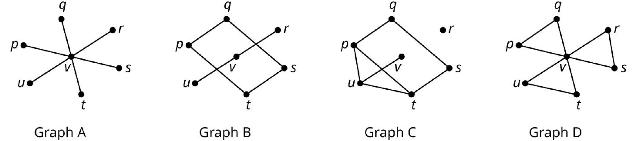
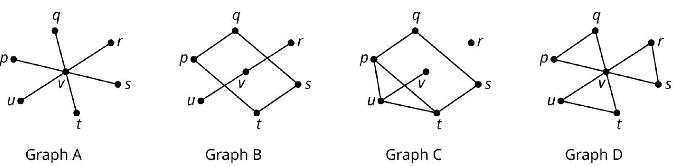
Explain why Graph \(B\) is not a subgraph of Graph \(C\).Use the given figure. Us Graph A = S U S Graph B U t Graph C S Graph D S
Identify any graphs that have a quadrilateral cyclic subgraph and name the vertices.Use the given figure. Us Graph A = S U S Graph B U t Graph C S Graph D S
Identify a clique in Graph \(C\) by listing its vertices.Use the given figure. Us Graph A = S U S Graph B U t Graph C S Graph D S
Draw a graph with the following characteristics: largest clique has 4 vertices, a pentagonal cyclic subgraph, exactly two vertices of degree 4 .Use the given figure. Us Graph A = S U S Graph B U t Graph C S Graph D S
How many edges are in a complete graph with 12 vertices?Use the given figure. Us Graph A = S U S Graph B U t Graph C S Graph D S
How many triangles are in a complete graph with 11 vertices?Use the given figure. Us Graph A = S U S Graph B U t Graph C S Graph D S
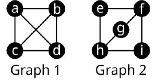
Identify three differences between Graph 1 and Graph 2 that demonstrate the graphs are not isomorphic. a b e C d Graph 1 h Graph 2
Determine if Graph 3 is isomorphic to Graph 4.If so, identify a correspondence between the vertices which demonstrates the isomorphism. If not, identify at least two characteristics that verifies this.Use the given figure. 8 Graph 3 14 18 15 34 31 30 20 28 16 24 Graph 4 Graph 5 29 Graph 6
Determine if Graph 3 is isomorphic to Graph 5.If so, identify a correspondence between the vertices that demonstrates the isomorphism. If not, identify a characteristic that verifies this.Use the given figure. 8 Graph 3 14 18 15 34 31 30 20 28 16 24 Graph 4 Graph 5 29 Graph 6
Consider Graph 4 and Graph 5.Determine if one graph is a subgraph of the other. If so, give a correspondence between vertices that demonstrates this relationship. If not, identify conflicting characteristics.Use the given figure. 8 Graph 3 14 18 15 34 31 30 20 28 16 24 Graph 4 Graph 5 29 Graph 6
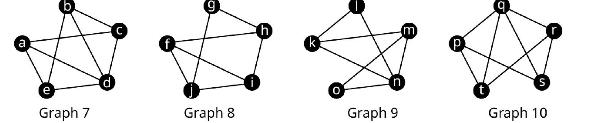
Draw the complements of Graphs 7 and 9.Determine whether the graphs you drew are isomorphic to each other and explain how you know. Use this information to determine whether Graphs 7 and 8 are isomorphic.Use the given figure. a e Graph 7 d. 9 m n 0 Graph 8 Graph 9 Graph 10
Draw the complements of Graphs 7 and 10.Determine whether the graphs you drew are isomorphic to each other and explain how you know. Use this information to determine whether Graphs 7 and 10 are isomorphic.Use the given figure. a e Graph 7 d. 9 m n 0 Graph 8 Graph 9 Graph 10
Draw the complements of Graphs 8 and 9.Determine whether the graphs you drew are isomorphic to each other and explain how you know. Use this information to determine whether Graphs 8 and 9 are isomorphic.Use the given figure. a e Graph 7 d. 9 m n 0 Graph 8 Graph 9 Graph 10
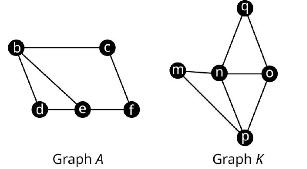
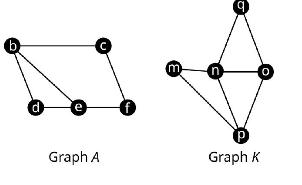
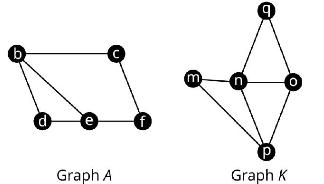
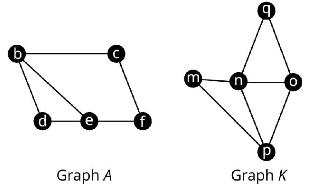
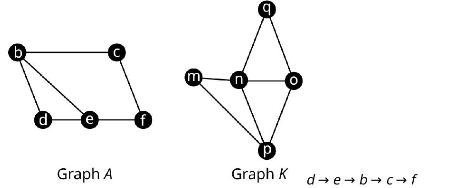
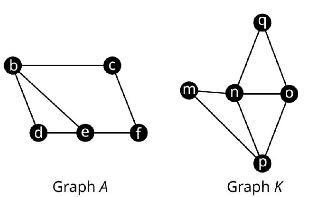
\(e \rightarrow d \rightarrow b \rightarrow e \rightarrow f\)Use Graph \(A\) in the given figure. Consider each sequence of vertices. Determine if it is only a walk, both a walk and a path, both a walk and a trail, all three, or none of these. b C d e m 0 Graph A Graph K
\(e \rightarrow b \rightarrow d \rightarrow e \rightarrow f \rightarrow c \rightarrow b \rightarrow d\)Use Graph \(A\) in the given figure. Consider each sequence of vertices. Determine if it is only a walk, both a walk and a path, both a walk and a trail, all three, or none of these. b C d e m 0
\(e \rightarrow f \rightarrow b \rightarrow d\)Use Graph \(A\) in the given figure. Consider each sequence of vertices. Determine if it is only a walk, both a walk and a path, both a walk and a trail, all three, or none of these. b C d e m 0 Graph A Graph K
\(n \rightarrow 0 \rightarrow q \rightarrow n \rightarrow p \rightarrow m \rightarrow n\)Use Graph \(K\) in Figure 12.352. Identify each sequence of vertices as a closed walk, circuit (closed trail), and/or directed cycle (closed path). Indicate all that apply.
\(m \rightarrow n \rightarrow 0 \rightarrow q \rightarrow n \rightarrow p \rightarrow 0 \rightarrow n \rightarrow m\)Use Graph \(K\) in Figure 12.352. Identify each sequence of vertices as a closed walk, circuit (closed trail), and/or directed cycle (closed path). Indicate all that apply.
\(p \rightarrow o \rightarrow q \rightarrow n \rightarrow m \rightarrow p\)Use Graph \(K\) in Figure 12.352. Identify each sequence of vertices as a closed walk, circuit (closed trail), and/or directed cycle (closed path). Indicate all that apply.
Are Graphs \(A\) and \(K\) planar graphs? What does your answer tell you about the chromatic number of each graph?Use Graphs \(A\) and \(K\) in Figure 12.352.
How many vertices are in the largest complete subgraph of Graph \(A\) ? What does this tell you about the chromatic number of Graph \(A\) ?Use Graphs \(A\) and \(K\) in Figure 12.352.
Create a coloring of Graph \(A\), which uses exactly four colors, or explain why it is not possible.Use Graphs \(A\) and \(K\) in Figure 12.352.
Create a coloring of Graph \(K\), which uses exactly two colors, or explain why it is not possible.Use Graphs \(A\) and \(K\) in Figure 12.352.
Determine the chromatic number of Graph A. Give a coloring that supports your conclusion.Use Graphs \(A\) and \(K\) in Figure 12.352.
Determine the chromatic number of Graph \(K\). Give a coloring that supports your conclusion.Use Graphs \(A\) and \(K\) in Figure 12.352.
connected Use the graphs and multigraphs shown. Identify any graphs and/or multigraphs with the given characteristics. If there are none, state so. W a m n M Graph 11 Graph 12 Graph 13 Multigraph 14 Multigraph 15
disconnected Use the graphs and multigraphs shown. Identify any graphs and/or multigraphs with the given characteristics. If there are none, state so. W a m n M Graph 11 Graph 12 Graph 13 Multigraph 14 Multigraph 15
Eulerian Use the graphs and multigraphs shown. Identify any graphs and/or multigraphs with the given characteristics. If there are none, state so. W a m n M Graph 11 Graph 12 Graph 13 Multigraph 14 Multigraph 15
List the set of vertices for each component in Graph 13.Use the graphs and multigraphs in Figure 12.354.
Determine whether the sequence of edges represents an Euler circuit in Multigraph 15: \(K \rightarrow L \rightarrow N \rightarrow M \rightarrow O \rightarrow S \rightarrow T \rightarrow Q \rightarrow U \rightarrow P \rightarrow R\)Use the graphs and multigraphs in Figure 12.354.
Find an Euler circuit beginning and ending at vertex \(g\) in Graph 12 if one exists. Otherwise, explain how you know such an Euler circuit does not exist.Use the graphs and multigraphs in Figure 12.354.
Give an example of a pair of edges that could be duplicated to eulerize Multigraph 14.Use the graphs and multigraphs in Figure 12.354.
Exactly two vertices of odd degree Use the graphs and multigraphs in Figure 12.354. Identify any graphs and/or multigraphs with the given characteristics. If there are none, state so.
Has an Euler trail Use the graphs and multigraphs in Figure 12.354. Identify any graphs and/or multigraphs with the given characteristics. If there are none, state so.
Has exactly one local bridge Use the graphs and multigraphs in Figure 12.354. Identify any graphs and/or multigraphs with the given characteristics. If there are none, state so.
Determine whether the sequence of edges, \(A \rightarrow B \rightarrow C \rightarrow H \rightarrow G \rightarrow D \rightarrow F \rightarrow E\), is an Euler trail, an Euler circuit, or neither for the graph. If it is neither, explain why.Use the graphs and multigraphs in Figure 12.354. In each
Suppose that an edge were added to Graph 11 between vertices \(s\) and \(w\). Determine if the graph would have an Euler trail or an Euler circuit, and find one.Use the graphs and multigraphs in Figure 12.354. In each exercise a graph and a sequence of vertices are given.
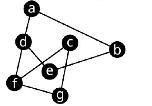
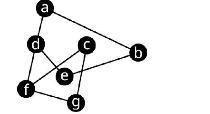
A student has been asked to use Fleury's algorithm to construct an Euler trail in the given graph. The student decides to begin the trail at vertex \(d\). Is this a good choice, why or why not?Refer to the graph in the given figure. +. d a b
A student who is using Fleury's algorithm to construct an Euler trail has decided to begin with \(f \rightarrow d \rightarrow a \rightarrow b \rightarrow\) .... If the student is off to a good start, help the student by completing the Euler trail. If the student has made an error, explain the
Use Fleury's algorithm to construct an Euler trail for Graph 16 beginning at the vertex of your choice.Refer to the graph in the given figure. +. d a b
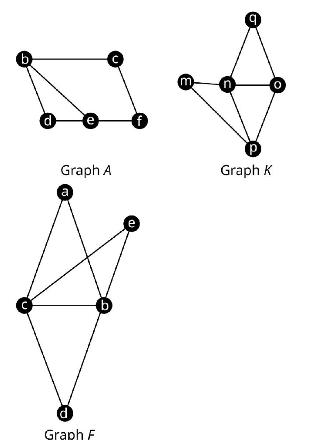
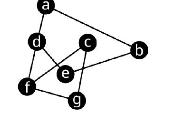
Graph F. \(a \rightarrow b \rightarrow e \rightarrow c \rightarrow b \rightarrow d \rightarrow c \rightarrow a\)Use the graphs from the given figures to determine whether the sequence of vertices in the given graph is a Hamilton cycle, an Euler circuit, both, or neither. C d e C m Graph A a e d
Graph \(K . m \rightarrow n \rightarrow q \rightarrow 0 \rightarrow p \rightarrow m\)Use the graphs from the given figures to determine whether the sequence of vertices in the given graph is a Hamilton cycle, an Euler circuit, both, or neither. C d e C m Graph A a e d Graph F b f P Graph K
Graph \(A\). \(b \rightarrow d \rightarrow e \rightarrow f \rightarrow c \rightarrow b \rightarrow e\)Use the graphs from the given figures to determine whether the sequence of vertices in the given graph is a Hamilton cycle, an Euler circuit, both, or neither. C d e C m Graph A a e d Graph F b f P
\((n-1)!, n=12\)Evaluate the factorial expression for the given value of \(n\).
\((n-1)!, n=14\)Evaluate the factorial expression for the given value of \(n\).
Calculate the number of distinct Hamilton cycles in a complete graph with 13 vertices.Evaluate the factorial expression for the given value of \(n\).
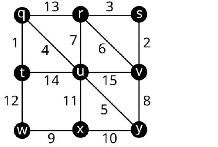
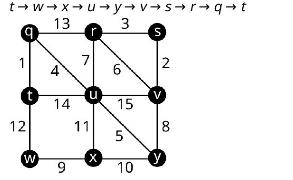
\(q \rightarrow t \rightarrow w \rightarrow x \rightarrow u \rightarrow y \rightarrow v \rightarrow s \rightarrow r \rightarrow q\)Use the figure shown to find the weight of each Hamilton cycle. 13 3 S 1 7 2 4 6 t U V 14 15 12 11 8 5 W X y 9 10
\(w \rightarrow x \rightarrow y \rightarrow u \rightarrow v \rightarrow s \rightarrow r \rightarrow q \rightarrow t \rightarrow w\)Use the figure shown to find the weight of each Hamilton cycle. 13 3 S 1 7 2 4 6 t U V 14 15 12 11 8 5 W X y 9 10
Graph A. \(e \rightarrow b \rightarrow c \rightarrow f \rightarrow e \rightarrow b \rightarrow e\)Use the figure shown to determine whether the sequence of vertices in the given graph is a Hamilton path, an Euler trail, both, or neither. b d e C m n p Graph A Graph K
Graph \(A\). \(b \rightarrow c \rightarrow f \rightarrow e \rightarrow d \rightarrow b \rightarrow e\)Use the figure shown to determine whether the sequence of vertices in the given graph is a Hamilton path, an Euler trail, both, or neither. b d e C m n p Graph A Graph K
Graph \(K . n \rightarrow q \rightarrow o \rightarrow p \rightarrow m\)Use the figure shown to determine whether the sequence of vertices in the given graph is a Hamilton path, an Euler trail, both, or neither. b d e C m n p Graph A Graph K
Graph \(K . o \rightarrow q \rightarrow m \rightarrow n \rightarrow p\)Use the figure shown to determine whether the sequence of vertices in the given graph is a Hamilton path, an Euler trail, both, or neither. b d e C m n p Graph A Graph K
Vertices \(a\) and \(e\).Recall the three common scenarios in which it is not possible to have a Hamilton between two vertices.Scenario 1: If an edge \(a b\) is a bridge, then there is no Hamilton path between a pair of vertices that are on the same side of edge \(a b\).Scenario 2: If an edge \(a
Vertices \(d\) and \(f\).Recall the three common scenarios in which it is not possible to have a Hamilton between two vertices.Scenario 1: If an edge \(a b\) is a bridge, then there is no Hamilton path between a pair of vertices that are on the same side of edge \(a b\).Scenario 2: If an edge \(a
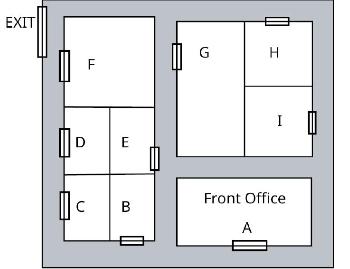
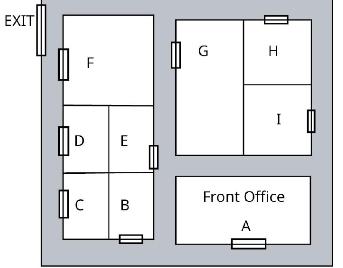
Draw a graph to represent the floor plan for the elementary school in which each vertex is a room and an edge between two vertices indicates that there is a path between the two rooms that does not pass the door to another room.The principal of an elementary school plans to visit each classroom
Use your graph to find a route that the principal can take beginning at the Front Office in room \(A\), visiting each room exactly once (without passing by another room), and ending at room \(F\), which is next to the exit.The principal of an elementary school plans to visit each classroom exactly
Would the route you found be best to trace out a Hamilton path, an Euler trail, both, or neither in the graph you drew? Explain how you know.The principal of an elementary school plans to visit each classroom exactly once before leaving for the day. The floor plan of the school is given. Use this
A lumber distributor is loading pallets onto trucks with the intention of using the fewest trucks possible to send a shipment. The distributor loads the pallets with the greatest length that will fit on the truck first and continues loading until no more pallets will fit. Then the next truck is
A traveler wants to visit five cities by airplane. The traveler lists all the possible orders in which the cities can be visited then calculates the best airfare for each itinerary and selects the least expensive option.Determine whether the algorithm described is a greedy algorithm or a brute
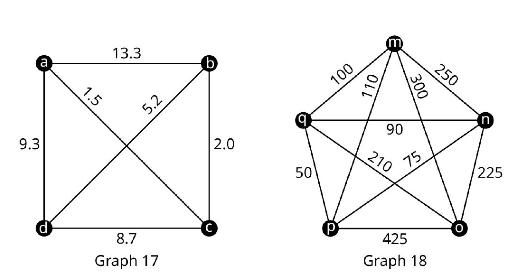
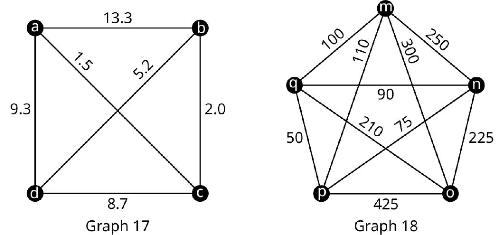
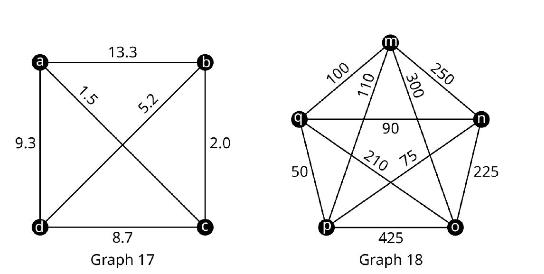
Graph 17, vertex \(a\)List all the distinct Hamilton cycles beginning at the given vertex in the given graph. Indicate which pairs of Hamilton cycles are reverses of each other. 9.3 1.5 13.3 5.2 8.7 Graph 17 2.0 50 100 110 250 300 90 75 225 210 425 Graph 18
Graph 18 , vertex \(m\)List all the distinct Hamilton cycles beginning at the given vertex in the given graph. Indicate which pairs of Hamilton cycles are reverses of each other. 9.3 1.5 13.3 5.2 8.7 Graph 17 2.0 50 100 110 250 300 90 75 225 210 425 Graph 18
Graph 18; vertex \(m\)Find a Hamilton cycle of least weight for the given graph in Figure 12.362, beginning at the given vertex, and using the brute force method. What is the weight of the cycle?
Graph 17; vertex \(a\)Find a Hamilton cycle of least weight for the given graph in Figure 12.362, beginning at the given vertex, and using the brute force method. What is the weight of the cycle?
Graph 18 vertex \(m\)Find a Hamilton cycle of low weight for the given graph in Figure 12.362, beginning at the given vertex, and using the nearest neighbor method. What is the weight of the cycle?
Graph 17 , vertex \(a\)Find a Hamilton cycle of low weight for the given graph in Figure 12.362, beginning at the given vertex, and using the nearest neighbor method. What is the weight of the cycle?
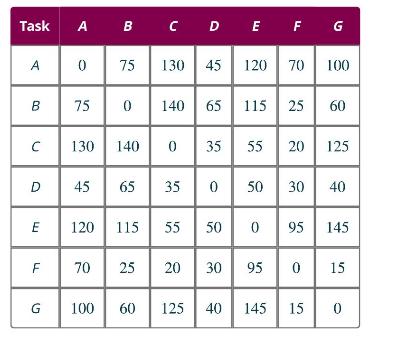
The products at a particular factory are manufactured in phases. The same equipment is utilized for each phase, but it must be formatted differently to accomplish different tasks. The transition time to convert between a format for one task and another task varies. The times are given in the table
A tree with eight vertices, exactly two of degree three.Draw a graph with the given characteristics.
A connected graph with eight vertices, exactly two of degree 3 , which is not a tree.Draw a graph with the given characteristics.
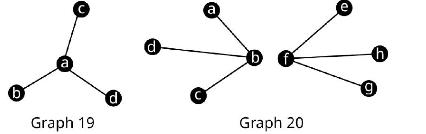
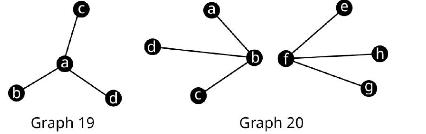
Graph 19 Identify each type of graph in the given figure: tree graph, star graph, starlike graph, line graph, lobster graph, caterpillar graph, and/or forest graph. B C Graph 19 d d a D b h 9 Graph 20
Graph 20 Identify each type of graph in the given figure: tree graph, star graph, starlike graph, line graph, lobster graph, caterpillar graph, and/or forest graph. B C Graph 19 d d a D b h 9 Graph 20
Three spanning trees of Graph \(A\), which include both edges be and \(d e\).Use the figure shown to draw three possible spanning trees that fit the given description. b C d e f Graph A m n P Graph K
Three spanning trees of Graph \(K\), which include edges \(m n\) and \(o q\), but do not include no.Use the figure shown to draw three possible spanning trees that fit the given description. b C d e f Graph A m n P Graph K
Graph 17 Use Kruskal's Algorithm to find a minimum spanning tree of the given graph. Graph it and calculate its weight. 9.3 a 1.5 13.3 5.2 8.7 Graph 17 2.0 50' 100 110 250 300 90 75 225 210 425 Graph 18
Graph 18 Use Kruskal's Algorithm to find a minimum spanning tree of the given graph. Graph it and calculate its weight. 9.3 a 1.5 13.3 5.2 8.7 Graph 17 2.0 50' 100 110 250 300 90 75 225 210 425 Graph 18
Name the edges in Graph \(T\).Use the figure shown. b a b a e F F F F d Graph S e Graph T e Graph U e Graph V Graph W
Identify the graph(s) with six edges.Use the figure shown. b a b a e F F F F d Graph S e Graph T e Graph U e Graph V Graph W
Identify any of the graphs that is a subgraph of Graph \(D\).Use the figure shown. Graph A S U Graph B S S pe 9 Graph C Graph D S
Identify any graphs with no cyclic subgraphs of any size.Use the figure shown. Graph A S U Graph B S S pe 9 Graph C Graph D S
Consider Graph 4 and Graph 6 in the given figure. Determine if one graph is a subgraph of the other. If so, give a correspondence between vertices that demonstrates this relationship. If not, identify conflicting characteristics. 4 9 8 3 Graph 3 16 10 18 21 34 33 30 Graph 4 Graph 5 24 28 26 29
For the following exercise, use Graph \(A\) in the given figure. Consider each sequence of vertices. Determine if it is only a walk, both a walk and a path, both a walk and a trail, all three, or none of these. D C m n O d e Graph A f Graph K deb+c+f
For the following exercise, use Graphs \(A\) and \(K\) in Figure 12.369. Determine the chromatic number of Graph \(K\). Give a coloring that supports your conclusion.
Identify any graphs and/or multigraphs that are not Eulerian. If there are none, state so.Use the graphs and multigraphs in the given figure. u W Graph 11 a m n B M P e Graph 12 Graph 13 Multigraph 14 Multigraph 15
List the set of vertices for each component in Graph 11.Use the graphs and multigraphs in the given figure. u W Graph 11 a m n B M P e Graph 12 Graph 13 Multigraph 14 Multigraph 15
Find an Euler circuit beginning and ending at vertex \(b\) in Graph 12 if one exists.Use the graphs and multigraphs in the given figure. u W Graph 11 a m n B M P e Graph 12 Graph 13 Multigraph 14 Multigraph 15
Use Fleury's algorithm to construct an Euler trail for the given graph beginning at vertex \(f\) of your choice. a d a 6 b
Use the graphs shown to determine whether the sequence of vertices \(d \rightarrow b \rightarrow c \rightarrow f \rightarrow e \rightarrow d\) is a Hamilton cycle, an Euler circuit, both, or neither. C m n d e Graph A f Graph K
Calculate the number of distinct Hamilton cycles in a complete graph with 15 vertices.
Use the figure shown to find the weight of the given Hamilton cycle: twxuy vs rqt 13 3 q r S 1 7 2 6 t u 14 15 12 11 8 5 W X 9 10
Draw a graph to represent the classrooms of the elementary school in which each vertex is a classroom and an edge between two vertices indicates that there is a path between the two rooms that does not pass the door to another classroom.Use this information: For the Halloween celebration at an
Use your graph to find a Hamilton circuit beginning and ending at \(I\).Use this information: For the Halloween celebration at an elementary school, the students from Classroom I will visit every classroom once and return to their own classroom. The floor plan of the school is given. EXIT F E B G H
Explain what the Hamilton circuit you found represents for the students in Classroom I.Use this information: For the Halloween celebration at an elementary school, the students from Classroom I will visit every classroom once and return to their own classroom. The floor plan of the school is given.
Find a Hamilton cycle of low weight for Graph 18, beginning at vertex \(q\), and using the nearest neighborhood method. What is the weight of the cycle? 9.3 1.5 13.3 5.2 8.7 Graph 17 20 2.0 50 100 110 90 210 250 300 75 75 225 425 Graph 18
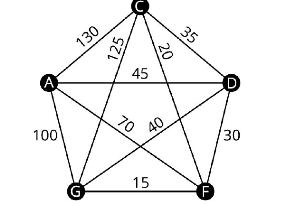
Use Kruskal's Algorithm to find a minimum spanning tree for the below graph. Graph the tree and give its weight. 100 G 130 125 70 45 15 35 20 20 40 D EL F 130
A person's height is \(5 \mathrm{ft} 2 \mathrm{in}\). What is the approximate length from their belly button to the floor rounded to the nearest inch?
Showing 100 - 200
of 6887
1
2
3
4
5
6
7
8
9
10
11
12
13
14
15
Last
Step by Step Answers

 Get 50% OFF
Claim Now
Get 50% OFF
Claim Now