New Semester
Started
Get
50% OFF
Study Help!
--h --m --s
Claim Now
Question Answers
Textbooks
Find textbooks, questions and answers
Oops, something went wrong!
Change your search query and then try again
S
Books
FREE
Study Help
Expert Questions
Accounting
General Management
Mathematics
Finance
Organizational Behaviour
Law
Physics
Operating System
Management Leadership
Sociology
Programming
Marketing
Database
Computer Network
Economics
Textbooks Solutions
Accounting
Managerial Accounting
Management Leadership
Cost Accounting
Statistics
Business Law
Corporate Finance
Finance
Economics
Auditing
Tutors
Online Tutors
Find a Tutor
Hire a Tutor
Become a Tutor
AI Tutor
AI Study Planner
NEW
Sell Books
Search
Search
Sign In
Register
study help
mathematics
edexcel as and a level mathematics
Edexcel AS And A Level Mathematics Pure Mathematics Year 1/AS 1st Edition Greg Attwood - Solutions
The table below gives the surface area, S, and the volume, V of five different spheres, rounded to 1 decimal place.Given that S = aVb, where a and b are constants,a. Show that log S = log a + b log V.b. Copy and complete the table of values of log S and log V, giving your answers to 2 decimal
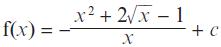
a. Show that f(x) can be written as where c is a constant.Given that f(x) passes through the point (3, −1),b. find the value of c. Give your answer in the form p + q√r where p, q and r are rational numbers to be found. f(x) = X x² + 2√x - 1 X + C
Relative to a fixed origin, point A has position vector 6i − 3j and point B has position vector 4i + 2j.Find the magnitude of the vector AB(vector) and the angle it makes with the unit vector i.
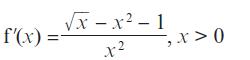
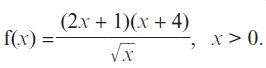
a. Show that f(x) can be written in the form Px3/2 + Qx1/2 + Rx−1/2, stating the values of the constants P, Q and R.b. Find f′(x).c. A curve has equation y = f(x). Show that the tangent to the curve at the point where x = 1 is parallel to the line with equation 2y = 11x + 3. f(x) =- (2x + 1)(x
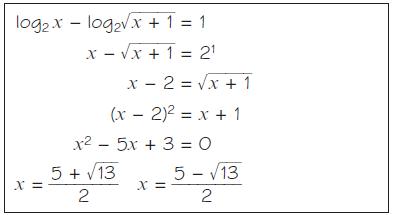
A student is asked to solve the equationThe student’s attempt is showna. Identify the error made by the student.b. Solve the equation correctly. log₂x log₂ (x + 1) = 1
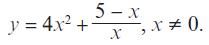
The curve C has equationThe point P on C has x-coordinate 1.a. Show that the value of dy/dx at P is 3.b. Find an equation of the tangent to C at P. This tangent meets the x-axis at the point (k, 0).c. Find the value of k. 5-x y = 4x² + 5 = x₁ x * 0. X,
The price of a computer system can be modelled by the formula P = 100 + 850 e−t/2 where P is the price of the system in £s and t is the age of the computer in years after being purchased.a. Calculate the new price of the system.b. Calculate its price after 3 years.c. When will it be worth less
Prove, from first principles, that the derivative of 5x2 is 10x.
The points P and Q lie on the curve with equation y = e1/2 x. The x-coordinates of P and Q are ln 4 and ln 16 respectively.a. Find an equation for the line PQ.b. Show that this line passes through the origin O.c. Calculate the length, to 3 significant figures, of the line segment PQ.
Given that y = 4x3 − 1 + 2x1/2, x > 0, find dy/dx.
g(x) = (x − 2)2(x + 1)(x − 7)a. Sketch the curve y = g(x), showing the coordinates of any points where the curve meets or cuts the coordinate axes.b. Write down the roots of the equation g(x + 3) = 0.
The temperature, T °C, of a cup of tea is given by T = 55 e−t/8 + 20 t ≥ 0 where t is the time in minutes since measurements began.a. Briefly explain why t ≥ 0.b. State the starting temperature of the cup of tea.c. Find the time at which the temperature of the tea is 50°C, giving your
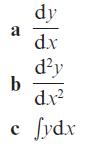
Given that y = 3x2 + 4√x, x > 0, find dy d.x d²y d.x² e fydx с a b
The moment magnitude scale is used by seismologists to express the sizes of earthquakes.The scale is calculated using the formulawhere S is the seismic moment in dyne cm.a. Find the magnitude of an earthquake with a seismic moment of 2.24 × 10²² dyne cm.b. Find the seismic moment of an earthquake
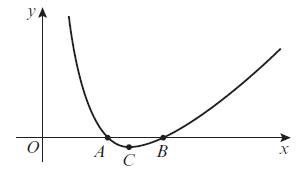
The diagram shows part of the curve with equation y = x + 2/x − 3 . The curve crosses the x-axis at A and B and the point C is the minimum point of the curvea. Find the coordinates of A and B.b. Find the exact coordinates of C, giving your answers in surd form. A с B X
The curve C has equation y = 4x + 3x3/2 − 2x2, x > 0.a. Find an expression for dy/dx.b. Show that the point P(4, 8) lies on C.c. Show that an equation of the normal to C at point P is 3y = x + 20. The normal to C at P cuts the x-axis at point Q.d. Find the length PQ, giving your answer in
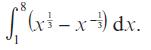
Use calculus to evaluate 8 f (x³ - x -+) dx.
Given that 92x = 27x2 −5, find the possible values of x.
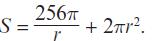
A company makes solid cylinders of variable radius r cm and constant volume 128π cm3.a. Show that the surface area of the cylinder is given byb. Find the minium value for the surface area of the cylinder. S= 256T +2771²².
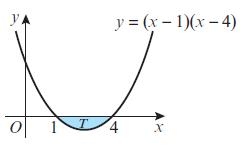
The diagram shows the shaded region T which is bounded by the curve y = (x − 1)(x − 4) and the x-axis. Find the area of the shaded region T. T y=(x-1)(x-4) 4 X
f(x) = (1 − 3x)5a. Expand f(x), in ascending powers of x, up to the term in x2. Give each term in its simplest form.b. Hence find an approximate value for 0.975.c. State, with a reason, whether your approximation is greater or smaller than the true value.
The radioactive decay of a substance is modelled by the formula R = 140ekt t ≥ 0 where R is a measure of radioactivity (in counts per minute) at time t days, and k is a constant.a. Explain briefly why k must be negative.b. Sketch the graph of R against t. After 30 days the radiation is
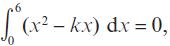
Given thatfind the value of the constant k. L₁(x²- (x²kx) dx = 0,
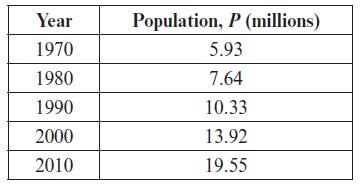
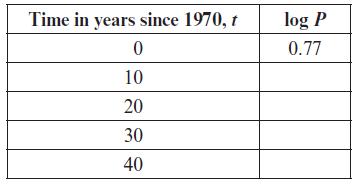
The table below shows the population of Angola between 1970 and 2010.This data can be modelled using an exponential function of the form P = abt, where t is the time in years since 1970 and a and b are constants.a. Copy and complete the table below, giving your answers to 2 decimal places.b. Plot a
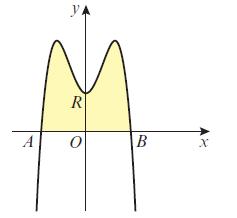
The diagram shows a section of the curve with equation y = −x4 + 3x2 + 4. The curve intersects the x-axis at points A and B. The finite region R, which is shown shaded, is bounded by the curve and the x-axis.a. Show that the equation −x4 + 3x2 + 4 = 0 only has two solutions, and hence or
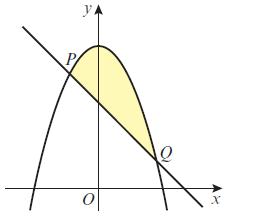
The diagram shows the curve with equation y = 5 − x2 and the line with equation y = 3 − x. The curve and the line intersect at the points P and Q.a. Find the coordinates of P and Q.b. Find the area of the finite region between PQ and the curve. P y X
The total number of views (in millions) V of a viral video in x days is modelled by V = e0.4x − 1a. Find the total number of views after 5 days.b. Find dV/dx.c. Find the rate of increase of the number of views after 100 days, stating the units of your answer.d. Use your answer to part c to
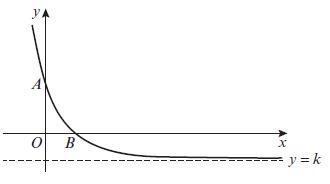
The graph of the function f(x) = 3e−x − 1, x ∈ ℝ, has an asymptote y = k, and crosses the x and y axes at A and B respectively, as shown in the diagram.a. Write down the value of k and the y-coordinate of A.b. Find the exact value of the x-coordinate of B, giving your answer as simply
Prove that the function f(x) = x3 − 12x2 + 48x is increasing for all x ∈ ℝ.
A circle, C, has equation x2 + y2 − 4x + 6y = 12a. Show that the point A(5, 1) lies on C and find the centre and radius of the circle.b. Find the equation of the tangent to C at point A. Give your answer in the form y = ax + b where a and b are rational numbers.c. The curve y = x2 − 2
a. Expressas a single logarithm to base p.b. Find the value of x in log4x = −1.5. log 12-log,9+ log,8)
The curve C with equation y = f(x) passes through the point (5, 65). Given that f′(x) = 6x2 − 10x − 12,a. Use integration to find f(x)b. Hence show that f(x) = x(2x + 3)(x − 4)c. Sketch C, showing the coordinates of the points where C crosses the x-axis.
A heated metal ball S is dropped into a liquid. As S cools, its temperature, T°C, t minutes after it enters the liquid, is given by T = 400e−0.05t + 25, t ≥ 0.a. Find the temperature of S as it enters the liquid.b. Find how long S is in the liquid before its temperature drops to 300 °C.Give
a. Find, to 3 significant figures, the value of x for which 5x = 0.75.b. Solve the equation 2log5x − log53x = 1
a. Solve 32x − 1 = 10, giving your answer to 3 significant figures.b. Solve log2x + log2(9 − 2x) = 2
Find the exact solutions to the equationsa. ln x + ln 3 = ln 6b. ex + 3e−x = 4
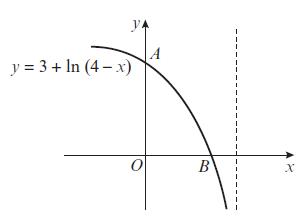
The graph of y = 3 + ln (4 − x) is shown to the right.a. State the exact coordinates of point A.b. Calculate the exact coordinates of point B. YA y = 3 + ln (4-x) A B X
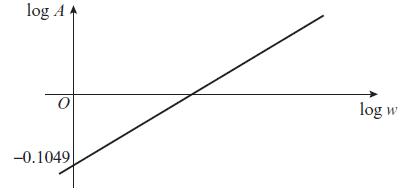
A student is investigating a family of similar shapes. She measures the width, w, and the area, A, of each shape. She suspects there is a formula of the form A = pwq, so she plots the logarithms of her results.The graph has a gradient of 2 and passes through −0.1049 on the vertical axis.a. Write
The 11th row of Pascal’s triangle is shown below.a. Find the next two values in the row.b. Hence find the coefficient of x3 in the expansion of (1 + 2x)10. 1 10 45
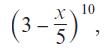
a. Find the first 3 terms, in ascending powers of x, of the binomial expansion ofgiving each term in its simplest form.b. Explain how you would use your expansion to give an estimate for the value of 2.9810. (3 – X 10 "
The 14th row of Pascal’s triangle is shown below.a. Find the next two values in the row.b. Hence find the coefficient of x4 in the expansion of (1 + 3x)13. 1 13 78
Find the binomial expansion ofgiving each term in its simplest form. 5 (x + ²)² 1 X
a. Find the first three terms, in ascending powers of x, of the binomial expansion of (5 + px)30, where p is a non-zero constant.b. Given that in this expansion the coefficient of x2 is 29 times the coefficient of x work out the value of p.
f(x) = (1 − 5x)30a. Find the first four terms, in ascending powers of x, in the binomial expansion of f(x).b. Use your answer to part a to estimate the value of (0.995)30, giving your answer to 6 decimal places.c. Use your calculator to evaluate 0.99530 and calculate the percentage error in your
a. Expand (1 − 2x)10 in ascending powers of x up to and including the term in x3, simplifying each coefficient in the expansion.b. Use your expansion to find an approximation of 0.9810, stating clearly the substitution which you have used for x.
The coefficient of x2 in the expansion of (2 + ax)3 is 54. Find the possible values of the constant a.
Find the first 3 terms, in ascending powers of x, of the binomial expansion of (3 − 2x)5 giving each term in its simplest form.
a. Find the first four terms, in ascending powers of x, of the binomial expansion of (1 + qx)10, where q is a non-zero constant.b. Given that in the expansion of (1 + qx)10 the coefficient of x3 is 108 times the coefficient of x, work out the value of q.
a. Use the binomial series to expand (2 − 3x)10 in ascending powers of x up to and including the term in x3, giving each coefficient as an integer.b. Use your series expansion, with a suitable value for x, to obtain an estimate for 1.9710, giving your answer to 2 decimal places.
The coefficient of x3 in the expansion of (2 − x)(3 + bx)3 is 45. Find possible values of the constant b.
a. Find the first three terms, in ascending powers of x of the binomial expansion of (1 + px)11, where p is a constant.b. The first 3 terms in the same expansion are 1, 77x and qx2, where q is a constant. Find the value of p and the value of q.
a. Find the first 4 terms, in ascending powers of x, of the binomial expansion of (1 − 3x)5. Give each term in its simplest form.b. If x is small, so that x2 and higher powers can be ignored, show that (1 + x)(1 −3x)5 ≈ 1 − 14x.
a. Expand (3 + 2x)4 in ascending powers of x, giving each coefficient as an integer.b. Hence, or otherwise, write down the expansion of (3 − 2x)4 in ascending powers of x.c. Hence by choosing a suitable value for x show that (3 + 2 √2)4 + ( 3 − 2√2)4 is an integer and state its value.
Work out the coefficient of x2 in the expansion of (p − 2x)3. Give your answer in terms of p.
a. Write down the first three terms, in ascending powers of x, of the binomial expansion of (1 + px)15, where p is a non-zero constant.b. Given that, in the expansion of (1 + px)15, the coefficient of x is (−q) and the coefficient of x2 is 5q, find the value of p and the value of q.
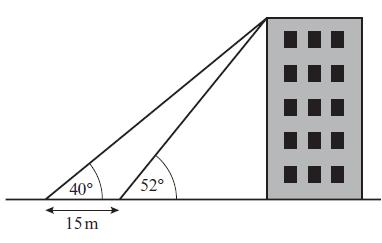
A surveyor wants to determine the height of a building. She measures the angle of elevation of the top of the building at two points 15 m apart on the ground.a. Use this information to determine the height of the building.b. State one assumption made by the surveyor in using this mathematical
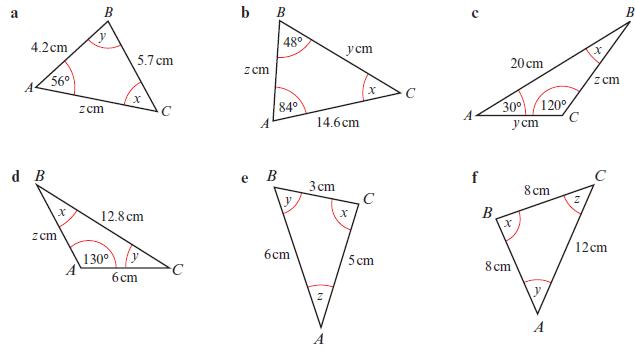
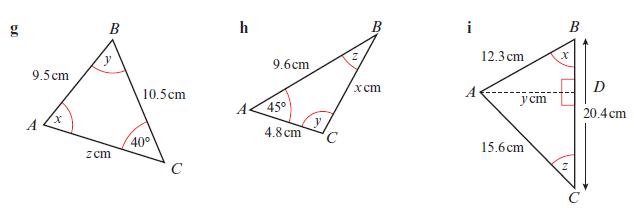
In each triangle below find the values of x, y and z. a 4.2cm d B 56° z cm x zcm 5.7 cm 130⁰ X 12.8cm y 6 cm C b B z cm e B 48° 84° V 6cm ycm 14.6cm 3 cm X x C 5cm f B 20 cm 30⁰ y cm x 8 cm 120° 8cm y C X z cm 12cm B
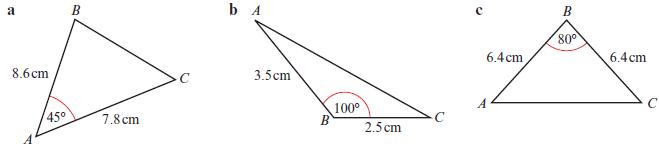
Calculate the area of each triangle. a 8.6cm 45⁰ B 7.8 cm b A 3.5cm 100⁰ 2.5 cm C 6.4 cm B 80° 6.4cm
a. Find the first 3 terms, in ascending powers of x, of the binomial expansion ofgiving each term in its simplest form.b. Explain how you would use your expansion to give an estimate for the value of 2.057. (2+1) 7
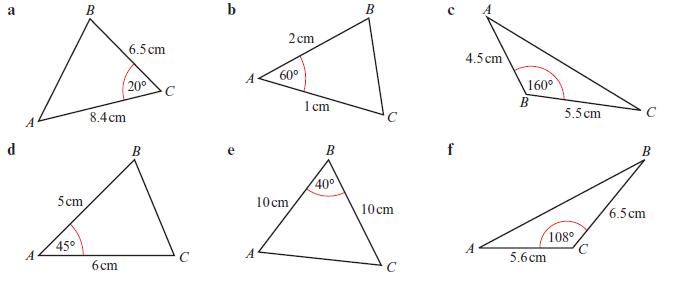
In each of the following triangles calculate the length of the missing side. મ d A A 5cm 45° B 8.4 cm 6 cm 6.5 cm 20⁰ B C C b e 2 cm 60⁰ 10 cm, 1 cm B 40° B 10 cm f 4.5 cm 4 160⁰ B 5.6cm 5.5 cm 108⁰ B 6.5 cm
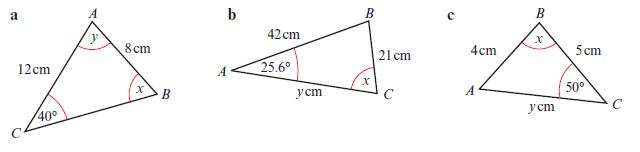
In each of the diagrams shown below, calculate the possible values of x and the corresponding values of y. a 12cm 40⁰ y 8 cm X B b 42 cm 25.6° y cm B x 21 cm C 4cm A B X yem 5cm 50⁰ с
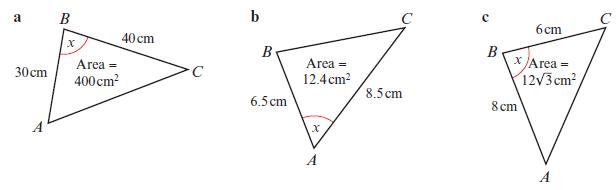
Work out the possible sizes of x in the following triangles. b 40 cm B Area = C BV 12.4 cm² 6.5 cm a B 30cm x Area = 400 cm² 8.5 cm с B 6cm x Area = 12√3 cm² 8 cm C
a. Find the first three terms, in ascending powers of x of the binomial expansion of (2 + px)7, where p is a constant. The first 3 terms are 128, 2240x and qx2, where q is a constant.b. Find the value of p and the value of q.
a. Write down the first three terms, in ascending powers of x, of the binomial expansion of (1 − px)12, where p is a non-zero constant.b. Given that, in the expansion of (1 − px)12, the coefficient of x is q and the coefficient of x2 is 6q, find the value of p and the value of q.
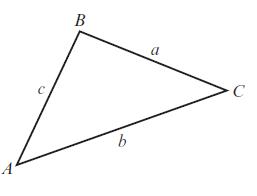
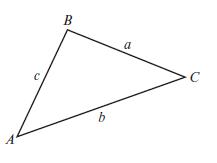
In each of parts a to d, the given values refer to the general triangle.a. Given that a = 8 cm, A = 30°, B = 72°, find b.b. Given that a = 24 cm, A = 110°, C = 22°, find c.c. Given that b = 14.7 cm, A = 30°, C = 95°, find a.d. Given that c = 9.8 cm, B = 68.4°, C = 83.7°, find a. B Ь а C
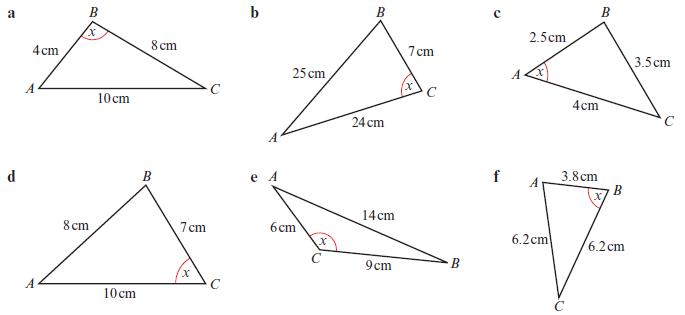
In the following triangles calculate the size of the angle marked x: g શ d 4cm A A B 8 cm 10cm 10cm 8cm B 7cm x C b e A 25 cm 6cm 24 cm 14cm 9cm 7cm x B f A 2.5cm A 6.2cm 4cm 3.8cm B B 6.2 cm 3.5cm
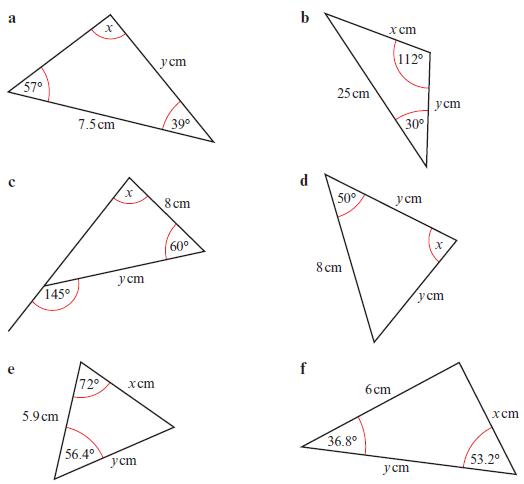
In each of the following triangles calculate the values of x and y. a 57⁰ 145⁰ 5.9 cm 7.5cm 72° 56.4° x y cm x cm yem y cm 39⁰ 8cm 60⁰ b d f 25 cm 50° 8cm 36.8⁰ x cm 6cm 112⁰ 30° y cm y cm ycm X ycm xcm 53.2°
Given that the coefficient of x3 in the binomial expansion of g(x) is 20, find the value of k.g(x) = (4 + kx)5, where k is a constant.
In △ABC, BC = 6 cm, AC = 4.5 cm and ∠ABC = 45°.a. Calculate the two possible values of ∠BAC.b. Draw a diagram to illustrate your answers.
Sketch the graph of y = cos θ in the interval −180° ≤ θ ≤ 180°.
Write down i the maximum value, and ii the minimum value, of the following expressions, and in each case give the smallest positive (or zero) value of x for which it occurs.a. cos x b. 4 sin x c. cos (−x)d. 3 + sin x e. −sin x f. sin 3x
Triangle ABC has area 10 cm2. AB = 6 cm, BC = 8 cm and ∠ABC is obtuse. Find:a. The size of ∠ABCb. The length of AC
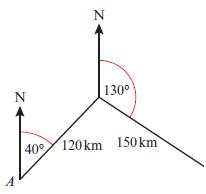
A plane flies from airport A on a bearing of 040° for 120 km and then on a bearing of 130° for 150 km. Calculate the distance of the plane from the airport. N A N ZA 130⁰ 40° 120 km 150 km
In △ABC, calculate the size of the remaining angles, the lengths of the third side and the area of the triangle given thata. △BAC = 40°, AB = 8.5 cm and BC = 10.2 cmb. △ACB = 110°, AC = 4.9 cm and BC = 6.8 cm
Sketch the graph of y = tan θ in the interval −180° ≤ θ ≤ 180°.
In each of the following sets of data for a triangle ABC, find the value of x.a. AB = 6 cm, BC = 9 cm, ∠BAC = 117°, ∠ACB = xb. AC = 11 cm, BC = 10 cm, ∠ABC = 40°, ∠CAB = xc. AB = 6 cm, BC = 8 cm, ∠BAC = 60°, ∠ACB = xd. AB = 8.7 cm, AC = 10.8 cm, ∠ABC = 28°, ∠BAC = x В b a C
Sketch, on the same set of axes, in the interval 0 ≤ θ ≤ 360°, the graphs of cos θ and cos 3θ.
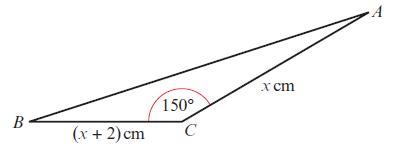
In triangle ABC, BC = (x + 2) cm, AC = x cm and ∠BCA = 150°. Given that the area of the triangle is 5 cm2, work out the value of x, giving your answer to 3 significant figures. B (x + 2) cm 150° C x cm A
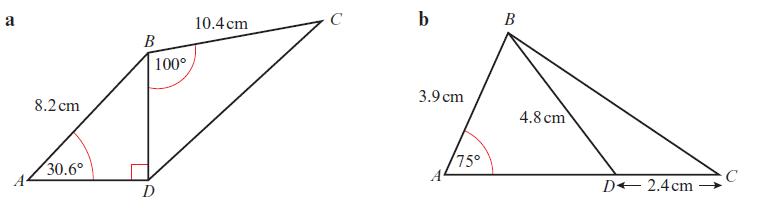
In each of the figures below calculate the total area. a 8.2 cm 30.6° B 100° D 10.4 cm C b 3.9 cm 75° B 4.8 cm D 2.4cm C
In each of the following cases △ABC has ∠ABC = 30° and AB = 10 cm.a. Calculate the least possible length that AC could be.b. Given that AC = 12 cm, calculate ∠ACB.c. Given instead that AC = 7cm, calculate the two possible values of ∠ACB.
A fenced triangular plot of ground has area 1200 m2. The fences along the two smaller sides are 60 m and 80 m respectively and the angle between them is θ. Show that θ = 150°, and work out the total length of fencing.
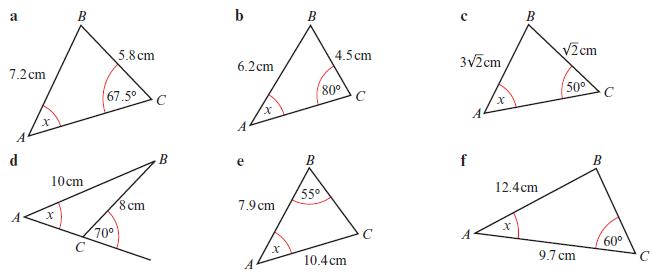
In each of the diagrams shown below, work out the size of angle x. રી 7.2cm d X B 10cm X C 5.8 cm 67.5° 70° 8 cm C B b 6.2cm e x 7.9 cm x B B 55⁰ 4.5 cm 80⁰ 10.4cm C с 3√2cm f B 12.4cm X √2 cm 50⁰ 9.7 cm B 0 60⁰ C
A hiker walks due north from A and after 8 km reaches B. She then walks a further 8 km on a bearing of 120° to C. Work out a the distance from A to C and b the bearing of C from A.
Sketch the graph of y = sin θ in the interval −90° ≤ θ ≤ 270°.
The sides of a triangle are 3 cm, 5 cm and 7 cm respectively. Show that the largest angle is 120°, and find the area of the triangle.
Sketch, on separate sets of axes, the graphs of the following, in the interval 0 ≤ θ ≤ 360°. Give the coordinates of points of intersection with the axes, and of maximum and minimum points where appropriate.a. y = −cos θ b. y = 1/3 sin θ c. y = sin 1/3 θ d. y = tan (θ −
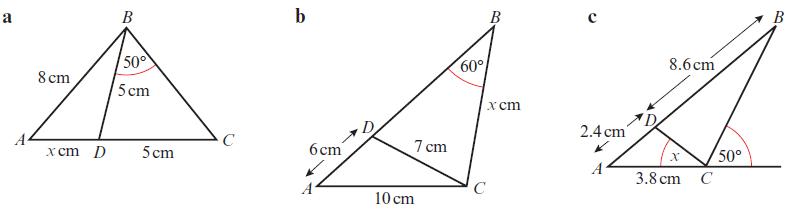
Find x in each of the following diagrams: a A 8 cm x cm D B 50⁰ 5 cm 5cm C b 6cm T 7 cm 10 cm 60° 0 BI x cm 2.4 cm A 8.6cm X 3.8 cm C 50° B
Triangle ABC is such that AB = 4 cm, BC = 6 cm and ∠ACB = 36°. Show that one of the possiblevalues of ∠ABC is 25.8° (to 3 s.f.). Using this value, calculate the length of AC.
A helicopter flies on a bearing of 200° from A to B, where AB = 70 km. It then flies on a bearing of 150° from B to C, where C is due south of A. Work out the distance of C from A.
a. cos 30° = √3/2 Use your graph in question 1 to find another value of θ for which cos θ = √3/2b. tan 60° = √3. Use your graph in question 2 to find other values of θ for which:i. tan θ = √3 ii. tan θ = −√3c. sin 45° = 1/√2 Use your graph in question 3 to find other
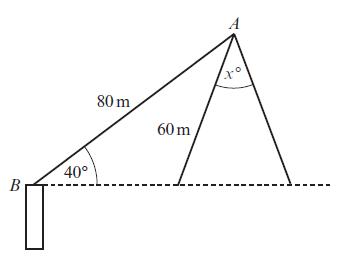
a. A crane arm AB of length 80 m is anchored at point B at an angle of 40° to the horizontal. A wrecking ball is suspended on a cable of length 60 m from A. Find the angle x through which the wrecking ball rotates as it passes the two points level with the base of the crane arm at B.b. Write down
Sketch, on separate sets of axes, the graphs of the following, in the interval −180° ≤ θ ≤ 180°. Give the coordinates of points of intersection with the axes, and of maximum and minimum points where appropriate.a. y = −2 sin θ b. y = tan (θ + 180°) c. y = cos 4θ d y =
From a point A a boat sails due north for 7 km to B. The boat leaves B and moves on a bearing of 100° for 10 km until it reaches C. Calculate the distance of C from A.
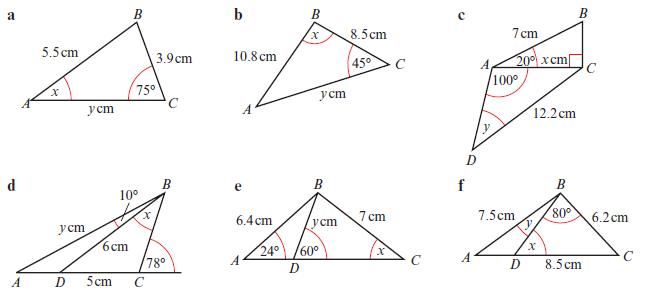
In each of the following diagrams work out the values of x and y. a d 5.5cm x y cm B 3.9cm 75⁰ с B b 10.8 cm B x e ycm 8.5cm 450 B 10° 6.4 cm 7cm A A yem ycm 6cm 24° 60° 78⁰ D D 5cm C D f A 7cm 20% xcm[ 100⁰ 7.5cm D 12.2cm x B 80° B 8.5 cm 6.2 cm C
In △PQR, QR = √3 cm, ∠PQR = 45° and ∠QPR = 60°. Find a PR and b PQ.
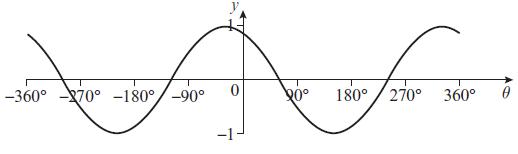
The graph shows the curve y = cos (x + 30°), −360° ≤ x ≤ 360°.a. Write down the coordinates of the points where the curve crosses the x-axis.b. Find the coordinates of the point where the curve crosses the y-axis. -360° 70° -180°-90° 0 -1- 90° 180° / 270° 360°
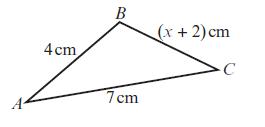
In △ABC, AB = 4 cm, BC = (x + 2) cm and AC = 7 cm.a. Explain how you know that 1 b. Work out the value of x and the area of the triangle for the cases wheni. ∠ABC = 60° andii. ∠ABC = 45°, giving your answers to 3 significant figures. 4 cm B 7cm (x + 2) cm >C
Two triangles ABC are such that AB = 4.5 cm, BC = 6.8 cm and ∠ACB = 30°. Work out the value of the largest angle in each of the triangles.
In △PQR, PQ = (x + 2) cm, PR = (5 − x) cm and ∠QPR = 30°. The area of the triangle is A cm2.a. Show that A = 1/4(10 + 3x − x2).b. Use the method of completing the square, or otherwise, to find the maximum value of A, and give the corresponding value of x.
Two radar stations A and B are 16 km apart and A is due north of B. A ship is known to be on a bearing of 150° from A and 10 km from B. Show that this information gives two positions for the ship, and calculate the distance between these two positions.
Showing 400 - 500
of 1136
1
2
3
4
5
6
7
8
9
10
11
12
Step by Step Answers

 Get 50% OFF
Claim Now
Get 50% OFF
Claim Now