New Semester
Started
Get
50% OFF
Study Help!
--h --m --s
Claim Now
Question Answers
Textbooks
Find textbooks, questions and answers
Oops, something went wrong!
Change your search query and then try again
S
Books
FREE
Study Help
Expert Questions
Accounting
General Management
Mathematics
Finance
Organizational Behaviour
Law
Physics
Operating System
Management Leadership
Sociology
Programming
Marketing
Database
Computer Network
Economics
Textbooks Solutions
Accounting
Managerial Accounting
Management Leadership
Cost Accounting
Statistics
Business Law
Corporate Finance
Finance
Economics
Auditing
Tutors
Online Tutors
Find a Tutor
Hire a Tutor
Become a Tutor
AI Tutor
AI Study Planner
NEW
Sell Books
Search
Search
Sign In
Register
study help
mathematics
edexcel as and a level mathematics
Edexcel AS And A Level Mathematics Pure Mathematics Year 1/AS 1st Edition Greg Attwood - Solutions
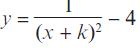
a. Sketch the graph of y = 1/x2 − 4, showing clearly the coordinates of the points where the curve crosses the coordinate axes and stating the equations of the asymptotes.b. The curve withpasses through the origin. Find the two possible values of k. y (x + k)² - 4
Given that x2 + 2x + 3 (x + a)2 + b,a. find the value of the constants a and b.b. Sketch the graph of y = x2 + 2x + 3, indicating clearly the coordinates of any intersections with the coordinate axes.c. Find the value of the discriminant of x2 + 2x + 3. Explain how the sign of the discriminant
Find the set of values of x for which:a. 3(2x + 1) > 5 − 2x,b. 2x2 − 7x + 3 > 0,c. both 3(2x + 1) > 5 − 2x and 2x2 − 7x + 3 > 0.
The functions p and q are defined as p(x) = −2(x + 1) and q(x) = x2 − 5x + 2, x ∈ ℝ. Show algebraically that there is no value of x for which p(x) = q(x).
Find the equation of the line with gradient m that passes through the point (x1, y1) when: a m= 2 and (x₁, y₁) = (2,5) c m = -1 and (x₁, y₁) = (3, -6) e m = and (x₁, y₁) = (-4, 10) g m= 2 and (x₁, y₁) = (a, 2a) b m = 3 and (x₁, y₁) = (-2, 1) d m-4 and (x₁, y₁) = (-2, -3) f
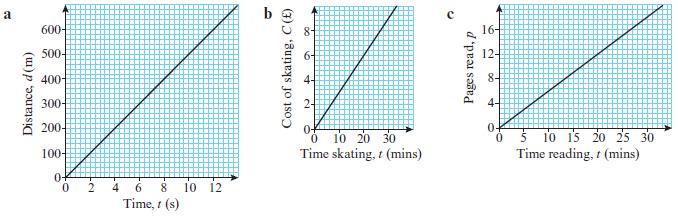
For each graphi. Calculate the gradient, k, of the lineii. Write a direct proportion equation connecting the two variables. a Distance, d (m) 600- 500- 400+ 300- 200+ 100+ 0- 0 2 4 6 8 10 12 Time, / (s) a Cost of skating, C (£) 8- + N 10 20 30 Time skating, t (mins) 16- Pages read, p £ ∞ 12- 10
The equation x2 + kx + (k + 3) = 0, where k is a constant, has different real roots.a. Show that k2 − 4k − 12 > 0.b. Find the set of possible values of k.
The functions f and g are defined as f(x) = 9 − x2 and g(x) = 14 − 6x, x ∈ ℝ.a. On the same set of axes, sketch the graphs of y = f(x) and y = g(x). Indicate clearly the coordinates of any points where the graphs intersect with each other or the coordinate axes.b. On your sketch, shade
a. Factorise completely x3 − 4x.b. Sketch the curve with equation y = x3 − 4x, showing the coordinates of the points where the curve crosses the x-axis.c. On a separate diagram, sketch the curve with equation y = (x − 1)3 − 4(x − 1) showing the coordinates of the points where the curve
Given that f(x) = 1/x, x ≠ 0,a. Sketch the graph of y = f(x) + 3 and state the equations of the asymptotes.b. Find the coordinates of the point where y = f(x) + 3 crosses a coordinate axis.
The quartic function t is defined as t(x) = (x2 − 5x + 2)(x2 − 5x + 4), x ∈ ℝ.a. Find the four roots of t(x), giving your answers to 3 significant figures where necessary.b. Sketch the graph of y = t(x), showing clearly the coordinates of all the points where the curve meets the axes.
The point (6, −8) lies on the graph of y = f(x). State the coordinates of the point to which P is transformed on the graph with equation:a. y = −f(x)b. y = f(x − 3)c. 2y = f(x)
The curve C1 has equation y = −a/x, where a is a positive constant.The curve C2 has equation y = (x − b)2, where b is a positive constant.a. Sketch C1 and C2 on the same set of axes. Label any points where either curve meets the coordinate axes, giving your coordinates in terms of a and
Find the distance between these pairs of points:a. (0, 1), (6, 9) b. (4, −6), (9, 6) c. (3, 1), (−1, 4)d. (3, 5), (4, 7) e. (0, −4), (5, 5) f. (−2, −7), (5, 1)
The point P(2, 1) lies on the graph with equation y = f(x).a. On the graph of y = f(ax), the point P is mapped to the point Q(4, 1). Determine the value of a.)b. Write down the coordinates of the point to which P maps under each transformationi. f(x – 4) ii. 3f(x) iii 1/2f(x) – 4
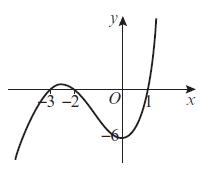
The graph of y = x3 + bx2 + cx + d is shown opposite, where b, c and d y are real constants.a. Find the values of b, c and d.b. Write down the coordinates of the point where the curve crosses the y-axis. УА 0 X
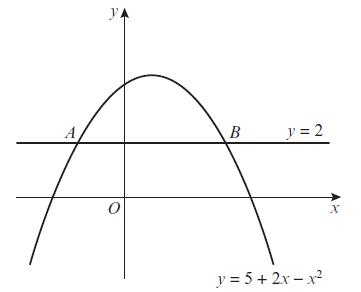
The diagram shows the curve with equation y = 5 + 2x − x2 and the line with equation y = 2.The curve and the line intersect at the points A and B. Find the x-coordinates of A and B. 0 В y = 2 y = 5 + 2x-x2 X
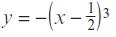
Sketch the following curves and indicate the coordinates of the points where the curves cross the axes:a. y = (x – 2)3 b. y = (2 – x)3 c. y = (x – 1)3 d. y = (x + 2)3e. y = –(x + 2)3 f. y = (x + 3)3 g. y = (x – 3)3 h. y = (1 – x)3i. y = – (x – 2)3j. y = -(x - 1)³
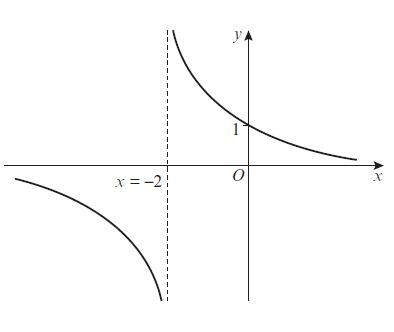
A sketch of the curve y = f(x) is shown in the diagram. The curve has a vertical asymptote with equation x = −2 and a horizontal asymptote with equation y = 0. The curve crosses the y-axis at (0, 1).a. Sketch, on separate diagrams, the graphs of:i. 2f(x) ii. f(2x) iii. f(x − 2)iv. f(x) −
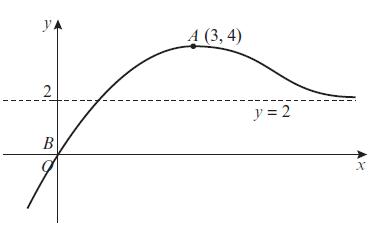
The diagram shows a sketch of the curve y = f(x). The point B(0, 0) lies on the curve and the point A(3, 4) is a maximum point. The line y = 2 is an asymptote. Sketch the following and in each case give the coordinates of the new positions of A and B and state the equation of the asymptote:a.
a. Sketch the curve y = x2 + 3x – 4.b. On the same axes, sketch the graph of 5y = x2 + 3x – 4.
a. Sketch the graph of y = f(x) where f(x) = x(x − 2)2.b. Sketch the curves with equations y = f(x) + 2 and y = f(x + 2).c. Find the coordinates of the points where the graph of y = f(x + 2) crosses the axes.
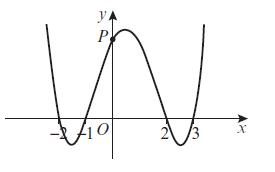
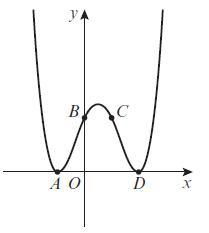
The graph of y = x4 + bx3 + cx2 + dx + e is shown opposite, where b, c, d and e are real constants.a. Find the coordinates of point P.b. Find the values of b, c, d and e. и YA P
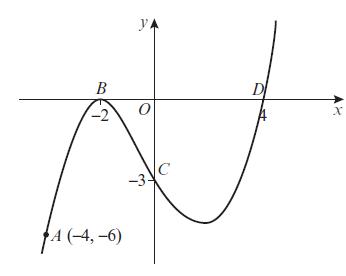
The curve with equation y = f(x) passes through the points A(−4, −6), B(−2, 0), C(0, −3) and D(4, 0) as shown in the diagram. Sketch the following and give the coordinates of the points A, B, C and D after each transformation.a. f(x − 2) b. f(x) + 6 c. f(2x)d. f(x + 4) e. f(x) + 3 f.
Use a separate diagram to sketch each pair of graphs. ay: = 2 x² 5 x² and y= 3 =and y = by: = - 3 x² c y= 2 x² and y = 6 x2
a. On the same axes sketch the curves given by y = 1/x and y = −x(x − 1)2.b. Explain how your sketch shows that there are no real solutions to the equation 1 + x2(x − 1)2 = 0.
Sketch the graph of y = (x + 5)(x – 4)(x2 + 5x + 14).
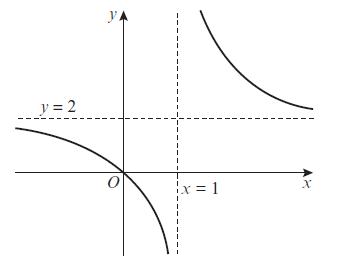
The curve y = f(x) passes through the origin and has horizontal asymptote y = 2 and vertical asymptote x = 1, as shown in the diagram. Sketch the following graphs. Give the equations of any asymptotes and give the coordinates of intersections with the axes after each transformation.a. f(x) + 2 b.
a. Expand and simplify (4 + √3)(4 − √3) .b. Express 26/4 + √3 in the form a + b√3, where a and b are integers.
a. Sketch the curve with equation y = x2(x – 3).b. On the same axes, sketch the curves with equations:i. y = (2x)2(2x – 3) ii. y = −x2(x – 3)
a. Sketch the graph of y = f(x) where f(x) = x2(1 − x).b. Sketch the curve with equation y = f(x + 1).c. By finding the equation f(x + 1) in terms of x, find the coordinates of the point in part b where the curve crosses the y-axis.
a. On the same axes sketch the curves given by y = (x + 1)3 and y = 3x(x − 1).b. Explain how your sketch shows that there is only one real solution to the equation x3 + 6x + 1 = 0.
a. Express √80 in the form a√5, where a is an integer.b. Express (4 − √5)2 in the form b + c√5, where b and c are integers.
Factorise the following equations and then sketch the curves:a. y = x3 + x2 – 2x b. y = x3 + 5x2 + 4x c. y = x3 + 2x2 + xd. y = 3x + 2x2 – x3 e. y = x3 – x2 f. y = x – x3g. y = 12x3 – 3x h. y = x3 – x2 – 2x i. y = x3 – 9xj. y = x3 – 9x2
a. Sketch the curve with equation y = f(x) where f(x) = (x − 2)(x + 2)x.b. Sketch the graphs of y = f(1/2 x), y = f(2x) and y = −f(x).
In each case:i. Sketch the two curves on the same axesii. State the number of points of intersectioniii. Write down a suitable equation which would give the x-coordinates of these points. a y = x², y = x(x² - 1) d y = x²(1-x), y = - 2 X g y = x(x-4), y = (x - 2)³ i y=-x³, y = -x(x + 2) 3 by =
a. Sketch the curve y = f(x) where f(x) = (x − 1)(x + 2).b. On separate diagrams sketch the graphs of i. y = f(x + 2) ii. y = f(x) + 2.c. Find the equations of the curves y = f(x + 2) and y = f(x) + 2, in terms of x, and use these equations to find the coordinates of the points where
Use a separate diagram to sketch each pair of graphs. a y = d y = 2 X 3 and y = and y = X 2 by = = and y = . - e y = 3 X and y = 2 X 8 X 4 c y=- and y = 2 X
a. On the same axes sketch the curves with equations y = 6/x and y = 1 + x.b. The curves intersect at the points A and B. Find the coordinates of A and B.c. The curve C with equation y = x2 + px + q, where p and q are integers, passes through A and B. Find the values of p and q.d. Add C to your
a. On the same axes sketch the curves given by y = x2(x − 3) and y = 2/xb. Explain how your sketch shows that there are only two real solutions to the equation x3(x − 3) = 2.
Sketch the following curves and indicate clearly the points of intersection with the axes:a. y = (x + 2)(x – 1)(x2 – 3x + 2) b. y = (x + 3)2(x2 – 5x + 6)c. y = (x – 4)2(x2 – 11x + 30)d. y = (x2 – 4x – 32)(x2 + 5x – 36)
Sketch the curves with the following equations:a. y = (x + 1)2(x – 1) b. y = (x + 2)(x – 1)2 c. y = (2 – x)(x + 1)2d. y = (x – 2)(x + 1)2 e. y = x2(x + 2) f. y = (x – 1)2xg. y = (1 – x)2(3 + x) h. y = (x – 1)2(3 – x) i. y = x2(2 – x)j. y = x2(x – 2)
a. Find the value of 1254/3.b. Simplify 24x2 ÷ 18 x4/3.
a. Sketch the curve with equation y = f(x) where f(x) = x2 − 4.b. Sketch the graphs of y = f(4x), 1/3 y = f(x), y = f(−x) and y = −f(x).
Apply the following transformations to the curves with equations y = f(x) where:i. f(x) = x2 ii. f(x) = x3 iii. f(x) = 1/xIn each case state the coordinates of points where the curves cross the axes and in iii state the equations of the asymptotes.a. f(x + 2) b. f(x) + 2 c. f(x
a. On the same axes sketch the graphs of y = x2(x − 2) and y = 2x − x2.b. By solving a suitable equation find the points of intersection of the two graphs.
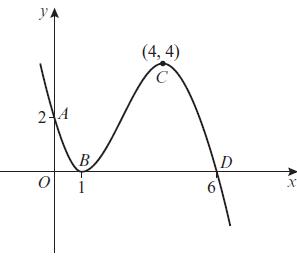
The following diagram shows a sketch of the curve with equation y = f(x). The points A(0, 2), B(1, 0), C(4, 4) and D(6, 0) lie on the curve.Sketch the following graphs and give the coordinates of the points, A, B, C and D after each transformation:a. f(x + 1) b. f(x) − 4 c. f(x + 4)d. f(2x) e.
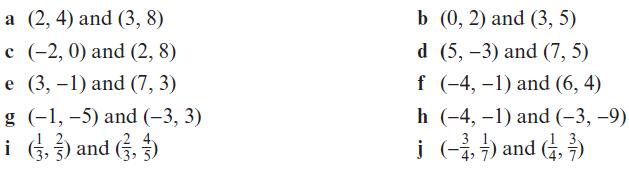
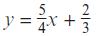
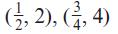
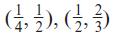
Find the equations of the lines that pass through these pairs of points: a (2, 4) and (3, 8) c (-2, 0) and (2,8) e (3,-1) and (7,3) g (-1,-5) and (-3, 3) i (,) and (3) b (0, 2) and (3, 5) d (5,-3) and (7,5) f (-4,-1) and (6,4) h (-4,-1) and (-3,-9) j (-3,-) and (3)
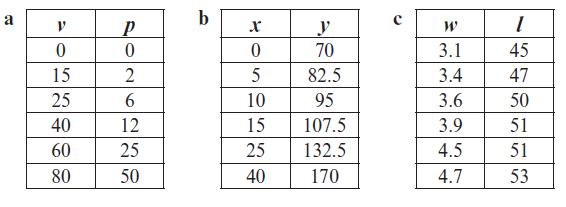
Draw a graph to determine whether a linear model would be appropriate for each set of data. AD V 0 15 25 40 60 80 P 0 2 6 12 25 50 b X y 0 70 5 82.5 10 95 15 107.5 25 132.5 40 170 W 3.1 3.4 3.6 3.9 4.5 4.7 I 45 47 50 51 51 53
Work out the gradients of these lines:a. y = −2x + 5 b. y = −x + 7 c. y = 4 + 3xd. y = 1/3x − 2 e. y = −2/3xf.g. 2x − 4y + 5 = 0 h. 10x − 5y + 1 = 0 i. −x + 2y − 4 = 0j. −3x + 6y + 7 = 0 k. 4x + 2y − 9 = 0 l. 9x + 6y + 2 = 0 + X + || y:
Sketch the following curves and indicate clearly the points of intersection with the axes:a. y = (x + 1)(x + 2)(x + 3)(x + 4) b. y = x(x – 1)(x + 3)(x – 2)c. y = x(x + 1)2(x + 2) d. y = (2x – 1)(x + 2)(x – 1)(x – 2)e. y = x2(4x + 1)(4x – 1) f. y = –(x – 4)2(x –
Work out the gradients of the lines joining these pairs of points:a. (4, 2), (6, 3) b. (−1, 3), (5, 4) c. (−4, 5), (1, 2)d. (2, −3), (6, 5) e. (−3, 4), (7, −6) f. (−12, 3), (−2, 8)g. (−2, −4), (10, 2)h.i.j. (−2.4, 9.6), (0, 0) k. (1.3, −2.2), (8.8, −4.7) l. (0, 5a),
Sketch the following curves and indicate clearly the points of intersection with the axes:a. y = (x – 3)(x – 2)(x + 1) b. y = (x – 1)(x + 2)(x + 3)c. y = (x + 1)(x + 2)(x + 3) d. y = (x + 1)(1 – x)(x + 3)e. y = (x – 2)(x – 3)(4 – x) f. y = x(x – 2)(x + 1)g. y = x(x +
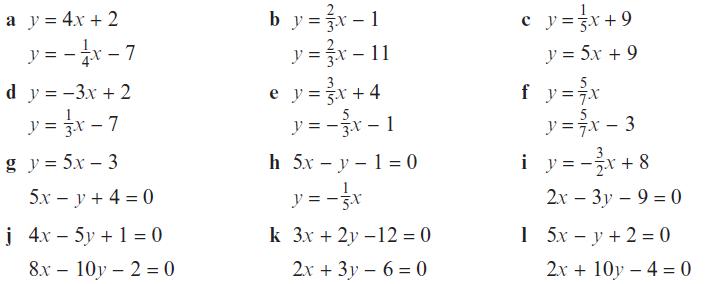
Work out whether these pairs of lines are parallel, perpendicular or neither: a y = 4x + 2 y=-x-7 dy=-3x + 2 y = x - 7 g y = 5x - 3 5x - y + 4 = 0 i 4x5y + 1 = 0 8x 10y 20 - by = 3x - 1 y = 3x - 11 ey=x+4 y=-x-1 h 5x-y-1=0 y=-x k 3x +2y-12 = 0 2x + 3y - 60 cy=x+9 y = 5x + 9 f_y=√x i y = √x -
a. Write down the value of 81/3.b. Find the value of 8−2/3.
Apply the following transformations to the curves with equations y = f(x) where:i. f(x) = x2 ii. f(x) = x3 iii. f(x) = 1/xIn each case show both f(x) and the transformation on the same diagram.a. f(2x) b. f(−x) c. f(1/2x) d. f(4x) e. f(1/4x)f. 2f(x) g.
A line is perpendicular to the line y = 6x − 9 and passes through the point (0, 1). Find an equation of the line.
The line r passes through the points (1, 4) and (6, 8) and the line s passes through the points (5, −3) and (20, 9). Show that the lines r and s are parallel.
Work out whether each pair of lines is parallel. a y = 5x - 2 15x3y + 9 = 0 b 7x + 14y - 1 = 0 y = x +9 c 4x3y8=0 3x - 4y - 80
The line y = −2x + 8 meets the y-axis at the point B. Find the equation of the line with gradient 2 that passes through the point B.
The points A and B have coordinates (k, 1) and (8, 2k − 1) respectively, where k is a constant. Given that the gradient of AB is 1/3a. Show that k = 2b. Find an equation for the line through A and B.
These lines cut the y-axis at (0, c). Work out the value of c in each case.a. y = −x + 4 b. y = 2x − 5 c. y = 1/2 x − 2/3d. y = −3x e. y = 6/7x + 7/5 f. y = 2 − 7xg. 3x − 4y + 8 = 0 h. 4x − 5y − 10 = 0 i. −2x + y − 9 = 0j. 7x + 4y + 12 = 0 k.
Consider the points A(−3, 5), B(−2, −2) and C (3, −7). Determine whether the line joining the points A and B is congruent to the line joining the points B and C.
The line y = 4x − 8 meets the x-axis at the point A. Find the equation of the line with gradient 3 that passes through the point A.
The straight line passing through the point P(2, 1) and the point Q(k, 11) has gradient −5/12a. Find the equation of the line in terms of x and y only.b. Determine the value of k.
Here are three numbers:Given that k is a positive integer, find:a. The mean of the three numbers.b. The range of the three numbers. 1-√k, 2+5√k and 2√/k
a. Sketch the graph of y = f(x) where f(x) = x(x − 4).b. Sketch the curves with equations y = f(x + 2) and y = f(x) + 4.c. Find the equations of the curves in part b in terms of x and hence find the coordinates of the points where the curves cross the axes.
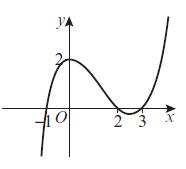
The graph of y = ax3 + bx2 + cx + d is shown opposite, where a, b, c and d are real constants. Find the values of a, b, c and d. YA |0| 23
f(x) = x2(x – 1)(x – 3).a. Sketch the graph of y = f(x).b. On the same axes, draw the line y = 2 – x.c. State the number of real solutions to the equation x2(x – 1)(x – 3) = 2 – x.d. Write down the coordinates of the point where the graph with equation y = f(x) + 2 crosses the y-axis.
a. Sketch the graph of y = x2(x – 2)2.b. On the same axes, sketch the graph of 3y = –x2(x – 2)2.
Given that y = 1/25x4, express each of the following in the form kxn, where k and n are constants.a. y−1b. 5y1/2
Given that f(x) = (x – 10)(x2 – 2x) + 12xa. Express f(x) in the form x(ax2 + bx + c) where a, b and c are real constants.b. Hence factorise f(x) completely.c. Sketch the graph of y = f(x) showing clearly the points where the graph intersects the axes.
a. On the same axes sketch the curves given by y = x2(x + a) and y = b/x where a and b are both positive constants.b. Using your sketch, state, giving a reason, the number of real solutions to the equation x4 + ax3 – b = 0.
The diagram shows a sketch of a curve with equation y = f(x).The points A(−1, 0), B(0, 2), C(1, 2) and D(2, 0) lie on the curve. Sketch the following graphs and give the coordinates of the points A, B, C and D after each transformation:a. y + 2 = f(x) b. 1/2 y = f(x)c. y − 3 = f(x) d. 3y =
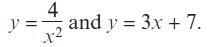
a. On the same set of axes sketch the graphs ofb. Write down the number of real solutions to the equation 4/x2 = 3x + 7.c. Show that you can rearrange the equation to give (x + 1)(x + 2)(3x – 2) = 0.d. Hence determine the exact coordinates of the points of intersection. 4 X2 and y = 3x + 7.
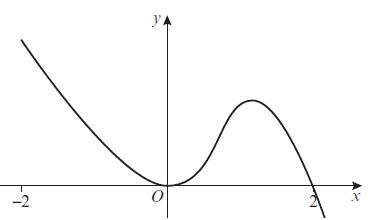
The figure shows a sketch of the curve with equation y = f(x). On separate axes sketch the curves with equations:a. y = f(– x)b. y = –f(x)Mark on each sketch the x-coordinate of any point, or points, where the curve touches or crosses the x-axis. -2 y X
a. Sketch the graph of y = f(x) where f(x) = x2(x – 1)(x – 2).b. Sketch the curves with equations y = f(x + 2) and y = f(x) – 1.
The point P(2, −3) lies on the curve with equation y = f(x).a. State the coordinates that point P is transformed to on the curve with equation y = f(2x).b. State the coordinates that point P is transformed to on the curve with equation y = 4f(x).
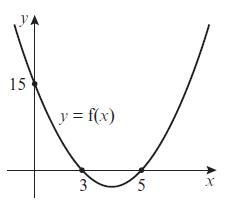
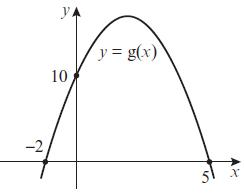
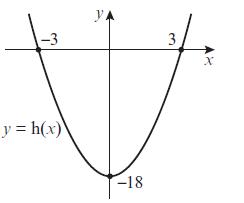
These sketches are graphs of quadratic functions of the form ax2 + bx + c. Find the values of a, b and c for each function.a.b.c.d. 15 y = f(x) 3 5 X
Factorise these expressions completely:a. 4x + 8 b. 6x − 24 c. 20x + 15d. 2x2 + 4 e. 4x2 + 20 f. 6x2 − 18xg. x2 − 7x h. 2x2 + 4x i. 3x2 − xj. 6x2 − 2x k. 10y2 − 5y l. 35x2 − 28xm. x2 + 2x n. 3y2 + 2y o. 4x2 + 12xp. 5y2 − 20y q.
Factorise:a. x2 + 4x b. 2x2 + 6x c. x2 + 11x + 24d. x2 + 8x + 12 e. x2 + 3x − 40 f. x2 − 8x + 12g. x2 + 5x + 6 h. x2 − 2x − 24 i. x2 − 3x − 10j. x2 + x − 20 k. 2x2 + 5x + 2 l. 3x2 + 10x − 8m. 5x2 − 16x + 3 n. 6x2 − 8x − 8o. 2x2 + 7x
Solve the following equations using factorisation:a. x2 + 3x + 2 = 0 b. x2 + 5x + 4 = 0 c. x2 + 7x + 10 = 0 d. x2 − x − 6 = 0e. x2 − 8x + 15 = 0 f. x2 − 9x + 20 = 0 g. x2 − 5x − 6 = 0 h. x2 − 4x − 12 = 0
Solve the following equations using the quadratic formula. Give your answers exactly, leaving them in surd form where necessary.a. x2 + 3x + 1 = 0 b. x2 − 3x − 2 = 0 c. x2 + 6x + 6 = 0 d. x2 − 5x − 2 = 0e. 3x2 + 10x − 2 = 0 f. 4x2 − 4x − 1 = 0 g. 4x2 − 7x =
Complete the square for the expressions:a. x2 + 4x b. x2 − 6x c. x2 − 16x d. x2 + x e. x2 − 14
Solve these quadratic equations by completing the square. Leave your answers in surd form.a. x2 + 6x + 1 = 0 b. x2 + 12x + 3 = 0 c. x2 + 4x − 2 = 0 d. x2 − 10x = 5
The function f(x) is defined by f(x) = x2 − 2x, x ∈ ℝ . Given that f(a) = 8, find two possible values for a.
Find the values of k for which x2 + 6x + k = 0 has two real solutions.
A car manufacturer uses a model to predict the fuel consumption, y miles per gallon (mpg), for a specific model of car travelling at a speed of x mph. y = −0.01x2 + 0.975x + 16, x > 0a. Use the model to find two speeds at which the car has a fuel consumption of 32.5 mpg.b. Rewrite y in the
For each of the equations below, choose a suitable method and find all of the solutions. Where necessary, give your answers to three significant figures.a. x2 + 8x + 12 = 0 b. x2 + 9x − 11 = 0c. x2 − 9x − 1 = 0 d. 2x2 + 5x + 2 = 0e. (2x + 8)2 = 100 f. 6x2 + 6 = 12xg. 2x2 − 11 = 7xh. x =
Sketch graphs of the following equations:a. y = x2 + 5x + 4 b. y = 2x2 + x − 3 c. y = 6 − 10x − 4x2 d. y = 15x − 2x2
Solve the following equations using factorisation:a. x2 = 4x b. x2 = 25x c. 3x2 = 6x d. 5x2 = 30xe. 2x2 + 7x + 3 = 0 f. 6x2 − 7x − 3 = 0 g. 6x2 − 5x − 6 = 0 h. 4x2 − 16x + 15 = 0
Solve the following equations using the quadratic formula. Give your answers to three significant figures.a. x2 + 4x + 2 = 0 b. x2 − 8x + 1 = 0 c. x2 + 11x − 9 = 0 d. x2 − 7x − 17 = 0e. 5x2 + 9x − 1 = 0 f. 2x2 − 3x − 18 = 0 g. 3x2 + 8 = 16x h. 2x2 +
Complete the square for the expressions:a. 2x2 + 16x b. 3x2 − 24x c. 5x2 + 20x d. 2x2 − 5x e. 8x − 2x2
Given that x ≠ 0, find the set of values of x for which: [>/ / | a 4/ e © 25> -1/2 X2 c/ +3>2 6 7 f +
Solve these quadratic equations by completing the square. Leave your answers in surd form.a. 2x2 + 6x − 3 = 0 b. 5x2 + 8x − 2 = 0 c. 4x2 − x − 8 = 0 d. 15 − 6x − 2x2 = 0
Find all of the roots of the following functions:a. f(x) = 10 − 15x b. g(x) = (x + 9)(x − 2) c. h(x) = x2 + 6x − 40d. j(x) = 144 − x2 e. k(x) = x(x + 5)(x + 7) f. m(x) = x3 + 5x2 − 24x
The graph of y = ax2 + bx + c has a minimum at (5, −3) and passes through (4, 0). Find the values of a, b and c.
Find the value of t for which 2x2 − 3x + t = 0 has exactly one solution.
A fertiliser company uses a model to determine how the amount of fertiliser used, f kilograms per hectare, affects the grain yield g, measured in tonnes per hectare. g = 6 + 0.03f − 0.00006f2a. According to the model, how much grain would each hectare yield without any fertiliser?b. One farmer
f(x) = x2 + 3x − 5 and g(x) = 4x + k, where k is a constant.a. Given that f(3) = g(3), find the value of k. (3 marks)b. Find the values of x for which f(x) = g(x).
Showing 900 - 1000
of 1136
1
2
3
4
5
6
7
8
9
10
11
12
Step by Step Answers

 Get 50% OFF
Claim Now
Get 50% OFF
Claim Now