New Semester
Started
Get
50% OFF
Study Help!
--h --m --s
Claim Now
Question Answers
Textbooks
Find textbooks, questions and answers
Oops, something went wrong!
Change your search query and then try again
S
Books
FREE
Study Help
Expert Questions
Accounting
General Management
Mathematics
Finance
Organizational Behaviour
Law
Physics
Operating System
Management Leadership
Sociology
Programming
Marketing
Database
Computer Network
Economics
Textbooks Solutions
Accounting
Managerial Accounting
Management Leadership
Cost Accounting
Statistics
Business Law
Corporate Finance
Finance
Economics
Auditing
Tutors
Online Tutors
Find a Tutor
Hire a Tutor
Become a Tutor
AI Tutor
AI Study Planner
NEW
Sell Books
Search
Search
Sign In
Register
study help
mathematics
edexcel as and a level mathematics
Edexcel AS And A Level Mathematics Pure Mathematics Year 1/AS 1st Edition Greg Attwood - Solutions
Find all the solutions, in the interval 0 ≤ x ≤ 360°, to the equation 8 sin2 x + 6 cos x – 9 = 0 giving each solution to one decimal place.
a. Sketch for 0 ≤ x ≤ 360° the graph of y = sin (x + 60°)b. Write down the exact coordinates of the points where the graph meets the coordinate axes.c. Solve, for 0 ≤ x ≤ 360°, the equation sin (x + 60°) = 0.55, giving your answers to 1 decimal place.
Solve the following equations for θ, in the interval 0 < θ < 360°:a. √3 sin θ = cos θ b. sin θ + cos θ = 0 c. 3 sin θ = 4 cos θd. 2 sin θ − 3 cos θ = 0 e. √2 sin θ = 2 cos θ f. √5 sin θ + √2 cos θ = 0
Given that θ is an acute angle, express in terms of sin θ:a. sin (−θ) b. sin (180° + θ) c. sin (360° − θ)d. sin (−(180° + θ)) e. sin (−180° + θ) f. sin (−360° + θ)g. sin (540° + θ) h. sin (720° − θ) i. sin (θ + 720°)
The line l1 has equation y = 3x − 6. The line l2 is perpendicular to l1 and passes through the point (6, 2).a. Find an equation for l2 in the form y = mx + c, where m and c are constants The lines l1 and l2 intersect at the point C.b. Use algebra to find the coordinates of C. The lines l1
Given that angle B is obtuse and tan B = +√21/2, find the exact value of: a. sin B b. cos B
Solve for θ, in the interval −180° ≤ θ ≤ 180°, the following equations.Give your answers to 3 significant figures where they are not exact.a. 5sin2 θ = 4cos2 θ b. tan θ = cos θ
Solve for 0 ≤ x ≤ 180° the equations:a. sin(x + 20°) = 1/2b. cos 2x = −0.8, giving your answers to 1 decimal place.
Solve the following equations for θ, in the interval 0 < θ < 360°:a. 7 sin θ = 5 b. 2 cos θ = −√2 c. 3 cos θ = −2 d. 4 sin θ = −3e. 7 tan θ = 1 f. 8 tan θ = 15 g. 3 tan θ = −11 h. 3 cos θ = √5
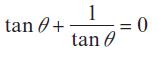
Without attempting to solve them, state how many solutions the following equations have in the interval 0 ≤ θ ≤ 360°. Give a brief reason for your answer.a. 2 sin θ = 3 b. sin θ = − cos θc. 2 sin θ + 3 cos θ + 6 = 0d. tan / + 1 tan = 0
a. Show that x2 + y2 − 6x + 2y − 10 = 0 can be written in the form (x − a)2 + (y − b)2 = r2, where a, b and r are numbers to be found.b. Hence write down the centre and radius of the circle with equation x2 + y2 − 6x + 2y − 10 = 0.
Given that cos θ = 3/4 and that θ is reflex, find the exact value of: a. sin θ b. tan θ
Find all the values of θ, to 1 decimal place, in the interval 0 < θ < 360° for which tan2 θ = 9.
a. Show that tan x = p ± √q where p and q are numbers to be found.b. Hence solve the equation tan2 x – 2tan x – 4 = 0 in the interval 0 ≤ x ≤ 540°.tan2 x – 2tan x – 4 = 0
a. Factorise 4xy − y2 + 4x − y.b. Solve the equation 4 sin θ cos θ − cos2 θ + 4 sin θ − cos θ = 0, in the interval 0 ≤ θ ≤ 360°.
The line 3x + y = 14 intersects the circle (x − 2)2 + (y − 3)2 = 5 at the points A and B.a. Find the coordinates of A and B.b. Determine the length of the chord AB.
In each of the following, eliminate θ to give an equation relating x and y:a. x = sin θ, y = cos θ b. x = sin θ, y = 2 cos θc. x = sin θ, y = cos2 θ d. x = sin θ, y = tan θe. x = sin θ + cos θ, y = cos θ − sin θ
a. Show that 4 sin2 x – 3 cos2 x = 2 can be written as 7 sin2 x = 5.b. Hence solve, for 0 < x < 360°, the equation 4 sin2 x – 3 cos2 x = 2. Give your answers to 1 decimal place.
a. Express 4 cos 3θ − sin (90° − 3θ) as a single trigonometric function.b. Hence solve 4 cos 3θ − sin (90° − 3θ) = 2 in the interval 0 ≤ θ ≤ 360°. Give your answers to 3 significant figures.
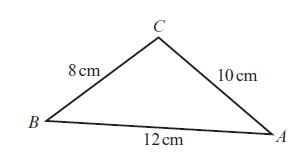
The diagram shows the triangle ABC with AB = 12 cm, BC = 8 cm and AC = 10 cm.a. Show that cos B = 9/16b. Hence find the exact value of sin B. B 8 cm 12 cm 10 cm
The line with equation y = 3x − 2 does not intersect the circle with centre (0, 0) and radius r. Find the range of possible values of r.
a. Show that the equation 2 sin2x + 5 cos2x = 1 can be written as 3 sin2x = 4.b. Use your result in part a to explain why the equation 2 sin2 x + 5 cos2 x = 1 has no solutions.
Given that 2 sin 2θ = cos 2θ:a. Show that tan 2θ = 0.5.b. Hence find the values of θ, to one decimal place, in the interval 0 ≤ θ ≤ 360° for which 2 sin 2θ = cos 2θ.
The circle C has centre (1, 5) and passes through the point P(4, −2). Find:a. An equation for the circle C.b. An equation for the tangent to the circle at P.
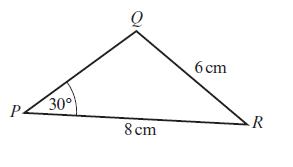
The diagram shows triangle PQR with PR = 8 cm, QR = 6 cm and angle QPR = 30°.a. Show that sin Q = 2/3b. Given that Q is obtuse, find the exact value of cos Q P. 30° 8 cm 6 cm R
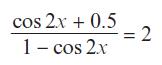
Find the values of x in the interval 0 ≤ x ≤ 270° which satisfy the equation cos 2x + 0.5 1 - cos 2x = 2 ||
Find all the values of θ in the interval 0 ≤ θ ≤ 360° for which:a. cos (θ + 75°) = 0.5,b. sin 2θ = 0.7, giving your answers to one decimal place.
The points A(2, 1), B(6, 5) and C(8, 3) lie on a circle.a. Show that ∠ABC = 90°.b. Deduce a geometrical property of the line segment AC.c. Hence find the equation of the circle.
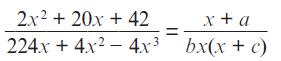
Where a, b and c are constants. Work outthe values of a, b and c. 2x² + 20x + 42 224x + 4x2 - 4x³ = x + a bx(x + c)
Find, in degrees, the values of θ in the interval 0 ≤ θ ≤ 360° for which 2cos2 θ – cos θ – 1 = sin2 θ Give your answers to 1 decimal place, where appropriate.
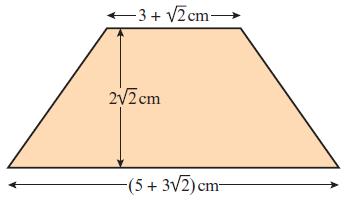
Find the area of this trapezium in cm2. Give your answer in the form a + b√2, where a and b are integers to be found. -3+ √2 cm- 2√2 cm -(5 + 3√2) cm-
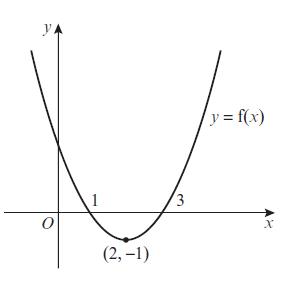
The diagram shows the graph of the quadratic function f(x). The graph meets the x-axis at (1, 0) and (3, 0) and the minimum point is (2, −1).a. Find the equation of the graph in the form y = ax2 + bx = cb. On separate axes, sketch the graphs ofi. y = f(x + 2) ii. y = (2x).c. On each graph label
The graph of y = f(x) where f(x) = 1/x is translated so that the asymptotes are at x = 4 and y = 0. Write down the equation for the transformed function in the form V 1 x + a
Given that p = 3 − 2√2 and q = 2 − √2,find the value ofGive your answer in the form m + n√2, where m and n are rational numbers to be found. p + q p-q
a. On the same axes sketch the curve y = x3 – 3x2 – 4x and the line y = 6x.b. Find the coordinates of the points of intersection.
The point P(4, –1) lies on the curve with equation y = f(x).a. State the coordinates that point P is transformed to on the curve with equation y = f(x – 2).b. State the coordinates that point P is transformed to on the curve with equation y = f(x) + 3.
f(x) = (x − 1)(x − 2)(x + 1).a. State the coordinates of the point at which the graph y = f(x) intersects the y-axis.b. The graph of y = af(x) intersects the y-axis at (0, −4). Find the value of a.c. The graph of y = f(x + b) passes through the origin. Find three possible values of b.
The point Q(−2, 8) lies on the curve with equation y = f(x).State the coordinates that point Q is transformed to on the curve with equation y = f(1/2 x).
Write these lines in the form ax + by + c = 0. a y = 4x + 3 d y = x-6 g y = 2x - jy = -x + 1/2 by = 3x - 2 e_y=x+2 h y=-3x + ² k y = x + ²/ c y = -6x + 7 f_y=zx i_y=-6x - 3 1 y = x + 1/ ان | درا
The cost of electricity, E, in pounds and the number of kilowatt hours, h, are shown in the table.a. Draw a graph of the data.b. Explain how you know a linear model would be appropriate.c. Deduce an equation in the form E = ah + b.d. Interpret the meaning of the coefficients a and b.e. Use the
a. On the same axes sketch the curve y = (x2 – 1)(x – 2) and the line y = 14x + 2.b. Find the coordinates of the points of intersection.
The point P(4, 3) lies on a curve y = f(x).a. State the coordinates of the point to which P is transformed on the curve with equation:i. y = f(3x) ii. 1/2 y = f(x) iii. y = f(x − 5) iv. −y = f(x) v. 2( y + 2) = f(x)b. P is transformed to point (2, 3). Write down two possible
a. Sketch the graph of y = (x – 2)(x – 3)2.b. The graph of y = (ax – 2)(ax – 3)2 passes through the point (1, 0).Find two possible values for a.
a. Factorise the expression x2 − 10x +16.b. Hence, or otherwise, solve the equation 82y − 10(8y) + 16 = 0.
The line joining (3, −5) to (6, a) has a gradient 4. Work out the value of a.
Consider the points P(11, −8), Q(4, −3) and R(7, 5). Show that the line segment joining the points P and Q is not congruent to the line joining the points Q and R.
Find the equation of the line l which passes through the points A(7, 2) and B(9, −8). Give your answer in the form ax + by + c = 0.
The line L1 has gradient 1/7 and passes through the point A(2, 2). The line L2 has gradient −1 and passes through the point B(4, 8). The lines L1 and L2 intersect at the point C.a. Find an equation for L1 and an equation for L2.b. Determine the coordinates of C.
The line y = 1/2x + 6 meets the x-axis at the point C. Find the equation of the line with gradient 2/3 that passes through the point C. Write your answer in the form ax + by + c = 0, where a, b and c are integers.
The coordinates of a quadrilateral ABCD are A(−6, 2), B(4, 8), C(6, 1) and D(−9, −8). Show that the quadrilateral is a trapezium.
A line is perpendicular to the line 3x + 8y − 11 = 0 and passes through the point (0, −8). Find an equation of the line.
A racing car accelerates from rest to 90 m/s in 10 seconds. The table shows the total distance travelled by the racing car in each of the first 10 seconds.a. Draw a graph of the data.b. Explain how you know a linear model would not be appropriate. time, t seconds distance, d
The line joining (5, b) to (8, 3) has gradient −3. Work out the value of b.
The distance between the points (−1, 13) and (x, 9) is √65. Find two possible values of x.
The line y = 6x − 18 meets the x-axis at the point P. Work out the coordinates of P.
The vertices of the triangle ABC have coordinates A(3, 5), B(−2, 0) and C(4, −1). Find the equations of the sides of the triangle.
a. Find an equation of the line l which passes through the points A(1, 0) and B(5, 6). The line m with equation 2x + 3y = 15 meets l at the point C.b. Determine the coordinates of C.
The line y = 1/4x + 2 meets the y-axis at the point B. The point C has coordinates (−5, 3). Find the gradient of the line joining the points B and C.
A line is parallel to the line y = 5x + 8 and its y-intercept is (0, 3).Write down the equation of the line.
Find an equation of the line that passes through the point (6, −2) and is perpendicular to the line y = 3x + 5.
The line joining (c, 4) to (7, 6) has gradient 3/4. Work out the value of c.
The distance between the points (2, y) and (5, 7) is 3√10. Find two possible values of y.
The line 3x + 2y = 0 meets the x-axis at the point R. Work out the coordinates of R.
A website designer charges a flat fee and then a daily rate in order to design new websites for companies. Company A’s new website takes 6 days and they are charged £7100. Company B’s new website take 13 days and they are charged £9550.a. Write an equation linking days, d and website cost, C
The straight line l passes through (a, 4) and (3a, 3). An equation of l is x + 6y + c = 0. Find the value of a and the value of c.
The line L passes through the points A(1, 3) and B(−19, −19). Find an equation of L in the form ax + by + c = 0. where a, b and c are integers.
The line that passes through the points (2, −5) and (−7, 4) meets the x-axis at the point P. Work out the coordinates of the point P.
A line is parallel to the line y = −2/5x + 1 and its y-intercept is (0, −4). Work out the equation of the line. Write your answer in the form ax + by + c = 0, where a, b and c are integers.
Find an equation of the line that passes through the point (−2, 5) and is perpendicular to the line y = 3x + 6.
The line joining (−1, 2d) to (1, 4) has gradient −1/4. Work out the value of d.
a. Show that the straight line l1 with equation y = 2x + 4 is parallel to the straight line l2 with equation 6x − 3y − 9 = 0.b. Find the equation of the straight line l 3 that is perpendicular to l1 and passes through the point (3, 10).c. Find the point of intersection of the lines l2 and l3.d.
The line 5x − 4y + 20 = 0 meets the y-axis at the point A and the x-axis at the point B. Work out the coordinates of A and B.
The straight line l1 passes through the points A and B with coordinats (2, 2) and (6, 0) respectively.a. Find an equation of l1. The straight line l2 passes through the point C with coordinate (−9, 0) and has gradient 1/4.b. Find an equation of l2.
The average August temperature in Exeter is 20°C or 68°F. The average January temperature in the same place is 9°C or 48.2°F.a. Write an equation linking Fahrenheit F and Celsius C in the form F = aC + b.b. Interpret the values of a and b.c. The highest temperature recorded in the UK was
The straight line l passes through (7a, 5) and (3a, 3). An equation of l is x + by − 12 = 0. Find the value of a and the value of b.
The line that passes through the points (−3, −5) and (4, 9) meets the y-axis at the point G. Work out the coordinates of the point G.
The line that passes through the pointsmeets the y-axis at the point J. Work out the coordinates of the point J. (3, 2) and (-11, 4)
A line is parallel to the line 3x + 6y + 11 = 0 and its intercept on the y-axis is (0, 7). Write down the equation of the line.
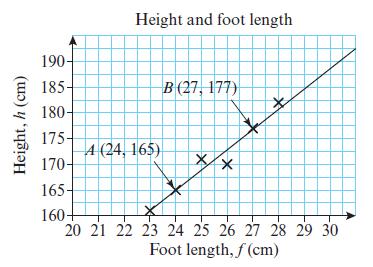
The scatter graph shows the height h and foot length f of 8 students. A line of best fit is drawn on the scatter graph.a. Explain why the data can be approximated to a linear model.b. Use points A and B on the scatter graph to write a linear equation in the form h = af + b.c. Calculate the expected
Find an equation of the line that passes through the point (3, 4) and is perpendicular to the line 4x − 6y + 7 = 0.
The line joining (−3, −2) to (2e, 5) has gradient 2. Work out the value of e.
A point P lies on the line with equation y = 4 − 3x. The point P is a distance √34 from the origin. Find the two possible positions of point P.
A line l passes through the points with coordinates (0, 5) and (6, 7).a. Find the gradient of the line.b. Find an equation of the line in the form ax + by + c = 0.
In 2004, in a city, there were 17,500 homes with internet connections. A service provider predicts that each year an additional 750 homes will get internet connections.a. Write a linear model for the number of homes n with internet connections t years after 2004.b. Write down one assumption made by
The straight line l passes through A(1, 3 √3) and B(2 + √3, 3 + 4√3). Show that l meets the x-axis at the point C(−2, 0).
A line is parallel to the line 2x − 3y − 1 = 0 and it passes through the point (0, 0). Write down the equation of the line.
Find an equation of the line that passes through the point (5, −5) and is perpendicular to the line y = 2/3x + 5. Write your answer in the form ax + by + c = 0, where a, b and c are integers.
The line joining (7, 2) to ( f, 3f) has gradient 4. Work out the value of f.
The vertices of a triangle are A(2, 7), B(5, −6) and C(8, −6).a. Show that the triangle is a scalene triangle.b. Find the area of the triangle ABC.
A line l cuts the x-axis at (5, 0) and the y-axis at (0, 2).a. Find the gradient of the line.b. Find an equation of the line in the form ax + by + c = 0.
The points A and B have coordinates (−4, 6) and (2, 8) respectively. A line p is drawn through B perpendicular to AB to meet the y-axis at the point C.a. Find an equation of the line p.b. Determine the coordinates of C.
The lines y = x and y = 2x − 5 intersect at the point A. Find the equation of the line with gradient 2/5 that passes through the point A.
Find an equation of the line that passes through the point (−2, 7) and is parallel to the line y = 4x + 1. Write your answer in the form ax + by + c = 0.
Find an equation of the line that passes through the point (−2, −3) and is perpendicular to the line y = − 4/7x + 5. Write your answer in the form ax + by + c = 0, where a, b and c are integers.
The line joining (3, −4) to (−g, 2g) has gradient −3. Work out the value of g.
The straight line l1 has equation y = 7x − 3. The straight line l2 has equation 4x + 3y − 41 = 0. The lines intersect at the point A.a. Work out the coordinates of A. The straight line l2 crosses the x-axis at the point B.b. Work out the coordinates of B.c. Work out the area of triangle
Show that the line with equation ax + by + c = 0 has gradient −a/b and cuts the y-axis at −c/b.
The price P of a good and the quantity Q of a good are linked. The demand for a new pair of trainers can be modelled using the equation P = −3/4Q + 35. The supply of the trainers can be modelled using the equation P = 2/3Q + 1.a. Draw a sketch showing the demand and supply lines
The line l has equation 2x − y − 1 = 0. The line m passes through the point A(0, 4) and is perpendicular to the line l.a. Find an equation of m.b. Show that the lines l and m intersect at the point P(2, 3). The line n passes through the point B(3, 0) and is parallel to the line m.c. Find the
The lines y = 4x − 10 and y = x − 1 intersect at the point T. Find the equation of the line with gradient −2/3 that passes through the point T. Write your answer in the form ax + by + c = 0, where a, b and c are integers.
Showing 600 - 700
of 1136
1
2
3
4
5
6
7
8
9
10
11
12
Step by Step Answers

 Get 50% OFF
Claim Now
Get 50% OFF
Claim Now