New Semester
Started
Get
50% OFF
Study Help!
--h --m --s
Claim Now
Question Answers
Textbooks
Find textbooks, questions and answers
Oops, something went wrong!
Change your search query and then try again
S
Books
FREE
Study Help
Expert Questions
Accounting
General Management
Mathematics
Finance
Organizational Behaviour
Law
Physics
Operating System
Management Leadership
Sociology
Programming
Marketing
Database
Computer Network
Economics
Textbooks Solutions
Accounting
Managerial Accounting
Management Leadership
Cost Accounting
Statistics
Business Law
Corporate Finance
Finance
Economics
Auditing
Tutors
Online Tutors
Find a Tutor
Hire a Tutor
Become a Tutor
AI Tutor
AI Study Planner
NEW
Sell Books
Search
Search
Sign In
Register
study help
mathematics
edexcel as and a level mathematics
Edexcel AS And A Level Mathematics Pure Mathematics Year 1/AS 1st Edition Greg Attwood - Solutions
The line l passes through the points (−3, 0) and (3, −2) and the line n passes through the points (1, 8) and (−1, 2). Show that the lines l and n are perpendicular.
Show that the points A(2, 3), B(4, 4) and C(10,7) can be joined by a straight line.
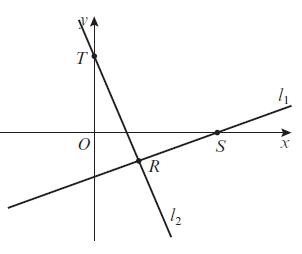
The points R(5, −2) and S(9, 0) lie on the straight line l1 as shown.a. Work out an equation for straight line l1. The straight line l2 is perpendicular to l1 and passes through the point R.b. Work out an equation for straight line l2.c. Write down the coordinates of T.d. Work out the lengths
The straight line l1 has equation 4x − 5y − 10 = 0 and intersects the x-axis at point A.The straight line l2 has equation 4x − 2y + 20 = 0 and intersects the x-axis at the point B.a. Work out the coordinates of A.b. Work out the coordinates of B. The straight lines l1 and l2 intersect at the
The line l with gradient 3 and y-intercept (0, 5) has the equation ax − 2y + c = 0. Find the values of a and c.
The line l1 passes through the points A and B with coordinates (0, −2) and (6, 7) respectively.The line l2 has equation x + y = 8 and cuts the y-axis at the point C.The line l1 and l2 intersect at D.Find the area of triangle ACD.
The line p has gradient 2/3 and passes through the point (6, −12). The line q has gradient −1 and passes through the point (5, 5). The line p meets the y-axis at A and the line q meets the x-axis at B. Work out the gradient of the line joining the points A and B.
The vertices of a quadrilateral ABCD have coordinates A(−1, 5), B(7, 1), C(5, −3) and D(−3, 1). Show that the quadrilateral is a rectangle.
Show that the points A(−2a, 5a), B(0, 4a) and points C(6a, a) are collinear.
The straight line l passes through (0, 6) and has gradient −2. It intersects the line with equation 5x − 8y − 15 = 0 at point P. Find the coordinates of P.
A line l1 has equation 5x + 11y − 7 = 0 and crosses the x-axis at A. The line l2 is perpendicular to l1 and passes through A.a. Find the coordinates of the point A.b. Find the equation of the line l2. Write your answer in the form ax + by + c = 0.
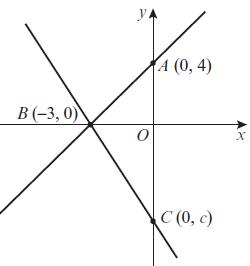
The points A and C lie on the y-axis and the point B lies on the x-axis as shown in the diagram.The line through points A and B is perpendicular to the line through points B and C. Find the value of c. B (-3,0) YA 0 A (0,4) C (0, c) X
The points A and B have coordinates (2, 16) and (12, −4) respectively. A straight line l1 passes through A and B.a. Find an equation for l1 in the form ax + by = c. The line l2 passes through the point C with coordinates (−1, 1) and has gradient 1/3b. Find an equation for l2.
The line y = −2x + 6 meets the x-axis at the point P. The line y = 3/2x − 4 meets the y-axis at the point Q. Find the equation of the line joining the points P and Q.
The straight line l1 passes through the point (−4, 14) and has gradient − 1/4a. Find an equation for l1 in the form ax + by + c = 0, where a, b and c are integers.b. Write down the coordinates of A, the point where straight line l1 crosses the y-axis. The straight line l2 passes through the
The straight line l1 with equation y = 3x − 7 intersects the straight line l2 with equation ax + 4y − 17 = 0 at the point P(−3, b).a. Find the value of b.b. Find the value of a.
The points A(−1, −2), B(7, 2) and C(k, 4), where k is a constant, are the vertices of △ABC. Angle ABC is a right angle.a. Find the gradient of AB.b. Calculate the value of k.c. Find an equation of the straight line passing through B and C. Give your answer in the form ax + by + c = 0, where
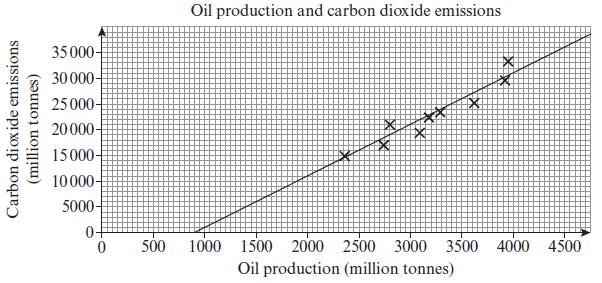
The scatter graph shows the oil production P and carbon dioxide emissions C for various years since 1970. A line of best fit has been added to the scatter graph.a. Use two points on the line to calculate its gradient.b. Formulate a linear model linking oil production P and carbon dioxide emissions
The line y = 3x − 5 meets the x-axis at the point M. The line y = −2/3x + 2/3 meets the y-axis at the point N. Find the equation of the line joining the points M and N. Write your answer in the form ax + by + c = 0, where a, b and c are integers.
Find the midpoint of the line segment joining each pair of points: a (4,2), (6, 8) d (-6, 4), (6,-4) g (6a, 4b), (2a, -4b) j (4/2, 1) (2√/2, 7) b (0, 6), (12, 2) e (7,-4), (-3, 6) h (-4u, 0), (3u, -2v) k (√2-√3, 3√2 + 4√3), (3√2+√3, -√2 + 2√3) c (2, 2), (-4, 6) f i (-5, -5), (-11,
a. Find an equation of the straight line passing through the points with coordinates (−1, 5) and (4, −2), giving your answer in the form ax + by + c = 0, where a, b and c are integers.The line crosses the x-axis at the point A and the y-axis at the point B, and O is the origin.b. Find the area
The line y = 2x − 10 meets the x-axis at the point A. The line y = −2x + 4 meets the y-axis at the point B. Find the equation of the line joining the points A and B.
The straight line l1 has equation 4y + x = 0. The straight line l2 has equation y = 2x − 3.a. On the same axes, sketch the graphs of l1 and l2. Show clearly the coordinates of all points at which the graphs meet the coordinate axes. The lines l1 and l2 intersect at the point A.b. Calculate, as
The line y = 4x + 5 meets the y-axis at the point C. The line y = −3x − 15 meets the x-axis at the point D. Find the equation of the line joining the points C and D. Write your answer in the form ax + by + c = 0, where a, b and c are integers.
The points A and B have coordinates (4, 6) and (12, 2) respectively. The straight line l1 passes through A and B.a. Find an equation for l1 in the form ax + by + c = 0, where a, b and c are integers. The straight line l2 passes through the origin and has gradient −2/3.b. Write down an equation
The lines y = x − 5 and y = 3x − 13 intersect at the point S. The point T has coordinates (−4, 2). Find the equation of the line that passes through the points S and T.
a. Use the distance formula to find the distance between (4a, a) and (−3a, 2a). Hence find the distance between the following pairs of points:b. (4, 1) and (−3, 2) c. (12, 3) and (−9, 6) d. (−20, −5) and (15, −10)
The lines y = −2x + 1 and y = x + 7 intersect at the point L. The point M has coordinates (−3, 1). Find the equation of the line that passes through the points L and M.
A is the point (−1, 5). Let (x, y) be any point on the line y = 3x.a. Write an equation in terms of x for the distance between (x, y) and A(−1, 5).b. Find the coordinates of the two points, B and C, on the line y = 3x which are a distance of √74 from (−1, 5).c. Find the equation of the line
The points U(−2, 8), V(7, 7) and W(−3, −1) lie on a circle.a. Show that triangle UVW has a right angle.b. Find the coordinates of the centre of the circle.c. Write down an equation for the circle.
The line segment QR is a diameter of the circle centre C, where Q and R have coordinates (11, 12) and (−5, 0) respectively. The point P has coordinates (13, 6).a. Find the coordinates of C.b. Find the radius of the circle.c. Write down the equation of the circle.d. Show that P lies on the circle.
Find the perpendicular bisector of the line segment joining each pair of points:a. A(−5, 8) and B(7, 2) b. C(−4, 7) and D(2, 25) c. E(3, −3) and F(13, −7)d. P(−4, 7) and Q(−4, −1) e. S(4, 11) and T(−5, −1) f. X(13, 11) and Y(5, 11)
Write down the equation of each circle:a. Centre (3, 2), radius 4 b. Centre (−4, 5), radius 6 c. Centre (5, −6), radius 2√3d. Centre (2a, 7a), radius 5a e. Centre (−2 √2, −3√2), radius 1
Find the coordinates of the points where the circle (x − 1)2 + (y − 3)2 = 45 meets the x-axis.
The line x + 3y − 11 = 0 touches the circle (x + 1)2 + (y + 6)2 = r2 at (2, 3).a. Find the radius of the circle.b. Show that the radius at (2, 3) is perpendicular to the line.
The point P(1, −2) lies on the circle centre (4, 6).a. Find the equation of the circle.b. Find the equation of the tangent to the circle at P.
The points A(2, 6), B(5, 7) and C(8, −2) lie on a circle.a. Show that AC is a diameter of the circle.b. Write down an equation for the circle.c. Find the area of the triangle ABC.
Show that (0, 0) lies inside the circle (x − 5)2 + (y + 2)2 = 30.
The line segment AB has endpoints A(−2, 5) and B(a, b). The midpoint of AB is M(4, 3). Find the values of a and b.
The line FG is a diameter of the circle centre C, where F and G are (−2, 5) and (2, 9) respectively.The line l passes through C and is perpendicular to FG. Find the equation of l.
Write down the coordinates of the centre and the radius of each circle:a. (x + 5)2 + (y − 4)2 = 92 b. (x − 7)2 + (y − 1)2 = 16 c. (x + 4)2 + y2 = 25d. (x + 4a)2 + (y + a)2 = 144a2 e. (x − 3 √5)2 + (y + √5)2 = 27
Find the coordinates of the points where the circle (x − 2)2 + (y + 3)2 = 29 meets the y-axis.
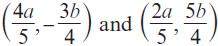
The line segment RS is a diameter of a circle, where R and S arerespectively. Find the coordinates of the centre of the circle. -3b) and (24 4a 5' 4 2a 5b 5' 4
The points A and B with coordinates (−1, −9) and (7, −5) lie on the circle C with equation (x − 1)2 + (y + 3)2 = 40.a. Find the equation of the perpendicular bisector of the line segment AB.b. Show that the perpendicular of bisector AB passes through the centre of the circle C.
The points A(−3, 19), B(9, 11) and C(−15, 1) lie on the circumference of a circle.a. Find the equation of the perpendicular bisector ofi. AB ii. ACb. Find the coordinates of the centre of the circle.c. Write down an equation for the circle.
The circle C has equation x2 + 3x + y2 + 6y = 3x − 2y − 7.a. Find the centre and radius of the circle.b. Find the points of intersection of the circle and the y-axis.c. Show that the circle does not intersect the x-axis.
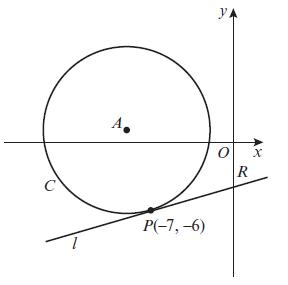
The circle C has equation x2 + 18x + y2 − 2y + 29 = 0.a. Verify the point P(−7, −6) lies on C.b. Find an equation for the tangent to C at the point P, giving your answer in the form y = mx + b.c. Find the coordinates of R, the point of intersection of the tangent and the y-axis.d. Find the
The line segment PQ is a diameter of a circle, where P and Q are (−4, 6) and (7, 8) respectively. Find the coordinates of the centre of the circle.
The line JK is a diameter of the circle centre P, where J and K are (0, −3) and (4, −5) respectively. The line l passes through P and is perpendicular to JK. Find the equation of l. Write your answer in the form ax + by + c = 0, where a, b and c are integers.
In each case, show that the circle passes through the given point:a. (x − 2)2 + (y − 5)2 = 13, point (4, 8) b. (x + 7)2 + (y − 2)2 = 65, point (0, −2)c. x2 + y2 = 252, point (7, −24) d. (x − 2a)2 + (y + 5a)2 = 20a2, point (6a, −3a)e. (x − 3 √5)2 + (y − √5)2 =
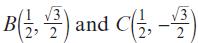
The points A(−1, 0),are the vertices of a triangle.a. Show that the circle x2 + y2 = 1 passes through the vertices of the triangle.b. Show that △ABC is equilateral. B(1, 2) and C(1, -1423)
The line y = x + 4 meets the circle (x − 3)2 + (y − 5)2 = 34 at A and B. Find the coordinates of A and B.
The points P and Q with coordinates (3, 1) and (5, −3) lie on the circle C with equation x2 − 4x + y2 + 4y = 2.a. Find the equation of the perpendicular bisector of the line segment PQ.b. Show that the perpendicular bisector of PQ passes through the centre of the circle C.
The points P(−11, 8), Q(−6, −7) and R(4, −7) lie on the circumference of a circle.a. Find the equation of the perpendicular bisector ofi. PQ ii. QRb. Find an equation for the circle.
The centres of the circles (x − 8)2 + (y − 8)2 = 117 and (x + 1)2 + (y − 3)2 = 106 are P and Q respectively.a. Show that P lies on (x + 1)2 + (y − 3)2 = 106.b. Find the length of PQ.
Points A, B, C and D have coordinates A(−4, −9), B(6, −3), C(11, 5) and D(−1, 9).a. Find the equation of the perpendicular bisector of line segment AB.b. Find the equation of the perpendicular bisector of line segment CD.c. Find the coordinates of the point of intersection of the two
The point (4, −2) lies on the circle centre (8, 1). Find the equation of the circle.
Find the coordinates of the points where the line x + y + 5 = 0 meets the circle x2 + 6x + y2 + 10y − 31 = 0.
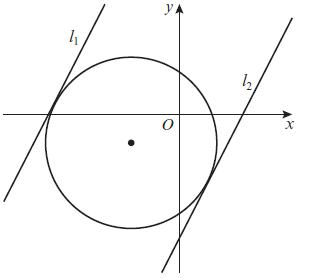
The circle C has equation (x + 5)2 + (y + 3)2 = 80. The line l is a tangent to the circle and has gradient 2. Find two possible equations for l giving your answers in the form y = mx + c. X 0 YA 1 4₁
The points R(−2, 1), S(4, 3) and T(10, −5) lie on the circumference of a circle C. Find an equation for the circle.
The line segment AB is a diameter of a circle, where A and B are (−3, −4) and (6, 10) respectively.a. Find the coordinates of the centre of the circle.b. Show the centre of the circle lies on the line y = 2x.
Point X has coordinates (7, −2) and point Y has coordinates (4, q). The perpendicular bisector of XY has equation y = 4x + b. Find the value of q and the value of b.
The line PQ is the diameter of the circle, where P and Q are (5, 6) and (−2, 2) respectively. Find the equation of the circle.
Show that the line x − y − 10 = 0 does not meet the circle x2 − 4x + y2 = 21.
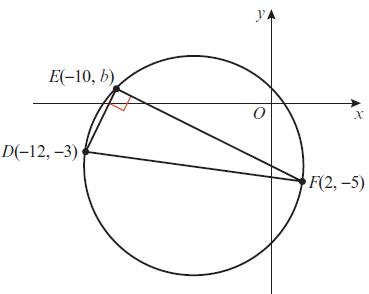
The points D(−12, −3), E(−10, b) and F(2, −5) lie on the circle C as shown in the diagram. Given that ∠ DEF = 90° and b > 0a. Show that b = 1b. Find an equation for C. E(-10, b) D(-12, -3) X F(2,-5)
The tangent to the circle (x + 4)2 + (y − 1)2 = 242 at (7, −10) meets the y-axis at S and the x-axis at T.a. Find the coordinates of S and T.b. Hence, find the area of △OST, where O is the origin.
Consider the points A(3, 15), B(−13, 3), C(−7, −5) and D(8, 0).a. Show that ABC is a right-angled triangle.b. Find the equation of the circumcircle.c. Hence show that A, B, C and D all lie on the circumference of this circle.
A circle with equation (x − k)2 + (y − 3k)2 = 13 passes through the point (3, 0).a. Find two possible values of k. (6 marks)b. Given that k > 0, write down the equation of the circle
The line segment JK is a diameter of a circle, where J and K are (3/4, 4/3) and (−1/2, 2) respectively. The centre of the circle lies on the line segment with equation y = 8x + b. Find the value of b.
The point (1, −3) lies on the circle (x − 3)2 + (y + 4)2 = r2. Find the value of r.
a. Show that the line x + y = 11 meets the circle with equation x2 + (y − 3)2 = 32 at only one point.b. Find the coordinates of the point of intersection.
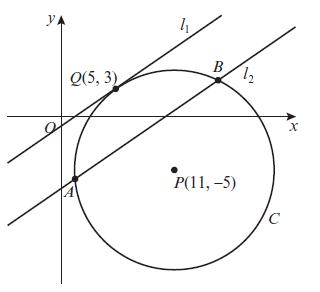
The circle C has centre P(11, −5) and passes through the point Q(5, 3).a. Find an equation for C. The line l1 is a tangent to C at the point Q.b. Find an equation for l1. The line l2 is parallel to l1 and passes through the midpoint of PQ. Given that l2 intersects C at A and Bc. Find the
The points A(−1, 9), B(6, 10), C(7, 3) and D(0, 2) lie on a circle.a. Show that ABCD is a square.b. Find the area of ABCD.c. Find the centre of the circle.
The line with 3x − y − 9 = 0 does not intersect the circle with equation x2 + px + y2 + 4y = 20. Show that 42 − √10 < p < 42 + 10√10.
The line segment AB is a diameter of a circle, where A and B are (0, −2) and (6, −5) respectively. Show that the centre of the circle lies on the line x − 2y −10 = 0.
The points P(2, 2), Q(2 + √3, 5) and R(2 − √3 , 5) lie on the circle (x − 2)2 + ( y − 4)2 = r2.a. Find the value of r.b. Show that △PQR is equilateral.
The line y = 2x − 2 meets the circle (x − 2)2 + (y − 2)2 = 20 at A and B.a. Find the coordinates of A and B.b. Show that AB is a diameter of the circle.
The line with equation 2x + y − 5 = 0 is a tangent to the circle with equation (x − 3)2 + (y − p)2 = 5a. Find the two possible values of p.b. Write down the coordinates of the centre of the circle in each case.
The line y = 2x − 8 meets the coordinate axes at A and B. The line segment AB is a diameter of the circle. Find the equation of the circle.
The line segment FG is a diameter of the circle centre (6, 1). Given F is (2, −3), find the coordinates of G.
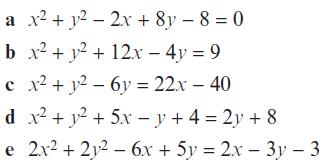
Find the centre and radius of the circle with each of the following equations. a x² + y² - 2x + 8y - 8 = 0 b x² + y² + 12x - 4y = 9 cx² + y²-6y= 22x - 40 d x² + y² + 5x -y + 4 = 2y + 8 e 2x² + 2y² - 6x + 5y = 2x - 3y - 3
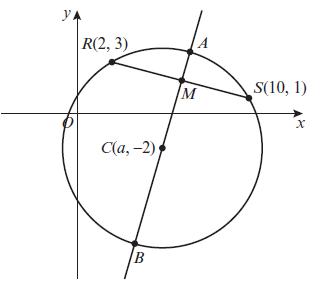
The points R and S lie on a circle with centre C(a, −2), as shown in the diagram. The point R has coordinates (2, 3) and the point S has coordinates (10, 1). M is the midpoint of the line segment RS. The line l passes through M and C.a. Find an equation for l.b. Find the value of a.c. Find the
a. Show that x2 + y2 − 4x − 11 = 0 can be written in the form (x − a)2 + y2 = r2, where a and r are numbers to be found.b. Hence write down the centre and radius of the circle with equation x2 + y2 − 4x − 11 = 0
The line x + y = a meets the circle (x − p)2 + (y − 6)2 = 20 at (3, 10), where a and p are constants.a. Work out the value of a.b. Work out the two possible values of p.
The circle centre (8, 10) meets the x-axis at (4, 0) and (a, 0).a. Find the radius of the circle.b. Find the value of a.
A circle has equation x2 + 2x + y2 − 24y − 24 = 0a. Find the centre and radius of the circle.b. The points A(−13, 17) and B(11, 7) both lie on the circumference of the circle. Show that AB is a diameter of the circle.c. The point C lies on the negative x-axis and the angle ACB = 90°. Find
The line segment CD is a diameter of the circle centre (−2a, 5a). Given D has coordinates (3a, −7a), find the coordinates of C.
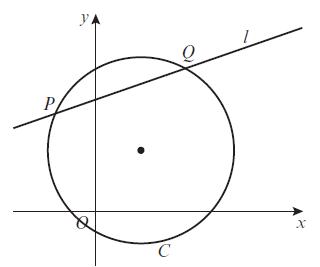
The circle C has equation x2 − 4x + y2 − 6y = 7. The line l with equation x − 3y + 17 = 0 intersects the circle at the points P and Q.a. Find the coordinates of the point P and the point Q.b. Find the equation of the tangent at the point P and the point Q.c. Find the equation of the
a. Show that x2 + y2 − 10x + 4y − 20 = 0 can be written in the form (x − a)2 + (y − b)2 = r2, where a, b and r are numbers to be found.b. Hence write down the centre and radius of the circle with equation x2 + y2 − 10x + 4y − 20 = 0.
The circle with equation (x − 4)2 + (y + 7)2 = 50 meets the straight line with equation x − y − 5 = 0 at points A and B.a. Find the coordinates of the points A and B.b. Find the equation of the perpendicular bisector of line segment AB.c. Show that the perpendicular bisector of AB passes
The circle (x − 5)2 + y2 = 36 meets the x-axis at P and Q. Find the coordinates of P and Q.
The points M(3, p) and N(q, 4) lie on the circle centre (5, 6). The line segment MN is a diameter of the circle.Find the values of p and q.
The line with equation y = kx intersects the circle with equation x2 − 10x + y2 − 12y + 57 = 0 at two distinct points. Find a range of possible values of k. Round your answer to 2 decimal places.a. Show that 21k2 − 60k + 32 < 0.b. Hence determine the range of possible values for k.
The circle (x + 4)2 + (y − 7)2 = 121 meets the y-axis at (0, m) and (0, n).Find the values of m and n.
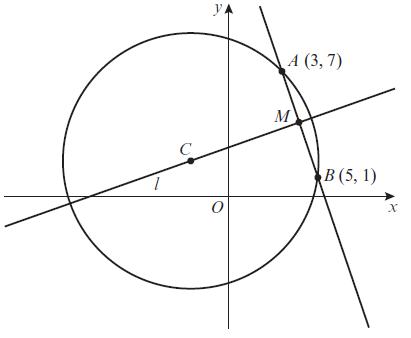
The points A and B lie on a circle with centre C, as shown in the diagram.The point A has coordinates (3, 7) and the point B has coordinates (5, 1). M is the midpoint of the line segment AB.The line l passes through the points M and C.a. Find an equation for l. Given that the x-coordinate of C is
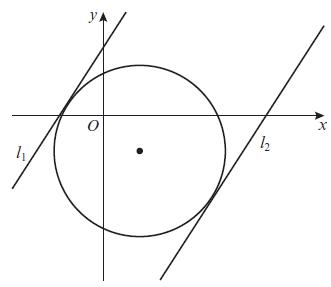
The circle C has equation (x − 3)2 + (y + 3)2 = 52. The baselines l1 and l2 are tangents to the circle and have gradient 3/2.a. Find the points of intersection, P and Q, of the tangents and the circle.b. Find the equations of lines l1 and l2, giving your answers in the form ax + by + c = 0.
The points V(−4, 2a) and W(3b, −4) lie on the circle centre (b, 2a). The line segment VW is a diameter of the circle. Find the values of a and b.
A circle C has equation x2 + y2 + 12x + 2y = k, where k is a constant.a. Find the coordinates of the centre of C.b. State the range of possible values of k.
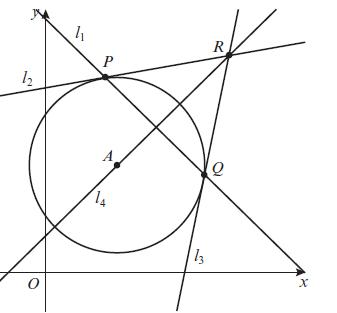
The circle C has a centre at (6, 9) and a radius of √50.The line l1 with equation x + y − 21 = 0 intersects the circle at the points P and Q.a. Find the coordinates of the point P and the point Q.b. Find the equations of l2 and l3, the tangents at the points P and Q respectively.c. Find the
The line with equation y = 4x − 1 does not intersect the circle with equation x2 + 2x + y2 = k. Find the range of possible values of k.
Showing 700 - 800
of 1136
1
2
3
4
5
6
7
8
9
10
11
12
Step by Step Answers

 Get 50% OFF
Claim Now
Get 50% OFF
Claim Now