New Semester
Started
Get
50% OFF
Study Help!
--h --m --s
Claim Now
Question Answers
Textbooks
Find textbooks, questions and answers
Oops, something went wrong!
Change your search query and then try again
S
Books
FREE
Study Help
Expert Questions
Accounting
General Management
Mathematics
Finance
Organizational Behaviour
Law
Physics
Operating System
Management Leadership
Sociology
Programming
Marketing
Database
Computer Network
Economics
Textbooks Solutions
Accounting
Managerial Accounting
Management Leadership
Cost Accounting
Statistics
Business Law
Corporate Finance
Finance
Economics
Auditing
Tutors
Online Tutors
Find a Tutor
Hire a Tutor
Become a Tutor
AI Tutor
AI Study Planner
NEW
Sell Books
Search
Search
Sign In
Register
study help
mathematics
mathematics physical chemistry
Mathematics for Physical Chemistry 4th Edition Robert G. Mortimer - Solutions
Find the Fourier transform of the function f(x) = e−|t|. Since this is an even function, you can use the one-sided cosine transform.
Show that L{t cos (kt)} = (s2 − k2)/(s2 + k2)2.
Find theLaplace transform of the function f(t) = eat where a is a constant.
Find the Laplace transform of cos2 (at).
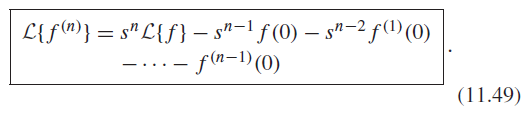
Derive the version of Eq. (11.49) for n = 2.
Find the Laplace transform of sin2 (at).
Find theLaplace transform of the functionf(t) = tn eat,where n is an integer.
Find the inverse Laplace transform of1/s(s2 + k2).
Find the inverse Laplace transform of 1/(s2 − a2).
Derive the formula for the volume of a sphere by integrating over the interior of a sphere of radius a with a surface given by r = a.
Find the Laplacian of the functionf = exp (x2 + y2 + z2) = ex2 ey2 ez2.
Find ∇ · r wherer = ix + jy + kz.
Find the gradient of the functiong(x,y,z) = ax3 + yebz,where a and b are constants.
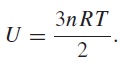
The thermodynamic energy of a monatomic ideal gas is given byFind the partial derivatives and write the expression for dU using T ,V, and n as independent variables. Show that your differential is exact. Зп RT U = 2
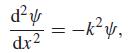
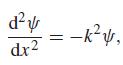
Show that the function ψ = ψ(x) = A sin (kx) satisfies the equationif A and k are constants. d² dr2
Show that the function ψ = ψ(x) cos (kx) satisfies the equationif A and k are constants. dr2
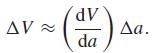
The volume of a cube is given byV = V(a) = a3,where a is the length of a side. Estimate the percent error in the volume if a 1.00% error is made in measuring the length, using the formulaCheck the accuracy of this estimate by comparing V(a) and V(1.0100a). dV AV = da (*) Δα.
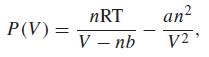
Find a formula for the curvature of the function:where n,R,a,b, and T are constants. nRT an? P(V) = V – nb V2 '
The number of atoms of a radioactive substance at time t is given byN(t) = Noe−t/τ ,where No is the initial number of atoms and τ is the relaxation time. For 14C,τ = 8320y. Calculate the fraction of an initial sample of 14C that remains after 15.00 years, using Eq. (6.10). Calculate the
The exponential function can be represented by the following power serieswhere the ellipsis ( · · · ) indicates that additional terms follow. The notation n! stands for n factorial, such that n! = n(n −1)(n −2) · · · (3)(2)(1) for any positive integral value of n and 0! = 1. Derive the
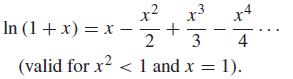
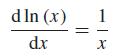
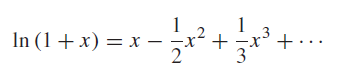
The natural logarithm of 1 + x is represented by the seriesUse the identityto find a series to represent 1/(1 + x). x2 In (1+ x) = x – x3 3 4 (valid for x? < 1 and x = 1).
Show that if z = ax3 + b sin (x) and x = cy then the chain rule is valid.
For the function y = x2/z, show that the cycle rule is valid.
Using the mnemonic device, write three additional Maxwell relations.
Show by differentiation that (∂2z/∂ y ∂x) = (∂2z/∂x ∂ y) if z = exy sin(x).
Find the integral: ʃ x ln (x2)dx.
Using Simpson's rule, calculate the integral from x = 0.00 to x = 1.20 for the following values of the integrand. 0.00 0.20 0.40 0.60 0.80 1.00 1.20 f(x) 1.000 1.041 1.174 1.433 1.896 2.718 4.220
Find the following area by computing the values of a definite integral: The area bounded by the straight line y = 2x + 3, the x axis, the line x = 1, and the line x = 4.
Evaluate the definite integral: ʃπ/20 x sin (x2) cos (x2) dx.
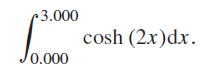
Using a table of indefinite integrals, find the definite integral. r 3.000 cosh (2x)dx. 0.000
Evaluate the definite integral: ʃ102 x in (x) dx.
Evaluate the definite integral: ʃπ/20 sin (x) cos (x) dx.
Evaluate the definite integral: ʃ42 1/x in (x) dx.
Evaluate the definite integral: ʃ2π0 sin (x) dx.
Find the indefinite integral without using a table:ʃ1/x(x - a)dx.
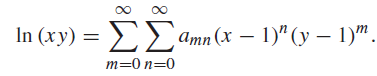
Find the first few terms of the two-variable Taylor series: In (xy) = ELmn (x – 1)" (y – 1)". -ΣΣο m=0 n=0
Using the Maclaurin series, show that |X1 - sin (x) sin (ax1). cos (ax)dx = (ах)dx a
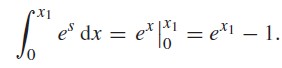
Using the Maclaurin series, show that |e* dx = e* = e*i – 1. e* = e*1 – 1. %3D 0,
Using the Maclaurin series for ex, show that the derivative of ex is equal to ex.
Find the first few terms of the two-variable Maclaurin series representing the functionf(x,y) = sin (x +y).
Find the coefficients of the first few terms of the Maclaurin seriessinh (x) = a0 + a1x + a2x2 +· · ·What is the radius of convergence of the series?
Find the volume of a solid produced by scooping out the interior of a circular cylinder of radius 10.00 cm and height 12.00 cm so that the inner surface conforms to z = 2.00 cm + (0.01000 cm−2)ρ3.
Find the volume of a cup obtained by rotating the parabolaz = 4.00ρ2around the z axis and cutting off the top of the paraboloid of revolution at z = 4.00.
Find the Maclaurin series for cos (x).
Test the following series for convergence: 00 п2 п31
Find the coefficients of the first fewterms of the Taylor serieswhere x is measured in radians. What is the radius of convergence of the series? л 2 +.. -1) +42 (x -)* sin (x) — do +aj (х IT
The cosine of 30—¦ (Ï€/6 radians) is equal to ˆš3/2 = 0.866025 . . . How many terms in the seriesmust be taken to achieve 0.1% accuracy x = Ï€/6? x2 x4 2! 4! 6! cos (x) = 1
Find the Maclaurin series that represents cosh(x). What is its radius of convergence?
Find the Taylor series for sin (x), expanding around π/2.
Find the interval of convergence for the series for sin (x).
Find the interval of convergence for the series for cos (x).
Prove the following fact about power series: If two power series in the same independent variable are equal to each other for all values of the independent variable, then any coefficient in one series is equal to the corresponding coefficient of the other series.
Determine whether the following improper integrals converge. Evaluate the convergent integralsa. ʃ∞1 (1/x2) dx.b. ʃπ/21 tan (x) dx.
Find the Taylor series in powers of (x − 5) that represents the function ln (x).
Find two different Taylor series to represent the functionf(x) = 1/xsuch that one series isf(x) = a0 + a1(x − 1) + a2(x − 1)2 +· · ·and the other isf(x) = b0 + b1(x − 2) + b3(x − 2)2 +· · ·Show that bn = an/2n for any value of n. Find the interval of convergence for each series (the
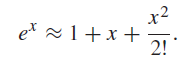
Estimate the largest value of x that allows exto be approximated to 0.01% accuracy by the following partial sum: x2 et - 1+x + 2!
Find the formulas for the coefficients in a Taylor series that expands the function f (x, y) around the point x = a, y = b.
Estimate the largest value of x that allows ex to be approximated to 1% accuracy by the following partial sum:ex ≈ 1 + x.
From the Maclaurin series for ln (1 + x)find the Taylor series for 1/(1 + x), using the fact thatFor what values of x is your series valid? In (1+x) = x – x3 d [In (1 +x)] dx
Determine how large X2can be before the truncation of Eq. (10.28) that was used in Eq. (10.29) is inaccurate by more than 1%. - In (X1) = – In (1 – X2) = X2 +X3+.. (10.28) Amplla G) Avap Hm X2 = (10.29) R To
The sine of Ï€/4 radians (45—¦) is ˆš2/2 = 0.70710678 . . . How many terms in the seriesmust be taken to achieve 1% accuracy at x = Ï€/4? sin (x) = x - +3 x' +.. 7! 3! 5!
Find the relationship between the coefficients A3 and B3.
Find the series for 1/(1 − x), expanding about x = 0. What is the interval of convergence?
Find the Taylor series for ln (x), expanding about x = 2, and show that the radius of convergence for this series is equal to 2, so that the series can represent the function in the region 0 ≺ x ≤ 4.
Find the Maclaurin series for ln (1 + x). You can save some work by using the result of the previous example.
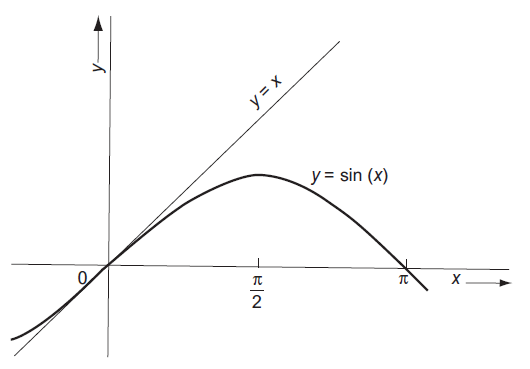
Show that the Maclaurin series for exis 1 e* = 1+x +x+ 1! ---****** (10.20) x* + . .. 4! 3!* 2! у 3х y = sin (x) TC
By use of the Maclaurin series already obtained in this chapter, prove the identity eix = cos (x) + i sin (x).a. Show that no Maclaurin seriesf(x) = a0 + a1x + a2x2 +· · ·can be formed to represent the function f(x) = √x. Why is this?b. Find the first few coefficients of the Maclaurin series
Show that the geometric series converges if r2 ≺ 1.
Find the Taylor series for cos (x), expanding about x = π/2.
Evaluate the first 20 partial sums of the harmonic series.
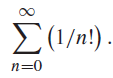
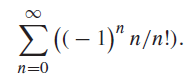
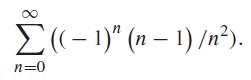
Find the value of the infinite series
Test the following series for convergence ο0 1/n n=0
Consider the serieswhich is known to be convergent and to equal Ï€2/6 = 1.64993 · · ·. Using Eq. (10.5) as an approximation, determine which partial sum approximates the series to(a) 1%.(b) 0.001%. 1 1 s = 1+ 22 + 32 42 n2
Test the following series for convergence
Show that in the series of Eq. (10.4) any term of the series is equal to the sum of all the terms following it. s = 1+ (10.4) 2n 2n n=0
Test the following series for convergence
Find the volume of a circular cylinder of radius 0.1000 m centered on the z axis, with a bottom surface given by the x–y plane and a top surface given by z = 0.1000 m + 0.0500y.
Find the moment of inertia of a flat rectangular plate with dimensions 0.500 m by 0.400 m around an axis through the center of the plate and perpendicular to it. Assume that the plate has a mass M = 2.000 kg and that the mass is uniformly distributed.
Find the moment of inertia of a ring with radius 10.00 cm, width 0.25 cm, and a mass of 0.100 kg.
Find the volume of a solid with vertical walls such that its base is a square in the x–y plane defined by 0 ≤ x ≤ 2.00 and 0 ≤ x ≤ 2.00 and its top is defined by the plane z = 20.00 + x + y.
Find the volume of a right circular cylinder of radius a = 4.00 with a paraboloid of revolution scooped out of the top of it such that the top surface is given byz = 10.00 + 1.00ρ2and the bottom surface is given by z = 0.00.
Evaluate the triple integral in cylindrical polar coordinates: 3.00 4.00 I = zp° cos? (4) dø dp dz.
Derive the formula for the volume of a right circular cylinder of radius a and height h.
Find the Jacobian for the transformation from Cartesian to cylindrical polar coordinates.
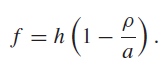
Use a double integral to find the volume of a cone of height h and radius a at the base. If the cone is standing with its point upward and with its base centered at the origin, the equation giving the height of the surface of the cone as a function of Ï is f = h (1 - a
Find an expression for the moment of inertia of a thin hollow sphere of radius a and a uniform mass per unit area of m. Evaluate your expression if a = 0.500 m, Δa = 0.112 mm, m = 3515 kg m−3.
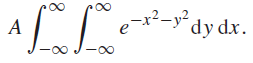
Find the value of the constant A such that the following integral equals unity: -x²–y² dy dx. A -00 -0-
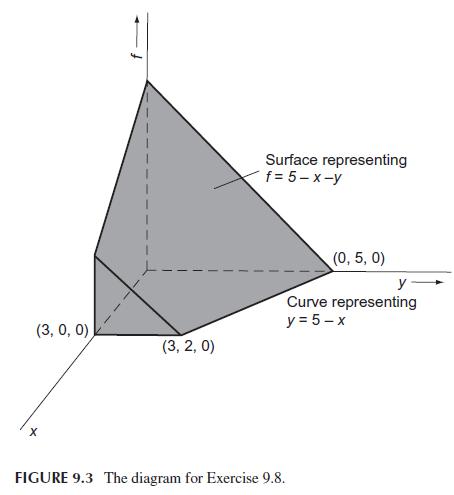
Find the volume of the solid object shown in Figure 9.3. The top of the object corresponds to f = 5.00 – x – y, the bottom of the object is the x–y plane, the trapezoidal face is the x–f plane, and the large triangular face is the y–f plane. The small triangular face corresponds to x =
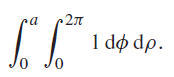
Find the moment of inertia of a uniform disk of radius 0.500m and a mass per unit area of 25.00 g m2. The moment of inertia is defined bywhere m(Ï) is the mass per unit area. = [[ m(p)o* aA = [* L° 2л m ( ρ)ρέρ dφ dp,
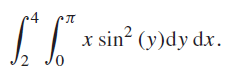
Evaluate the double integral 24 x sin? (y)dy dx. 12
The thermodynamic energy of a monatomic ideal gas is temperature-independent, so that dU = 0 in an isothermal process (one in which the temperature does not change). Evaluate wrev and qrev for the isothermal reversible expansion of 1.000 mol of a monatomic ideal gas from a volume of 15.50 l to a
Find the function whose exact differential isd f = cos (x) sin (y) sin (z)dx +sin (x) cos (y) sin (z)dy +sin (x) sin (y) cos (z)dzand whose value at (0,0,0) is 0. Find the area of the circle of radius a given by Ï = a by doing the
A two-phase system contains both liquid and gaseouswater, so its equilibrium pressure is determined by the temperature. Calculate the cyclic integral of dwrev for the following process: The volume of the system is changed from 10.00 l to 20.00 l at a constant temperature of 25.00◦ C, at
Find the function f (x,y) whose differential isdf = (x + y)−1dx + (x + y)−1dyand which has the value f(1,1) = 0. Do this by performing a line integral on a rectangular path from (1,1) to (x1,y1) where x1 > 0 and y1 > 0.
Find the function whose differential isdf = cos (x) cos (y)dx − sin (x) sin (y)dyand whose value at x = 0, y = 0 is 0.
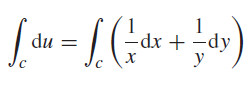
Perform the line integralon the curve represented byy = xfrom (1,1) to (2,2). 1 -dx + –dy du х
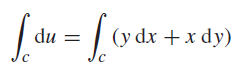
Perform the line integralon the curve represented byy = x2from (0,0) to (2,4). Г- -Го (y dx +x dy) du
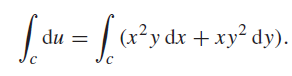
Perform the line integral(a) On the line segment from (0,0) to (2,2).(b) On the path from (0,0) to (2,0) and then from (2,0) to (2,2). (x²y dx + xy² dy).
The average distance from the center of the sun to the center of the earth is 1.495 × 10¹¹ m. The mass of the earth is 5.983 × 1024 kg, and the mass of the sun is greater than the mass of the earth by a factor of 332958. Find the magnitude of the force exerted on the earth by the sun and the
Carry out the line integral of the previous example, du = yz dx + xz dy + xy dz, on the path from (0,0,0) to (3,0,0) and then from (3,0,0) to (3,3,0) and then from (3,3,0) to (3,3,3).
Showing 200 - 300
of 572
1
2
3
4
5
6
Step by Step Answers

 Get 50% OFF
Claim Now
Get 50% OFF
Claim Now








![d [In (1 +x)] dx](https://dsd5zvtm8ll6.cloudfront.net/si.question.images/images/question_images/1545/9/9/3/9875c25ff03b865f1545976565611.jpg)




![EIIN (2)]](https://dsd5zvtm8ll6.cloudfront.net/si.question.images/images/question_images/1545/9/9/3/7265c25fdfe75aeb1545976304293.jpg)