New Semester
Started
Get
50% OFF
Study Help!
--h --m --s
Claim Now
Question Answers
Textbooks
Find textbooks, questions and answers
Oops, something went wrong!
Change your search query and then try again
S
Books
FREE
Study Help
Expert Questions
Accounting
General Management
Mathematics
Finance
Organizational Behaviour
Law
Physics
Operating System
Management Leadership
Sociology
Programming
Marketing
Database
Computer Network
Economics
Textbooks Solutions
Accounting
Managerial Accounting
Management Leadership
Cost Accounting
Statistics
Business Law
Corporate Finance
Finance
Economics
Auditing
Tutors
Online Tutors
Find a Tutor
Hire a Tutor
Become a Tutor
AI Tutor
AI Study Planner
NEW
Sell Books
Search
Search
Sign In
Register
study help
mathematics
mathematics physical chemistry
Mathematics for Physical Chemistry 4th Edition Robert G. Mortimer - Solutions
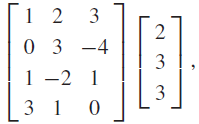
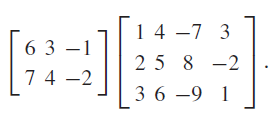
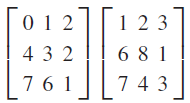
Find the matrix products. Use Mathematica to check your result.a.b. 1 2 3 0 1 2 4 3 2 6 8 1 7 43 76 1 6 3 2 -1 4 7 -6 –8 -7 4 3 2 3 -6 8 -6 1 3 2 -2 6 7 -1 -3]L-1 4 2 2 3 -3 4 3
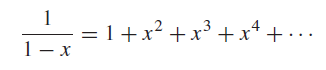
If x is an ordinary variable, the Maclaurin series for 1/(1 ˆ’ x) isIf XÌ‚ is some operator, show that the series1 + XÌ‚ + XÌ‚2 + XÌ‚3 + XÌ‚4 +· · ·is the inverse of the operator 1
Show that the solution in the previous example satisfies the original equation.
If  is the operator corresponding to the mechanicalquantity A and ϕnis an eigenfunction of Â, such thatÂϕn = anϕnshow that the expectation value of A is equal to an if the state of the system corresponds to ϕn.
Find an expression for B̂2 if B̂ = x(d/dx) and find B̂2 f if f = bx4.
If  = x + d dx, find Â3.
Find the commutator [x2, d2/dx2].
Find the speed of propagation of a traveling wave in an infinite string with the same mass per unit length and the same tension force as the violin string in the previous exercise.
A certain violin string has a mass per unit length of 20.00 mg cm−1 and a length of 55.0 cm. Find the tension force necessary to make it produce a fundamental tone of A above middle C (440 oscillations per second = 440 s−1 = 440 Hz).
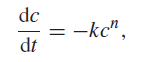
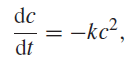
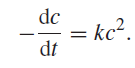
In a second-order chemical reaction involving one reactant and having no back reaction,Solve this differential equation by separation of variables. Do a definite integration from t = 0 to t = t1. dc = kc². dt
If z(0) = z0 and if vz(0) = 0, express the constants b1 and b2 in terms of z0.
The frequency of vibration of the H2 molecule is 1.3194 × 10¹⁴ s−1. Find the value of the force constant.
Show that the function of Eq. (12.25) satisfies Eq. (12.12).z = b1 cos(ωt) + b2 sin(ωt). (12.25) d²z (12.12) -kz. т dt2
An object falling in a vacuum near the surface of the earth experiences a gravitational force in the z direction given byFz = −mg,where g is called the acceleration due to gravity and is equal to 9.80 m s−2. This corresponds to a constant accelerationaz = −g.Find the expression for the
Use the derivative theorem to derive the Laplace transform of cos (at) from the Laplace transform of sin (at).
A flywheel of radius R has a distribution of mass given by m(ρ) = aρ + b, where ρ, is the distance from the center, a and b are constants, and m(ρ) is the mass per unit area as a function of ρ. The flywheel has a circular hole in the center with radius r. Find an expression for the
Find the result of each operation on the given point (represented by Cartesian coordinates):(a) Ĉ2(z) î σ̂h(1,1,1).(b) Ŝ2(y) σ̂h(1,1,0).
Find Ĉ2(x)(1,2, − 3).
Find the result of each operation on the given point (represented by Cartesian coordinates):(a) Ĉ2(z) î (1,1,1).(b) î Ĉ2(z)(1,1,1).
Find Ŝ2(y)(3,4,5).
Find the 3 by 3 matrix that is equivalent in its action to each of the symmetry operators:(a) Ŝ2(z).(b) Ĉ2(x).
List the symmetry elements of a uniform cube centered at the origin with its faces perpendicular to the coordinate axes.
Find the 3 by 3 matrix that is equivalent in its action to each of the symmetry operators:(a) Ĉ8(x).(b) Ŝ6(x).
List the symmetry elements for(a) H2O (bent).(b) CO2 (linear).
Give the function that results if the given symmetry operator operates on the given function for each of the following:(a) Ĉ4(z)x2.(b) σ̂h x cos (x/y).
Find Îψ2px where Î is the inversion operator. Show that ψ2px is an eigenfunction of the inversion operator, and find its eigenvalue.
Give the function that results if the given symmetry operator operates on the given function for each of the following:(a) î (x + y + z2).(b) Ŝ4(x)(x + y + z).
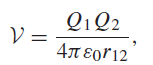
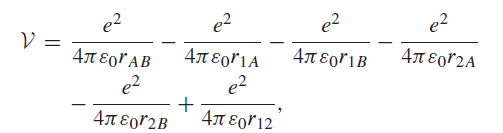
The potential energy of two electric charges Q1and Q2in a vacuum iswhere r12 is the distance between the charges and ε0 is a constant called the permittivity of a vacuum, equal to 8.854187817 × 10ˆ’12 F mˆ’1 = 8.854187817 × 10ˆ’12
Find the matrix products. Use Mathematica to checkyour result.a.b.c. 2 3 [3 21 4] 3 -4 1 -2 1 0 1 3 1 2 3 0 3 -4 3 1 -2 1 3 3 1 0
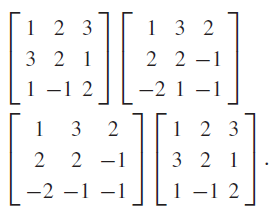
Find the two matrix productsThe left factor in one product is equal to the right factor in the other product, and vice versa. Are the two products equal to each other? 13 2 2 3 3 2 1 -1 2 1 2 2 -1 -2 1 –1 1 3 2 2 3 3 2 1 2 2 -1 -2 –1 –1 1 -1 2
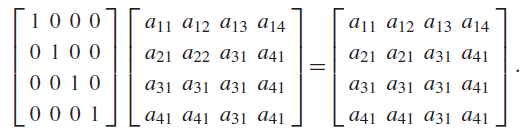
Show by explicit matrix multiplication that а11 а12 а13 ај4 а21 а21 аз1 а41 аз1 аз1 аз1 а41 а41 а41 аз1 041 а11 а12 а13 ај4 а21 а22 аз1 а41 аз1 аз1 аз1 а41 а41 а41 аз1 а41 1000 0 1 0 0 0 0 1 0 0 0 0 1
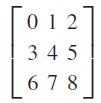
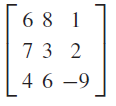
Test the following matrices for singularity. Find the inverses of any that are nonsingular. Multiply the original matrix by its inverse to check your work. Use Mathematica to check your work.a.b. 0 1 2 3 4 5 678 6 8 1 7 3 2 4 6 –9
Show that AA−1 = E and that A−1A = E for the matrices of the preceding example.
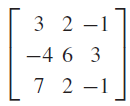
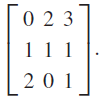
Test the following matrices for singularity. Find the inverses of any that are nonsingular. Multiply the original matrix by its inverse to check your work. Use Mathematica to check your work.a.b. 2 -1 3 -4 6 3 7 2 -1 0 2 3 111 201 1
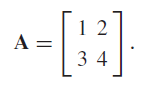
Find the inverse of the matrix A = 3 4
The H2O molecule belongs to the point group C2v, which contains the symmetry operators Ê, Ĉ2, σ̂a, and σ̂b, where the C2 axis passes through the oxygen nucleus and midway between the two hydrogen nuclei, and where the σa mirror plane contains the three nuclei and the σb mirror plane is
The BF3 molecule is planar with bond angles of 120◦.(a) List the symmetry operators that belong to this molecule. We place the molecule in the x–y plane with the boron atom at the origin and one of the fluorine atoms on the x axis. Call the fluorine atoms a, b, and c starting at the x axis and
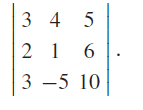
(a) Find the value of the determinant(b) Interchange the first and second columns and find the value of the resulting determinant.(c) Replace the second column by the sum of the first and second columns and find the value of the resulting determinant.(d) Replace the second column by the first, thus
Obtain the multiplication table for the C2v point group and show that it satisfies the conditions to be a group.
(a) Find the matrix equivalent to Ĉ2(z).(b) Find the matrix equivalent to Ŝ3(z).(c) Find the matrix equivalent to σ̂h.
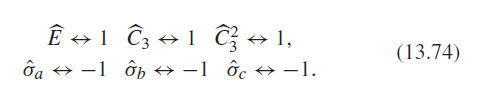
Show that the 1 by 1 matrices (scalars) in Eq. (13.74) obey the same multiplication table as does the group of symmetry operators. Ê + 1 Ĉz + 1 Ĉ → 1, ớa + –1 ốp → -1 ốc +→ -1. (13.74)
Find ∇ × r ifr = ix + jy + kz.
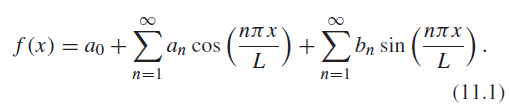
Using trigonometric identities, show that the basis functions in the series in Eq. (11.1) are periodic with period 2L. ο (Η) +> bn sin ηπx (). f (x) a0 +aη cos . n=1 n=1 (11.1)
Sketch a rough graph of the product cos (πx/L) sin (πx/L) from 0 to L and convince yourself that its integral from −L to L vanishes.
Find the one-sided Fourier cosine transform of the function a/(b2 + t2).
Find the one-sided Fourier sine transform of the function f(x) = x.
Repeat the calculation of the previous example with a = 0.500 s−1. Show that a narrower line width occurs.
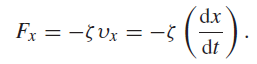
An object moves through a fluid in the x direction. The only force acting on the object is a frictional force that is proportional to the negative of the velocity:Write the equation of motion of the object. Find the general solution to this equation and obtain the particular solution that applies
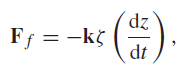
A particle moves along the z axis. It is acted upon by a constant gravitational force equal to ˆ’kmg, where k is the unit vector in the z direction. It is also acted on by a frictional force given bywhere ζ is a constant called a €œfriction constant.€ Find
An object sliding on a solid surface experiences a frictional force that is constant and in the opposite direction to the velocity if the particle is moving, and is zero it is not moving. Find the position of the particle as a function of time if it moves only in the x direction and the initial
A harmonic oscillator has a mass m = 0.300 kg and a force constant k = 155 N m−1:(a) Find the period and the frequency of oscillation.(b) Find the value of the friction constant ζ necessary to produce critical damping with this oscillator. Find the value of the constant λ1.(c) Construct a graph
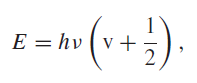
According to quantum mechanics, the energy of a harmonic oscillator is quantized. That is, it can take on any one of a certain set of values, given bywhere h is Planck€™s constant, equal to 6.62608 × 10ˆ’34 J s, ν is the frequency and v is a quantum
A less than critically damped harmonic oscillator has a mass m = 0.3000 kg, a force constant k = 98.00 N m−1, and a friction constant ζ = 1.000 kg s−1.(a) Find the circular frequency of oscillation ω and compare it with the frequency that would occur if there were no damping.(b) Find the time
Show that eλ1t does satisfy the differential equation.
A forced harmonic oscillator with a circular frequency ω = 6.283 s−1 (frequency ν = 1.000 s−1) is exposed to an external force F0 sin (αt) with circular frequency α = 7.540 s−1 such that in the solution of Eq. (12.63) becomesz(t) = sin(ωt) + 0.100 sin (αt).Using Excel or Mathematica,
An object of mass m is subjected to an oscillating force in the x direction given by F0 sin(bt) where a and b are constants. Find the solution to the equation of motion of the particle. Find the particular solution for the case that x(0) = 0 and dx/dt = 0 at t = 0.
Find an expression for the initial velocity.
A forced harmonic oscillator with mass m = 0.300 kg and a circular frequency ω = 6.283 s−1 (frequency ν = 1.000 s−1) is exposed to an external force F0 exp (− βt) sin (αt) with α = 7.540 s−1 and β = 0.500 s−1. Find the solution to its equation of motion. Construct a graph of the
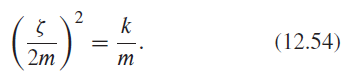
Substitute this trial solution into Eq. (12.43), using the condition of Eq. (12.54), and show that the equation is satisfied. ´d²z' dz (12.43) - 3 kz = m dt dt2
A tank contains a solution that is rapidly stirred, so that it remains uniform at all times. A solution of the same solute is flowing into the tank at a fixed rate of flow, and an overflow pipe allows solution from the tank to flow out at the same rate. If the solution flowing in has a fixed
Locate the time at which z attains its maximum value and find the maximum value.
An nth-order chemical reaction with one reactant obeys the differential equation
If zc(t) is a general solution to the complementary equation and zp(t) is a particular solution to the inhomogeneous equation, show that zc + zpis a solution to the inhomogeneous equation of Eq. (12.59). d z + f2(t)- dt3 d?z dz + fi(t) (12.59) = g(t), f3(t)- dt2 dt
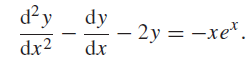
Find the solution to the differential equation d²y - 2y = –xe*. dx dy dx2
Test the following equations for exactness and solve the exact equations:(a) (x2 + xy + y2)dx + (4x2 − 2xy + 3y2) dy = 0.(b) yexdx + exdy = 0.(c) 2xy − cos (x) dx + (x2 − 1) dy = 0.
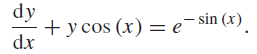
Use Mathematica to solve the differential equation symbolically - sin (x) dy + y cos (x) = e° dx
Solve the equation (4x + y)dx + x dy = 0.
Use Mathematica to obtain a numerical solution to the differential equation in the previous problem for the range 0 < x < 10 and for the initial condition y(0) = 1. Evaluate the interpolating function for several values of x and make a plot of the interpolating function for the range 0 < x
Show that 1/y2 is an integrating factor for the equation in the previous example and show that it leads to the same solution.
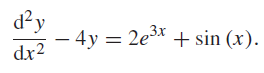
Solve the differential equation d²y - 4y = 2e3* + sin (x). dx2
Radioactive nuclei decay according to the same differential equation which governs first-order chemical reactions, Eq. (12.71). In living matter, the isotope14C is continually replaced as it decays, but it decays without replacement beginning with the death of the organism. The half-life of the
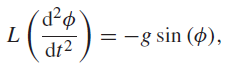
A pendulum of length L oscillates in a vertical plane. Assuming that the mass of the pendulum is all concentrated at the end of the pendulum, show that it obeys the differential equationwhere g is the acceleration due to gravity and Ï• is the angle between the pendulum and the vertical.
Use Mathematica to obtain a numerical solution to the pendulum equation in the previous problem without approximation for the case that L = 1.000 m with the initial conditions ϕ(0) = 0.350 rad (about 20◦) and dϕ/dt = 0. Evaluate the solution for t = 0.500 s, 1.000 s, and 1.500 s. Make a graph
Obtain the solution of Eq. (12.112) in the case of critical damping, using Laplace transforms. d²z' Ś dz +"z = z2) +z") + z = 0, m dt k k (1) dt2 т т т (12.112)
Obtain the solution for Eq. (12.62) for the forced harmonic oscillator using Laplace transforms.
The differential equation for a secondorder chemical reaction without back reaction iswhere c is the concentration of the single reactant and k is the rate constant. Set up an Excel spreadsheet to carry out Euler€™s method for this differential equation. Carry out the calculation for the
An object of mass m is subjected to a gradually increasing force given by F0(1−e−bt) where a and b are constants. Solve the equation of motion of the particle. Find the particular solution for the case that x(0) = 0 and dx/dt = 0 at t = 0.
Find the following commutators, where Dx = d/dx:(a) [D̂x , sin (x)];(b) [D̂3x ,x];
Find the eigenfunctions and eigenvalues of the operator i d/dx, where i = √ −1.
Find the following commutators, where Dx = d/dx:(a) [D̂3x, x2];(b) [D̂2x, f(x)].
Find the operator equal to the operator product d2/dx2 x.
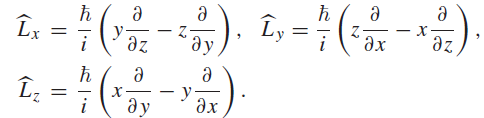
The components of the angular momentum correspond to the quantum-mechanical operators:These operators do not commute with each other. Find the commutator [LÌ‚x, LÌ‚y]. Îx Îy ду y- х Әх i дz az х ду дх (,
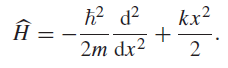
The Hamiltonian operator for a one-dimensional harmonic oscillator moving in the x direction isFind the value of the constant a such that the function eˆ’ax2 is an eigenfunction of the Hamiltonian operator and find the eigenvalue E. The quantity k is the force constant, m is the mass of
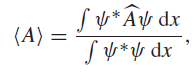
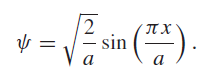
In quantum mechanics, the expectation value of a mechanical quantity is given bywhere  is the operator for the mechanical quantity and ψ is the wave function for the state of the system. The integrals are over all permitted values of the coordinates of the system. The
Find the eigenfunction of the Hamiltonian operator for motion in the x direction if V(x) = E0 = constant.
Find the result of each operation on the given point (represented by Cartesian coordinates):(a) î (2,4,6).(b) Ĉ2(y)(1,1,1).
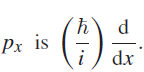
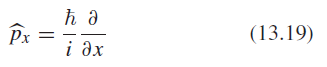
Show that the operator for the momentum in Eq. (13.19) is hermitian. (13.19) Px i дх ||
Find the result of each operation on the given point (represented by Cartesian coordinates):(a) Ĉ3(z)(1,1,1).(b) Ŝ4(z)(1,1,1).
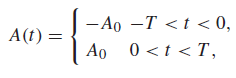
Find the Fourier series that represents the square wavewhere A0 is a constant and T is the period.Make graphs of the first two partial sums. - Ao -T
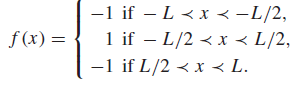
Find the Fourier series to represent the functionConstruct a graph showing the first three terms of the series and the third partial sums. -1 if – L
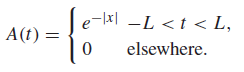
Find the Fourier series to represent the functionYour series will be periodic and will represent the function only in the region ˆ’L < t < L. e-lx| -L
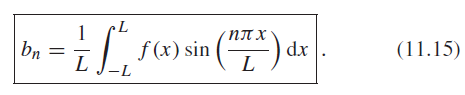
Show that Eq. (11.15) is correct. NT X f (x) sin bn (11.15) dx -L
Find the one-sided Fourier cosine transform of the function f(x) = xe−ax.
Show that the an coefficients for the series representing the function in the previous example all vanish.
Find the one-sided Fourier sine transform of the function f(x) = e−ax/x.
Find the Fourier cosine series for the even functionf(x) = |x| for − L < x < L.Sketch a graph of the periodic function that is represented by the series.
Find the Fourier transform of the function exp (−(x − x0)2).
Derive the orthogonality relation expressed above.
Find the one-sided Fourier sine transform of the function ae−bx.
Construct a graph with the function f from the previous example and c1ψ1 on the same graph. Let a = 1 for your graph. Comment on how well the partial sum with one term approximates the function.
Showing 100 - 200
of 572
1
2
3
4
5
6
Step by Step Answers

 Get 50% OFF
Claim Now
Get 50% OFF
Claim Now


![6 3 2 -1 4 7 -6 –8 -7 4 3 2 3 -6 8 -6 1 3 2 -2 6 7 -1 -3]L-1 4 2 2 3 -3 4 3](https://dsd5zvtm8ll6.cloudfront.net/si.question.images/images/question_images/1546/0/8/6/7815c27697db28151546069380834.jpg)

![2 3 [3 21 4] 3 -4 1 -2 1 0 1 3](https://dsd5zvtm8ll6.cloudfront.net/si.question.images/images/question_images/1546/0/8/6/8115c27699b0c3041546069410156.jpg)