New Semester
Started
Get
50% OFF
Study Help!
--h --m --s
Claim Now
Question Answers
Textbooks
Find textbooks, questions and answers
Oops, something went wrong!
Change your search query and then try again
S
Books
FREE
Study Help
Expert Questions
Accounting
General Management
Mathematics
Finance
Organizational Behaviour
Law
Physics
Operating System
Management Leadership
Sociology
Programming
Marketing
Database
Computer Network
Economics
Textbooks Solutions
Accounting
Managerial Accounting
Management Leadership
Cost Accounting
Statistics
Business Law
Corporate Finance
Finance
Economics
Auditing
Tutors
Online Tutors
Find a Tutor
Hire a Tutor
Become a Tutor
AI Tutor
AI Study Planner
NEW
Sell Books
Search
Search
Sign In
Register
study help
mathematics
precalculus
Thomas Calculus Early Transcendentals 13th Edition Joel R Hass, Christopher E Heil, Maurice D Weir - Solutions
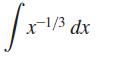
Find the most general antiderivative or indefinite integral. You may need to try a solution and then adjust your guess. Check your answers by differentiation. fr x-1/3 dx
Graph the curve.y = (1/8)(x3 + 3x2 - 9x - 27)
Graph the curve.y = x3(8 - x)
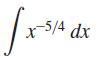
Find the most general antiderivative or indefinite integral. You may need to try a solution and then adjust your guess. Check your answers by differentiation. fr x-5/4 dx
Find the equation for the curve in the xy-plane that passes through the point (1, -1) if its slope at x is always 3x2 + 2.
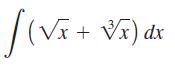
Find the most general antiderivative or indefinite integral. You may need to try a solution and then adjust your guess. Check your answers by differentiation. / (√x + √x) dx
A wire b m long is cut into two pieces. One piece is bent into an equilateral triangle and the other is bent into a circle. If the sum of the areas enclosed by each part is a minimum, what is the length of each part?
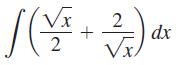
Find the most general antiderivative or indefinite integral. You may need to try a solution and then adjust your guess. Check your answers by differentiation. √x 2 + 2 Vx dx
A particle moves along the x-axis. Its acceleration is a = -t2. At t = 0, the particle is at the origin. In the course of its motion, it reaches the point x = b, where b 7 0, but no point beyond b. Determine its velocity at t = 0.
Graph the curve.y = x - 3x2/3
Graph the curve. y = x√4 = x² –
Graph the curve.y = x2(2x2 - 9)
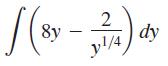
Find the most general antiderivative or indefinite integral. You may need to try a solution and then adjust your guess. Check your answers by differentiation. 8y 2 1/4 dy
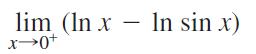
Use l’Hôpital’s rule to find the limit. lim (lnx - In sin x) x->0+
Graph the curve.y = x1/3(x - 4)
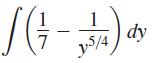
Find the most general antiderivative or indefinite integral. You may need to try a solution and then adjust your guess. Check your answers by differentiation. dy P (1/58 - 1) /
Graph the curve.y = (x - 3)2 ex
Find the critical points, domain endpoints, and extreme values (absolute and local) for each function. y = x²√3 - x
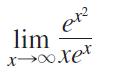
L’Hôpital’s Rule does not help with the limit. Try it—you just keep on cycling. Find the limits some other way. 27 lim x-xxex
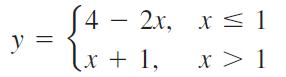
Find the critical points, domain endpoints, and extreme values (absolute and local) for each function. y = S4 - 2x, lx x + 1, x ≤ 1 x > 1
Verify the formula differentiation. f(3x (3x + 5)2 dx = (3x + 5)-¹ 3 + C
Jane is 2 mi offshore in a boat and wishes to reach a coastal village 6 mi down a straight shoreline from the point nearest the boat. She can row 2 mph and can walk 5 mph. Where should she land her boat to reach the village in the least amount of time?
Verify the formula differentiation. [s sec² (5x - 1) dx -tan (5x - 1) + C tar
a. Find the open intervals on which the function is increasing and decreasing.b. Identify the function’s local and absolute extreme values, if any, saying where they occur.g(x) = x2/3(x + 5)
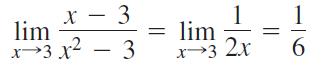
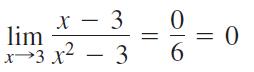
Which one is correct, and which one is wrong? Give reasons for your answers.a.b. x - 3 lim x-3x² 3 - 1 x3 2x = lim 1 6
Find all possible functions with the given derivative.a. y′ = sec2 θ b. y′ = √θ c. y′ = 2θ - sec2 θ
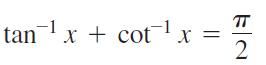
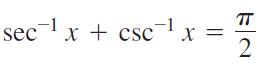
Use the same-derivative argument to prove the identities.a.b. tan ¹x + cot¹ x = TT 2
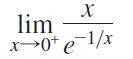
L’Hôpital’s Rule does not help with the limit. Try it—you just keep on cycling. Find the limits some other way. X lim x→0+e=1/x
Graph the curve.y = xe-x2
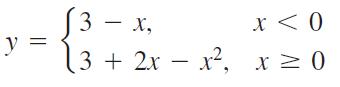
Find the critical points, domain endpoints, and extreme values (absolute and local) for each function. = y = √3 - X₂ x < 0 13 + 2x - x², x ≥ 0
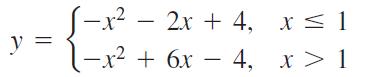
Find the critical points, domain endpoints, and extreme values (absolute and local) for each function. y = -x² - 2x + 4, -x² + 6x4, x ≤ 1 x > 1
Only one of these calculations is correct. Which one? Why are the others wrong? Give reasons for your answers.a.b.c.d. lim x ln x = 0·(-∞) = 0 x->0+
Verify the formula differentiation. [csc² ( ² = ¹) dx - 300€ ( ² =¹) ₁ = -3 cot + C 3 3
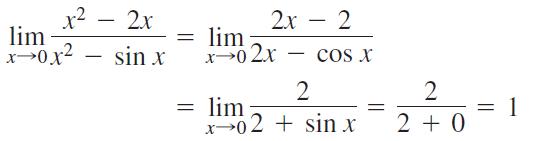
Which one is correct, and which one is wrong? Give reasons for your answers.a.b. x² 2x lim x-0x² sin x = = 2x - 2 lim x-02x lim x-02 2 COS X sin x = 2 2 +0 || 1
Let ƒ be differentiable at every value of x and suppose that ƒ(1) = 1, that ƒ′ < 0 on (-∞, 1), and that ƒ′ > 0 on (1, ∞).a. Show that ƒ(x) ≥ 1 for all x.b. Must ƒ′(1) = 0? Explain.
Determine the values of constants a and b so that ƒ(x) = ax2 + bx has an absolute maximum at the point (1, 2).
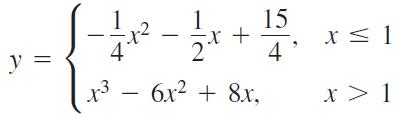
Find the critical points, domain endpoints, and extreme values (absolute and local) for each function. y = (-1/1² - 11/x 43 -x + 6x² + 8x, 15 4' x ≤ 1 x > 1
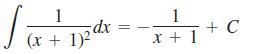
Verify the formula differentiation. 1 1₁x + ₁²x = -x + ₁ + C 1 dx (x 1)² 1
Let ƒ(x) = px2 + qx + r be a quadratic function defined on a closed interval [a, b]. Show that there is exactly one point c in (a, b) at which ƒ satisfies the conclusion of the Mean Value Theorem.
Determine the values of constants a, b, c, and d so that ƒ(x) = ax3 + bx2 + cx + d has a local maximum at the point (0, 0) and a local minimum at the point (1, -1).
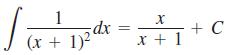
Verify the formula differentiation. 1 (x + 1)² 5dx X x + 1 + C
Verify the formula differentiation. [₁ 1 x + 1 - dx = ln x + 1 + C, x −1
Use the same-derivative argument, as was done to prove the Product and Power Rules for logarithms, to prove the Quotient Rule property.
Locate and identify the absolute extreme values ofa. ln (cos x) on [-π/4, π/3],b. cos (ln x) on [1/2, 2].
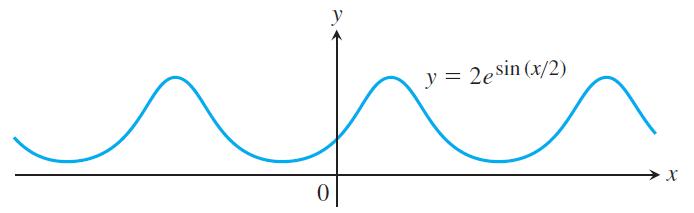
Where does the periodic function ƒ(x) = 2esin (x/2) take on its extreme values and what are these values? 0 y y = 2esin (x/2) X
a. Prove that ƒ(x) = x - ln x is increasing for x > 1.b. Using part (a), show that ln x < x if x > 1.
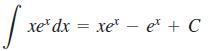
Verify the formula differentiation. S xe dx = xet etc
Starting with the equation ex1ex2 = ex1+x2, derived in the text, show that e-x = 1/ex for any real number x. Then show that ex1/ex2 = ex1-x2 for any numbers x1 and x2.
Find the absolute maximum and minimum values of ƒ(x) = ex - 2x on [0, 1].
Show that (ex1)x2 = ex1x2 = (ex2)x1 for any numbers x1 and x2.
Find all values of c that satisfy the conclusion of Cauchy’s Mean Value Theorem for the given functions and interval.a. ƒ(x) = x, g(x) = x2, (a, b) = (-2, 0)b. ƒ(x) = x, g(x) = x2, (a, b) arbitraryc. ƒ(x) = x3/3 - 4x, g(x) = x2, (a, b) = (0, 3)
Find the absolute maximum value of ƒ(x) = x2 ln (1/x) and say where it is assumed.
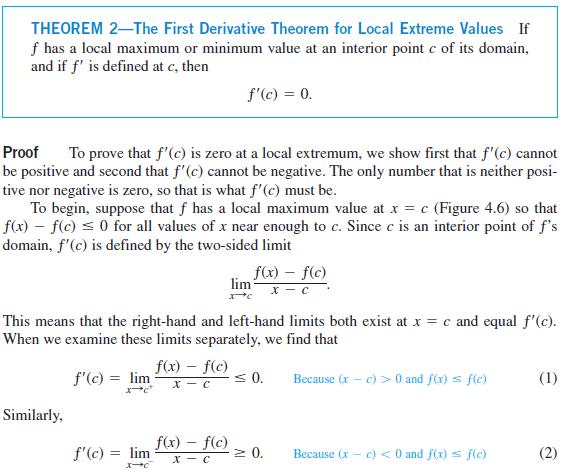
The function ƒ(x) = |x| has an absolute minimum value at x = 0 even though ƒ is not differentiable at x = 0. Is this consistent with Theorem 2? Give reasons for your answer.Theorem 2 THEOREM 2-The First Derivative Theorem for Local Extreme Values If f has a local maximum or minimum value at an
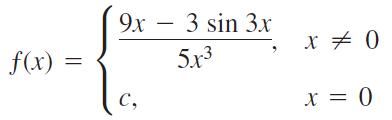
Find a value of c that makes the functioncontinuous at x = 0. Explain why your value of c works. f(x) = 9x C, 3 sin 3x 5x³ x = 0 x = 0
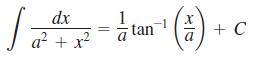
Verify the formula differentiation. Ja dx a² + x² Lam¹()+ t tan C
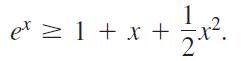
a. Prove that ex ≥ 1 + x if x ≥ 0.b. Use the result in part (a) to show that et ≥ 1 + x + 2.1².
For what values of a and b is tan 2x lim x-0 x³ + a x² + sin bx X = 0?
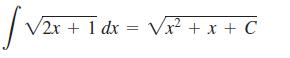
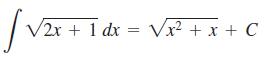
Right, or wrong? Say which for each formula and give a brief reason for each answer.a.b.c. [V2x + 1 dx = Vx² + x + C 2
If an even function ƒ(x) has a local maximum value at x = c, can anything be said about the value of ƒ at x = -c? Give reasons for your answer.
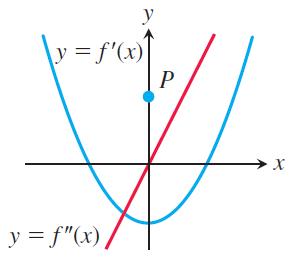
Shows the graphs of the first and second derivatives of a function y = ƒ(x). Copy the picture and add to it a sketch of the approximate graph of ƒ, given that the graph passes through the point P. \ y = f'(x)] P V y = f"(x)/ X
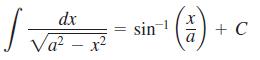
Verify the formula differentiation. dx 1 V₁²=sin-¹ (4) + + C
Verify the formula differentiation. [(si (sin¹ x)² dx = x(sin¹ x)² - 2x + 2V1x²2 sin¹x + C
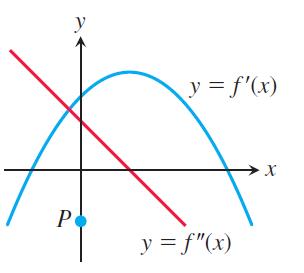
Shows the graphs of the first and second derivatives of a function y = ƒ(x). Copy the picture and add to it a sketch of the approximate graph of ƒ, given that the graph passes through the point P. Po y = f'(x) y = f"(x) X
Show that increasing functions and decreasing functions are oneto- one. That is, show that for any x1 and x2 in I, x2 ≠ x1 implies ƒ(x2) ≠ ƒ(x1).
If an odd function g(x) has a local minimum value at x = c, can anything be said about the value of g at x = -c? Give reasons for your answer.
Right, or wrong? Give a brief reason why. -15(x + 3)² (x - 2)4 -dx x + (x - 2) 3 + C
Right, or wrong? Give a brief reason why. *x cos (x²) - sin (x²) x² - dx sin (x²) X + C
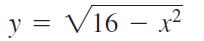
Identify the coordinates of any local and absolute extreme points and inflection points. Graph the function. y = V16 – 2 X²
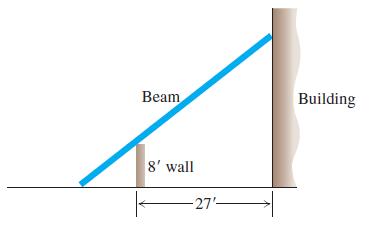
The 8-ft wall shown here stands 27 ft from the building. Find the length of the shortest straight beam that will reach to the side of the building from the ground outside the wall. Beam 8' wall -27'- Building
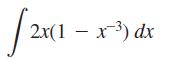
Find the most general antiderivative or indefinite integral. You may need to try a solution and then adjust your guess. Check your answers by differentiation. [2 2x(1-x-³) dx
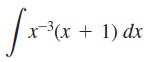
Find the most general antiderivative or indefinite integral. You may need to try a solution and then adjust your guess. Check your answers by differentiation. fra. x ³(x + 1) dx
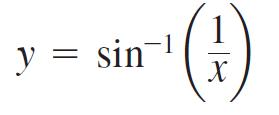
Graph the curve. y sin = 1 X
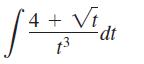
Find the most general antiderivative or indefinite integral. You may need to try a solution and then adjust your guess. Check your answers by differentiation. 4 + Vt dt [4+
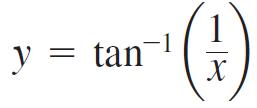
Graph the curve. y = tan -1 1 X
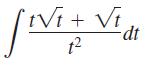
Find the most general antiderivative or indefinite integral. You may need to try a solution and then adjust your guess. Check your answers by differentiation. t√t + √t dt Vt 27
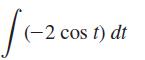
Find the most general antiderivative or indefinite integral. You may need to try a solution and then adjust your guess. Check your answers by differentiation. (-2 cos t) dt
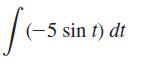
Find the most general antiderivative or indefinite integral. You may need to try a solution and then adjust your guess. Check your answers by differentiation. Je -5 sin t) dt
Graph the curve.y = ln (x2 - 4x + 3)
a. Identify the function’s local extreme values in the given domain, and say where they occur.b. Which of the extreme values, if any, are absolute?c. Support your findings with a graphing calculator or computer grapher. f(x) = 2x − x², - ·∞ < x < 2
Graph the curve.y = ln (sin x)
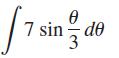
Find the most general antiderivative or indefinite integral. You may need to try a solution and then adjust your guess. Check your answers by differentiation. 1₁ 0 7 sin de 3 do
a. Identify the function’s local extreme values in the given domain, and say where they occur.b. Which of the extreme values, if any, are absolute?c. Support your findings with a graphing calculator or computer grapher. x² - 4x + 4, 1 g(x) = x² ≤ x 1 ≤ x
Gives the first derivative of a function y = ƒ(x). (a) At what points, if any, does the graph of ƒ have a local maximum, local minimum, or inflection point? (b) Sketch the general shape of the graph.y′ = 16 - x2
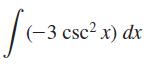
Find the most general antiderivative or indefinite integral. You may need to try a solution and then adjust your guess. Check your answers by differentiation. √(-30 (-3 csc² x) dx
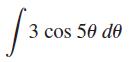
Find the most general antiderivative or indefinite integral. You may need to try a solution and then adjust your guess. Check your answers by differentiation. 3 cos 50 de
Gives the first derivative of a function y = ƒ(x). (a) At what points, if any, does the graph of ƒ have a local maximum, local minimum, or inflection point? (b) Sketch the general shape of the graph.y′ = 6x(x + 1)(x - 2)
Gives the first derivative of a function y = ƒ(x). (a) At what points, if any, does the graph of ƒ have a local maximum, local minimum, or inflection point? (b) Sketch the general shape of the graph.y′ = x2 - x - 6
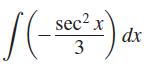
Find the most general antiderivative or indefinite integral. You may need to try a solution and then adjust your guess. Check your answers by differentiation. SE sec² x 3 dx a
a. Identify the function’s local extreme values in the given domain, and say where they occur.b. Which of the extreme values, if any, are absolute?c. Support your findings with a graphing calculator or computer grapher. f(t) = 12t – - t³, −3 ≤ t < -3
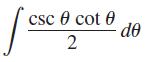
Find the most general antiderivative or indefinite integral. You may need to try a solution and then adjust your guess. Check your answers by differentiation. csc 0 cot 0 2 de
Gives the first derivative of a function y = ƒ(x). (a) At what points, if any, does the graph of ƒ have a local maximum, local minimum, or inflection point? (b) Sketch the general shape of the graph.y′ = x4 - 2x2
Gives the first derivative of a function y = ƒ(x). (a) At what points, if any, does the graph of ƒ have a local maximum, local minimum, or inflection point? (b) Sketch the general shape of the graph.y′ = x2(6 - 4x)
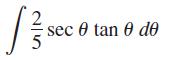
Find the most general antiderivative or indefinite integral. You may need to try a solution and then adjust your guess. Check your answers by differentiation. [ 3 - sec 0 tan 0 de
Gives the first derivative of a function y = ƒ(x). (a) At what points, if any, does the graph of ƒ have a local maximum, local minimum, or inflection point? (b) Sketch the general shape of the graph.y′ = 4x2 - x4
Graph each function. Then use the function’s first derivative to explain what you see.y = x2/3 + (x - 1)1/3
Graph each function. Then use the function’s first derivative to explain what you see.y = x2/3 + (x - 1)2/3
Graph each function. Then use the function’s first derivative to explain what you see.y = x1/3 + (x - 1)1/3
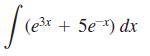
Find the most general antiderivative or indefinite integral. You may need to try a solution and then adjust your guess. Check your answers by differentiation. [(e³x (e³x + 5ex) dx
a. Identify the function’s local extreme values in the given domain, and say where they occur.b. Which of the extreme values, if any, are absolute?c. Support your findings with a graphing calculator or computer grapher. h(x) = x³ 3 - 2x² + 4x, 0 ≤ x
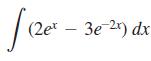
Find the most general antiderivative or indefinite integral. You may need to try a solution and then adjust your guess. Check your answers by differentiation. [(ze (2e - 3e-2x) dx
Showing 11900 - 12000
of 29454
First
113
114
115
116
117
118
119
120
121
122
123
124
125
126
127
Last
Step by Step Answers

 Get 50% OFF
Claim Now
Get 50% OFF
Claim Now