New Semester
Started
Get
50% OFF
Study Help!
--h --m --s
Claim Now
Question Answers
Textbooks
Find textbooks, questions and answers
Oops, something went wrong!
Change your search query and then try again
S
Books
FREE
Study Help
Expert Questions
Accounting
General Management
Mathematics
Finance
Organizational Behaviour
Law
Physics
Operating System
Management Leadership
Sociology
Programming
Marketing
Database
Computer Network
Economics
Textbooks Solutions
Accounting
Managerial Accounting
Management Leadership
Cost Accounting
Statistics
Business Law
Corporate Finance
Finance
Economics
Auditing
Tutors
Online Tutors
Find a Tutor
Hire a Tutor
Become a Tutor
AI Tutor
AI Study Planner
NEW
Sell Books
Search
Search
Sign In
Register
study help
mathematics
precalculus
Calculus Of A Single Variable 11th Edition Ron Larson, Bruce H. Edwards - Solutions
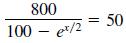
Solve for x accurate to three decimal places. 800 100 e¹/2 50
Solve for x accurate to three decimal places. 5000 1 + ²x 2x e 2
Which of the following functions are their own derivative?y = ex + 4 y = ex y = e4x y = 4ex
Explain when to use long division before applying the Log Rule.
What is the value of n?ln 4 + ln(n-1) = ln 4 - ln 7
The function f has an inverse function, f-1. Is the domain of f the same as the domain of f-1? Explain.
Describe two ways to alter an integrand so that it fits an integration formula.
The function f is decreasing on its domain and has an inverse function, f-1. Is f-1 increasing, decreasing, or constant on its domain?
Integrating which trigonometric function results in ln|sin x| + C?
State the Chain Rule version of the derivative of the natural logarithmic function in your own words.
Sketch the graph of the function and state its domain.f (x) = ln 2x
Sketch the graph of the function.y = e-x
Sketch the graph of the function and state its domain.f (x) = -2 ln x
Solve for x accurate to three decimal places.ln x2 = -8
Sketch the graph of the function and state its domain.f (x) = ln |x|
Sketch the graph of the function.y = ex + 1
Use a graphing utility to graph the function. Then use the Horizontal Line Test to determine whether the function is one-to-one on its entire domain and therefore has an inverse function.f (x) = 1 - x3
Sketch the graph of the function.y = 1/3ex
Use a graphing utility to graph the function. Then use the Horizontal Line Test to determine whether the function is one-to-one on its entire domain and therefore has an inverse function.f (x) = x cos x
Use the properties of logarithms to expand the logarithmic expression.ln x/4
Sketch the graph of the function.y = e-x2
Sketch the graph of the function.y = -e-x-1
Use the properties of logarithms to expand the logarithmic expression.ln√x5
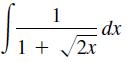
Find the indefinite integral by making a change of variables 1 + 1 2x dx
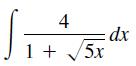
Find the indefinite integral by making a change of variables |++ 4 1 + √5x dx
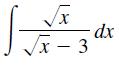
Find the indefinite integral by making a change of variables √x dx √x - 3
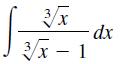
Find the indefinite integral by making a change of variables X 3√x-1 dx
Use the properties of logarithms to expand the logarithmic expression.ln xy/z
Sketch the graph of the function.y = e-x/2
Use a graphing utility to graph the function. Then use the Horizontal Line Test to determine whether the function is one-to-one on its entire domain and therefore has an inverse function.h(x) = ln x2
Use the properties of logarithms to expand the logarithmic expression.x ln √x - 4
Use the derivative to determine whether the function is strictly monotonic on its entire domain and therefore has an inverse function.f (x) = 8x3 + x2 - 1
Use the derivative to determine whether the function is strictly monotonic on its entire domain and therefore has an inverse function.f (x) = 1 - x3 - 6x5
Use the properties of logarithms to expand the logarithmic expression.ln z/e
Show that f is strictly monotonic on the given interval and therefore has an inverse function on that interval.f (x) = (x - 4)2, [4, ∞)
(a) Find the inverse function of f,(b) Graph f and f-1 on the same set of coordinate axes,(c) Describe the relationship between the graphs, and(d) State the domains and ranges of f and f-1.f (x) = x5
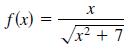
(a) Find the inverse function of f,(b) Graph f and f-1 on the same set of coordinate axes,(c) Describe the relationship between the graphs, and(d) State the domains and ranges of f and f-1. X 2 √x² + 7
Write the expression as a logarithm of a single quantity.4 ln 2 -1/2 ln(x3 + 6x)
(a) Find the inverse function of f,(b) Graph f and f-1 on the same set of coordinate axes,(c) Describe the relationship between the graphs, and(d) State the domains and ranges of f and f-1.f (x) = √x
(a) Find the inverse function of f,(b) Graph f and f-1 on the same set of coordinate axes,(c) Describe the relationship between the graphs, and(d) State the domains and ranges of f and f-1.f (x) = 9 - 5x
Find the derivative of the function.y = e-2x3
Find the derivative of the function.y = ex-4
(a) Find the inverse function of f,(b) Graph f and f-1 on the same set of coordinate axes,(c) Describe the relationship between the graphs, and(d) State the domains and ranges of f and f-1.f (x) = x3 - 1
Find the derivative of the function.y = 5ex2+5
Find the derivative of the function.y = ex ln x
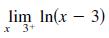
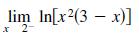
Find the limit.
(a) Find the inverse function of f,(b) Graph f and f-1 on the same set of coordinate axes,(c) Describe the relationship between the graphs, and(d) State the domains and ranges of f and f-1.f (x) = √4 - x2, 0 ≤ x ≤ 2
(a) Find the inverse function of f,(b) Graph f and f-1 on the same set of coordinate axes,(c) Describe the relationship between the graphs, and(d) State the domains and ranges of f and f-1.f (x) = x4, x ≥ 0
Find the derivative of the function.y = xe4x
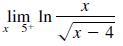
Find the limit.
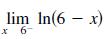
Find the limit.
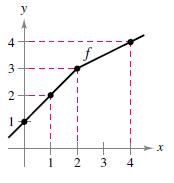
Use the graph of the function f to make a table of values for the given points. Then make a second table that can be used to find f-1 and sketch the graph of f-1. To print an enlarged copy of graph, go to MathGraphs.com. 4 3 2 y 1 f I 2 3 I I 4
(a) Find the inverse function of f,(b) Graph f and f-1 on the same set of coordinate axes,(c) Describe the relationship between the graphs, and(d) State the domains and ranges of f and f-1.f (x) = 3√x - 1
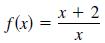
(a) Find the inverse function of f,(b) Graph f and f-1 on the same set of coordinate axes,(c) Describe the relationship between the graphs, and(d) State the domains and ranges of f and f-1. f(x) = x + 2 X
Find the derivative of the function.y = (x + 1)2ex
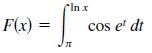
Find the limit.
Find the derivative of the function.y = x2e-x
Find the derivative of the function.f (x) = ln(x2 + 3)
Find the derivative of the function.f (x) = ln 3x
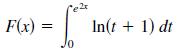
Find the derivative of the function.
Find the derivative of the function.f (x) = ln(x - 1)
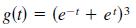
Find the derivative of the function.g(t) = e-3/t2
Find the derivative of the function.y = (ln x)4
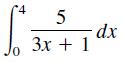
Evaluate the definite integral. Use a graphing utility to verify your result. 4 5 3x + 1 dx
Find the derivative of the function.y = ln(2 - e5x)
Find the derivative of the function.h(x) = ln(2x2 + 1)
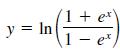
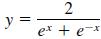
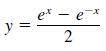
Find the derivative of the function.
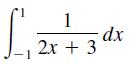
Evaluate the definite integral. Use a graphing utility to verify your result. S₁ -1 1 2x + 3 dx
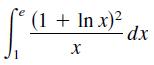
Evaluate the definite integral. Use a graphing utility to verify your result. (1 + In x)² X
Find the derivative of the function.
Find the derivative of the function.y = x2 ln x
Find the derivative of the function.
Find the derivative of the function.y = ln(x√x2 - 1)
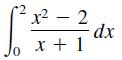
Evaluate the definite integral. Use a graphing utility to verify your result. [² x² - 2 x + 1 dx
Find the derivative of the function.y = ln√x2 - 4
Find the derivative of the function.
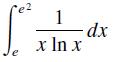
Evaluate the definite integral. Use a graphing utility to verify your result. e 1 x ln - dx x
Find the derivative of the function.f(x) = ln x/ x2 + 1
Find the derivative of the function.y = ex(sin x + cos x)
Find the derivative of the function.y = ln[t(t2 + 3)3]
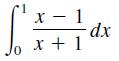
Evaluate the definite integral. Use a graphing utility to verify your result. S x - 1 x + 1 dx
Find the derivative of the function.y = e2xtan 2x
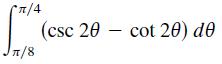
Evaluate the definite integral. Use a graphing utility to verify your result. Cπ/4 Jл/8 (csc 20 cot 20) de
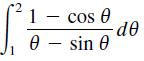
Evaluate the definite integral. Use a graphing utility to verify your result. J 1 - cos Ꮎ - dᎾ Ꮎ - sin Ꮎ
Find the derivative of the function.
Find the derivative of the function.f (x) = ln 2x / x + 3
Find the derivative of the function.
Find the derivative of the function.g(t) = ln t/ t2
Find the derivative of the function.y = ln(ln x2)
Find the derivative of the function.h(t) = ln t/t3 + 5
Find an equation of the tangent line to the graph of the function at the given point.f(x) = e-x - 6, (0, -5)
Find the derivative of the function.y = ln √x + 1/ x - 1
Find an equation of the tangent line to the graph of the function at the given point.y = e3x-x2, (3, 1)
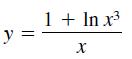
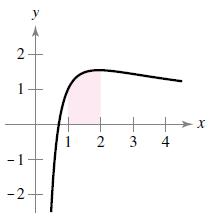
Find the area of the given region. Use a graphing utility to verify your result. y = 1 + ln x³ X
Find the derivative of the function.y = ln(ln x)
Find the derivative of the function.f (x) = ln √4 + x2 /x
Find an equation of the tangent line to the graph of the function at the given point.f (x) = e-x ln x, (1, 0)
Find the derivative of the function.y = ln 3√x - 1/ x + 1
Find the derivative of the function.f (x) = ln(x + √4 + x2)
Find the derivative of the function.y = ln |sin x|
Showing 11600 - 11700
of 29454
First
110
111
112
113
114
115
116
117
118
119
120
121
122
123
124
Last
Step by Step Answers

 Get 50% OFF
Claim Now
Get 50% OFF
Claim Now