New Semester
Started
Get
50% OFF
Study Help!
--h --m --s
Claim Now
Question Answers
Textbooks
Find textbooks, questions and answers
Oops, something went wrong!
Change your search query and then try again
S
Books
FREE
Study Help
Expert Questions
Accounting
General Management
Mathematics
Finance
Organizational Behaviour
Law
Physics
Operating System
Management Leadership
Sociology
Programming
Marketing
Database
Computer Network
Economics
Textbooks Solutions
Accounting
Managerial Accounting
Management Leadership
Cost Accounting
Statistics
Business Law
Corporate Finance
Finance
Economics
Auditing
Tutors
Online Tutors
Find a Tutor
Hire a Tutor
Become a Tutor
AI Tutor
AI Study Planner
NEW
Sell Books
Search
Search
Sign In
Register
study help
mathematics
precalculus
Calculus Of A Single Variable 11th Edition Ron Larson, Bruce H. Edwards - Solutions
Find the areas of the regions enclosed by the lines and curves.y = x2 - 2 and y = 2
Find the areas of the regions enclosed by the lines and curves.y = 2x - x2 and y = -3
Find the areas of the regions enclosed by the lines and curves.y = x4 and y = 8x
Find the areas of the regions enclosed by the lines and curves.y = x2 - 2x and y = x
Find the areas of the regions enclosed by the lines and curves.y = x2 and y = -x2 + 4x
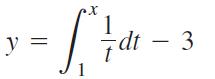
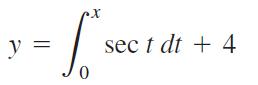
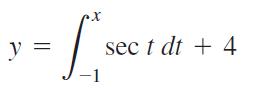
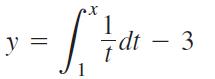
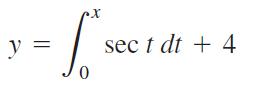
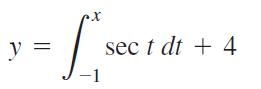
Each of the following functions solves one of the initial value problem. Which function solves which problem? Give brief reasons for your answers.a.b.c.d. y = S 1 1 -dt lt - 3
Each of the following functions solves one of the initial value problem. Which function solves which problem? Give brief reasons for your answers.a.b.c.d. y = S 1 1 -dt lt - 3
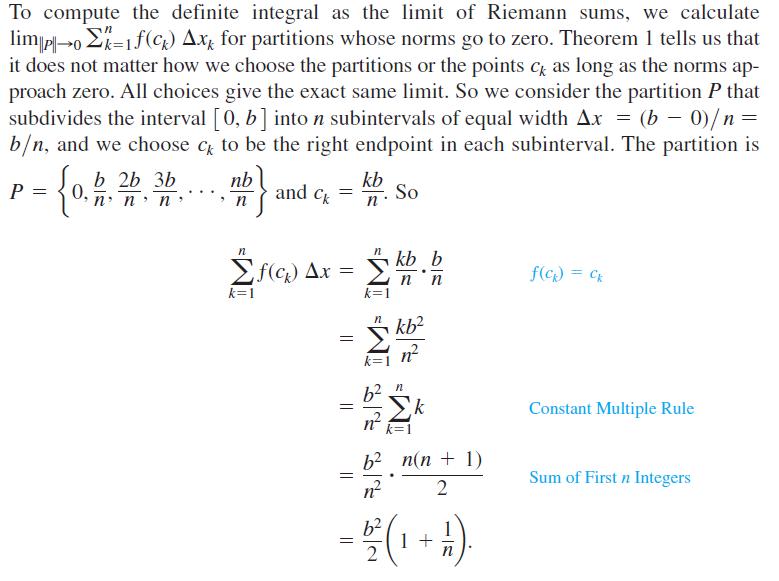
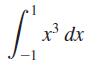
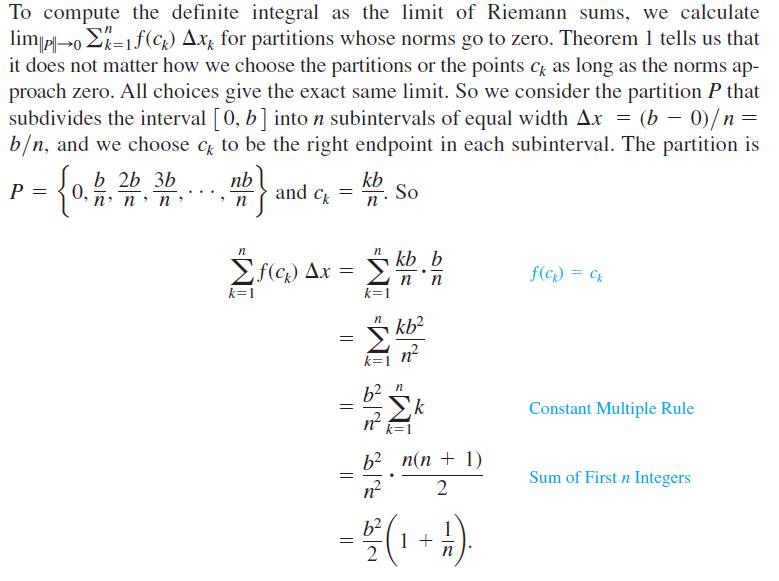
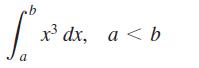
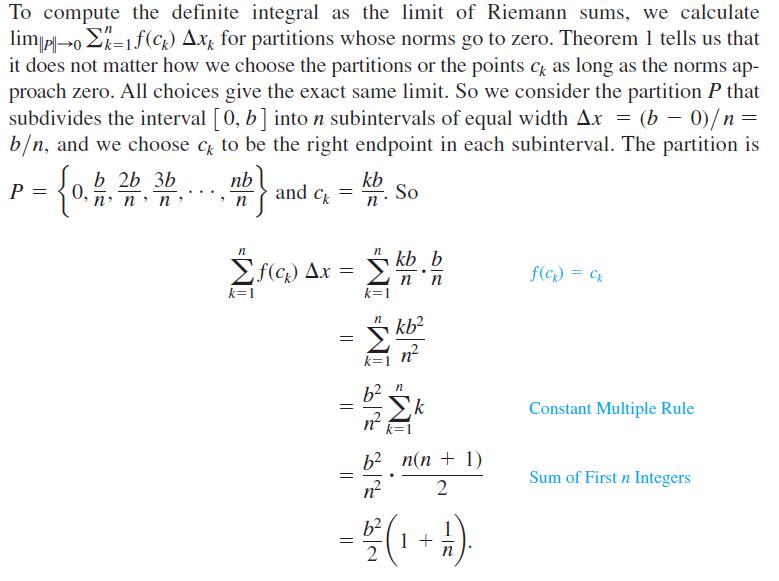
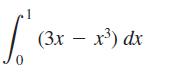
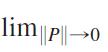
Use the method of Example 4a or Equation (1) to evaluate the definite integral.Example 4aCompute ∫0bx dx and find the area A under y = x over the interval [0, b], b > 0. To compute the definite integral as the limit of Riemann sums, we calculate lim-0 =1f(c) Ax for partitions whose norms go to
If you do not know what substitution to make, try reducing the integral step by step, using a trial substitution to simplify the integral a bit and then another to simplify it some more. You will see what we mean if you try the sequences of substitution.a. u = x - 1, followed by ν = sin u, then by
Use the method of Example 4a or Equation (1) to evaluate the definite integral.Example 4aCompute ∫0bx dx and find the area A under y = x over the interval [0, b], b > 0. To compute the definite integral as the limit of Riemann sums, we calculate lim-0 =1f(c) Ax for partitions whose norms go to
Use the method of Example 4a or Equation (1) to evaluate the definite integral.Example 4aCompute ∫0bx dx and find the area A under y = x over the interval [0, b], b > 0. To compute the definite integral as the limit of Riemann sums, we calculate lim-0 =1f(c) Ax for partitions whose norms go to
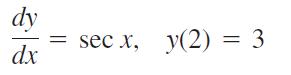
Express the solutions of the initial value problem in terms of integral. dy dx = sec x, y(2) = 3
Find the areas of the regions enclosed by the lines and curves. y=x√a² = x², a>0, and y = 0
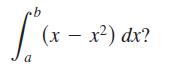
What values of a and b maximize the value of [² a (x - x²) dx?
Find the areas of the regions enclosed by the lines and curves.y = 7 - 2x2 and y = x2 + 4
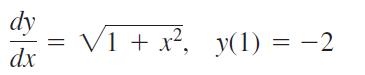
Express the solutions of the initial value problem in terms of integral. dy dx = V1 + x, y(1) = -2
Find the areas of the regions enclosed by the lines and curves.How many intersection points are there?z y Vxand and 5y = x + 6
Find the areas of the regions enclosed by the lines and curves.y = x4 - 4x2 + 4 and y = x2
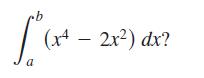
What values of a and b minimize the value of Le (x4 - 2x²) dx? a
Archimedes (287–212 B.C.), inventor, military engineer, physicist, and the greatest mathematician of classical times in the Western world, discovered that the area under a parabolic arch is two-thirds the base times the height. Sketch the parabolic arch y = h - (4h/b2)x2, -b/2 ≤ x ≤ b/2,
Find the areas of the regions enclosed by the lines and curves. y = |x² − 4 and y - = y = (x²/2) + 4
The velocity of a particle moving back and forth on a line is y = ds/dt = 6 sin 2t m/sec for all t. If s = 0 when t = 0, find the value of s when t = π/2 sec.
The acceleration of a particle moving back and forth on a line is a = d2s/dt2 = π2 cos πt m/sec2 for all t. If s = 0 and v = 8 m/sec when t = 0, find s when t = 1 sec.
let F(x) = ∫au(x) ƒ(t) dt for the specified a, u, and ƒ. Use a CAS to perform the following steps and answer the questions posed.a. Find the domain of F.b. Calculate F′(x) and determine its zeros. For what points in its domain is F increasing? Decreasing?c. Calculate F″(x) and determine
a. Draw a figure like the one in Exercise 83 for a continuous function ƒ(x) whose values decrease steadily as x moves from left to right across the interval [a, b]. Let P be a partition of [a, b] into subintervals of equal length. Find an expression for U - L that is analogous to the one you found
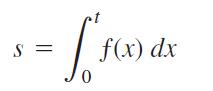
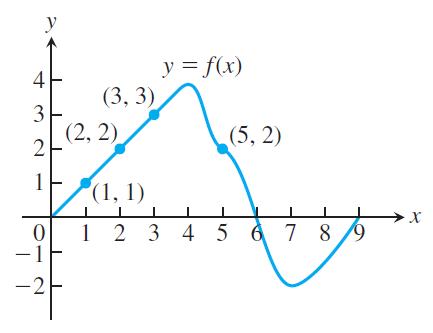
Suppose that ƒ is the differentiable function shown in the accompanying graph and that the position at time t (sec) of a particle moving along a coordinate axis ismeters. Use the graph to answer the following questions. Give reasons for your answers.a. What is the particle’s velocity at time t =
Find the areas of the regions enclosed by the lines and curves. x = y² - 1 and = |y|√1 - y² and x =
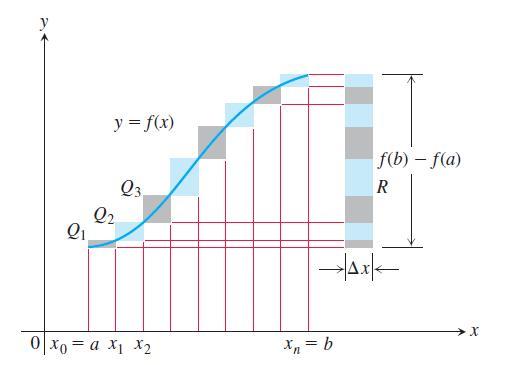
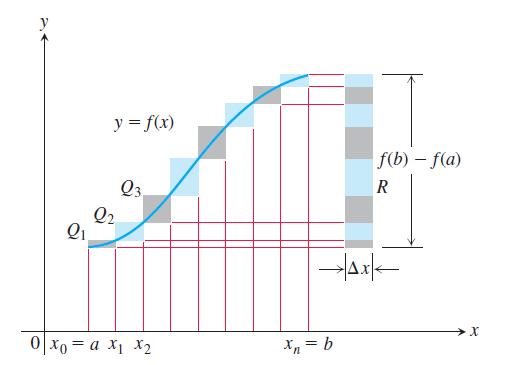
a. Suppose the graph of a continuous function ƒ(x) rises steadily as x moves from left to right across an interval [a, b]. Let P be a partition of [a, b] into n subintervals of equal length Δx = (b - a)/n. Show by referring to the accompanying figure that the difference between the upper and
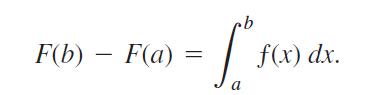
a. Let a = x0 < x1 < x2 · · · < xn = b be any partition of [a, b], and let F be any antiderivative of ƒ. Show thatb. Apply the Mean Value Theorem to each term to show that F(xi) - F(xi-1) = ƒ(ci)(xi - xi-1) for some ci in the interval (xi-1, xi). Then show that F(b) - F(a)
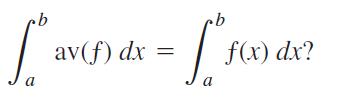
If av(ƒ) really is a typical value of the integrable function ƒ(x) on [a, b], then the constant function av(ƒ) should have the same integral over [a, b] as ƒ. Does it? That is, doesGive reasons for your answer. pb ["av(1) dx = f* f(x) a f(x) dx?
Find the areas of the regions enclosed by the lines and curves.x - y2/3 = 0 and x + y4 = 2
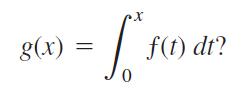
Suppose that ƒ has a positive derivative for all values of x and that ƒ(1) = 0. Which of the following statements must be true of the functionGive reasons for your answers.a. g is a differentiable function of x.b. g is a continuous function of x.c. The graph of g has a horizontal tangent at x =
Find ƒ(4) if ∫0x ƒ(t) dt = x cos πx.
Use the inequality sin x ≤ x, which holds for x ≥ 0, to find an upper bound for the value of ∫01 sin x dx.
The inequality sec x ≥ 1 + (x2/2) holds on (-π/2, π/2). Use it to find a lower bound for the value of ∫01 sec x dx.
Find the areas of the regions enclosed by the lines and curves.x = y3 - y2 and x = 2y
Find the areas of the regions enclosed by the curves.4x2 + y = 4 and x4 - y = 1
Let F(x) = ∫axƒ(t) dt for the specified function ƒ and interval [a, b]. Use a CAS to perform the following steps and answer the questions posed.a. Plot the functions ƒ and F together over [a, b].b. Solve the equation F′(x) = 0. What can you see to be true about the graphs of ƒ and F at
It would be nice if average values of integrable functions obeyed the following rules on an interval [a, b].a. av(ƒ + g) = av(ƒ) + av(g)b. av(kƒ) = k av(ƒ) (any number k)c. av(ƒ) ≤ av(g) if ƒ(x) ≤ g(x) on [a, b].Do these rules ever hold? Give reasons for your answers.
Let F(x) = ∫axƒ(t) dt for the specified function ƒ and interval [a, b]. Use a CAS to perform the following steps and answer the questions posed.a. Plot the functions ƒ and F together over [a, b].b. Solve the equation F′(x) = 0. What can you see to be true about the graphs of ƒ and F at
Find the areas of the regions enclosed by the curves.x3 - y = 0 and 3x2 - y = 4
Let F(x) = ∫au(x) ƒ(t) dt for the specified a, u, and ƒ. Use a CAS to perform the following steps and answer the questions posed.a. Find the domain of F.b. Calculate F′(x) and determine its zeros. For what points in its domain is F increasing? Decreasing?c. Calculate F″(x) and determine
Let F(x) = ∫axƒ(t) dt for the specified function ƒ and interval [a, b]. Use a CAS to perform the following steps and answer the questions posed.a. Plot the functions ƒ and F together over [a, b].b. Solve the equation F′(x) = 0. What can you see to be true about the graphs of ƒ and F at
Find the areas of the regions enclosed by the curves.x + 4y2 = 4 and x + y4 = 1, for x ≥ 0
Find the areas of the regions enclosed by the curves.x + y2 = 3 and 4x + y2 = 0
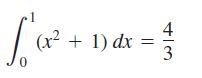
If your CAS can draw rectangles associated with Riemann sums, use it to draw rectangles associated with Riemann sums that converge to the integral. Use n = 4, 10, 20, and 50 subintervals of equal length in each case. L'ox² Jo (x² + 1) dx = 3
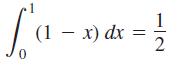
If your CAS can draw rectangles associated with Riemann sums, use it to draw rectangles associated with Riemann sums that converge to the integral. Use n = 4, 10, 20, and 50 subintervals of equal length in each case. L'a (1-x) dx = 2
Let F(x) = ∫axƒ(t) dt for the specified function ƒ and interval [a, b]. Use a CAS to perform the following steps and answer the questions posed.a. Plot the functions ƒ and F together over [a, b].b. Solve the equation F′(x) = 0. What can you see to be true about the graphs of ƒ and F at
Find the areas of the regions enclosed by the lines and curves.y = 2 sin x and y = sin 2x, 0 ≤ x ≤ π
Find the areas of the regions enclosed by the lines and curves.y = 8 cos x and y = sec2 x, -π/3 ≤ x ≤ π/3
Find the areas of the regions enclosed by the lines and curves.y = cos (πx/2) and y = 1 - x2
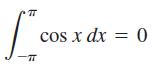
If your CAS can draw rectangles associated with Riemann sums, use it to draw rectangles associated with Riemann sums that converge to the integral. Use n = 4, 10, 20, and 50 subintervals of equal length in each case. [co cos x dx = 0
Find the areas of the regions enclosed by the lines and curves. V = sec² (7x/3) and y = x¹/³, -1 ≤ x ≤ 1
If you average 30 mi/h on a 150-mi trip and then return over the same 150 mi at the rate of 50 mi/h, what is your average speed for the trip? Give reasons for your answer.
Find the areas of the regions enclosed by the lines and curves. x = 3 sin y Vcos y and x = 0, 0≤ y ≤ π/2
Assume that ƒ is continuous and u(x) is twicedifferentiable.Calculateand check your answer using a CAS. ¹P (1)ƒ a dx P CT
Find the areas of the regions enclosed by the lines and curves.y = sin (πx/2) and y = x
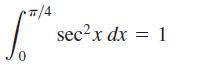
If your CAS can draw rectangles associated with Riemann sums, use it to draw rectangles associated with Riemann sums that converge to the integral. Use n = 4, 10, 20, and 50 subintervals of equal length in each case. π/4 sec² x dx = 1
Find the areas of the regions enclosed by the lines and curves.y = sec2 x, y = tan2 x, x = -π/4, and x = π/4
If your CAS can draw rectangles associated with Riemann sums, use it to draw rectangles associated with Riemann sums that converge to the integral. Use n = 4, 10, 20, and 50 subintervals of equal length in each case.The integral’s value is about 0.693. 2 S rdx X
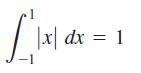
If your CAS can draw rectangles associated with Riemann sums, use it to draw rectangles associated with Riemann sums that converge to the integral. Use n = 4, 10, 20, and 50 subintervals of equal length in each case. -1 |x| dx = 1
Find the areas of the regions enclosed by the lines and curves.x = tan2 y and x = -tan2 y, -π/4 ≤ y ≤ π/4
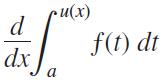
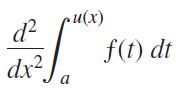
Assume that ƒ is continuous and u(x) is twicedifferentiable.Calculateand check your answer using a CAS. f(t) dt a LEND (x)no zxp zP
let F(x) = ∫au(x) ƒ(t) dt for the specified a, u, and ƒ. Use a CAS to perform the following steps and answer the questions posed.a. Find the domain of F.b. Calculate F′(x) and determine its zeros. For what points in its domain is F increasing? Decreasing?c. Calculate F″(x) and
Let F(x) = ∫au(x) ƒ(t) dt for the specified a, u, and ƒ. Use a CAS to perform the following steps and answer the questions posed.a. Find the domain of F.b. Calculate F′(x) and determine its zeros. For what points in its domain is F increasing? Decreasing?c. Calculate F″(x) and
Find the area of the propeller-shaped region enclosed by the curve x - y3 = 0 and the line x - y = 0.
Find the area of the propeller-shaped region enclosed by the curves x - y1/3 = 0 and x - y1/5 = 0.
Find the area of the region in the first quadrant bounded by the line y = x, the line x = 2, the curve y = 1/x2, and the x-axis.
Find the area of the “triangular” region in the first quadrant bounded on the left by the y-axis and on the right by the curves y = sin x and y = cos x.
Find the area between the curves y = ln x and y = ln 2x from x = 1 to x = 5.
Find the area between the curve y = tan x and the x-axis from x = -π/4 to x = π/3.
Find the area of the “triangular” region in the first quadrant that is bounded above by the curve y = e2x, below by the curve y = ex, and on the right by the line x = ln 3.
Find the area of the “triangular” region in the first quadrant that is bounded above by the curve y = ex/2, below by the curve y = e-x/2, and on the right by the line x = 2 ln 2.
Find the area of the region between the curve y = 2x/(1 + x2) and the interval -2 ≤ x ≤ 2 of the x-axis.
Find the area of the region between the curve y = 21-x and the interval -1 ≤ x ≤ 1 of the x-axis.
The region bounded below by the parabola y = x2 and above by the line y = 4 is to be partitioned into two subsections of equal area by cutting across it with the horizontal line y = c.a. Sketch the region and draw a line y = c across it that looks about right. In terms of c, what are the
Find the area of the region between the curve y = 3 - x2 and the line y = -1 by integrating with respect to a. x, b. y.
Find the area of the region in the first quadrant bounded on the left by the y-axis, below by the line y = x/4, above left by the curve y = 1 + √x, and above right by the curve y = 2/√x.
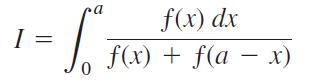
If ƒ is a continuous function, find the value of the integralby making the substitution u = a - x and adding the resulting integral to I. J- = I 0 xp (x) f f(x) + f(a − x)
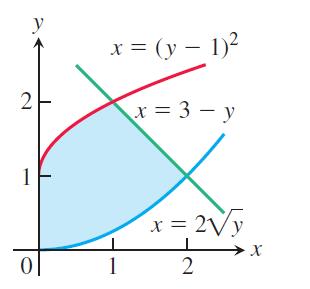
Find the area of the region in the first quadrant bounded on the left by the y-axis, below by the curve x = 2√y, above left by the curve x = (y - 1)2, and above right by the line x = 3 - y. 2 1 0 x = (y − 1)² 1 x=3-y x = 2√/y 2
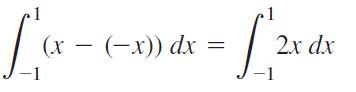
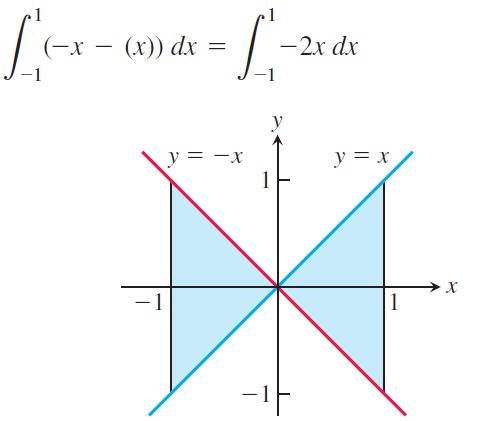
Which of the following integrals, if either, calculates the area of the shaded region shown here? Give reasons for your answer.a.b. L'or (x - (-x)) dx = ['2v dx 2x
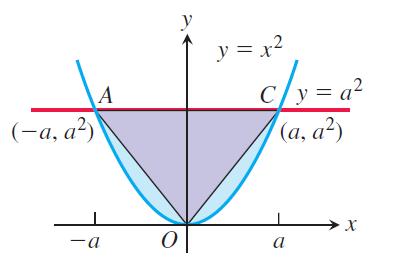
The figure here shows triangle AOC inscribed in the region cut from the parabola y = x2 by the line y = a2. Find the limit of the ratio of the area of the triangle to the area of the parabolic region as a approaches zero. (-a, a²) A -a y O y = x² c/y=a² (a, a²) a X
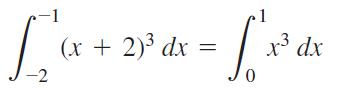
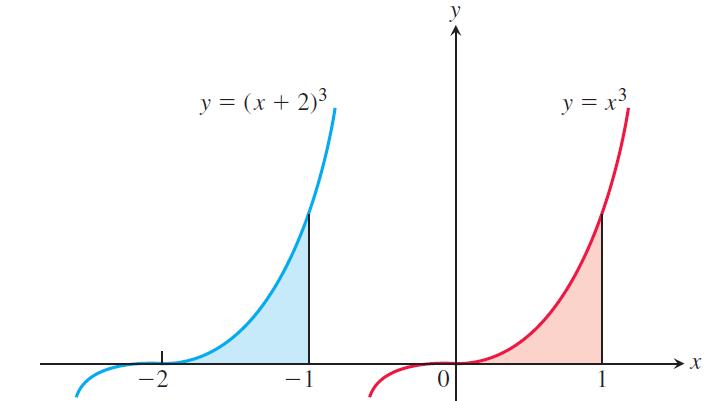
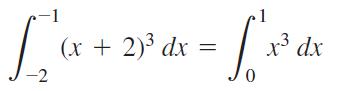
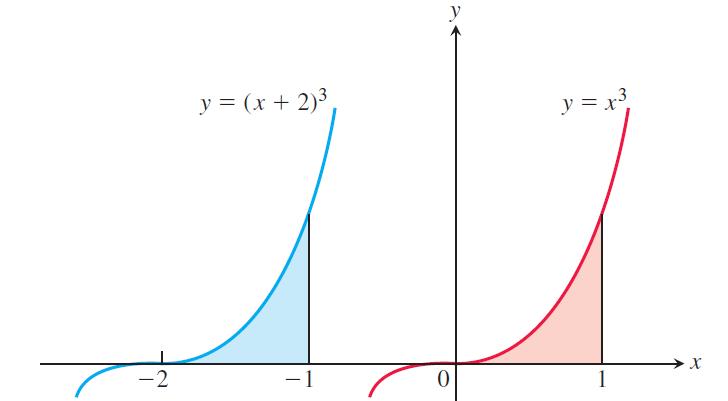
A basic property of definite integrals is their invariance under translation, as expressed by the equationThe equation holds whenever ƒ is integrable and defined for the necessary values of x. For example in the accompanying figure, show thatbecause the areas of the shaded regions are
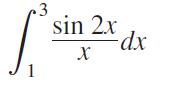
Suppose that F(x) is an antiderivative of ƒ(x) = (sin x) > x, x > 0. Expressin terms of F. 3 sin 2x X dx
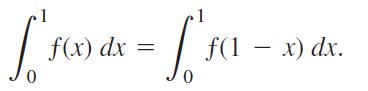
Show that if ƒ is continuous, then [ 1630) dx = ['10₁1 I's f(x) 0 f(1-x) dx.
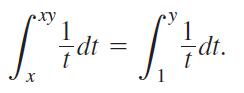
By using a substitution, prove that for all positive numbers x and y, • xy X 7dt = 7 dt.
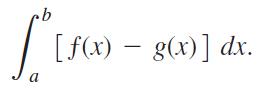
True, sometimes true, or never true? The area of the region between the graphs of the continuous functions y = ƒ(x) and y = g(x) and the vertical lines x = a and x = b (a < b) isGive reasons for your answer. b Stroo [f(x) = g(x)] dx. a
Suppose the area of the region between the graph of a positive continuous function ƒ and the x-axis from x = a to x = b is 4 square units. Find the area between the curves y = ƒ(x) and y = 2ƒ(x) from x = a to x = b.
A basic property of definite integrals is their invariance under translation, as expressed by the equationThe equation holds whenever ƒ is integrable and defined for the necessary values of x. For example in the accompanying figure, show thatbecause the areas of the shaded regions are
You will find the area between curves in the plane when you cannot find their points of intersection using simple algebra. Use a CAS to perform the following steps:a. Plot the curves together to see what they look like and how many points of intersection they have.b. Use the numerical equation
You will find the area between curves in the plane when you cannot find their points of intersection using simple algebra. Use a CAS to perform the following steps:a. Plot the curves together to see what they look like and how many points of intersection they have.b. Use the numerical equation
You will find the area between curves in the plane when you cannot find their points of intersection using simple algebra. Use a CAS to perform the following steps:a. Plot the curves together to see what they look like and how many points of intersection they have.b. Use the numerical equation
You will find the area between curves in the plane when you cannot find their points of intersection using simple algebra. Use a CAS to perform the following steps:a. Plot the curves together to see what they look like and how many points of intersection they have.b. Use the numerical equation
Find the derivative of the function.y = ln(t +1)2
You need a total of 50 pounds of two commodities costing $1.25 and $2.75 per pound.(a) Verify that the total cost is y = 1.25x + 2.75(50 - x), where x is the number of pounds of the less expensive commodity.(b) Find the inverse function of the cost function. What does each variable represent in the
Find the derivative of the function.
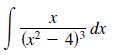
Can you use the Log Rule to find the integral below? Explain. X (x²-4)³ dx
Explain why ln x is positive for x > 1 and negative for 0 < x < 1.
In your own words, describe what it means to say that the function g is the inverse function of the function f.
Describe the graph of f (x) = ex.
Showing 11500 - 11600
of 29454
First
109
110
111
112
113
114
115
116
117
118
119
120
121
122
123
Last
Step by Step Answers

 Get 50% OFF
Claim Now
Get 50% OFF
Claim Now