New Semester
Started
Get
50% OFF
Study Help!
--h --m --s
Claim Now
Question Answers
Textbooks
Find textbooks, questions and answers
Oops, something went wrong!
Change your search query and then try again
S
Books
FREE
Study Help
Expert Questions
Accounting
General Management
Mathematics
Finance
Organizational Behaviour
Law
Physics
Operating System
Management Leadership
Sociology
Programming
Marketing
Database
Computer Network
Economics
Textbooks Solutions
Accounting
Managerial Accounting
Management Leadership
Cost Accounting
Statistics
Business Law
Corporate Finance
Finance
Economics
Auditing
Tutors
Online Tutors
Find a Tutor
Hire a Tutor
Become a Tutor
AI Tutor
AI Study Planner
NEW
Sell Books
Search
Search
Sign In
Register
study help
mathematics
precalculus
Calculus Early Transcendentals 8th edition James Stewart - Solutions
Find all values of x in the interval [0, 2π] that satisfy the equation.sin 2x = cos x
Find all values of x in the interval [0, 2π] that satisfy the equation.2 cos x + sin 2x = 0
Find all values of x in the interval [0, 2π] that satisfy the equation.sin x = tan x
Find all values of x in the interval [0, 2π] that satisfy the equation.2 + cos 2x = 3 cos x
Find all values of x in the interval [0, 2π] that satisfy the inequality.sin x < 1/2
Find all values of x in the interval [0, 2π] that satisfy the inequality.2 cos x + 1 > 0
Find all values of x in the interval [0, 2π] that satisfy the inequality.-1 < tan x < 1
Find all values of x in the interval [0, 2π] that satisfy the inequality.sin x > cos x
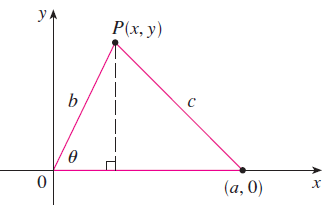
Prove the Law of Cosines: If a triangle has sides with lengths a, b, and c, and θ is the angle between the sides with lengths a and b, then c2 = a2 + b2 - 2ab cos θ Introduce a coordinate system so that θ is in standard position, as in the figure. Express x and y in terms of θ and then use the
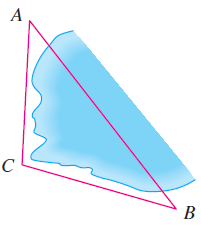
In order to find the distance |AB|across a small inlet, a point C was located as in the figure and the following measurements were recorded: ∠C = 103o |AC| = 820 m |BC| = 910 m Use the Law of Cosines from Exercise 83 to find the required distance.
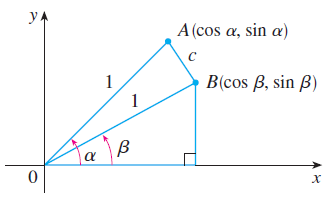
Use the figure to prove the subtraction formula cos(a - B) = cos a cos B + sin a sin B Compute c2 in two ways (using the Law of Cosines from Exercise 83 and also using the distance formula) and compare the two expressions.]
Use the addition formula for cosine and the identitiescos(π/2 - θ) = sin θsin(π/2 - θ) = cos θto prove the subtraction formula (13a) for the sine function.
Show that the area of a triangle with sides of lengths a and b and with included angle θ isA = 1/2 ab sin θ
Find the area of triangle ABC, correct to five decimal places, if|AB | − 10 cm |BC | − 3 cm /ABC = 107o
Use spherical coordinates.(a) Find the volume of the solid that lies above the cone Ф = π/3 and below the sphere p = 4 cos Ф.(b) Find the centroid of the solid in part (a).
What does the Squeeze Theorem say?
What does the Intermediate Value Theorem say?
(a) State the First Derivative Test.(b) State the Second Derivative Test.(c) What are the relative advantages and disadvantages of these tests?
Find the length of the curve.y = 4(x - 1)3/2, 1 < x < 4
Determine whether the statement is true or false. If it is true, explain why. If it is false, explain why or give an example that disproves the statement.All solutions of the differential equation y' = -1 - y4 are decreasing functions.
Determine whether the statement is true or false. If it is true, explain why. If it is false, explain why or give an example that disproves the statement.The function f (x) = (ln x)yx is a solution of the differential equation x2y' + xy = 1.
Determine whether the statement is true or false. If it is true, explain why. If it is false, explain why or give an example that disproves the statement.The equation y' = x + y is separable.
Determine whether the statement is true or false. If it is true, explain why. If it is false, explain why or give an example that disproves the statement.The equation y' = 3y - 2x + 6xy - 1 is separable.
Determine whether the statement is true or false. If it is true, explain why. If it is false, explain why or give an example that disproves the statement.The equation exy' = y is linear.
Determine whether the statement is true or false. If it is true, explain why. If it is false, explain why or give an example that disproves the statement.The equation y' + xy = ey is linear.
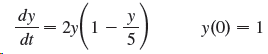
Determine whether the statement is true or false. If it is true, explain why. If it is false, explain why or give an example that disproves the statement. then limt → ∞ y = 5.
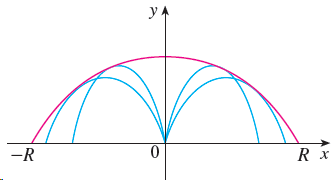
Find the length of the curve.
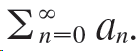
A sequence {an} is defined recursively by the equations Find the sum of the series
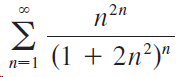
Determine whether the series is convergent or divergent.
Write expressions for the scalar and vector projections of b onto a. Illustrate with diagrams.
Determine whether the statement is true or false. If it is true, explain why. If it is false, explain why or give an example that disproves the statement.The curve with vector equation r(t) = t3i + 2t3 j + 3t3 k is a line.
A particle P moves with constant angular speed w around a circle whose center is at the origin and whose radius is R. The particle is said to be in uniform circular motion. Assume that the motion is counterclockwise and that the particle is at the point (R, 0) when t = 0.The position vector at time
A projectile is fired from the origin with angle of elevation a and initial speed v0. Assuming that air resistance is negligible and that the only force acting on the projectile is gravity, g, we showed in Example 13.4.5 that the position vector of the projectile is r(t) = (v0 cos a)t i + f(v0 sin
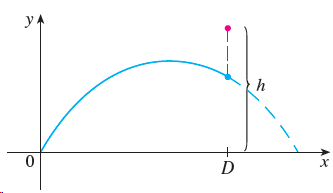
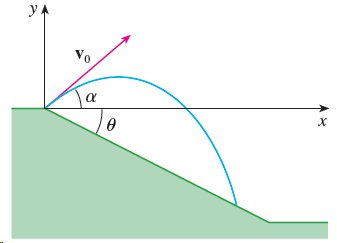
(a) A projectile is fired from the origin down an inclined plane that makes an angle θ with the horizontal. The angle of elevation of the gun and the initial speed of the projectile are a and v0, respectively. Find the position vector of the projectile and the parametric equations of the path of
Find the curvature of the curve with parametric equations
Show that the curve with vector equation r(t) = (a1t2 + b1t + c1, a2t2 + b2t + c2, a3t2 + b3t + c3) lies in a plane and find an equation of the plane.
Find the first partial derivatives.G(x, y, z) = exz sin(y/z)
Find the directional derivative of f at the given point in the indicated direction.f (x, y, z) = x2y + x√1 + z , (1, 2, 3), in the direction of v = 2i + j - 2k
Find the mass and center of mass of the lamina that occupies the region D and has the given density function p.D is bounded by y = 1 - x2 and y = 0; p(x, y) = ky
Use the given transformation to evaluate the integral.where R is the region in the first quadrant bounded by the lines y = x and y = 3x and the hyperbolas xy = 1, xy = 3; x = u/v, y = v
Use spherical coordinates. where E lies above the cone ϕ = π/3 and below the sphere p = 1.
A lamina with constant density p(x, y) = p occupies the given region. Find the moments of inertia Ix and Iy and the radii of gyration x̅̅ and Y̅̅.The region under the curve y = sin x from x = 0 to x = π
Use a computer algebra system to find the mass, center of mass, and moments of inertia of the lamina that occupies the region D and has the given density function.D is enclosed by the right loop of the four-leaved rose r = cos 2θ; p(x, y) = x2 + y2
Use a computer algebra system to find the mass, center of mass, and moments of inertia of the lamina that occupies the region D and has the given density function.D = {(x, y) |0 < y < xe-x, 0 < x < 2}; p(x, y) = x2y2
Use spherical coordinates.Find the volume of the part of the ball p < a that lies between the cones Ф = π/6 and Ф = π/3.
Suppose X and Y are random variables with joint density function (a) Verify that f is indeed a joint density function. (b) Find the following probabilities. (i) P(Y > 1) (ii) P(X 2, Y 4) (c) Find the expected values of X and Y.
A model for the density δ of the earth’s atmosphere near its surface is δ = 619.09 - 0.000097p where (the distance from the center of the earth) is measured in meters and δ is measured in kilograms per cubic meter. If we take the surface of the earth to be a sphere with radius 6370 km,
State the Second Derivatives Test.
A cable has radius r and length L and is wound around a spool with radius R without over-lapping. What is the shortest length along the spool that is covered by the cable?
State the Comparison Theorem for improper integrals.
How do you use power series to solve a differential equation?
Discuss two applications of second-order linear differential equations.
(a) Write the general form of a second-order nonhomogeneous linear differential equation with constant coefficients.(b) What is the complementary equation? How does it help solve the original differential equation?(c) Explain how the method of undetermined coefficients works.(d) Explain how the
(a) What is an initial-value problem for a second-order differential equation?(b) What is a boundary-value problem for such an equation?
(a) Write the general form of a second-order homogeneous linear differential equation with constant coefficients.(b) Write the auxiliary equation.(c) How do you use the roots of the auxiliary equation to solve the differential equation? Write the form of the solution for each of the three cases
In what ways are the Fundamental Theorem for Line Integrals, Green’s Theorem, Stokes’ Theorem, and the Divergence Theorem similar?
State the Divergence Theorem.
State Stokes’ Theorem.
(a) What is an oriented surface? Give an example of a nonorientable surface.(b) Define the surface integral (or flux) of a vector field F over an oriented surface S with unit normal vector n.(c) How do you evaluate such an integral if S is a parametric surface given by a vector function r(u, v)?(d)
(a) Write the definition of the surface integral of a scalar function f over a surface S.(b) How do you evaluate such an integral if S is a parametric surface given by a vector function r(u, v)?(c) What if S is given by an equation z = g(x, y)?(d) If a thin sheet has the shape of a surface S, and
(a) What is a parametric surface? What are its grid curves? (b) Write an expression for the area of a parametric surface.(c) What is the area of a surface given by an equation z = g(x, y)?
If F = P i + Q j, how do you determine whether F is conservative? What if F is a vector field on R3?
Suppose F is a vector field on R3.(a) Define curl F. (b) Define div F.(c) If F is a velocity field in fluid flow, what are the physical interpretations of curl F and div F?
Write expressions for the area enclosed by a curve C in terms of line integrals around C.
State Green’s Theorem.
(a) What does it mean to say that ∫c f • dr is independent of path?(b) If you know that ∫c f • dr is independent of path, what can you say about F?
State the Fundamental Theorem for Line Integrals.
(a) Define the line integral of a vector field F along a smooth curve C given by a vector function r(t).(b) If F is a force field, what does this line integral represent?(c) If F = (P, Q, R), what is the connection between the line integral of F and the line integrals of the component functions P,
(a) Write the definition of the line integral of a scalar function f along a smooth curve C with respect to arc length.(b) How do you evaluate such a line integral?(c) Write expressions for the mass and center of mass of a thin wire shaped like a curve C if the wire has linear density function p(x,
(a) What is a conservative vector field?(b) What is a potential function?
What is a vector field? Give three examples that have physical meaning.
(a) If a transformation T is given by x = g(u, v), y = h(u, v), what is the Jacobian of T?(b) How do you change variables in a double integral?(c) How do you change variables in a triple integral?
(a) How do you change from rectangular coordinates to cylindrical coordinates in a triple integral?(b) How do you change from rectangular coordinates to spherical coordinates in a triple integral?(c) In what situations would you change to cylindrical or spherical coordinates?
Suppose a solid object occupies the region E and has density function p(x, y, z). Write expressions for each of the following.(a) The mass(b) The moments about the coordinate planes(c) The coordinates of the center of mass(d) The moments of inertia about the axes
Write an expression for the area of a surface with equation z = (x, y), (x, y) Е D.
Let f be a joint density function of a pair of continuous random variables X and Y.(a) Write a double integral for the probability that X lies between a and b and Y lies between c and d.(b) What properties does f possess?(c) What are the expected values of X and Y?
How do you change from rectangular coordinates to polar coordinates in a double integral? Why would you want to make the change?
Explain how the method of Lagrange multipliers works in finding the extreme values of f sx, y, zd subject to the constraint g(x, y, z) = k. What if there is a second constraint h(x, y, z) = c?
(a) What is a closed set in R2? What is a bounded set?(b) State the Extreme Value Theorem for functions of two variables.(c) How do you find the values that the Extreme Value Theorem guarantees?
(a) If f has a local maximum at (a, b), what can you say about its partial derivatives at (a, b)?(b) What is a critical point of f ?
What do the following statements mean?(a) f has a local maximum at (a, b).(b) f has an absolute maximum at (a, b).(c) f has a local minimum at (a, b).(d) f has an absolute minimum at (a, b).(e) f has a saddle point at (a, b).
(a) Define the gradient vector ∇f for a function f of two or three variables.(b) Express Duf in terms of ∇f .(c) Explain the geometric significance of the gradient.
(a) Write an expression as a limit for the directional derivative of f at (x0, y0) in the direction of a unit vector u = (a, b).How do you interpret it as a rate? How do you interpret it geometrically?(b) If f is differentiable, write an expression for Duf (x0, y0) in terms of fx and fy.
If z is defined implicitly as a function of x and y by an equation of the form F(x, y, z) = 0, how do you find ∂z/∂x and ∂z/∂y?
State the Chain Rule for the case where z = f (x, y) and x and y are functions of one variable. What if x and y are functions of two variables?
If z = f (x, y), what are the differentials dx, dy, and dz?
(a) What does it mean to say that f is differentiable at (a, b)?(b) How do you usually verify that f is differentiable?
Define the linearization of f at (a, b). What is the corresponding linear approximation? What is the geometric interpretation of the linear approximation?
How do you find a tangent plane to each of the following types of surfaces?(a) A graph of a function of two variables, z = f (x, y) (b) A level surface of a function of three variables, F(x, y, z) = k
What does Clairaut’s Theorem say?
(a) What does it mean to say that f is continuous at (a, b)?(b) If f is continuous on R2, what can you say about its graph?
(a) State Rolle’s Theorem.(b) State the Mean Value Theorem and give a geometric interpretation.
(a) Write expressions for the partial derivatives fx(a, b) and fy(a, b) as limits.(b) How do you interpret fx(a, b) and fy(a, b) geometrically?How do you interpret them as rates of change?(c) If f (x, y) is given by a formula, how do you calculate fx and fy?
What doesmean? How can you show that such a limit does not exist? lim f(x, y) = L (x, y)-(a, b)
What is a function of three variables? How can you visualize such a function?
(a) What is a function of two variables?(b) Describe three methods for visualizing a function of two variables.
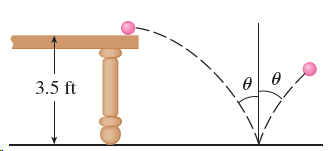
A ball rolls off a table with a speed of 2 ft/s. The table is 3.5 ft high.(a) Determine the point at which the ball hits the floor and find its speed at the instant of impact.(b) Find the angle ? between the path of the ball and the vertical line drawn through the point of impact (see the
How do you find the tangent vector to a smooth curve at a point? How do you find the tangent line? The unit tangent vector?
What is the connection between vector functions and space curves?
What is a vector function? How do you find its derivative and its integral?
Showing 15300 - 15400
of 29454
First
147
148
149
150
151
152
153
154
155
156
157
158
159
160
161
Last
Step by Step Answers

 Get 50% OFF
Claim Now
Get 50% OFF
Claim Now