New Semester
Started
Get
50% OFF
Study Help!
--h --m --s
Claim Now
Question Answers
Textbooks
Find textbooks, questions and answers
Oops, something went wrong!
Change your search query and then try again
S
Books
FREE
Study Help
Expert Questions
Accounting
General Management
Mathematics
Finance
Organizational Behaviour
Law
Physics
Operating System
Management Leadership
Sociology
Programming
Marketing
Database
Computer Network
Economics
Textbooks Solutions
Accounting
Managerial Accounting
Management Leadership
Cost Accounting
Statistics
Business Law
Corporate Finance
Finance
Economics
Auditing
Tutors
Online Tutors
Find a Tutor
Hire a Tutor
Become a Tutor
AI Tutor
AI Study Planner
NEW
Sell Books
Search
Search
Sign In
Register
study help
mathematics
precalculus
Calculus Of A Single Variable 11th Edition Ron Larson, Bruce H. Edwards - Solutions
Use graphing software to graph the functions specified. Select a viewing window that reveals the key features of the function.Graph the function ƒ(x) = sin 2x + cos 3x.
Suppose that a colony of bacteria starts with 1 bacterium and doubles in number every half hour. How many bacteria will the colony contain at the end of 24 hr?
a. Find the inverse of the function ƒ(x) = mx, where m is a constant different from zero.b. What can you conclude about the inverse of a function y = ƒ(x) whose graph is a line through the origin with a nonzero slope m?
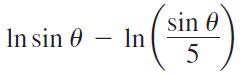
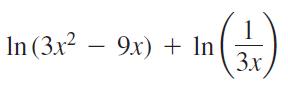
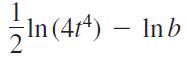
Use the properties of logarithms to write the expression as a single term.a.b.c. In sin - In sin 0 5
a. Find the inverse of ƒ(x) = x + 1. Graph ƒ and its inverse together. Add the line y = x to your sketch, drawing it with dashes or dots for contrast.b. Find the inverse of ƒ(x) = x + b (b constant). How is the graph of ƒ -1 related to the graph of ƒ?c. What can you conclude about the inverses
Express the following logarithms in terms of ln 2 and ln 3.a. ln 0.75 b. ln (4/9)c. ln (1/2) d. ln 3√9e. ln 3√2 f. ln √13.5
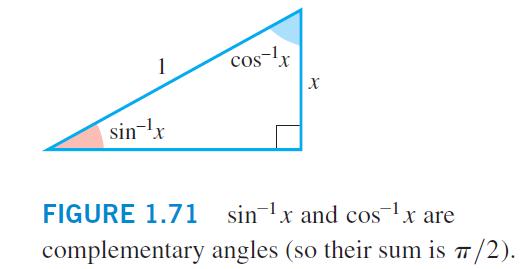
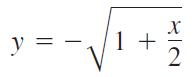
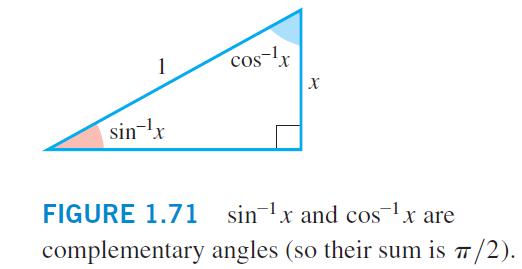
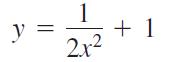
Graph each function, not by plotting points, but by starting with the graph of one of the standard functions presented in Figures 1.15–1.17, and applying an appropriate transformation. 1 sin-¹x cos ¹x X FIGURE 1.71 sin ¹x and cos¹x are complementary angles (so their sum is 7/2).
Find simpler expressions for the quantitie.a. eln 7.2b. e-ln x2 c. eln x-ln y
Graph each function, not by plotting points, but by starting with the graph of one of the standard functions presented in Figures 1.15–1.17, and applying an appropriate transformation. 1 sin-¹x cos ¹x X FIGURE 1.71 sin ¹x and cos¹x are complementary angles (so their sum is 7/2).
Find simpler expressions for the quantitie.a. 2ln√e b. ln (ln ee) c. ln (e-x2-y2)
Solve for y in terms of t or x, as appropriate.ln y = 2t + 4
Suppose the graph of g is given. Write equations for the graphs that are obtained from the graph of g by shifting, scaling, or reflecting, as indicated.a. Up 1/2 unit, right 3b. Down 2 units, left 2/3c. Reflect about the y-axisd. Reflect about the x-axise. Stretch vertically by a factor of 5f.
Solve for y in terms of t or x, as appropriate.ln (y - b) = 5t
Solve for y in terms of t or x, as appropriate.ln (y - 1) - ln 2 = x + ln x
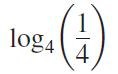
Simplify the expression.a. 5log5 7b. 8log8√2 c. 1.3log1.3 75d. log4 16 e. log3√3f. log4 4
Solve for k.a. e2k = 4 b. 100e10k = 200 c. ek/1000 = a
Sketch the graph of the given function. What is the period of the function?y = cos 2x
Solve for t.a. e-0.3t = 27b. ekt = 1/2c. e(ln 0.2)t = 0.4
Sketch the graph of the given function. What is the period of the function?y = sin πx
Solve for t.e√t = x2
Express the ratios as ratios of natural logarithms and simplify.a.b.c. log₂x log3 x
ABC is a right triangle with the right angle at C. The sides opposite angles A, B, and C are a, b, and c, respectively.a. Find a and b if c = 2, B = π/3.b. Find a and c if b = 2, B = π/3.
Simplify the expression.a. 2log4x b. 9log3x c. log2 (e(ln 2)(sin x))
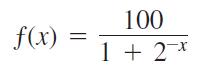
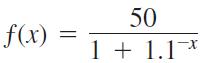
Find a formula for the inverse function ƒ -1 and verify that (ƒ ∘ ƒ-1 )(x) = (ƒ-1 ∘ ƒ)(x) = x.a.b. f(x) = 100 1 + 2x
ABC is a right triangle with the right angle at C. The sides opposite angles A, B, and C are a, b, and c, respectively.a. Express a in terms of B and b.b. Express c in terms of A and a.
Two wires stretch from the top T of a vertical pole to points B and C on the ground, where C is 10 m closer to the base of the pole than is B. If wire BT makes an angle of 35° with the horizontal and wire CT makes an angle of 50° with the horizontal, how high is the pole?
If ƒ(x) is one-to-one, can anything be said about g(x) = -ƒ(x)? Is it also one-to-one? Give reasons for your answer.
Suppose that the range of g lies in the domain of ƒ so that the composite ƒ ∘ g is defined. If ƒ and g are one-to-one, can anything be said about ƒ ∘ g? Give reasons for your answer.
The equation x2 = 2x has three solutions: x = 2, x = 4, and one other. Estimate the third solution as accurately as you can by graphing.
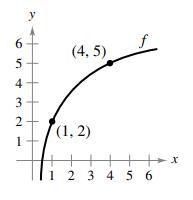
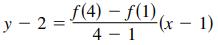
Use the graph shown in the figure. To print an enlarged copy of the graph, go to MathGraphs.com.Identify or sketch each of the quantities on the figure.(a) f(1) and f(4)(b) f(4) − f(1)(c) 4 − 1(d) 65432 1 y ++ (4,5) f (1, 2) + 1 2 3 4 5 6 +x
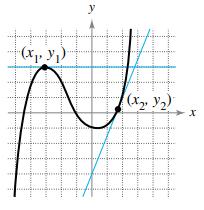
Estimate the slope of the graph at the points (x1, y1) and (x2, y2). (x₁, y₁) y quate (²x²x), X almente
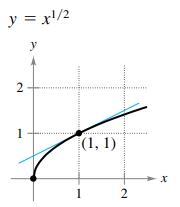
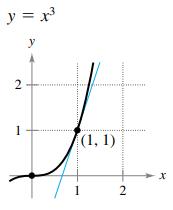
Use the graph to estimate the slope of the tangent line to y = xn at the point (1, 1). Verify your answer analytically. To print an enlarged copy of the graph, go to MathGraphs.com.(a)(b) y = x¹/2 y 2 1 (1, 1) 1 2 X
Describe how to find the slope of the tangent line to the graph of a function at a point.
Describe the Product Rule in your own words.
Describe how to find the derivative of a function using the limit process.
What are the derivatives of the sine and cosine function?
Use the Product Rule to find the derivative of the function.g(x) = (2x − 3)(1 − 5x)
Use the Product Rule to find the derivative of the function.h(t) = √t(1 − t2)
Find the slope of the tangent line to the graph of the function at the given point.f(x) = 3 − 5x, (−1, 8)
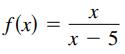
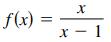
Use the Quotient Rule to find the derivative of the function. f(x) X x-5
Find the slope of the tangent line to the graph of the function at the given point.f(x) = 2x2 − 3, (2, 5)
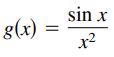
Use the Quotient Rule to find the derivative of the function. g(x) sin x x²
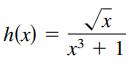
Use the Quotient Rule to find the derivative of the function. h(x) = √x x³ + 1
Find f′(x) and f′(c).
Find f′(x) and f′(c). Function
Use the rules of differentiation to find the derivative of the function.f(x) = 9√x
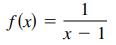
Find the derivative of the function by the limit process. f(x) = 1 x - 1
Find the derivative of the function by the limit process.f(x) = −5x
Complete the table to find the derivative of the function. Original Function 2 7x4 y = Rewrite Differentiate Simplify
Complete the table to find the derivative of the function without using the Quotient Rule. Function y = x³ + 6x 3 Rewrite Differentiate Simplify
Find f′(x) and f′(c).Function Value of cf(x) = (x3 + 4x)(3x2 + 2x − 5) c = 0
Use the rules of differentiation to find the derivative of the function.f(t) = −3t2 + 2t − 4
Use the rules of differentiation to find the derivative of the function.g(x) = x2 + 4x3
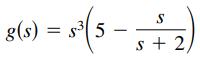
Find the derivative of the algebraic function. g(s) = $³5 S s+2,
Find the derivative of the function by the limit process.f(x) = x3 − 12x
Use the rules of differentiation to find the derivative of the function.y = 2- sin
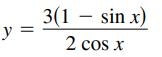
Find the derivative of the trigonometric function. y = 3(1 - sin x) 2 cos x
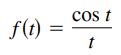
Find the derivative of the trigonometric function. f(t) COS t t
Use the rules of differentiation to find the derivative of the function.y = x2 − 1/2 cos x
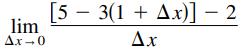
The limit represents f′(c) for a function f and a number c. Find f and c. lim Δ.x - 0 [5 - 3(1 + Ax)] - 2 Δε
Find an equation of the line that is tangent to the graph of f and parallel to the given line.Function Linef(x) = −1/4 x2 x + y = 0
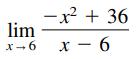
The limit represents f′(c) for a function f and a number c. Find f and c. lim -x² + 36 9- x 9-x
Find the derivative of the function.f(x) = x2 + 5 − 3x−2
Find the derivative of the trigonometric function.f(t) = t2 sin t
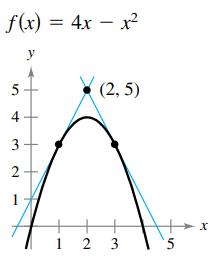
Find equations of the two tangent lines to the graph of f that pass through the indicated point. f(x) = 4x - x² 5 4 3 نا 2 1 y (2,5) 1 2 3 5 X
Find the derivative of the trigonometric function.f(x) = −x + tan x
Find the slope of the graph of the function at the given point. Use the derivative feature of a graphing utility to confirm your results. Function
Find the derivative of the trigonometric function.g(t) = 4√t + 6 csc t
Find the derivative of the function.f(x) = 6√x + 5 cos x
Do f and f′ always have the same domain? Explain.
(a) Find an equation of the tangent line to the graph of the function at the given point,(b) Use a graphing utility to graph the function and its tangent line at the point, and(c) Use the tangent feature of a graphing utility to confirm your results.Function
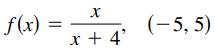
(a) Find an equation of the tangent line to the graph of f at the given point,(b) Use a graphing utility to graph the function and its tangent line at the point, and(c) Use the tangent feature of a graphing utility to confirm your results. f(x) X x + 4' (-5,5)
(a) Find an equation of the tangent line to the graph of the function at the given point,(b) Use a graphing utility to graph the function and its tangent line at the point, and(c) Use the tangent feature of a graphing utility to confirm your results.Function
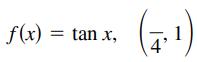
(a) Find an equation of the tangent line to the graph of f at the given point,(b) Use a graphing utility to graph the function and its tangent line at the point, and(c) Use the tangent feature of a graphing utility to confirm your results. f(x) = tan x,
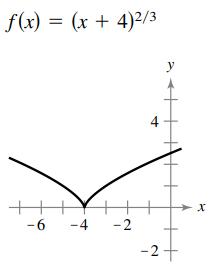
Describe the x-values at which f is differentiable. f(x) = (x + 4)2/3 H -6 -4 H - 2 4 y -2 + X
Identify a function f that has the given characteristics. Then sketch the function.f(0) = 2; f′(x) = −3 for −∞ < x < ∞
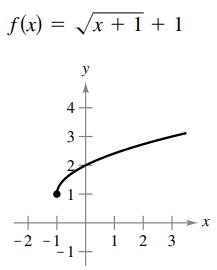
Describe the x-values at which f is differentiable. f(x) = √x + 1 + 1 -2 4 3 نیا -1 y + 1 2 3
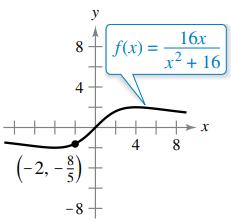
Find an equation of the tangent line to the graph at the given point. (The graphs in Exercises 69 and 70 are called Witches of Agnesi. The graphs in Exercises 71 and 72 are called serpentines.) (-2,- V100 8 4 8 -8 y = + 4 16x 2 x² + 16 8
Determine the point(s) (if any) at which the graph of the function has a horizontal tangent line.y = x + sin x, 0 ≤ x < 2
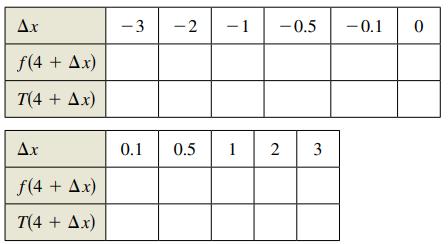
Consider the function f(x) = x3/2 with the solution point (4, 8).(a) Use a graphing utility to graph f. Use the zoom feature to obtain successive magnifications of the graph in the neighborhood of the point (4, 8). After zooming in a few times, the graph should appear nearly linear. Use the trace
Consider the function f(x) = 1/2x2.(a) Use a graphing utility to graph the function and estimate the values of f′(0), f′(1/2), f′(1), and f′(2).(b) Use your results from part (a) to determine the values of f′(−1/2), f′(−1), and f′(−2).(c) Sketch a possible graph of f′.(d) Use
The relationship between f and g is given. Explain the relationship between f′ and g′.g(x) = f(x) + 6
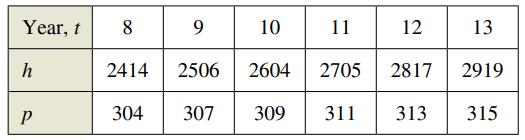
The table shows the national health care expenditures h (in billions of dollars) in the United States and the population p (in millions) of the United States for the years 2008 through 2013. The year is represented by t, with t = 8 corresponding to 2008. (Source: U.S. Centers for Medicare &
The relationship between f and g is given. Explain the relationship between f′ and g′.g(x) = −5 f(x)
Sketch the graph of a function f such that f′ > 0 for all x and the rate of change of the function is decreasing.
Use a graphing utility to graph the function and find the x values at which f is differentiable.f(x) = ∣x − 5∣
Find the second derivative of the function. f(x): X x-1
Determine whether the statement is true or false. If it is false, explain why or give an example that shows it is false.If f′(x) = g′(x), then f(x) = g(x).
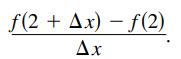
Determine whether the statement is true or false. If it is false, explain why or give an example that shows it is false. The slope of the tangent line to the differentiable function f at the point (2, f(2)) is Δx) - f(2) - · Δε f(2 +
Determine whether the statement is true or false. If it is false, explain why or give an example that shows it is false.If y = 2, then dy/dx = 2.
Determine whether the statement is true or false. If it is false, explain why or give an example that shows it is false.If f(x) = 0, then f′(x) is undefined.
Find the average rate of change of the function over the given interval. Compare this average rate of change with the instantaneous rates of change at the endpoints of the interval.f(t) = 3t + 5, [1, 2]
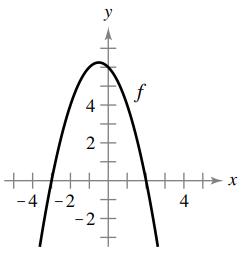
The graph of f is shown. Sketch the graphs of f′ and f ″. To print an enlarged copy of the graph, go to MathGraphs.com. ++ - 4 4 2 -2 -2 y 111 - X 4
A line with slope m passes through the point (0, 4) and has the equation y = mx + 4.(a) Write the distance d between the line and the point (3, 1) as a function of m.(b) Use a graphing utility to graph the function d in part (a). Based on the graph, is the function differentiable at every value of
Find the second derivative of the function.f(x) = 4x3/2
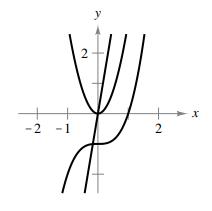
The graphs of f, f′, and f″ are shown on the same set of coordinate axes. Identify each graph. Explain your reasoning. To print an enlarged copy of the graph, go to MathGraphs.com. -2 -1 2 y 2 X
Use the position function s(t) = −16t2 + v0t + s0 for free-falling objects.A silver dollar is dropped from the top of a building that is 1362 feet tall.(a) Determine the position and velocity functions for the coin.(b) Determine the average velocity on the interval [1, 2].(c) Find the
Determine whether the statement is true or false. If it is false, explain why or give an example that shows it is false.If a function has derivatives from both the right and the left at a point, then it is differentiable at that point.
Find the second derivative of the function.f(x) = csc x
Find the given higher-order derivative.f′(x) = x3 − x2/5, f (3) (x)
Showing 14600 - 14700
of 29454
First
140
141
142
143
144
145
146
147
148
149
150
151
152
153
154
Last
Step by Step Answers

 Get 50% OFF
Claim Now
Get 50% OFF
Claim Now