New Semester
Started
Get
50% OFF
Study Help!
--h --m --s
Claim Now
Question Answers
Textbooks
Find textbooks, questions and answers
Oops, something went wrong!
Change your search query and then try again
S
Books
FREE
Study Help
Expert Questions
Accounting
General Management
Mathematics
Finance
Organizational Behaviour
Law
Physics
Operating System
Management Leadership
Sociology
Programming
Marketing
Database
Computer Network
Economics
Textbooks Solutions
Accounting
Managerial Accounting
Management Leadership
Cost Accounting
Statistics
Business Law
Corporate Finance
Finance
Economics
Auditing
Tutors
Online Tutors
Find a Tutor
Hire a Tutor
Become a Tutor
AI Tutor
AI Study Planner
NEW
Sell Books
Search
Search
Sign In
Register
study help
mathematics
precalculus
Calculus Early Transcendentals 8th edition James Stewart - Solutions
Solve the differential equation.y'' - 2y' + 10y = 0
Solve the differential equation.4y'' - y = 0
Determine whether the statement is true or false. If it is true, explain why. If it is false, explain why or give an example that disproves the statement.The equation y'' - y = ex has a particular solution of the form yp = Aex
Determine whether the statement is true or false. If it is true, explain why. If it is false, explain why or give an example that disproves the statement.The general solution of y'' - y = 0 can be written as y = c1 cosh x + c2 sinh x
Determine whether the statement is true or false. If it is true, explain why. If it is false, explain why or give an example that disproves the statement.If y1 and y2 are solutions of y0 + 6y' + 5y = x, then c1y1 + c2 y2 is also a solution of the equation.
The solution of the initial-value problem x2y'' + xy' + x2y = 0 y(0) = 1 y'(0) = 0 is called a Bessel function of order 0.(a) Solve the initial-value problem to find a power series expansion for the Bessel function.(b) Graph several Taylor polynomials until you reach one that looks like a good
Use power series to solve the differential equation.y'' + x2y9 + xy = 0, y(0) = 0, y'(0) = 1
Use power series to solve the differential equation.y'' + x2y = 0, y(0) = 1, y'(0) = 0
Use power series to solve the differential equation.y'' - xy' - y = 0, y(0) = 1, y'(0) = 0
Use power series to solve the differential equation.y'' = xy
Use power series to solve the differential equation.(x - 1) y'' + y' = 0
Use power series to solve the differential equation.y'' = y
Use power series to solve the differential equation.y'' + xy' + y = 0
Use power series to solve the differential equation.(x - 3)y' + 2y = 0
Use power series to solve the differential equation.y' = x2y
Use power series to solve the differential equation.y' = xy
Use power series to solve the differential equation.y' - y = 0
Verify that the solution to Equation 1 can be written in the form x(t) = A cos(wt + ).
The battery in Exercise 14 is replaced by a generator producing a voltage of E(t) = 12 sin 10t.(a) Find the charge at time t.(b) Graph the charge function.
The battery in Exercise 13 is replaced by a generator producing a voltage of E(t) = 12 sin 10t. Find the charge at time t.
A series circuit contains a resistor with R = 24 V, an inductor with L = 2 H, a capacitor with C = 0.005 F, and a 12-V battery.The initial charge is Q = 0.001 C and the initial current is 0.(a) Find the charge and current at time t.(b) Graph the charge and current functions.
A series circuit consists of a resistor with R = 20 Ω, an inductor with L = 1 H, a capacitor with C = 0.002 F, and a 12-V battery. If the initial charge and current are both 0, find the charge and current at time t.
Consider a spring subject to a frictional or damping force.(a) In the critically damped case, the motion is given by x = c1ert + c2tert. Show that the graph of x crosses the t-axis whenever c1 and c2 have opposite signs.(b) In the overdamped case, the motion is given by x = c1er1t + c2ter2t. where
Show that if w0 ≠ w, but w/w0 is a rational number, then the motion described by Equation 6 is periodic.
Suppose a spring has mass m and spring constant k and let w = √k/m. Suppose that the damping constant is so small that the damping force is negligible. If an external force F(t) = F0 cos w0t is applied, where w0 ≠ w, use the method of undetermined coefficients to show that the motion of the
A spring has a mass of 1 kg and its damping constant is c = 10. The spring starts from its equilibrium position with a velocity of 1 m/s. Graph the position function for the following values of the spring constant k: 10, 20, 25, 30, 40. What type of damping occurs in each case?
A spring has a mass of 1 kg and its spring constant is k = 100. The spring is released at a point 0.1 m above its equilibrium position. Graph the position function for the following values of the damping constant c: 10, 15, 20, 25, 30. What type of damping occurs in each case?
For the spring in Exercise 4, find the damping constant that would produce critical damping.
For the spring in Exercise 3, find the mass that would produce critical damping.
A force of 13 N is needed to keep a spring with a 2-kg mass stretched 0.25 m beyond its natural length. The damping constant of the spring is c = 8.(a) If the mass starts at the equilibrium position with a velocity of 0.5 m/s, find its position at time t.(b) Graph the position function of the mass.
A spring with a mass of 2 kg has damping constant 14, and a force of 6 N is required to keep the spring stretched 0.5 m beyond its natural length. The spring is stretched 1 m beyond its natural length and then released with zero velocity. Find the position of the mass at any time t.
A spring with an 8-kg mass is kept stretched 0.4 m beyond its natural length by a force of 32 N. The spring starts at its equilibrium position and is given an initial velocity of 1 m/s. Find the position of the mass at any time t.
A spring has natural length 0.75 m and a 5-kg mass. A force of 25 N is needed to keep the spring stretched to a length of 1 m. If the spring is stretched to a length of 1.1 m and then released with velocity 0, find the position of the mass after t seconds.
Solve the differential equation using the method of variation of parameters.y'' + 4y' + 4y = e-2x/x3
Solve the differential equation using the method of variation of parameters.y'' - 2y' + y = eX/1 + x2
Solve the differential equation using the method of variation of parameters.y'' + 3y' + 2y = sin(ex)
Solve the differential equation using the method of variation of parameters.y'' - 3y' + 2y = 1/1 + e-x
Solve the differential equation using the method of variation of parameters.y'' + y = sec3x, 0 < x < π/2
Solve the differential equation using the method of variation of parameters.y'' + y = sec2x, 0 < x < π/2
Solve the differential equation using (a) undetermined coefficients and (b) variation of parameters.y'' - y' = ex
Solve the differential equation using (a) undetermined coefficients and (b) variation of parameters.y'' - 2y' + y = e-x
Solve the differential equation using (a) undetermined coefficients and (b) variation of parameters.y'' - 2y' - 3y = x + 2
Solve the differential equation using (a) undetermined coefficients and (b) variation of parameters.4y'' + y = cos x
Write a trial solution for the method of undetermined coefficients. Do not determine the coefficients.y'' + 4y = e3x + x sin 2x
Write a trial solution for the method of undetermined coefficients. Do not determine the coefficients.y'' + 2y' + 10y = x2e-x cos 3x
Write a trial solution for the method of undetermined coefficients. Do not determine the coefficients.y'' + 3y' - 4y = (x3 + x)ex
Write a trial solution for the method of undetermined coefficients. Do not determine the coefficients.y'' - 3y' + 2y = ex + sin x
Write a trial solution for the method of undetermined coefficients. Do not determine the coefficients.y'' + 4y = cos 4x + cos 2x
Write a trial solution for the method of undetermined coefficients. Do not determine the coefficients.y'' - y' - 2y = xex cos x
Graph the particular solution and several other solutions. What characteristics do these solutions have in common?y'' + 4y = e-x
Graph the particular solution and several other solutions. What characteristics do these solutions have in common?y'' + 3y' + 2y = cos x
Solve the differential equation or initial-value problem using the method of undetermined coefficients.y'' + y' - 2y = x + sin 2x, y(0) = 1, y'(0) = 0
Solve the differential equation or initial-value problem using the method of undetermined coefficients.y'' - y' = xex, y(0) = 2, y'(0) = 1
Solve the differential equation or initial-value problem using the method of undetermined coefficients.y'' - y = xe-x, y(0) = 0, y'(0) = 1
Solve the differential equation or initial-value problem using the method of undetermined coefficients.y'' - 2y' + 5y = sin x, y(0) = 1, y(0) = 1
Solve the differential equation or initial-value problem using the method of undetermined coefficients.y'' - 4y' + 4y = x - sin x
Solve the differential equation or initial-value problem using the method of undetermined coefficients.y'' - 4y' + 5y = e-x
Solve the differential equation or initial-value problem using the method of undetermined coefficients.y'' - 2y' + 2y = x + ex
Solve the differential equation or initial-value problem using the method of undetermined coefficients.9y'' + y = e-x
Solve the differential equation or initial-value problem using the method of undetermined coefficients.y'' - 3y' = sin 2x
Solve the differential equation or initial-value problem using the method of undetermined coefficients.y'' + 2y' - 8y = 1 - 2x2
Consider the boundary-value problem y'' - 2y' + 2y = 0, y(a) = c, y(b) = d.(a) If this problem has a unique solution, how are a and b related?(b) If this problem has no solution, how are a, b, c, and d related?(c) If this problem has infinitely many solutions, how are a, b, c, and d related?
If a, b, and c are all positive constants and y(x) is a solution of the differential equation ay'' + by' + cy = 0, show that limx→∞ y(x) = 0.
Let L be a nonzero real number.(a) Show that the boundary-value problem y'' + λy = 0, y(0) = 0, y(L) = 0 has only the trivial solution y = 0 for the cases λ = 0 and λ < 0.(b) For the case λ > 0, find the values of λ for which this problem has a nontrivial solution and give the
Solve the boundary-value problem, if possible.y'' + 4y' + 20y = 0, y(0) = 1, y(π) = e-2π
Solve the boundary-value problem, if possible.y'' + 4y' + 20y = 0, y(0) = 1, y(π) = 2
Solve the boundary-value problem, if possible.4y'' - 4y' + y = 0, y(0) = 4, y(2) = 0
Solve the boundary-value problem, if possible.y'' = y', y(0) = 1, y(1) = 2
Solve the boundary-value problem, if possible.y'' - 8y' + 17y = 0, y(0) = 3, y(π) = 2
Solve the boundary-value problem, if possible.y'' + 4y' + 4y = 0, y(0) = 2, y(1) = 0
Solve the boundary-value problem, if possible.y'' + 6y' = 0, y(0) = 1, y(1) = 0
Solve the boundary-value problem, if possible.y'' + 16y = 0, y(0) = -3, y(π/8) = 2
Solve the initial-value problem.4y'' + 4y' + 3y = 0, y(0) = 0, y'(0) = 1
Solve the initial-value problem.y'' - y' - 12y = 0, y(1) = 0, y'(1) = 1
Solve the initial-value problem.4y'' - 20y' + 25y = 0, y(0) = 2, y'(0) = -3
Solve the initial-value problem.y'' - 6y' + 10y = 0, y(0) = 2, y'(0) = 3
Solve the initial-value problem.3y'' - 2y' - y = 0, y(0) = 0, y'(0) = -4
Solve the initial-value problem.9y'' + 12y' + 4y = 0, y(0) = 1, y'(0) = 0
Solve the initial-value problem.y'' - 2y' - 3y = 0, y(0) = 2, y'(0) = 2
Solve the initial-value problem.y'' + 3y = 0, y(0) = 1, y'(0) = 3
Graph the two basic solutions along with several other solutions of the differential equation. What features do the solutions have in common?2d2y/dx2 + dy/dx - y = 0
Graph the two basic solutions along with several other solutions of the differential equation. What features do the solutions have in common?d2y/dx2 + 2dy/dx + 2y = 0
Graph the two basic solutions along with several other solutions of the differential equation. What features do the solutions have in common?4d2y/dx2 - 4dy/dx + y = 0
Solve the differential equation.3d2V/dt2 + 4dV/dt + 3V = 0
Solve the differential equation.d2R/dt2 + 6 dR/dt + 34R = 0
Solve the differential equation.2/d2y/dt2 + 2dy/dt - y = 0
Solve the differential equation.3y'' + 4y' - 3y = 0
Solve the differential equation.y'' - 4y' + 13y = 0
Solve the differential equation.y = y''
Solve the differential equation.3y'' = 4y'
Solve the differential equation.9y'' + 4y = 0
Solve the differential equation.y'' + 4y' + y = 0
Solve the differential equation.y'' + y' - 12y = 0
Solve the differential equation.y'' + 2y = 0
Solve the differential equation.y'' - 6y' + 9y = 0
Solve the differential equation.y'' - y' - 6y = 0
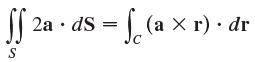
If a is a constant vector, r = x i + y j + z k, and S is an oriented, smooth surface with a simple, closed, smooth, positively oriented boundary curve C, show that 2a 2a · dS = (a X r) · dr
If the components of F have continuous second partial derivatives and S is the boundary surface of a simple solid region, show that ∫∫S curl F • dS = 0.
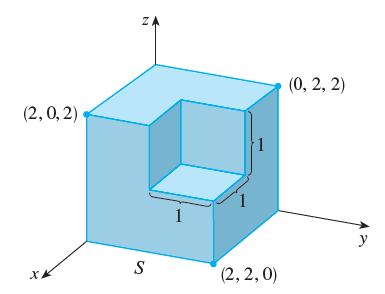
Find ∫∫S F • n dS, where F(x, y, z) = x i + y j + z k and S is the outwardly oriented surface shown in the figure (the boundary surface of a cube with a unit corner cube removed). ZA (0, 2, 2) (2, 0, 2) (2, 2, 0) хк
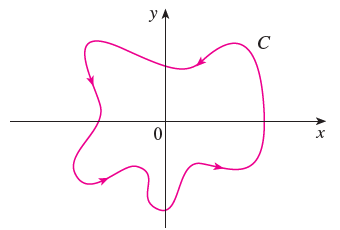
Let F(x, y) = (2x3 + 2xy2 - 2y) i + (2y3 + 2x3y + 2x) j/x2 + y2 Evaluate where C is shown in the figure. $ F• dr, х
Showing 16900 - 17000
of 29454
First
163
164
165
166
167
168
169
170
171
172
173
174
175
176
177
Last
Step by Step Answers

 Get 50% OFF
Claim Now
Get 50% OFF
Claim Now