New Semester
Started
Get
50% OFF
Study Help!
--h --m --s
Claim Now
Question Answers
Textbooks
Find textbooks, questions and answers
Oops, something went wrong!
Change your search query and then try again
S
Books
FREE
Study Help
Expert Questions
Accounting
General Management
Mathematics
Finance
Organizational Behaviour
Law
Physics
Operating System
Management Leadership
Sociology
Programming
Marketing
Database
Computer Network
Economics
Textbooks Solutions
Accounting
Managerial Accounting
Management Leadership
Cost Accounting
Statistics
Business Law
Corporate Finance
Finance
Economics
Auditing
Tutors
Online Tutors
Find a Tutor
Hire a Tutor
Become a Tutor
AI Tutor
AI Study Planner
NEW
Sell Books
Search
Search
Sign In
Register
study help
mathematics
precalculus
Calculus Early Transcendentals 8th edition James Stewart - Solutions
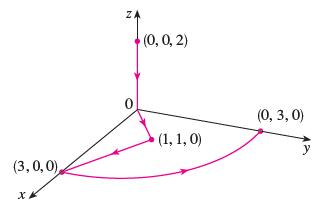
Let F(x, y, z) = (3x2yz - 3y) i + (x3z - 3x) j + (x3y + 2z) k. Evaluate ∫C F • dr, where C is the curve with initial point (0, 0, 2) and terminal point (0, 3, 0) shown in the figure. z. ZA (0, 0, 2) (0, 3, 0) (1, 1, 0) y (3,0,0) хк
Compute the outward flux of F(x, y, z) = x i + y j + z k/(x2 + y2 + z2 )3/2 through the ellipsoid 4x2 + 9y2 + 6z2 = 36.
Use the Divergence Theorem to calculate the surface integral ∫∫s F • dS, where F(x, y, z) = x3 i + y3 j + z3 k and S is the surface of the solid bounded by the cylinder x2 + y2 = 1 and the planes z = 0 and z = 2.
Use Stokes’ Theorem to evaluate ∫c F • dr, where F(x, y, z) = xy i + yz j + z x k, and C is the triangle with vertices (1, 0, 0), (0, 1, 0), and (0, 0, 1), oriented counterclockwise as viewed from above.
Use Stokes’ Theorem to evaluate ∫∫S curl F • dS, where F(x, y, z) = x2yz i + yz2 j + z3exy k, S is the part of the sphere x2 + y2 + z2 = 5 that lies above the plane z = 1, and S is oriented upward.
Verify that Stokes’ Theorem is true for the vector field F(x, y, z) = x2 i + y2 j + z2 k, where S is the part of the paraboloid z = 1 - x2 - y2 that lies above the xy-plane and S has upward orientation.
Evaluate the surface integral.∫∫S F • dS, where F(x, y, z) = x2 i + xy j + z k and S is the part of the paraboloid z = x2 + y2 below the plane z = 1 with upward orientation
Evaluate the surface integral. ∫∫S (x2z + y2z) dS, where S is the part of the plane z = 4 + x + y that lies inside the cylinder x2 + y2 = 4
Evaluate the surface integral.∫∫S F • dS, where F(x, y, z) = xz i - 2y j + 3x k and S is the sphere x2 + y2 + z2 = 4 with outward orientation
Evaluate the surface integral. ∫∫S z dS where S is the part of the paraboloid z = x2 + y2 that lies under the plane z = 4
(a) Find an equation of the tangent plane at the point (4, -2, 1)to the parametric surface S given by r(u, v) = v2 i - uv j + u2 k 0 < u < 3, -3 < v < 3(b) Use a computer to graph the surface S and the tangent plane found in part (a).(c) Set up, but do not evaluate, an integral for the
Find the area of the part of the surface z = x2 + 2y that lies above the triangle with vertices (0, 0), (1, 0), and (1, 2).
(a) Sketch the curve C with parametric equationsx = cos t y = sin t z = sin t 0 < t < 2π(b) Find
If f is a harmonic function, that is, ∇2f = 0, show that the line integral ∫fy dx - fx dy is independent of path in any simple region D.
If f and t are twice differentiable functions, show that∇2(fg) = f∇2g + g∇2f + 2∇f • ∇g v°(fg) = fV°g + gV²f + 2Vf • Vg
If C is any piecewise-smooth simple closed plane curve and f and g are differentiable functions, show that∫C f (x) dx + g(y) dy = 0.
If F and G are vector fields whose component functions have continuous first partial derivatives, show thatcurl(F x G) = F div G - G div F + (G • ∇)F - (F • ∇)G
Show that there is no vector field G such thatcurl G = 2x i + 3yz j - xz2 k
Find curl F and div F ifF(x, y, z) = e-x sin y i + e-y sin z j + e-z sin x k
Use Green’s Theorem to evaluate ∫Cx2y dx - xy2 dy, where C is the circle x2 + y2 = 4 with counterclockwise orientation.
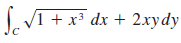
Use Green’s Theorem to evaluate`where C is the triangle with vertices (0, 0), (1, 0), and (1, 3). VI + x³ dx + 2xydy
Verify that Green’s Theorem is true for the line integral ∫Cxy2 dx - x2 y dy, where C consists of the parabola y = x2 from (-1, 1) to (1, 1) and the line segment from (1, 1) to (-1, 1).
Show that F is conservative and use this fact to evaluate ∫C F • dr along the given curve.F(x, y, z) = ey i + (xey + ez) j + yez k, C is the line segment from (0, 2, 0) to (4, 0, 3)
Show that F is conservative and use this fact to evaluate ∫C F • dr along the given curve.f(x, y ) = (4x3y2 - 2xy3)i + (2x4y - 3x2y2 + 4y3)j,C: r (t) = (t + sin πt)i + (2t + cos πt)j, 0 < t < 1
Show that F is a conservative vector field. Then find a function f such that F = ∇f.F(x, y, z) = sin y i + x cos y j - sin z k
Show that F is a conservative vector field. Then find a function f such that F = ∇f .F(x, y) = (1 + xy)exy i + (ey + x2exy) j
Find the work done by the force field F(x, y, z) = z i + x j + y k in moving a particle from the point (3, 0, 0) to the point (0, π/2, 3) along (a) a straight line(b) the helix x = 3 cos t, y = t, z = 3 sin t
Evaluate the line integral.∫C F • dr, where F(x, y, z) = ez i + xz j + (x + y) k and C is given by r(t) = t2 i + t3 j - t k, 0 < t < 1
Evaluate the line integral.∫C F • dr, where F(x, y) = xy i + x2 j and C is given byr(t) = sin t i + (1 + t) j, 0 < t < π
Evaluate the line integral.∫C xy dx + y2 dy + yz dz,C is the line segment from (1, 0, -1), to (3, 4, 2)
Evaluate the line integral.∫C √xy dx + ey dy + xz dz,C is given by r(t) = t4 i + t2 j + t3 k, 0 < t < 1
Evaluate the line integral.∫C y3 dx + x2 dy, C is the arc of the parabola x = 1 - y2from (0, -1) to (0, 1)
Evaluate the line integral.∫C y dx + (x + y2)dy, C is the ellipse 4x2 + 9y2 = 36 with counterclockwise orientation
Evaluate the line integral.∫C yz cos x ds,C: x = t, y = 3 cos t, z = 3 sin t, 0 < t < π
Evaluate the line integral.∫C x ds,C is the arc of the parabola y = x2 from (0, 0) to (1, 1)
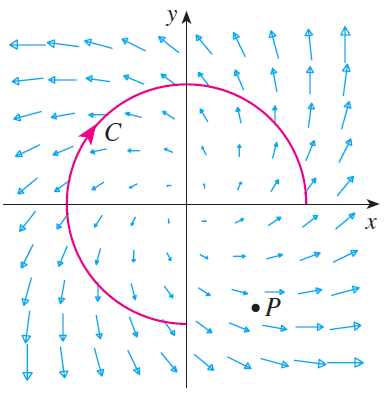
A vector field F, a curve C, and a point P are shown.(a) Is ∫C F • dr positive, negative, or zero? Explain.(b) Is div F(P) positive, negative, or zero? Explain. УА х P R RR
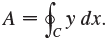
Determine whether the statement is true or false. If it is true, explain why. If it is false, explain why or give an example that disproves the statement.The area of the region bounded by the positively oriented, piecewise smooth, simple closed curve C is y dx.
Determine whether the statement is true or false. If it is true, explain why. If it is false, explain why or give an example that disproves the statement.There is a vector field F such that curl F = x i + y j + z k
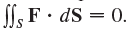
Determine whether the statement is true or false. If it is true, explain why. If it is false, explain why or give an example that disproves the statement.If S is a sphere and F is a constant vector field, then SLF· as = 0. JJS
Determine whether the statement is true or false. If it is true, explain why. If it is false, explain why or give an example that disproves the statement.If F and G are vector fields, thencurl(F • G) = curl F • curl G
Determine whether the statement is true or false. If it is true, explain why. If it is false, explain why or give an example that disproves the statement.If F and G are vector fields, thencurl(F + G) = curl F + curl G
Determine whether the statement is true or false. If it is true, explain why. If it is false, explain why or give an example that disproves the statement.The work done by a conservative force field in moving a particle around a closed path is zero.
Determine whether the statement is true or false. If it is true, explain why. If it is false, explain why or give an example that disproves the statement.If F and G are vector fields and divF = divG, then F = G.
Determine whether the statement is true or false. If it is true, explain why. If it is false, explain why or give an example that disproves the statement. S-c f(x, y) ds = -Sc f(x, y) ds %3D
Determine whether the statement is true or false. If it is true, explain why. If it is false, explain why or give an example that disproves the statement.If F = P i + Q j and Py = Qx in an open region D, then F is conservative.
Determine whether the statement is true or false. If it is true, explain why. If it is false, explain why or give an example that disproves the statement.If f has continuous partial derivatives on R3 and C is any circle, then ∫C =f ∇dr = 0.
Determine whether the statement is true or false. If it is true, explain why. If it is false, explain why or give an example that disproves the statement.If f has continuous partial derivatives of all orders on R3, then divscurl ∇f d = 0.
Determine whether the statement is true or false. If it is true, explain why. If it is false, explain why or give an example that disproves the statement.If F is a vector field, then curl F is a vector field.
Determine whether the statement is true or false. If it is true, explain why. If it is false, explain why or give an example that disproves the statement.If F is a vector field, then div F is a vector field.
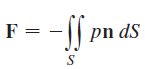
A solid occupies a region E with surface S and is immersed in a liquid with constant density p. We set up a coordinate system so that the xy-plane coincides with the surface of the liquid, and positive values of z are measured downward into the liquid. Then the pressure at depth z is p = pgz, where
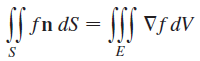
Suppose S and E satisfy the conditions of the Divergence Theorem and f is a scalar function with continuous partial derivatives.Prove thatThese surface and triple integrals of vector functions are vectors defined by integrating each component function. SI vsav | fn dS = VfdV
Prove each identity, assuming that S and E satisfy the conditions of the Divergence Theorem and the scalar functions and components of the vector fields have continuous second-order partial derivatives. SII (sV'g – gv°f) aV || (SVg – gVf)· n dS =
Prove each identity, assuming that S and E satisfy the conditions of the Divergence Theorem and the scalar functions and components of the vector fields have continuous second-order partial derivatives. | (SV°g+ Vf • Vg) dV || (ƒ Vg) • n dS
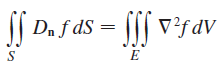
Prove each identity, assuming that S and E satisfy the conditions of the Divergence Theorem and the scalar functions and components of the vector fields have continuous second-order partial derivatives. Daf dS = [[ v?fav
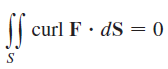
Prove each identity, assuming that S and E satisfy the conditions of the Divergence Theorem and the scalar functions and components of the vector fields have continuous second-order partial derivatives. || curl F · dS = 0
Prove each identity, assuming that S and E satisfy the conditions of the Divergence Theorem and the scalar functions and components of the vector fields have continuous second-order partial derivatives. F· dS, where F(x, y, z) = x i + yj+ z k V(E) = ||
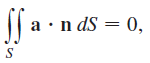
Prove each identity, assuming that S and E satisfy the conditions of the Divergence Theorem and the scalar functions and components of the vector fields have continuous second-order partial derivatives.where a is a constant vector = 0, a ·n dS = 0,
Use the Divergence Theorem to evaluate∫∫s (2x + 2y + z2) dSwhere S is the sphere x2 + y2 + z2 = 1.
Verify that div E = 0 for the electric field E(x) = єQ/|x|3 x.
Plot the vector field and guess where div F > 0 and where div F < 0. Then calculate div F to check your guess.F(x, y) = (x2, y2)
Plot the vector field and guess where div F > 0 and where div F < 0. Then calculate div F to check your guess.F(x, y) = (xy, x2 + y2)
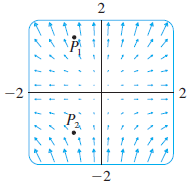
(a) Are the points P1 and P2 sources or sinks for the vector field F shown in the figure? Give an explanation based solely on the picture.(b) Given that F(x, y) = (x, y2), use the definition of divergence to verify your answer to part (a). -2 -2 2.
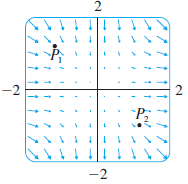
A vector field F is shown. Use the interpretation of divergence derived in this section to determine whether div F is positive or negative at P1 and at P2. -2 -2 2. 2.
Let F(x, y, z) = z tan-1(y2 ) i + z3 ln(x2 + 1) j + z k. Find the flux of F across the part of the paraboloid x2 + y2 + z = 2 that lies above the plane z = 1 and is oriented upward.
Use the Divergence Theorem to evaluate ʃʃS F π dS, where F(x, y, z) = z2x i + (1/3y3 + tan z) j + (x2z + y2 ) k and S is the top half of the sphere x2 + y2 + z2 = 1.That S is not a closed surface. First compute integrals over S1 and S2, where S1 is the disk x2 + y2 < 1, oriented downward, and
Use a computer algebra system to plot the vector field F(x, y, z) = sin x cos2y i + sin3y cos4z j + sin5z cos6x k in the cube cut from the first octant by the planes x = πy2, y = πy2, and z = πy2. Then compute the flux across the surface of the cube.
Use the Divergence Theorem to calculate the surface integral ʃʃS F • dS; that is, calculate the flux of F across S.F(x, y, z) = ey tan z i + y√3 - x2 j + x sin y k, S is the surface of the solid that lies above the xy-plane and below the surface z = 2 - x4 - y4, -1 < x < 1, -1 < y
Use the Divergence Theorem to calculate the surface integral ʃʃS F • dS; that is, calculate the flux of F across S.F = |r|2 r, where r = x i + y j + z k, S is the sphere with radius R and center the origin
Use the Divergence Theorem to calculate the surface integral ʃʃS F • dS; that is, calculate the flux of F across S.F = |r| r, where r = x i + y j + z k, S consists of the hemisphere z = √1 - x2 - y2 and the disk x2 + y2 < 1 in the xy-plane
Use the Divergence Theorem to calculate the surface integral ʃʃS F • dS; that is, calculate the flux of F across S.F(x, y, z) = (xy + 2xz) i + (x2 + y2) j + (xy - z2) k, S is the surface of the solid bounded by the cylinder x2 + y2 = 4 and the planes z = y2 - and z = 0
Use the Divergence Theorem to calculate the surface integral ʃʃS F • dS; that is, calculate the flux of F across S.F(x, y, z) = (2x3 + y3) i + (y3 + z3) j + 3y2z k, S is the surface of the solid bounded by the paraboloid z = 1 - x2 - y2 and the xy-plane
Use the Divergence Theorem to calculate the surface integral ʃʃS F • dS; that is, calculate the flux of F across S.F(x, y, z) = z i + y j + zx k,S is the surface of the tetrahedron enclosed by the coordinate planes and the planex/a + y/b + z/c = 1where a, b, and c are positive numbers
Use the Divergence Theorem to calculate the surface integral ʃʃS F • dS; that is, calculate the flux of F across S.F(x, y, z) = xey i + (z - ey)j - xy k, S is the ellipsoid x2 + 2y2 + 3z2 = 4
Use the Divergence Theorem to calculate the surface integral ʃʃS F • dS; that is, calculate the flux of F across S.F(x, y, z) = (x3 + y3) i + (y3 + z3) j + (z3 + x3) k, S is the sphere with center the origin and radius 2
Use the Divergence Theorem to calculate the surface integral ʃʃS F • dS; that is, calculate the flux of F across S.F(x, y, z) = 3xy2 i + xez j + z3 k, S is the surface of the solid bounded by the cylinder y2 + z2 = 1 and the planes x = -1 and x = 2
Use the Divergence Theorem to calculate the surface integral ʃʃS F • dS; that is, calculate the flux of F across S.F(x, y, z) = x2yz i + xy2z j + xyz2 k, S is the surface of the box enclosed by the planes x = 0, x = a, y = 0, y = b, z = 0, and z = c, where a, b, and c are positive numbers
Use the Divergence Theorem to calculate the surface integral ʃʃS F • dS; that is, calculate the flux of F across S.F(x, y, z) = xyez i + xy2z3 j - yez k, S is the surface of the box bounded by the coordinate planes and the planes x = 3, y = 2, and z = 1
Verify that the Divergence Theorem is true for the vector field F on the region E.F(x, y, z) = (x2, 2y, z), E is the solid cylinder y2 + z2 < 9, 0 < x < 2
Verify that the Divergence Theorem is true for the vector field F on the region E.F(x, y, z) = (z, y, x), E is the solid ball x2 + y2 + z2 < 16
Verify that the Divergence Theorem is true for the vector field F on the region E.F(x, y, z) = y2z3 i + 2yz j + 4z - k, E is the solid enclosed by the paraboloid z = x2 + y2 and the plane z = 9
Verify that the Divergence Theorem is true for the vector field F on the region E.F(x, y, z) = 3x i + xy j + 2xz k, E is the cube bounded by the planes x = 0, x = 1, y = 0, y = 1, z = 0, and z = 1
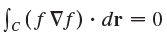
Suppose S and C satisfy the hypotheses of Stokes’ Theorem and f, t have continuous second-order partial derivatives. Use Exercises 24 and 26 in Section 16.5 to show the following.(a)(b)(c) Se(S Vg) • dr = [[s (Vf × Vg) • dS Sc (f Vf)· dr = 0
If S is a sphere and F satisfies the hypotheses of Stokes’ Theorem, show that ʃʃS curl F • dS = 0.
EvaluateʃC(y + sin x) dx + (z2 + cos y) dy + x2 dzwhere C is the curve r(t) = (sin t, cos t, sin 2t), 0 < t < 2π,. Observe that C lies on the surface z = 2xy.]
A particle moves along line segments from the origin to the points (1, 0, 0), (1, 2, 1), (0, 2, 1), and back to the origin under the influence of the force fieldF(x, y, z) = z2 i + 2xy j + 4y2 kFind the work done.
Let C be a simple closed smooth curve that lies in the plane x + y + z = 1. Show that the line integralʃC z dx - 2x dy + 3ydzdepends only on the area of the region enclosed by C and not on the shape of C or its location in the plane.
Verify that Stokes’ Theorem is true for the given vector field F and surface S.F(x, y, z) = y i + z j + x k, S is the hemisphere x2 + y2 + z2 = 1, y > 0, oriented in the direction of the positive y-axis
Verify that Stokes’ Theorem is true for the given vector field F and surface S.F(x, y, z) = -2yz i + y j + 3x k, S is the part of the paraboloid z = 5 - x2 - y2 that lies above the plane z = 1, oriented upward
Verify that Stokes’ Theorem is true for the given vector field F and surface S.F(x, y, z) = 2y i + x j - 2 k,S is the cone z2 = x2 + y2, 0 < z < 4, oriented downward
(a) Use Stokes’ Theorem to evaluate ʃC F • dr, where F(x, y, z) = x2y i + 1/3 x3 j + xy k and C is the curve of intersection of the hyperbolic paraboloid z = y2 - x2 and the cylinder x2 + y2 = 1, oriented counterclockwise as viewed from above.(b) Graph both the hyperbolic paraboloid
(a) Use Stokes’ Theorem to evaluate ʃC F • dr, where F(x, y, z) = x2z i + xy2 j + z2 k and C is the curve of intersection of the plane x + y + z = 1 and the cylinder x2 + y2 = 9, oriented counterclockwise as viewed from above.(b) Graph both the plane and the cylinder with domains chosen
Use Stokes’ Theorem to evaluate ʃC F • dr. In each case C is oriented counterclockwise as viewed from above.F(x, y, z) = 2y i + xz j + (x + y) k, C is the curve of intersection of the plane z = y + 2 and the cylinder x2 + y2 = 1
Use Stokes’ Theorem to evaluate ʃC F • dr. In each case C is oriented counterclockwise as viewed from above.F(x, y, z) = xy i + yz j + zx k, C is the boundary of the part of the paraboloid z = 1 - x2 - y2 in the first octant
Use Stokes’ Theorem to evaluate ʃC F • dr. In each case C is oriented counterclockwise as viewed from above.F(x, y, z) = i + (x + yz) j + (xy - √z) k, C is the boundary of the part of the plane 3x + 2y + z = 1 in the first octant
Use Stokes’ Theorem to evaluate ʃC F • dr. In each case C is oriented counterclockwise as viewed from above.F(x, y, z) = (x + y2) i + (y + z2) j + (z + x2) k, C is the triangle with vertices (1, 0, 0), (0, 1, 0), and (0, 0, 1)
Use Stokes’ Theorem to evaluate ʃʃS curl F • dS.F(x, y, z) = exy i + exz j + x2z k, S is the half of the ellipsoid 4x2 + y2 + 4z2 = 4 that lies to the right of the xz-plane, oriented in the direction of the positive y-axis
Use Stokes’ Theorem to evaluate ʃʃS curl F • dS.F(x, y, z) = xyz i + xy j + x2yz k,S consists of the top and the four sides (but not the bottom) of the cube with vertices (±1, ±1, ±1), oriented outward
Use Stokes’ Theorem to evaluate ʃʃS curl F • dS.F(x, y, z) = tan-1(x2yz2) i + x2y j + x2z2 k, S is the cone x = √y2 + z2 , 0 < x < 2, oriented in the direction of the positive x-axis
Use Stokes’ Theorem to evaluate ʃʃS curl F • dS.F(x, y, z) = zey i + x cos y j + xz sin y k, S is the hemisphere x2 + y2 + z2 = 16, y > 0, oriented in the direction of the positive y-axis
Use Stokes’ Theorem to evaluate ʃʃS curl F • dS.F(x, y, z) = x2 sin z i + y2 j + xy k, S is the part of the paraboloid z = 1 - x2 - y2 that lies above the xy-lane, oriented upward
Showing 17000 - 17100
of 29454
First
164
165
166
167
168
169
170
171
172
173
174
175
176
177
178
Last
Step by Step Answers

 Get 50% OFF
Claim Now
Get 50% OFF
Claim Now