New Semester
Started
Get
50% OFF
Study Help!
--h --m --s
Claim Now
Question Answers
Textbooks
Find textbooks, questions and answers
Oops, something went wrong!
Change your search query and then try again
S
Books
FREE
Study Help
Expert Questions
Accounting
General Management
Mathematics
Finance
Organizational Behaviour
Law
Physics
Operating System
Management Leadership
Sociology
Programming
Marketing
Database
Computer Network
Economics
Textbooks Solutions
Accounting
Managerial Accounting
Management Leadership
Cost Accounting
Statistics
Business Law
Corporate Finance
Finance
Economics
Auditing
Tutors
Online Tutors
Find a Tutor
Hire a Tutor
Become a Tutor
AI Tutor
AI Study Planner
NEW
Sell Books
Search
Search
Sign In
Register
study help
mathematics
precalculus
Precalculus 9th edition Michael Sullivan - Solutions
Find the remaining angle(s) and side(s) of triangle, if it (they) exists. If no triangle exists, say “No triangle.” a = 3, b = 5, B = 80°
Find the remaining angle(s) and side(s) of triangle, if it (they) exists. If no triangle exists, say “No triangle.” a = 3, c = 1, B = 100°
Find the remaining angle(s) and side(s) of triangle, if it (they) exists. If no triangle exists, say “No triangle.” a = 3, c = 1, C = 20°
Find the remaining angle(s) and side(s) of triangle, if it (they) exists. If no triangle exists, say “No triangle.” a = 3, c = 1, C = 110°
Find the remaining angle(s) and side(s) of triangle, if it (they) exists. If no triangle exists, say “No triangle.” a = 2, c = 5, A = 60°
Find the remaining angle(s) and side(s) of triangle, if it (they) exists. If no triangle exists, say “No triangle.” A = 100°, a = 5, c = 2
Find the remaining angle(s) and side(s) of triangle, if it (they) exists. If no triangle exists, say “No triangle.” A = 10°, C = 40°, c = 2
Find the remaining angle(s) and side(s) of triangle, if it (they) exists. If no triangle exists, say “No triangle.” A = 50°, B = 30°, a = 1
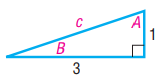
Solve Triangle. 3.
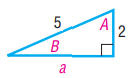
Solve Triangle. 5 2.
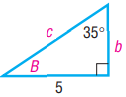
Solve Triangle. 35 B.
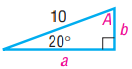
Solve Triangle. 10 20° aి
Find the exact value of each expression. Do not use a calculator. tan2 40° - cos2 50°
Find the exact value of each expression. Do not use a calculator. cos240° + cos250°
Find the exact value of each expression. Do not use a calculator. tan 40°/cot 50°
Find the exact value of each expression. Do not use a calculator. sec 55°/csc 35°
Find the exact value of each expression. Do not use a calculator. tan 15° - cot 75°
Find the exact value of each expression. Do not use a calculator. cos 62° - sin 28°
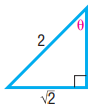
Find the exact value of the six trigonometric functions of the angle in each figure. Ө V2 2.
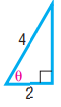
Find the exact value of the six trigonometric functions of the angle in each figure. 2. 4,
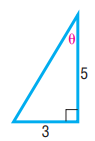
Find the exact value of the six trigonometric functions of the angle in each figure. 3,
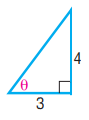
Find the exact value of the six trigonometric functions of the angle in each figure. 3
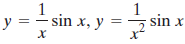
Use a graphing utility to graphand y = 1/x3 sin x for x > 0. That patterns do you observe? sin x - sin x, y = y =
Use a graphing utility to graph y = x sin x, y = x2 sin x, and y = x3 sin x for x > 0. What patterns do you observe?
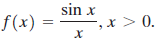
Use a graphing utility to graph the functionBased on the graph, what do you conjecture about the value of sinx/x for x close to 0? sin x -, x > 0. f(x)
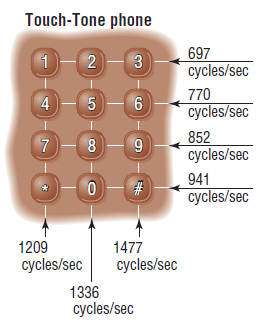
Use a graphing utility to graph the sound emitted by the * key on a Touch-Tone phone. See Problem 57.Data from problem 57On a Touch-Tone phone, each button produces a unique sound. The sound produced is the sum of two tones, given bywhere l and h are the low and high frequencies (cycles per second)
On a Touch-Tone phone, each button produces a unique sound. The sound produced is the sum of two tones, given bywhere l and h are the low and high frequencies (cycles per second) shown in the illustration. For example, if you touch 7, the low frequency is l = 852 cycles per second and the high
An oscilloscope often displays a sawtooth curve.This curve can be approximated by sinusoidal curves of varying periods and amplitudes.(a) Use a graphing utility to graph the following function, which can be used to approximate the sawtooth curve.(b) A better approximation to the sawtooth curve is
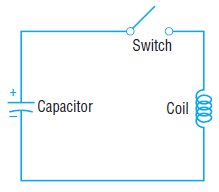
See the illustration. If a charged capacitor is connected to a coil by closing a switch, energy is transferred to the coil and then back to the capacitor in an oscillatory motion. The voltage V (in volts) across the capacitor will gradually diminish to 0 with time t (in seconds).(a) Graph the
The end of a tuning fork moves in simple harmonic motion described by the equation d = a sin (ωt). If a tuning fork for the note E above middle C on an even-tempered scale (E4) has a frequency of approximately 329.63 hertz (cycles per second), find ω. If the maximum displacement of the end of the
The end of a tuning fork moves in simple harmonic motion described by the equation d = a sin (ωt). If a tuning fork for the note A above middle C on an even tempered scale (A4, the tone by which an orchestra tunes itself) has a frequency of 440 hertz (cycles per second), find ω. If the maximum
Added to Six Flags St. Louis in 1986, the Colossus is a giant Ferris wheel. Its diameter is 165 feet, it rotates at a rate of about 1.6 revolutions per minute, and the bottom of the wheel is 15 feet above the ground. Determine an equation that relates a rider’s height above the ground at time t.
A loudspeaker diaphragm is oscillating in simple harmonic motion described by the equation d = a cos (ωt) with a frequency of 520 hertz (cycles per second) and a maximum displacement of 0.80 millimeter. Find ω and then determine the equation that describes the movement of the diaphragm.
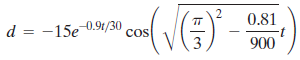
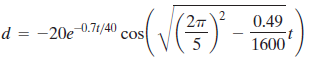
The distance d (in meters) of the bob of a pendulum of mass m (in kilograms) from its rest position at time t (in seconds) is given. The bob is released from the left of its rest position and represents a negative direction.(a) Describe the motion of the object. Be sure to give the mass and damping
The distance d (in meters) of the bob of a pendulum of mass m (in kilograms) from its rest position at time t (in seconds) is given. The bob is released from the left of its rest position and represents a negative direction.(a) Describe the motion of the object. Be sure to give the mass and damping
The distance d (in meters) of the bob of a pendulum of mass m (in kilograms) from its rest position at time t (in seconds) is given. The bob is released from the left of its rest position and represents a negative direction.(a) Describe the motion of the object. Be sure to give the mass and damping
The distance d (in meters) of the bob of a pendulum of mass m (in kilograms) from its rest position at time t (in seconds) is given. The bob is released from the left of its rest position and represents a negative direction.(a) Describe the motion of the object. Be sure to give the mass and damping
The distance d (in meters) of the bob of a pendulum of mass m (in kilograms) from its rest position at time t (in seconds) is given. The bob is released from the left of its rest position and represents a negative direction.(a) Describe the motion of the object. Be sure to give the mass and damping
The distance d (in meters) of the bob of a pendulum of mass m (in kilograms) from its rest position at time t (in seconds) is given. The bob is released from the left of its rest position and represents a negative direction.(a) Describe the motion of the object. Be sure to give the mass and damping
An object of mass m (in grams) attached to a coiled spring with damping factor b (in grams per second) is pulled down a distance a (in centimeters) from its rest position and then released. Assume that the positive direction of the motion is up and the period is T (in seconds) under simple harmonic
An object of mass m (in grams) attached to a coiled spring with damping factor b (in grams per second) is pulled down a distance a (in centimeters) from its rest position and then released. Assume that the positive direction of the motion is up and the period is T (in seconds) under simple harmonic
An object of mass m (in grams) attached to a coiled spring with damping factor b (in grams per second) is pulled down a distance a (in centimeters) from its rest position and then released. Assume that the positive direction of the motion is up and the period is T (in seconds) under simple harmonic
An object of mass m (in grams) attached to a coiled spring with damping factor b (in grams per second) is pulled down a distance a (in centimeters) from its rest position and then released. Assume that the positive direction of the motion is up and the period is T (in seconds) under simple harmonic
An object of mass m (in grams) attached to a coiled spring with damping factor b (in grams per second) is pulled down a distance a (in centimeters) from its rest position and then released. Assume that the positive direction of the motion is up and the period is T (in seconds) under simple harmonic
An object of mass m (in grams) attached to a coiled spring with damping factor b (in grams per second) is pulled down a distance a (in centimeters) from its rest position and then released. Assume that the positive direction of the motion is up and the period is T (in seconds) under simple harmonic
(a) Use the Product-to-Sum Formulas to express product as a sum,(b) Use the method of adding y-coordinates to graph the function on the interval [0, 2π].g(x) = 2 sin x cos(3x)
(a) Use the Product-to-Sum Formulas to express product as a sum,(b) Use the method of adding y-coordinates to graph the function on the interval [0, 2π].H(x) = 2 sin(3x) cos(x)
(a) Use the Product-to-Sum Formulas to express product as a sum,(b) Use the method of adding y-coordinates to graph the function on the interval [0, 2π].h(x) = cos(2x) cos(x)
(a) Use the Product-to-Sum Formulas to express product as a sum,(b) Use the method of adding y-coordinates to graph the function on the interval [0, 2π].G(x) = cos(4x) cos (2x)
(a) Use the Product-to-Sum Formulas to express product as a sum,(b) Use the method of adding y-coordinates to graph the function on the interval [0, 2π].F(x) = sin(3x) sinx
(a) Use the Product-to-Sum Formulas to express product as a sum,(b) Use the method of adding y-coordinates to graph the function on the interval [0, 2π].f(x) = sin(2x) sinx
Use the method of adding y-coordinates to graph the function.g(x) = cos(2x) + cos x
Use the method of adding y-coordinates to graph the function.g(x) = sin x + sin(2x)
Use the method of adding y-coordinates to graph the function.f(x) = sin(2x) + cos x
Use the method of adding y-coordinates to graph the function.f(x) = sin x + cos x
Use the method of adding y-coordinates to graph the function.f(x) = x - cos x
Use the method of adding y-coordinates to graph the function.f(x) = x - sin x
Use the method of adding y-coordinates to graph the function.f(x) = x + cos(2x)
Use the method of adding y-coordinates to graph the function.f(x) = x + cos x
Graph damped vibration curve for 0 ≤ t ≤ 2π.d(t) = e-t/4π cos t
Graph damped vibration curve for 0 ≤ t ≤ 2π.d(t) = e-t/2π cos t
Graph damped vibration curve for 0 ≤ t ≤ 2π.d(t) = e-t/2π cos(2t)
Graph damped vibration curve for 0 ≤ t ≤ 2π.d(t) = e-t/π cos(2t)
The displacement d (in meters) of an object at time t (in seconds) is given.(a) Describe the motion of the object.(b) What is the maximum displacement from its resting position?(c) What is the time required for one oscillation?(d) What is the frequency?d = 4 + 3 sin (πt)
The displacement d (in meters) of an object at time t (in seconds) is given.(a) Describe the motion of the object.(b) What is the maximum displacement from its resting position?(c) What is the time required for one oscillation?(d) What is the frequency?d = 6 + 2 cos(2πt)
The displacement d (in meters) of an object at time t (in seconds) is given.(a) Describe the motion of the object.(b) What is the maximum displacement from its resting position?(c) What is the time required for one oscillation?(d) What is the frequency?d = -2 cos(2t)
The displacement d (in meters) of an object at time t (in seconds) is given.(a) Describe the motion of the object.(b) What is the maximum displacement from its resting position?(c) What is the time required for one oscillation?(d) What is the frequency?d = -3 sin(1/2 t)
The displacement d (in meters) of an object at time t (in seconds) is given.(a) Describe the motion of the object.(b) What is the maximum displacement from its resting position?(c) What is the time required for one oscillation?(d) What is the frequency?d = 5 cos(π/2 t)
The displacement d (in meters) of an object at time t (in seconds) is given.(a) Describe the motion of the object.(b) What is the maximum displacement from its resting position?(c) What is the time required for one oscillation?(d) What is the frequency?d = 6 cos(πt)
The displacement d (in meters) of an object at time t (in seconds) is given.(a) Describe the motion of the object.(b) What is the maximum displacement from its resting position?(c) What is the time required for one oscillation?(d) What is the frequency?d = 4 sin(2t)
The displacement d (in meters) of an object at time t (in seconds) is given.(a) Describe the motion of the object.(b) What is the maximum displacement from its resting position?(c) What is the time required for one oscillation?(d) What is the frequency?d = 5 sin(3t)
Rework Problem 8 under the same conditions except that, at time t = 0, the object is at its resting position and moving down.Data from problem 8a = 4; T = π/2 seconds
Rework Problem 7 under the same conditions except that, at time t = 0, the object is at its resting position and moving down.Data from problem 7a = 6; T = π seconds
Rework Problem 6 under the same conditions except that, at time t = 0, the object is at its resting position and moving down.Data from problem 6a = 10; T = 3 seconds
Rework Problem 5 under the same conditions except that, at time t = 0, the object is at its resting position and moving down.Data from problem 5a = 5; T = 2 seconds
An object attached to a coiled spring is pulled down a distance a from its rest position and then released. Assuming that the motion is simple harmonic with period T, write an equation that relates the displacement d of the object from its rest position after t seconds. Also assume that the
An object attached to a coiled spring is pulled down a distance a from its rest position and then released. Assuming that the motion is simple harmonic with period T, write an equation that relates the displacement d of the object from its rest position after t seconds. Also assume that the
An object attached to a coiled spring is pulled down a distance a from its rest position and then released. Assuming that the motion is simple harmonic with period T, write an equation that relates the displacement d of the object from its rest position after t seconds. Also assume that the
An object attached to a coiled spring is pulled down a distance a from its rest position and then released. Assuming that the motion is simple harmonic with period T, write an equation that relates the displacement d of the object from its rest position after t seconds. Also assume that the
True or FalseIf the distance d of an object from its rest position at time t is given by a sinusoidal graph, the motion of the object is simple harmonic motion.
When a mass hanging from a spring is pulled down and then released, the motion is called _____ ________ if there is no frictional force to retard the motion, and the motion is called _____if there is friction.
The motion of an object obeys the equation d = 4 cos(6t). Such motion is described as _____ _______. The number 4 is called the _______.
The amplitude A and period T of f(x) = 5 sin(4x) are ______ and ______.
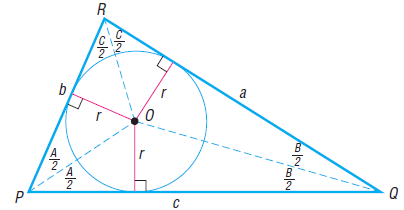
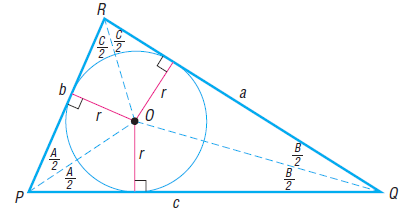
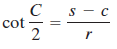
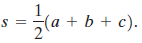
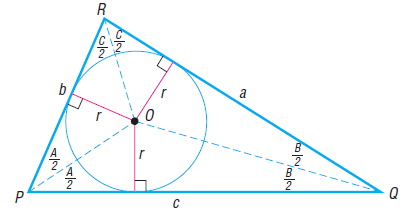
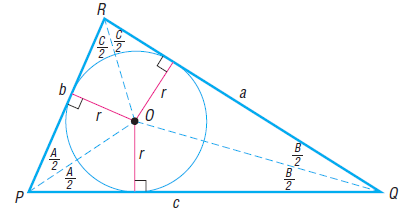
Show that the area K of triangle PQR is K = rs, where s = ½(a + b + c). Then show thatThe lines that bisect each angle of a triangle meet in a single point O, and the perpendicular distance r from O to each side of the triangle is the same. The circle with center at O and radius r is called the
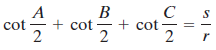
Show thatThe lines that bisect each angle of a triangle meet in a single point O, and the perpendicular distance r from O to each side of the triangle is the same. The circle with center at O and radius r is called the inscribed circle of the triangle (see the figure). A B 아들- + cot- + cot- 2
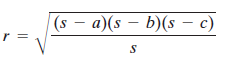
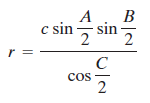
Use the result of Problem 50 and the results of Problems 56 and 57 in Section 8.3 to show thatwhereThe lines that bisect each angle of a triangle meet in a single point O, and the perpendicular distance r from O to each side of the triangle is the same. The circle with center at O and radius r is
Apply the formula from Problem 49 to triangle OPQ to show thatThe lines that bisect each angle of a triangle meet in a single point O, and the perpendicular distance r from O to each side of the triangle is the same. The circle with center at O and radius r is called the inscribed circle of the
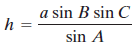
Show that a formula for the altitude h from a vertex to the opposite side a of a triangle is a sin B sin C sin A
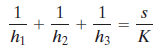
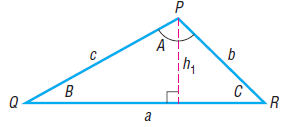
If h1, h2, and h3 are the altitudes dropped from P, Q, and R, respectively, in a triangle (see the figure), show thatwhere K is the area of the triangle and s = ½ (a + b + c). h3 h2 K hị 이K ||
A perfect triangle is one having natural number sides for which the area is numerically equal to the perimeter. Show that the triangles with the given side lengths are perfect.(a) 9, 10, 17(b) 6, 25, 29
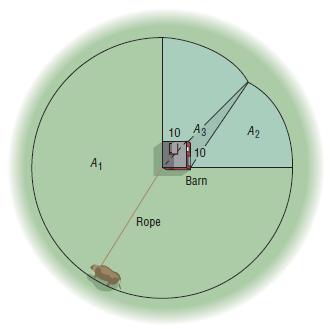
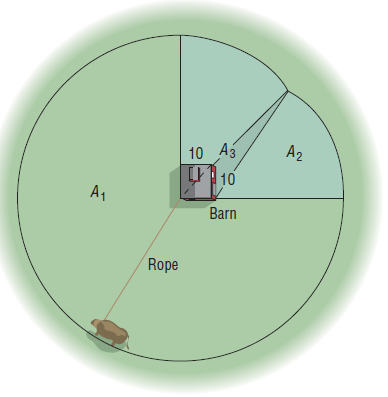
If the barn in Problem 45 is rectangular, 10 feet by 20 feet, what is the maximum grazing area for the cow?Data from problem 45 10 Ag U 10 A2 A1 Barn Rope
A cow is tethered to one corner of a square barn, 10 feet by 10 feet, with a rope 100 feet long. What is the maximum grazing area for the cow? 10 Аз 10 A2 A1 Barn Rope
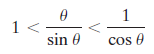
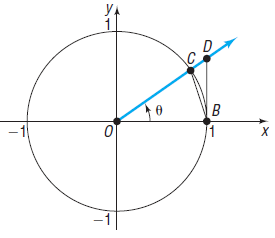
Refer to the figure, in which a unit circle is drawn. The line segment DR is tangent to the circle and 0 is acute (a) Express the area of ΔOBC in terms of sin θ and cos θ. (b) Express the area of ΔOBD in terms of sin θ and cos θ.(c) The area of the sector O͡B͡C͡ of the circle is
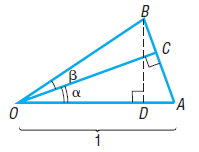
Geometry Refer to the figure. If |OA| = 1, show that: (a) Area ΔOAC = 1/2 sin α cos α(b) Area ΔOCB = 1/2 |OB|2 sin β cos β (c) Area ΔOAB = 1/2 |OB| sin(α + β)(d) |OB| = cos α/cos β(e) sin(α + β) = sin α cos β + cos α sin β C A D
The Bermuda Triangle is roughly defined by Hamilton, Bermuda; San Juan, Puerto Rico; and Fort Lauderdale, Florida. The distances from Hamilton to Fort Lauderdale, Fort Lauderdale to San Juan, and San Juan to Hamilton are approximately 1028, 1046, and 965 miles, respectively. Ignoring the curvature
Completed in 1902 in New York City, the Flatiron Building is triangular shaped and bounded by 22nd Street, Broadway, and 5th Avenue. The building measures approximately 87 feet on the 22nd Street side, 190 feet on the Broadway side, and 173 feet on the 5th Avenue side.Approximate the ground area
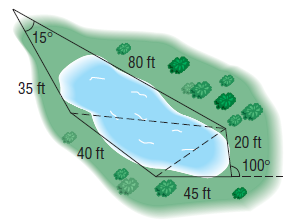
To approximate the area of a lake, a surveyor walks around the perimeter of the lake, taking the measurements shown in the illustration. Using this technique, what is the approximate area of the lake? 15 80 ft 35 ft 20 ft 40 ft 100° 45 ft
Consult the figure, which shows a circle of radius r with center at O. Find the area K of the shaded region as a function of the central angle θ.
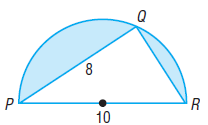
Find the area of the shaded region enclosed in a semicircle of diameter 10 inches. The length of the chord PQ is 8 inches. R. 10
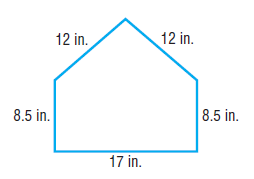
The dimensions of home plate at any major league baseball stadium are shown. Find the area of home plate. 12 in. 12 in. 8.5 in. 8.5 in. 17 in.
Showing 23900 - 24000
of 29454
First
233
234
235
236
237
238
239
240
241
242
243
244
245
246
247
Last
Step by Step Answers

 Get 50% OFF
Claim Now
Get 50% OFF
Claim Now



![y = sin[27 (852)t] + sin[2#(1209)t] %3D](https://dsd5zvtm8ll6.cloudfront.net/si.question.images/images/question_images/1551/2/0/2/6945c7579865fdfe1551185412441.jpg)