New Semester
Started
Get
50% OFF
Study Help!
--h --m --s
Claim Now
Question Answers
Textbooks
Find textbooks, questions and answers
Oops, something went wrong!
Change your search query and then try again
S
Books
FREE
Study Help
Expert Questions
Accounting
General Management
Mathematics
Finance
Organizational Behaviour
Law
Physics
Operating System
Management Leadership
Sociology
Programming
Marketing
Database
Computer Network
Economics
Textbooks Solutions
Accounting
Managerial Accounting
Management Leadership
Cost Accounting
Statistics
Business Law
Corporate Finance
Finance
Economics
Auditing
Tutors
Online Tutors
Find a Tutor
Hire a Tutor
Become a Tutor
AI Tutor
AI Study Planner
NEW
Sell Books
Search
Search
Sign In
Register
study help
mathematics
precalculus
Calculus Early Transcendentals 8th edition James Stewart - Solutions
Differentiate the function.g(t) = 2t-3/4
Calculate y'.y = 1/√x - 1/5√x3
What is the maximum vertical distance between the line y = x + 2 and the parabola y=x² for -1 sx 21
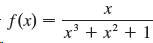
Produce graphs of f that reveal all the important aspects of the curve. In particular, you should use graphs of f' and f'' to estimate the intervals of increase and decrease, extreme values, intervals of concavity, and inflection points. х f(x) = x³ + x? + 1
Find the most general antiderivative of the function.f(x) = x(12x + 8)
Find the linearization L(x) of the function at a.f (x) = sin x, a = π/6
Show that the inflection points of the curve y = (sin x)/x lie on the curve y2(x4 + 4) = 4.
Find the linearization L(x) of the function at a.f (x) = x3 - x2 + 3, a = -2
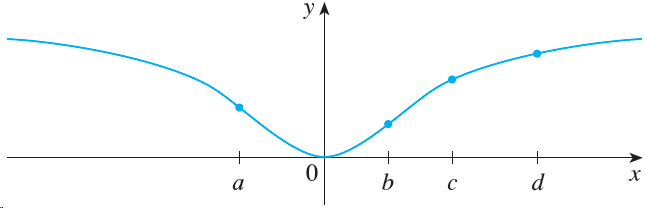
For which of the initial approximations x1 = a, b, c, and d do you think Newton’s method will work and lead to the root of the equation f (x) − 0? ул + + х a
Find the local and absolute extreme values of the function on the given interval. f(s) -x+2 cos x [-π, π]
If the minute hand of a clock has length r (in centimeters), find the rate at which it sweeps out area as a function of r.
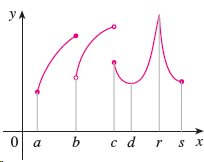
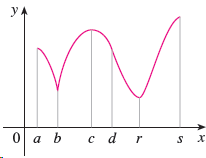
For each of the numbers a, b, c, d, r, and s, state whether the function whose graph is shown has an absolute maximum or minimum, a local maximum or minimum, or neither a maximum nor a minimum. УА c d r s x
Calculate y'.y = (x2 + x3)4
Differentiate the function.f (t) = 2t3 - 3t2 - 4t
Use the guidelines of this section to sketch the curve. y = x* – 8x² + 8
Write the composite function in the form f ( g(x)). [Identify the inner function u = t(x) and the outer function y = f (u).] Then find the derivative dy/dx.y = √2 - ex
Find the numerical value of each expression.(a) sinh 1 (b) sinh-1 1
Draw the graph of a function that is continuous on [0, 8] where f (0) = 1 and f (8) = 4 and that does not satisfy the conclusion of the Mean Value Theorem on [0, 8].
The sum of two positive numbers is 16. What is the smallest possible value of the sum of their squares?
Determine whether the statement is true or false. If it is true, explain why. If it is false, explain why or give an example that disproves the statement.d/dx (10x) = x10x-1
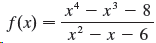
Produce graphs of f that reveal all the important aspects of the curve. In particular, you should use graphs of f' and f'' to estimate the intervals of increase and decrease, extreme values, intervals of concavity, and inflection points. x* — х3 — 8 x? — х — 6 |f(x) = .2
Find the most general antiderivative of the function. f(x) = 6x – 8x* – 9x? .2
The area of a triangle with sides of lengths a and b and contained angle θ is A = 1/2 ab sin θ(a) If a = 2 cm, b = 3 cm, and θ increases at a rate of 0.2 rad/min, how fast is the area increasing when θ = π/3?(b) If a = 2 cm, b increases at a rate of 1.5 cm/min, and θ increases at a rate of
Find the local and absolute extreme values of the function on the given interval. f(x) = Vr2 + x + 1, [-2, 1]
For each of the numbers a, b, c, d, r, and s, state whether the function whose graph is shown has an absolute maximum or minimum, a local maximum or minimum, or neither a maximum nor a minimum. УА c dr х
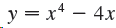
Use the guidelines of this section to sketch the curve. y = x* – 4x
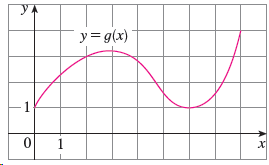
The graph of a function t is shown.(a) Verify that t satisfies the hypotheses of the Mean Value Theorem on the interval [0, 8].(b) Estimate the value(s) of c that satisfy the conclusion of the Mean Value Theorem on the interval [0, 8].(c) Estimate the value(s) of c that satisfy the conclusion of
Differentiate the function.f(t) = 1.4t5 - 2.5t2 + 6.7
Determine whether the statement is true or false. If it is true, explain why. If it is false, explain why or give an example that disproves the statement.d/dx (ln 10) = 1/10
Produce graphs of f that reveal all the important aspects of the curve. In particular, you should use graphs of f' and f'' to estimate the intervals of increase and decrease, extreme values, intervals of concavity, and inflection points. f(x) = x° – 5x + 25x – 6x? – 48x .3
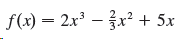
Find the most general antiderivative of the function. f(x) = 2x' – x² + 5x |
Find the numerical value of each expression.(a) sech 0 (b) cosh-1 1
Does the function f(x) = e10|x-2|-x2 have an absolute maximum? If so, find it. What about an absolute minimum?
Differentiate.y = sec θ tan θ
Suppose the tangent line to the curve y = f (x) at the point (2, 5) has the equation y = 9 - 2x. If Newton’s method is used to locate a root of the equation f (x) = 0 and the initial approximation is x1 = 2, find the second approximation x2.
Differentiate the function.f (x) = 5.2x + 2.3
Determine whether the statement is true or false. If it is true, explain why. If it is false, explain why or give an example that disproves the statement.If y = e2, then y' = 2e.
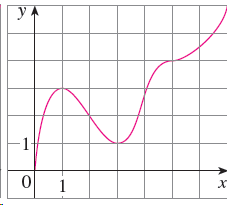
Use the given graph of f to find the following.(a) The open intervals on which f is increasing.(b) The open intervals on which f is decreasing.(c) The open intervals on which f is concave upward.(d) The open intervals on which f is concave downward.(e) The coordinates of the points of inflection.
Use the guidelines of this section to sketch the curve. y = 2 + 3x? – x³
Differentiate.y = ex/1 - ex
Draw the graph of a function defined on [0, 8] such that f (0) = f(8) = 3 and the function does not satisfy the conclusion of Rolle’s Theorem on [0, 8].
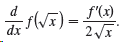
Determine whether the statement is true or false. If it is true, explain why. If it is false, explain why or give an example that disproves the statement.If f is differentiable, then f'(x) 2JI dx x,
Produce graphs of f that reveal all the important aspects of the curve. In particular, you should use graphs of f' and f'' to estimate the intervals of increase and decrease, extreme values, intervals of concavity, and inflection points. f(x) = -2x° + 5x + 140x³ – 110x²
Find the most general antiderivative of the function. — х? — Зх + 2 f(x)
Differentiate.y = x/ex
Find the numerical value of each expression.(a) sinh 4 (b) sinhsln 4d
Follow the instructions for Exercise 1(a) but use x1 = 1 as the starting approximation for finding the root r.
(a) Find y' by implicit differentiation.(b) Solve the equation explicitly for y and differentiate to get y' in terms of x.(c) Check that your solutions to parts (a) and (b) are consistent by substituting the expression for y into your solution for part (a).2/x - 1/y = 4
Find the local and absolute extreme values of the function on the given interval. f(x) = x/T- x, [-1, 1]
Use the guidelines of this section to sketch the curve.y = x3 + 3x2
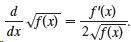
Determine whether the statement is true or false. If it is true, explain why. If it is false, explain why or give an example that disproves the statement.If f is differentiable, then f'(x) 2F(x) VF(x) dx
Show that cos'x 1 + tan x sin'x dx \1+ cotx -cos 2.x
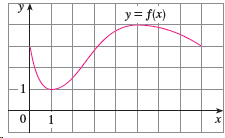
The graph of a function f is shown. Verify that f satisfies the hypotheses of Rolle’s Theorem on the interval [0, 8]. Then estimate the value(s) of c that satisfy the conclusion of Rolle’s Theorem on that interval. y = f(x) -1 1
Produce graphs of f that reveal all the important aspects of the curve. In particular, you should use graphs of f' and f'' to estimate the intervals of increase and decrease, extreme values, intervals of concavity, and inflection points. f(x) = x – 5x* – x³ – 28x? – 2x .3
Find the most general antiderivative of the function.f(x) = 4x + 7
Write the composite function in the form f (g(x)). [Identify the inner function u = t(x) and the outer function y = f (u).] Then find the derivative dy/dx.y = sin(cot x)
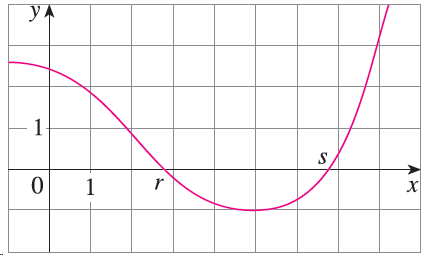
The figure shows the graph of a function f. Suppose that Newton’s method is used to approximate the root s of the equation f (x) = 0 with initial approximation x1 = 6.(a) Draw the tangent lines that are used to find x2 and x3, and estimate the numerical values of x2 and x3.(b) Would x1 = 8 be a
Differentiate.g(x) = (x + 2√x)ex
Find the numerical value of each expression.(a) coshsln 5d (b) cosh 5
Find the local and absolute extreme values of the functionon the given interval. f0) — х* — 9х? + 24х — 2, [0,5]
(a) Find y' by implicit differentiation.(b) Solve the equation explicitly for y and differentiate to get y' in terms of x.(c) Check that your solutions to parts (a) and (b) are consistent by substituting the expression for y into your solution for part (a).√x + √y = 1
Write the composite function in the form f (g(x)). [Identify the inner function u = t(x) and the outer function y = f (u).] Then find the derivative dy/dx.y = tan πx
Differentiate.f (x) = (3x2 - 5x)ex
Determine whether the statement is true or false. If it is true, explain why. If it is false, explain why or give an example that disproves the statement.If f and t are differentiable, then
Find the numerical value of each expression.(a) tanh 0 (b) tanh 1
(a) Find y' by implicit differentiation.(b) Solve the equation explicitly for y and differentiate to get y' in terms of x.(c) Check that your solutions to parts (a) and (b) are consistent by substituting the expression for y into your solution for part (a).2x2 + x + xy = 1
Write the composite function in the form f ( g(x)). [Identify the inner function u = t(x) and the outer function y = f (u).] Then find the derivative dy/dx.y = (2x3 + 5)4
Determine whether the statement is true or false. If it is true, explain why. If it is false, explain why or give an example that disproves the statement.If f and t are differentiable, then [f(x) g(x)] = f'(x)g'(x) dx
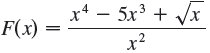
Find the derivative of the functionin two ways: by using the Quotient Rule and by simplifying first. Show that your answers are equivalent. Which method do you prefer? 5x + Vx x* F(x) x?
(a) If A is the area of a circle with radius r and the circle expands as time passes, find dA/dt in terms of dr/dt.(b) Suppose oil spills from a ruptured tanker and spreads in a circular pattern. If the radius of the oil spill increases at a constant rate of 1 mys, how fast is the area of the spill
(a) Find y' by implicit differentiation.(b) Solve the equation explicitly for y and differentiate to get y' in terms of x.(c) Check that your solutions to parts (a) and (b) are consistent by substituting the expression for y into your solution for part (a).9x2 - y2 = 1
Determine whether the statement is true or false. If it is true, explain why. If it is false, explain why or give an example that disproves the statement.If f and t are differentiable, then [f(x) + g(x)] = f'(x) + g'(x) dx
Let B(t) be the number of US $20 bills in circulation at time t. The table gives values of this function from 1990 to 2010, as of December 31, in billions. Interpret and estimate the value of
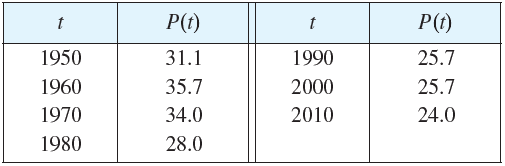
Let P(t) be the percentage of Americans under the age of 18 at time t. The table gives values of this function in census years from 1950 to 2010.(a) What is the meaning of P'(t)? What are its units?(b) Construct a table of estimated values for P'(t).(c) Graph P and P'.(d) How would it be possible
Sketch the graph of a function f that satisfies all of the following conditions: The domain of f is all real numbers except 0, for all x in the domain of lim f(x) = 1, lim f(x) = 0, f'(x) > 0 f, lim f'(x) = 0, lim f'(x) = 1.
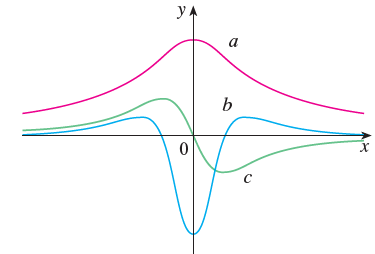
The figure shows the graphs of f , f′, and f′′. Identify each curve, and explain your choices. УА х
Determine whether the statement is true or false. If it is true, explain why. If it is false, explain why or give an example that disproves the statement.An equation of the tangent line to the parabola y = x2 at (-2, 4) is y - 4 = 2x(x + 2).
If a snowball melts so that its surface area decreases at a rate of 1 cm/min, find the rate at which the diameter decreases when the diameter is 10 cm.(a) What quantities are given in the problem?(b) What is the unknown?(c) Draw a picture of the situation for any time t.(d) Write an equation that
Find the differential of each function.(a) y = tan √t (b) y = 1 - v2/1 + v2
Prove the identity.coth2x - 1 = csch2x
How many lines are tangent to both of the circles x2 + y2 = 4 and x2 + (y - 3)2 = 1?At what points do these tangent lines touch the circles?
Find the differential of each function.(a) y = 1 + 2u/1 + 3u (b) y = θ2 sin 2θ
Determine whether the statement is true or false. If it is true, explain hy. If it is false, explain why or give an example that disproves the statement.The derivative of a rational function is a rational function.
Determine whether the statement is true or false. If it is true, explain hy. If it is false, explain why or give an example that disproves the statement.If f (x) = (x6 - x4)5, then f(31) (x) = 0.
Find the differential of each function.(a) y = xe-4x (b) y = √1 - t4
A particle is moving along a hyperbola xy = 8. As it reaches the point (4, 2), the y-coordinate is decreasing at a rate of 3 cm/s. How fast is the x-coordinate of the point changing at that instant?
Determine whether the statement is true or false. If it is true, explain why. If it is false, explain why or give an example that disproves the statement.The derivative of a polynomial is a polynomial.
Differentiate the function.H(u) = (3u - 1) (u + 2)
Determine whether the statement is true or false. If it is true, explain why. If it is false, explain why or give an example that disproves the statement.d/dx|x2 + x| = |2x + 1|
Find dy/dx by implicit differentiation.x2/x + y = y2 + 1
Suppose 4x2 + 9/2 = 36, where x and y are functions of t.(a) If dy/dt = 1/3 , find dx/dt when x = 2 and y = 2/3 √5.(b) If dx/dt = 3, find dy/dt when x = -2 and y = 2/3 √5.
Differentiate the function.g(x) = x2(1 - 2x)
Prove that
Differentiate.H(u) = (u - √u)(u + √u)
Determine whether the statement is true or false. If it is true, explain why. If it is false, explain why or give an example that disproves the statement.d/dx (tan2x) = d/dx (sec2x)
(a) If t is differentiable, the Reciprocal Rule says thatUse the Quotient Rule to prove the Reciprocal Rule.(b) Use the Reciprocal Rule to differentiate the function in Exercise 16.(c) Use the Reciprocal Rule to verify that the Power Rule is valid for negative integers, that is, d/dx(x-n) =
Let f(x) = x/√1 - cos 2x.(a) Graph f. What type of discontinuity does it appear to have at 0?(b) Calculate the left and right limits of f at 0. Do these values confirm your answer to part (a)?
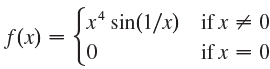
Show that the functionis continuous on (-∞, ∞). Jx* sin(1/x) ifx + 0 if x = 0 f(x) =
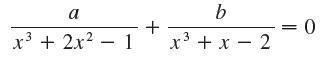
If a and b are positive numbers, prove that the equationhas at least one solution in the interval (-1, 1). 3 х3 +x — 2 x³ + 2x? – 1
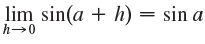
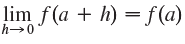
To prove that sine is continuous, we need to show that limxla sin x − sin a for every real number a. By Exercise 63 an equivalent statement is thatUse (6) to show that this is true.Exercise 63Prove that f is continuous at a if and only if lim sin(a + h) = sin a lim f(a + h) = f (a)
Showing 25000 - 25100
of 29454
First
244
245
246
247
248
249
250
251
252
253
254
255
256
257
258
Last
Step by Step Answers

 Get 50% OFF
Claim Now
Get 50% OFF
Claim Now



![f(s) -x+2 cos x [-π, π]](https://dsd5zvtm8ll6.cloudfront.net/si.question.images/images/question_images/1550/0/0/3/1345c632bbe9f81b1549985818755.jpg)


![f(x) = Vr2 + x + 1, [-2, 1]](https://dsd5zvtm8ll6.cloudfront.net/si.question.images/images/question_images/1550/0/0/3/0945c632b96da4bd1549985778982.jpg)




![f(x) = x/T- x, [-1, 1]](https://dsd5zvtm8ll6.cloudfront.net/si.question.images/images/question_images/1550/0/4/8/2995c63dc2b0a80b1550030982601.jpg)


![f0) — х* — 9х? + 24х — 2, [0,5]](https://dsd5zvtm8ll6.cloudfront.net/si.question.images/images/question_images/1550/0/0/2/9395c632afbd478f1549985623967.jpg)
![deF(g(x))] = f](https://dsd5zvtm8ll6.cloudfront.net/si.question.images/images/question_images/1551/1/9/6/1795c756013ccf171551139294669.jpg)
![[f(x) g(x)] = f'(x)g'(x) dx](https://dsd5zvtm8ll6.cloudfront.net/si.question.images/images/question_images/1549/2/8/5/1065c5836f26e5021549267783708.jpg)
![[f(x) + g(x)] = f'(x) + g'(x) dx](https://dsd5zvtm8ll6.cloudfront.net/si.question.images/images/question_images/1549/2/8/5/0145c583696aaafe1549267691966.jpg)



![g(x) [g(x)]? dx L g(x).](https://dsd5zvtm8ll6.cloudfront.net/si.question.images/images/question_images/1548/3/3/0/8605c49a76c0b7581548313511881.jpg)