







Question: Consider a cell with volume V , like those of Fig. 5.1, that has imaginary walls and is immersed in a bath of identical, nonrelativistic,
Consider a cell with volume V , like those of Fig. 5.1, that has imaginary walls and is immersed in a bath of identical, nonrelativistic, classical perfect-gas particles with temperature Tb and chemical potential μb. Suppose that we make a large number of measurements of the number of particles in the cell and that from those measurements we compute the probability pN for that cell to contain N particles.
(a) How widely spaced in time must the measurements be to guarantee that the measured probability distribution is the same as that computed, using the methods of this section, from an ensemble of cells (Fig. 5.1) at a specific moment of time?
(b) Assume that the measurements are widely enough separated for this criterion to be satisfied. Show that pN is given by
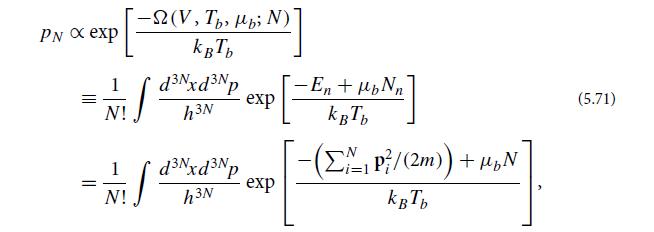
where Ω(V, Tb, μb; N) is the grand potential for the ensemble of cells, with each cell constrained to have precisely N particles in it.(c) By evaluating Eq. (5.71) exactly and then computing the normalization constant, show that the probability pN for the cell to contain N particles is given by the Poisson distribution

where N̅ is the mean number of particles in a cell,

[Eq. (3.39a)].(d) Show that for the Poisson distribution (5.72a), the expectation value is (N) = N̅, and the rms deviation from this is

(e) Show that for 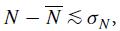
this Poisson distribution is exceedingly well approximated by a Gaussian with mean N̅ and variance σN.
Eq. (3.39a)

Fig. 5.1
PN o exp N! -&(V, , ; N) d3Nxd3Np h3N I exp[- exp -En + n kBTb d3Nxd3N (Ex=y p?/(2m)) + HN = n exp p -fess> N! h3N kBTb (5.71)
Step by Step Solution
3.31 Rating (172 Votes )
There are 3 Steps involved in it
Lets break down and solve each part of the problem Part a The question asks how widely spaced in time must the measurements be to guarantee that the measured probability distribution is the same as th... View full answer

Get step-by-step solutions from verified subject matter experts
 Study Help