New Semester
Started
Get
50% OFF
Study Help!
--h --m --s
Claim Now
Question Answers
Textbooks
Find textbooks, questions and answers
Oops, something went wrong!
Change your search query and then try again
S
Books
FREE
Study Help
Expert Questions
Accounting
General Management
Mathematics
Finance
Organizational Behaviour
Law
Physics
Operating System
Management Leadership
Sociology
Programming
Marketing
Database
Computer Network
Economics
Textbooks Solutions
Accounting
Managerial Accounting
Management Leadership
Cost Accounting
Statistics
Business Law
Corporate Finance
Finance
Economics
Auditing
Tutors
Online Tutors
Find a Tutor
Hire a Tutor
Become a Tutor
AI Tutor
AI Study Planner
NEW
Sell Books
Search
Search
Sign In
Register
study help
physics
college physics a strategic approach 2nd
College Physics Essentials Electricity And Magnetism Optics Modern Physics Volume Two 8th Edition Jerry D. Wilson, Anthony J. Buffa, Bo Lou - Solutions
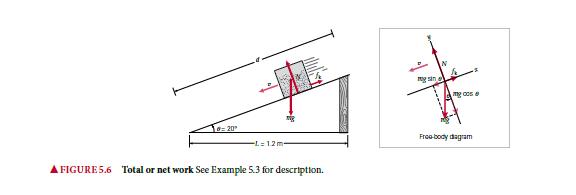
A 0.75-kg block slides with a uniform velocity down a 20° inclined plane (▼ Figure 5.6). (a) How much work is done by the force of friction on the block as it slides the total length of the plane? (b) What is the net work done on the block? (c) Discuss the network done if the angle of incline is
A worker pulls a \(40.0-\mathrm{kg}\) crate with a rope, as illustrated in \(abla\) Figure 5.5. The coefficient of kinetic (sliding) friction between the crate and the floor is 0.550. If he moves the crate with a constant velocity a distance of \(7.00 \mathrm{~m}\), how much is the work done by the
A student holds her \(1.5-\mathrm{kg}\) psychology textbook out a second story dormitory window until her arm is tired; then she releases it \(\square\) Figure 5.4). (a) How much work is done on the book by the student by simply holding it out the window? (b) How much work is done by the force of
A loaded Airbus 380 jumbo jet has a mass close to 6.0 × 10⁵ kg. What net force is required to give the plane an acceleration of 3.5 m/s2 down the runway for takeoffs?
The purpose of a car’s antilock brakes is to prevent the wheels from locking up so as to keep the car rolling rather than sliding. Why would rolling decrease the stopping distance as compared with sliding?
Is something wrong with the following statement?When a baseball is hit with a bat, there are equal and opposite forces on the bat and baseball. The forces then cancel, and there is no motion.
Here is a story of a horse and a farmer: One day, the farmer attaches a heavy cart to the horse and demands that the horse pull the cart. “Well,” says the horse, “I cannot pull the cart, because, according to Newton’s third law, if I apply a force to the cart, the cart will apply an equal
An astronaut has a mass of 70 kg when measured on Earth. What is her weight in deep space, far from any celestial body? What is her mass there?
An object weighs 300 N on Earth and 50 N on the Moon.Does the object also have less inertia on the Moon?
A crate sits in the middle of the bed of a flatbed truck.The driver accelerates the truck gradually from rest to a normal speed, but then has to make a sudden stop to avoid hitting a car. If the crate slides as the truck stops, the frictional force would be (a) in the forward direction,(b) in the
The coefficient of kinetic friction, μk,(a) is usually greater than the coefficient of static friction, μs,(b) usually equals μs,(c) is usually smaller than μs,(d) equals the applied force that exceeds the maximum static force.
In general, the frictional force (a) is greater for smooth than rough surfaces, (b) depends significantly on sliding speeds, (c) is proportional to the normal force,(d) depends significantly on the surface area of contact.
The condition(s) for translational equilibrium is (are)ΣFx = 0, (b) ΣFy = 0, (c) F1 =0, (d) all of the preceding.
The kinematic equations of Chapter 2 cannot be used with (a) constant accelerations, (b) constant velocities,(c) variable velocities, (d) variable accelerations.
A semi-truck collides head-on with a passenger car, causing a lot more damage to the car than to the truck.From this condition, we can say that (a) the magnitude of the force of the truck on the car is greater than the magnitude of the force of the car on the truck, (b) the magnitude of the force
A brick hits a glass window. The brick breaks the glass, so(a) the magnitude of the force of the brick on the glass is greater than the magnitude of the force of the glass on the brick,(b) the magnitude of the force of the brick on the glass is smaller than the magnitude of the force of the glass
The action and reaction forces of Newton’s third law(a) are in the same direction, (b) have different magnitudes,(c) act on different objects, (d) are the same force.
The weight of an object is directly proportional to(a) its mass,(b) its inertia,(c) the acceleration due to gravity,(d) all of the preceding.
The acceleration of an object is(a) inversely proportional to the acting net force,(b) directly proportional to its mass,(c) directly proportional to the net force and inversely proportional to its mass,(d) none of these.
The newton unit of force is equivalent to(a) kg·m/s,(b) kg·m/s2,(c) kg·m2/s,(d) none of the preceding.
The force required to keep a rocket ship moving at a constant velocity in deep space is(a) equal to the weight of the ship,(b) dependent on how fast the ship is moving,(c) equal to that generated by the rocket's engines at half-power,(d) zero.
If the net force on an object is zero, the object could(a) be at rest, (b) be in motion at a constant velocity,(c) have zero acceleration, (d) all of the preceding.
If an object is moving at constant velocity, (a) there must be a force in the direction of the velocity, (b) there must be no force in the direction of the velocity, (c) there must be no net force, (d) there must be a net force in the direction of the velocity.
A force (a) always produces motion, (b) is a scalar quantity,(c) is capable of producing a change in motion,(d) both (a) and (b).
Mass is related to an object’s (a) weight, (b) inertia,(c) density, (d) all of the preceding.
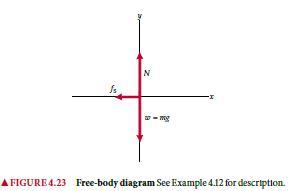
A crate sits in the middle of the bed on a flatbed truck that is traveling at 80 km/h on a straight, level road. The coefficient of static friction between the crate and the truck bed is 0.40. When the truck comes uniformly to a stop, the crate does not slide, but remains stationary on the truck.
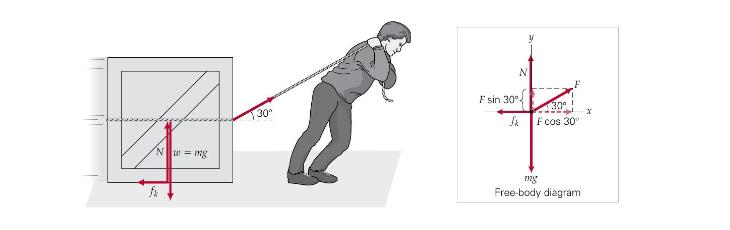
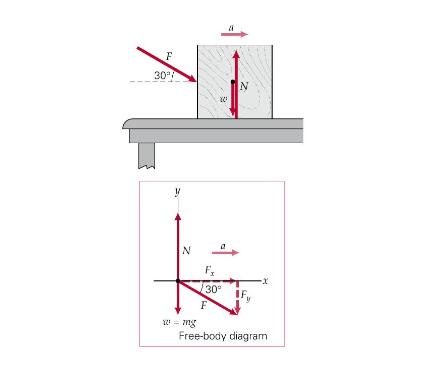
A worker pulling a crate applies a force at an angle of 30° to the horizontal, as shown in Figure 4.22. What is the magnitude of the minimum force he must apply to move the crate? (Before looking at the solution, would you expect that the force needed in this case wouldbe greater or less than that
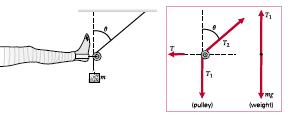
Keeping a broken leg bone straight while it is healing sometimes requirestraction, which is the procedure in which the bone is held under stretchingtension forces at both ends to keep it aligned. Consider a leg undertractional tension as shown in ▼ Figure 4.16. The cord is attached toa suspended
A force of \(10.0 \mathrm{~N}\) is applied at an angle of \(30^{\circ}\) to the horizontal on a \(1.25-\mathrm{kg}\) block initially at rest on a frictionless surface, as illustrated in Figure 4.14.(a) What is the magnitude of the block's acceleration?(b) What is the magnitude of the normal
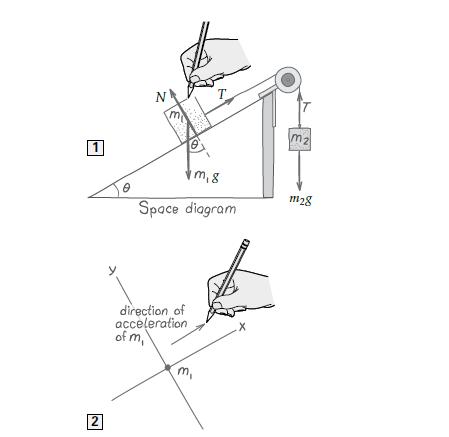
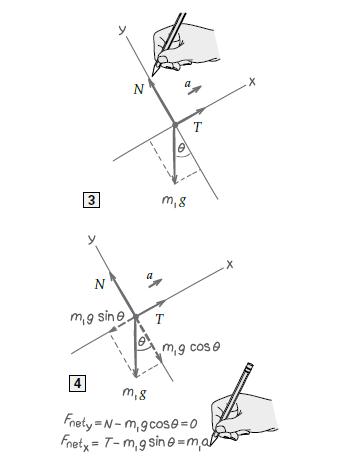
Two masses are connected by a light string running over a light pulley of negligible friction, as illustrated in the space diagram (1) of Figure 4.13. One mass (m1 = 5.0 kg) is on a frictionless 20° inclined plane, and the other (m2 = 1.5 kg) is freely suspended. What is the acceleration of the
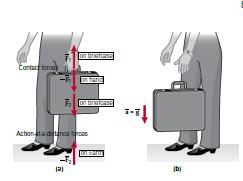
Focusing only on thecase, two equal and opposite forces acting on it can be identified –the downward weight of the case and the upward applied force bythe hand. However, these two forces cannot be a third law force pairbecause they act on the same object.On an overall inspection, you should
A woman waiting to cross the street holds a briefcase in her handas shown in ▶ Figure 4.12a. Identify all of the third law force pairsinvolving the briefcase in this situation.▲ FIGURE 4.12 Force pairs of Newton’s third law (a) When a person holds a briefcase, there are two force pairs: a
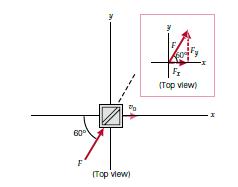
A block of mass 0.50 kg travels with a speed of 2.0 m/s in the +x-direction on a flat, frictionless surface. On passing through the ▲ FIGURE 4.10 Off the straight and narrow A force is applied to a moving block when it reaches the origin, and the block then begins to deviate from its
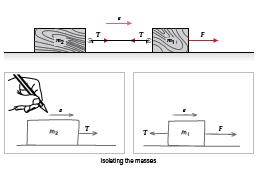
A student weighs 588 N. What is her mass? THINKING IT THROUGH. Newton’s second law allows us to determine an object’s mass if we know the object’s weight (force), since g is known.Given:w = 588 N3.Two blocks with masses m1 = 2.5 kg and m2 = 3.5 kg rest on a frictionless surface and are
A tractor pulls a loaded wagon on a level road with a constant horizontal force of 440 N (▼ Figure 4.8). If the mass of the wagon is 200 kg and that of the load is 75 kg, what is the magnitude of the wagon’s acceleration? (Ignore frictional forces.) THINKING IT THROUGH. This problem is a
A pouring rain comes straight down with a raindrop speed of \(6.0 \mathrm{~m} / \mathrm{s}\). A woman with an umbrella walks eastward at a brisk pace of \(1.5 \mathrm{~m} / \mathrm{s}\) to get home. At what angle should she tilt her umbrella to get the maximum protection from the rain?
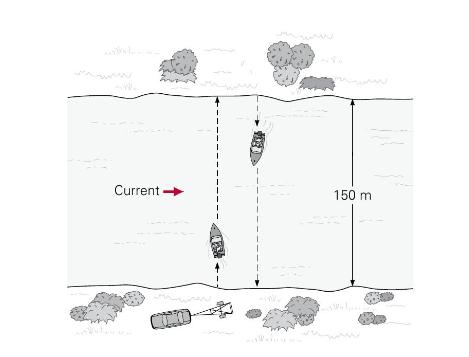
A boat that travels at a speed of \(6.75 \mathrm{~m} / \mathrm{s}\) in still water is to go directly across a river and back ( \(abla\) Figure 3.34). The current flows at \(0.50 \mathrm{~m} / \mathrm{s}\).(a) At what angle(s) must the boat be steered?(b) How long does it take to make the round
In Exercise 59, what are the relative velocities if the ball is thrown in the direction of the truck?Exercise 59A person riding in the back of a pickup truck traveling at \(70 \mathrm{~km} / \mathrm{h}\) on a straight, level road throws a ball with a speed of \(15 \mathrm{~km} / \mathrm{h}\)
A shopper is in a hurry to catch a bargain in a department store. She walks up the escalator, rather than letting it carry her, at a speed of \(1.0 \mathrm{~m} / \mathrm{s}\) relative to the escalator. If the escalator is \(10 \mathrm{~m}\) long and moves at a speed of \(0.50 \mathrm{~m} /
A shot-putter launches the shot from a vertical distance of \(2.0 \mathrm{~m}\) off the ground (from just above her ear) at a speed of \(12.0 \mathrm{~m} / \mathrm{s}\). The initial velocity is at an angle of \(20^{\circ}\) above the horizontal. Assume the ground is flat.(a) Compared to a
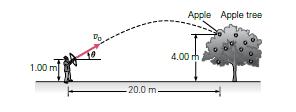
This time, William Tell is shooting at an apple that hangs on a tree ( \(abla\) Figure 3.32). The apple is a horizontal distance of \(20.0 \mathrm{~m}\) away and at a height of \(4.00 \mathrm{~m}\) above the ground. If the arrow is released from a height of \(1.00 \mathrm{~m}\) above the ground and
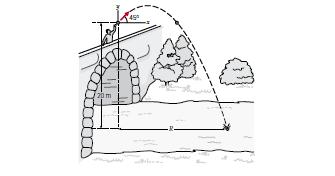
A stone thrown off a bridge \(20 \mathrm{~m}\) above a river has an initial velocity of \(12 \mathrm{~m} / \mathrm{s}\) at an angle of \(45^{\circ}\) above the horizontal ( \(>\) Figure 3.31).(a) What is the range of the stone?(b) At what velocity does the stone strike the water? 20 m
A convertible travels down a straight, level road at a slow speed of \(13 \mathrm{~km} / \mathrm{h}\). A person in the car throws a ball with a speed of \(3.6 \mathrm{~m} / \mathrm{s}\) forward at an angle of \(30^{\circ}\) above the horizontal, relative to the car. Where is the car when the ball
A wheeled car with a spring-loaded cannon fires a metal ball vertically (Figure 3.24). If the vertical initial speed of the ball is \(5.0 \mathrm{~m} / \mathrm{s}\) as the cannon moves horizontally at a speed of \(0.75 \mathrm{~m} / \mathrm{s}\),(a) how far from the launch point does the ball fall
An electron is ejected horizontally at a speed of \(1.5 \times 10^{6} \mathrm{~m} / \mathrm{s}\) from the electron gun of an old computer monitor. If the viewing screen is \(35 \mathrm{~cm}\) from the end of the gun, how far will the electron travel in the vertical direction before hitting the
A ball with a horizontal speed of \(1.0 \mathrm{~m} / \mathrm{s}\) rolls off a bench \(2.0 \mathrm{~m}\) high.(a) How long will the ball take to reach the floor?(b) How far from a point on the floor directly below the edge of the bench will the ball land?
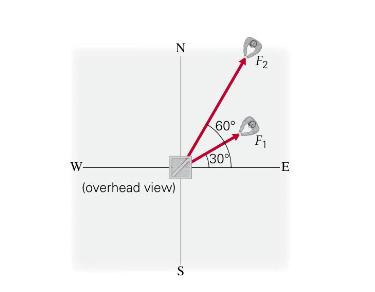
Two students are pulling a box, as shown in Figure 3.25, where \(F_{1}=100 \mathrm{~N}\) and \(F_{2}=150 \mathrm{~N}\). What third force would cause the box to be stationary when all three forces are applied? W- (overhead view) N S F2 60 F 30% E
A person walks from point \(A\) to point \(B\) as shown in \(\checkmark\) Figure 3.30. What is the person's displacement relative to point A? 20 m /45 40 m A 20 m 30 30 m
A student works three problems involving the addition of two different vectors, \(\overrightarrow{\mathbf{F}}_{1}\) and \(\overrightarrow{\mathbf{F}}_{2}\). He states that the magnitudes of the three resultants are given by(a) \(F_{1}+F_{2}\),(b) \(F_{1}-F_{2}\), and(c)
Two force vectors, \(\overrightarrow{\mathbf{F}}_{1}=(3.0 \mathrm{~N}) \hat{\mathbf{x}}-(4.0 \mathrm{~N}) \hat{\mathbf{y}}\) and \(\overrightarrow{\mathbf{F}}_{2}=(-6.0 \mathrm{~N}) \hat{\mathbf{x}}+(4.5 \mathrm{~N}) \hat{\mathbf{y}}\), are applied to a particle. What third force
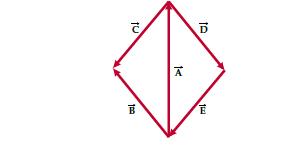
Referring to the parallelogram in \(abla\) Figure 3.28, express \(\overrightarrow{\mathbf{C}}, \overrightarrow{\mathbf{C}}-\overrightarrow{\mathbf{B}}\) and \((\overrightarrow{\mathbf{E}}-\overrightarrow{\mathbf{D}}+\overrightarrow{\mathbf{C}})\) in terms of \(\overrightarrow{\mathbf{A}}\) and
In two successive chess moves, a player first moves his queen two squares forward, then moves the queen three steps to the left (from the player's view). Assume each square is \(3.0 \mathrm{~cm}\) on a side.(a) Using forward (toward the player's opponent) as the \(+y\)-axis and right as the
Given two vectors \(\overrightarrow{\mathbf{A}}\) and \(\overrightarrow{\mathbf{B}}\) with magnitudes \(A\) and \(B\) respectively, you can subtract \(\overrightarrow{\mathbf{B}}\) from \(\overrightarrow{\mathbf{A}}\) to get a third vector
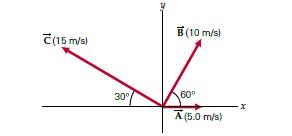
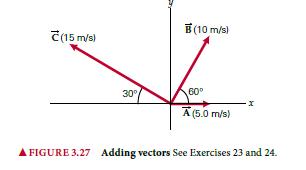
For the velocity vectors shown in Figure 3.27, determine \(\overrightarrow{\mathbf{A}}-\overrightarrow{\mathbf{B}}-\overrightarrow{\mathbf{C}}\) (15 m/s) B(10 m/s) 30 60 A (5.0 m/s) x
For the vectors shown in \(\boldsymbol{abla}\) Figure 3.27, determine \(\overrightarrow{\mathbf{A}}+\overrightarrow{\mathbf{B}}+\overrightarrow{\mathbf{C}}\). (10 m/s) (15 m/s) 30% 60 A (5.0 m/s) FIGURE 3.27 Adding vectors See Exercises 23 and 24.
The velocity of object 1 in component form is \(\overrightarrow{\mathbf{v}}_{1}=(+2.0 \mathrm{~m} / \mathrm{s}) \hat{\mathbf{x}}+(-4.0 \mathrm{~m} / \mathrm{s}) \hat{\mathbf{y}}\). Object 2 has twice the speed of object 1 but moves in the opposite direction.(a) Determine the velocity of object 2 in
Given two vectors, A which has a length of 10.0 and makes an angle of 45° below the −x-axis, and B which has an x-component of +2.0 and a y-component of +4.0, (a) sketch the vectors on x-y axes, with all their “tails” starting at the origin, and (b) calculate A+ B.
For each of the given vectors, give a vector that, when added to it, yields a null vector (a vector with a magnitude of zero). Express the vector in the form other than that in which it is given (component or magnitude- angle):(a) \(\overrightarrow{\boldsymbol{A}}=4.5 \mathrm{~cm}, 40^{\circ}\)
(a) What is the resultant if \(\overrightarrow{\mathbf{A}}=3.0 \hat{\mathbf{x}}+5.0 \hat{\mathbf{y}}\) is added to \(\overrightarrow{\mathbf{B}}=1.0 \hat{\mathbf{x}}-3.0 \hat{\mathbf{y}}\) ?(b) What are the magnitude and direction of \(\overrightarrow{\mathbf{A}}+\overrightarrow{\mathbf{B}}\) ?
Using the triangle method, show graphically that(a) \(\overrightarrow{\mathbf{A}}+\overrightarrow{\mathbf{B}}=\overrightarrow{\mathbf{B}}+\overrightarrow{\mathbf{A}}\) and(b) if \(\overrightarrow{\mathbf{A}}-\overrightarrow{\mathbf{B}}=\overrightarrow{\mathbf{C}}\), then
The resultant of \(\overrightarrow{\mathbf{A}}-\overrightarrow{\mathbf{B}}\) is the same as(a) \(\overrightarrow{\mathbf{B}}-\overrightarrow{\mathbf{A}}\),(b) \(-\overrightarrow{\mathbf{A}}+\overrightarrow{\mathbf{B}}\),(c)
An airplane with an airspeed of \(200 \mathrm{~km} / \mathrm{h}\) (its speed in still air) flies in a direction such that with a west wind of \(50.0 \mathrm{~km} / \mathrm{h}\), it travels in a straight line northward. (Wind direction is specified by the direction from which the wind blows, so a
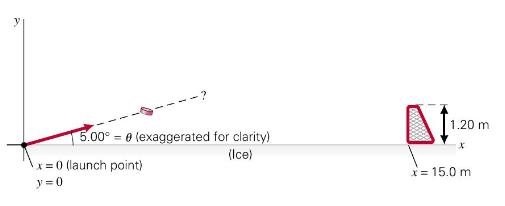
A hockey player hits a "slap shot" in practice (with no goalie present) when he is \(15.0 \mathrm{~m}\) directly in front of the net. The net is \(1.20 \mathrm{~m}\) high, and the puck is initially hit at an angle of \(5.00^{\circ}\) above the ice with a speed of \(35.0 \mathrm{~m} / \mathrm{s}\).
In a long-jump event, does the jumper normally have a launch angle of(a) less than \(45^{\circ}\),(b) exactly \(45^{\circ}\), or(c) greater than \(45^{\circ}\) ? Clearly establish the reasoning and physical principle(s) used in determining your answer before checking it. That is, why did you select
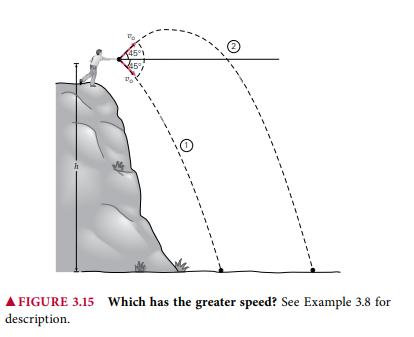
Consider two balls, both thrown with the same initial speed \(v_{0}\), but one at an angle of \(45^{\circ}\) above the horizontal and the other at an angle of \(45^{\circ}\) below the horizontal ( Figure 3.15). Determine whether, upon reaching the ground, (a) the ball projected upward will have the
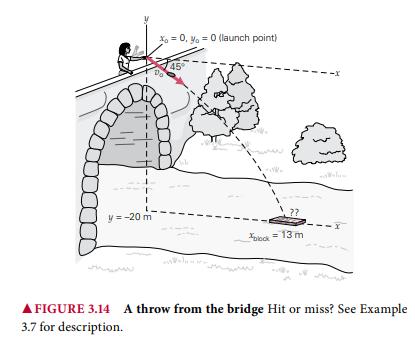
A young girl standing on a bridge throws a stone with an initial velocity of \(12 \mathrm{~m} / \mathrm{s}\) at a downward angle of \(45^{\circ}\) to the horizontal, in an attempt to hit a block of wood floating in the river below (Figure 3.14). If the stone is thrown from a height of \(20
Suppose a golf ball is hit off the tee with an initial velocity of 30.0 m/s at an angle of 35° to the horizontal, as in Figure 3.12. (a) What is the maximum height reached by the ball? (b) What is its range? THINKING IT THROUGH. The maximum height involves the y-component; the procedure for
Suppose that the ball in Figure 3.1la is projected from a height of \(25.0 \mathrm{~m}\) above the ground and is thrown with an initial horizontal velocity of \(8.25 \mathrm{~m} / \mathrm{s}\).(a) How long is the ball in flight before striking the ground?(b) How far from the building does the ball
Let’s apply the procedural steps of the component method to the addition of the vectors in Figure 3.8a. The vectors with units of meters per second represent velocities.THINKING IT THROUGH. Follow and learn the steps of the procedure. Basically, the vectors are resolved into components and the
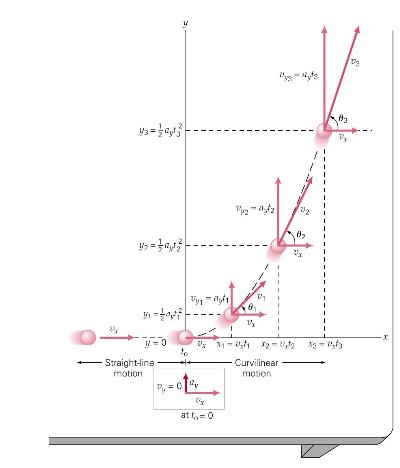
Suppose that the ball in Figure 3.2 has an initial velocity of \(1.50 \mathrm{~m} / \mathrm{s}\) along the \(x\)-axis. Starting at \(t_{\mathrm{o}}=0\), the ball receives an acceleration of \(2.80 \mathrm{~m} / \mathrm{s}^{2}\) in the \(y\)-direction. (a) What is the position of the ball \(3.00
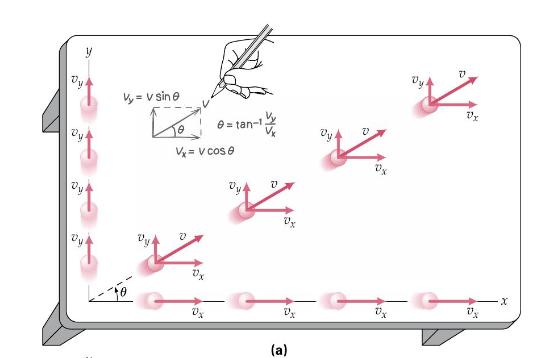
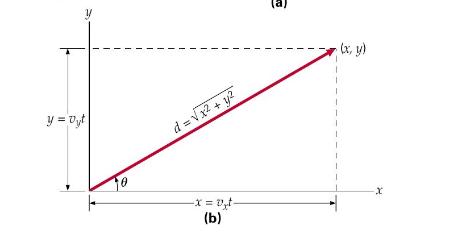
If the diagonally moving ball in Figure 3.1a has a constant velocity of \(0.50 \mathrm{~m} / \mathrm{s}\) at an angle of \(37^{\circ}\) relative to the \(x\)-axis, find how far it travels in 3.0 s by using \(x\) - and \(y\)-components of its motion.THINKING IT THROUGH. Given the magnitude and
If the sports car in Exercise 20 can accelerate at a rate of \(7.2 \mathrm{~m} / \mathrm{s}^{2}\), how long does the car take to accelerate from 0 to \(60 \mathrm{mi} / \mathrm{h}\) ? Exercise 20A sports car can accelerate from 0 to \(60 \mathrm{mi} / \mathrm{h}\) in \(3.9 \mathrm{~s}\). What is
The location of a moving particle at a particular time is given by \(x=a t-b t^{2}\), where \(a=10 \mathrm{~m} / \mathrm{s}\) and \(b=0.50 \mathrm{~m} / \mathrm{s}^{2}\).(a) Where is the particle at \(t=0\)?(b) What is the particle's displacement for the time interval \(t_{1}=2.0 \mathrm{~s}\) and
A high school kicker makes a \(30.0-\) yd field goal attempt (in American football) and hits the crossbar at a height of \(10.0 \mathrm{ft}\).(a) What is the net displacement of the football from the time it leaves the ground until it hits the crossbar?(b) Assuming the football took \(2.50
A dropped object in free fall(a) falls 9.8 m each second,(b) falls 9.8 m during the first second,(c) has an increase in speed of 9.8 m/s each second,(d) has an increase in acceleration of 9.8 m/s2 each second.
13. Consider Equation 2.12, v2 = vo2 + 2a(x − xo). An object starts from rest (vo = 0) and accelerates. Since v is squared and therefore always positive, can the acceleration be negative? Explain.
When an object is thrown vertically upward, it is accelerating on(a) the way up,(b) the way down,(c) both(a) and (b),(d) neither(a) and (b).
An object is thrown straight upward. At its maximum height,(a) its velocity is zero(b) its acceleration is zero(c) both(a) and (b)(d) neither(a) and (b)
A dropped object in free fall(a) falls 9.8 m each second,(b) falls 9.8 m during the first second,(c) has an increase in speed of 9.8 m/s each second,(d) has an increase in acceleration of 9.8 m/s2 each second.
The free-fall motion described in this section applies to(a) an object dropped from rest,(b) an object is thrown vertically downward,(c) an object is thrown vertically upward,(d) all of the preceding.
An object is thrown vertically upward. Which of the following statements is true:(a) its velocity changes nonuniformly;(b) its maximum height is independent of the initial velocity;(c) its travel time upward is slightly greater than its travel time downward; or(d) its speed on returning to its
A Lunar Lander makes a descent toward a level plain on the Moon. It descends slowly by using retro (braking) rockets. At a height of \(6.0 \mathrm{~m}\) above the surface, the rockets are shut down with the Lander having a downward speed of \(1.5 \mathrm{~m} / \mathrm{s}\). What is the speed of the
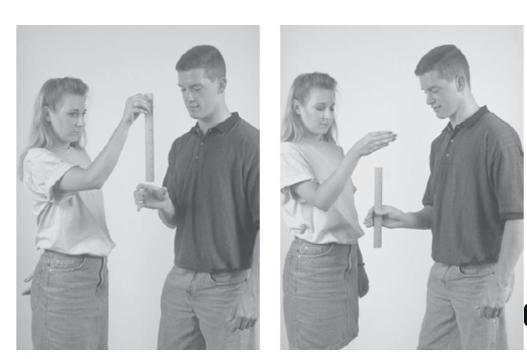
A person's reaction time can be measured by having another person drop a ruler (without warning) through the first person's thumb and forefinger, as shown in Figure 2.17. After observing the unexpected release, the first person grasps the falling ruler as quickly as possible, and the length of the
A boy on a bridge throws a stone vertically downward with an initial speed of \(14.7 \mathrm{~m} / \mathrm{s}\) toward the river below. If the stone hits the water \(2.00 \mathrm{~s}\) later, what is the height of the bridge above the water?THINKING IT THROUGH. This is a free-fall problem, but
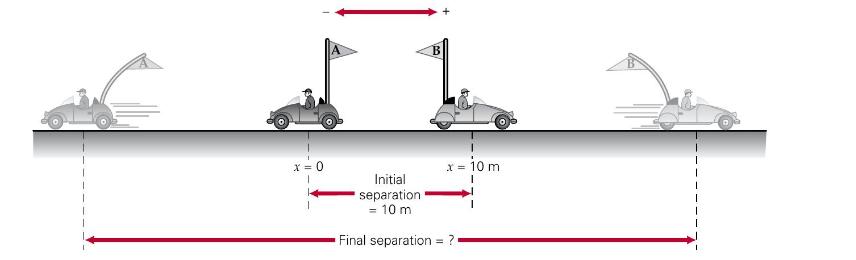
Two riders on dune buggies sit \(10 \mathrm{~m}\) apart on a long, straight track, facing in opposite directions. Starting at the same time, both riders accelerate at a constant rate of \(2.0 \mathrm{~m} / \mathrm{s}^{2}\). How far apart will the dune buggies be at the end of \(3.0 \mathrm{~s}\)
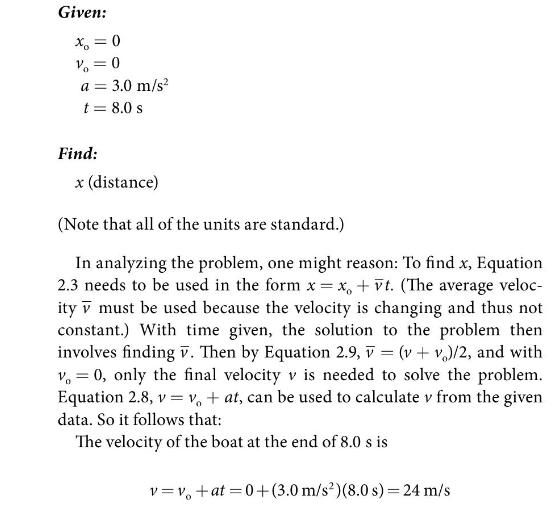
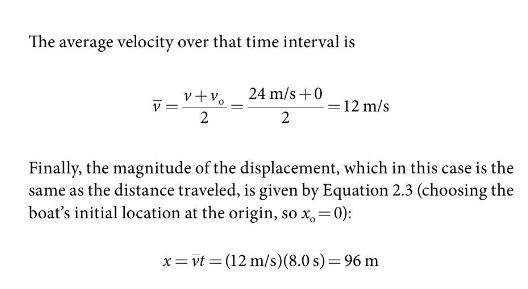
A motorboat starting from rest on a lake accelerates in a straight line at a constant rate of \(3.0 \mathrm{~m} / \mathrm{s}^{2}\) for \(8.0 \mathrm{~s}\). How far does the boat travel during this time?THINKING IT THROUGH. We have only one equation for distance (Equation 2.3, \(x=x_{0}+\bar{v} t\)
A drag racer starting from rest accelerates in a straight line at a constant rate of \(5.5 \mathrm{~m} / \mathrm{s}^{2}\) for \(6.0 \mathrm{~s}\).(a) What is the racer's velocity at the end of this time?(b) If a parachute deployed at this time causes the racer to slow down uniformly at a rate of
A couple in a sport-utility vehicle (SUV) is traveling at \(90 \mathrm{~km} / \mathrm{h}\) on a straight highway. The driver sees an accident in the distance and slows down to \(40 \mathrm{~km} / \mathrm{h}\) in \(5.0 \mathrm{~s}\). What is the average acceleration of the SUV?THINKING IT
A jogger jogs from one end to the other of a straight \(300-\mathrm{m}\) track in \(2.50 \mathrm{~min}\) and then jogs back to the starting point in \(3.30 \mathrm{~min}\). What was the jogger's average velocity(a) in jogging to the far end of the track,(b) coming back to the starting point, and(c)
39. •• Referring to Exercise 37, estimate the activity of the Earth’s oceans (in curies) due to proton decay. Assume the oceans are 3 km deep covering 75% of the Earth’s surface.
38. •• (a) Referring to Exercise 37, what would be the proton decay constant λ? (b) Suppose your experiment required detection of at least one decay per week.What would be the minimum length of one side of a cube-shaped sample of water?
37. • Suppose the grand unified theory (GUT) was correct and the half-life of a proton was 1.2 × 1035 y. Estimate the decay rate for the protons in a liter of water both in decays/second and curies. How does this compare to a small (by laboratory standards) radioactive source of one microcurie?
36. • (a) Show that the neutral pion cannot be composed solely of any pair of quarks in which one is an up quark (or an anti-up quark) and one is a down quark(or an anti-down quark). (b) According to quantum theory, the πo can be thought of as a sum of two different pairs of quarks/antiquarks.
35. IE • (a) The quark combination for a antineutron is(1) udd, (2) uud, (3) uud, (4) ddd. (b) Show that your answer to (a) gives the correct electric charge for the antineutron.
34. IE • (a) The quark combination for an antiproton is(1) uud, (2) udd, (3) uud, (4) udd. (b) Show that your answer to (a) gives the correct electric charge for the antiproton.
33. •• (a) Using Table 30.2, estimate the average distance a τ− particle would travel in the laboratory if it were moving at 0.95c. (b) What would its kinetic energy be?
32. •• (a) Using Table 30.2, calculate the mass of the Ω−particle in kilograms. (b) Determine its total energy if it is moving at a speed of 0.800c.
31. •• If the (electron) neutrino mass were 6.0 × 10⁻⁶ MeV, what is its speed if its total energy is 0.50 MeV? [Hint:See Section 26.4 and binomial expansion usage since E ≫ mc2.]
30. •• (a) What is the mass difference between the charged pion and its neutral version? Express your answer in both kilograms and rest energy (MeV). (b) What is the kinetic energy of a neutral pion traveling at 0.75c?
28. •• By what minimum amount is energy conservation“violated” during a πo exchange process?29. •• How long is the conservation of energy “violated” in a πo exchange process?
Showing 100 - 200
of 3511
1
2
3
4
5
6
7
8
9
10
11
12
13
14
15
Last
Step by Step Answers

 Get 50% OFF
Claim Now
Get 50% OFF
Claim Now