New Semester
Started
Get
50% OFF
Study Help!
--h --m --s
Claim Now
Question Answers
Textbooks
Find textbooks, questions and answers
Oops, something went wrong!
Change your search query and then try again
S
Books
FREE
Study Help
Expert Questions
Accounting
General Management
Mathematics
Finance
Organizational Behaviour
Law
Physics
Operating System
Management Leadership
Sociology
Programming
Marketing
Database
Computer Network
Economics
Textbooks Solutions
Accounting
Managerial Accounting
Management Leadership
Cost Accounting
Statistics
Business Law
Corporate Finance
Finance
Economics
Auditing
Tutors
Online Tutors
Find a Tutor
Hire a Tutor
Become a Tutor
AI Tutor
AI Study Planner
NEW
Sell Books
Search
Search
Sign In
Register
study help
physics
college physics a strategic approach 2nd
College Physics Essentials Electricity And Magnetism Optics Modern Physics Volume Two 8th Edition Jerry D. Wilson, Anthony J. Buffa, Bo Lou - Solutions
16. ••• The terminals of a 6.0-V battery are connected to points A and B in Figure 18.25. (a) How much current is in each resistor? (b) How much power is delivered to each? (c) Compare the sum of the individual powers with the power delivered to the equivalent resistance for the circuit.
14. •• Suppose that the resistor arrangement in Figure 18.24 is connected to a 12-V battery. What will be (a) the current in each resistor, (b) the voltage drop across each resistor, and (c) the total power delivered?
13. •• For the circuit in ▼ Figure 18.27, find (a) the current in each resistor, (b) the voltage across each resistor, and (c) the total power delivered.
12. •• Find the current in and voltage across the 10-Ωresistor shown in ▶ Figure 18.26.
11. •• What is the equivalent resistance between points A and B in ▼ Figure 18.25?
10. •• What is the equivalent resistance of the resistors in▼ Figure 18.24?
8. •• You are given four 5.00-Ω resistors. (a) Show how to connect all the resistors so as to produce an effective total resistance of 3.75 Ω. (b) If this network were then connected to a 12-V battery, determine the current in and voltage across each resistor.
7. IE •• A length of wire with a resistance R is cut into two equal-length segments. These segments are then twisted together (i.e., in parallel) to form a conductor half as long as the original wire. (a) The resistance of the shortened conductor is (1) R/4, (2) R/2, (3) R. Explain your
20. ••• (a) Determine the equivalent resistance of the circuit in ▼ Figure 18.30. Find (b) the current in each resistor, (c) the voltage across each resistor, and (d) the total power delivered to the circuit.
21. • Apply Kirchhoff’s rules to the circuit in Figure 18.27 to find the current in each resistor.
34. ••• A series RC circuit consisting of a 5.0-MΩ resistor and a 0.40-μF capacitor is connected to a 12-V battery.If the capacitor is initially uncharged, (a) what is the change in voltage across it between t = 2τ and t = 4τ? (b) By how much does the capacitor’s stored energy change in
33. •• (a) For the circuit in Exercise 32, after the switch has been closed for a time t = 4τ, what is the charge on the capacitor? (b) After a very long time, what are the voltages across the capacitor and the resistor?
31. •• A 3.00-μF capacitor, initially charged to 24 V, discharges when connected in series with a resistor.(a) How much energy does this capacitor store when fully charged? (b) What is the capacitor’s voltage when it has only half of its maximum energy? Is it 12 V?Why or why not? (c) What
30. •• A 1.00-μF capacitor, initially charged to 12 V, discharges when connected in series with a resistor.(a) What resistance is necessary to cause the capacitor to have only 37% of its initial charge 1.50 s after starting?(b) What is the voltage across the capacitor at a time t = 3τ if the
28. • A capacitor in a single-loop RC circuit is charged to 63% of its final voltage in 1.5 s. Find (a) the time constant for the circuit and (b) the percentage of the circuit’s final voltage after 3.5 s.
27. ••• For the multiloop circuit shown in ▼ Figure 18.35, what is the current in each branch?
26. ••• Find the currents in the circuit branches in▼ Figure 18.34.
25. ••• Find the current in each resistor in the circuit shown in ▼ Figure 18.33.
24. •• Apply Kirchhoff’s rules to the circuit in ▼ Figure 18.32, and find (a) the current in each resistor and (b) the rate at which energy is being delivered to the 8.0-Ωresistor.
23. •• Using Kirchhoff’s rules, find the current in each resistor in ▼ Figure 18.31.
14. An alternative way to describe the discharge/charge time of an RC circuit is to use a time interval called the half-life, which is defined as the time for the capacitor to lose half its initial charge. Based on this definition,is the time constant longer or shorter than the halflife?Explain
13. Use Kirchhoff’s loop theorem to explain why, in a series connection, the largest resistance has the greatest voltage drop across it.
12. Use both of Kirchhoff’s theorems to explain why a 60-W lightbulb produces less light than one rated at 100 W when they are connected in parallel to a 120-V source. [Hint: Recall that the power ratings are meaningful only at 120 V.]
11. Use Kirchhoff’s loop theorem to explain why a 60-W lightbulb produces more light than one rated at 100 W when they are connected in series to a 120-V source.[Hint: Recall that the power ratings are meaningful only at 120 V.]
10. Use Kirchhoff’s junction theorem to explain why the total equivalent resistance of a circuit is reduced, not increased, by connecting a second resistor in parallel to another resistor.
9. Must currents always leave from the positive terminal of a battery that is in a complete circuit? Explain. If not, give an example in which the current can enter at the positive terminal.
6. Lightbulbs are labeled with their power output.For example, when a lightbulb is labeled 60 W, it is assumed that the bulb is connected to a 120-V source.Suppose you have two bulbs. A 60-W bulb is followed by a 40-W bulb in series to a 120-V source. Which one glows brighter? Why? What happens if
3. Are the currents in resistors in parallel generally the same? If not, under what circumstance(s) could they be the same?
15. Is the time it takes to charge a capacitor in an RC circuit to 25% of its maximum value longer or shorter than one time constant? Is the time it takes to discharge a capacitor to 25% of its initial charge longer or shorter than one time constant? Explain your answers.
16. Use Kirchhoff’s loop theorem to explain why the current in an RC circuit that is discharging a capacitor decreases as time goes on. Use the loop theorem to explain why the current in a charging RC circuit also decreases with time. [Hint: The loop theorem will tell you about the voltage across
4. IE • (a) In how many different ways can three 4.0-Ωresistors, be wired: (1) three, (2) five, or (3) seven?(b) Sketch the different ways you found in part (a)and determine the equivalent resistance for each.
25. After a collision with a power pole, you are trapped in your car, with a high-voltage line (with frayed insulation) in contact with the hood of the car. If you must get out before help arrives, is it safer to step out of the car one foot at a time or to jump with both feet leaving the car at
24. Explain why it is safe for birds to perch with both feet on the same high-voltage wire, even if the insulation is worn through.
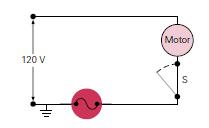
23. The severity of injury from electrocution depends on the magnitude of the current and its path, yet we commonly see signs that warn “Danger: High Voltage.” Shouldn’t such signs be changed to refer to high current? Explain. 120 V Motor) S
22. In terms of electrical safety, explain clearly what is wrong with the circuit in ▶ Figure 18.23, and why.
21. Draw the circuit diagrams indicating the correct placement for the voltmeter in the following situations.(Use a circle with a “V” in it to represent the voltmeter.) (a) Three resistors are wired in parallel and you want to measure the voltage across all of them with just one measurement.
20. Draw the circuit diagrams indicating the correct placement for the ammeter in the following situations. (Use a circle with an “A” in it to represent the ammeter.)(a) Three resistors are wired in parallel and you want to measure the total current through all of them with just one
19. If designed properly, a good ammeter should have a very small resistance. Why? Explain clearly, using Kirchhoff’s laws.
18. Explain clearly, using Kirchhoff’s laws, why the resistance of an ideal voltmeter is infinite.
1. Are the voltage drops across resistors in series generally the same? If not, under what circumstance(s)could they be the same?
53. •• An open-open organ pipe and one that is closed at one end both have lengths of 0.52 m. Assuming a temperature of 20 °C, what is the fundamental frequency of each pipe?
52. •• An organ pipe that is closed at one end has a length of 0.80 m. At 20 °C, what is the distance between a node and an adjacent antinode for (a) the second harmonic and (b) the third harmonic?
51. • The human ear canal is about 2.5 cm long. It is open at one end and closed at the other. (a) What is the fundamental frequency of the ear canal at 20 °C? (b) To what frequency is the ear most sensitive? (c) If a person’s ear canal is longer than 2.5 cm, is the fundamental frequency
50. • An open-closed organ pipe has a fundamental frequency of 528 Hz (a C note) at 20 °C. What is the fundamental frequency of the pipe when the temperature is 0 °C?
49. • The first three natural frequencies of an organ pipe are 126, 378, and 630 Hz. (a) Is the pipe an open-open or open-closed? (b) Taking the speed of sound in air to be 340 m/s, find the length of the pipe.
47. ••• Bats emit sounds of frequencies around 35.0 kHz and use echolocation to find their prey. If a bat is moving with a speed of 12.0 m/s toward a hovering, stationary insect, (a) what is the frequency received by the insect if the air temperature is 20 °C? (b) What frequency of the
45. •• An observer is traveling between two identical sources of sound (frequency 100 Hz). His speed is 10.0 m/s as he approaches one and recedes from the other. (a) What frequency does he hear from each source? (b) How many beats per second does he hear?Assume normal room temperature.
44. •• The half-angle θ of the conical shock wave formed by a supersonic jet is 30°. What are (a) the Mach number of the aircraft and (b) the actual speed of the aircraft if the air temperature is −20 °C?
43. IE •• A fighter jet flies at a speed of Mach 1.5. (a) If the jet were to fly faster than Mach 1.5, the half-angle θ of the conical shock wave would (1) increase, (2) remain the same, (3) decrease. Why? (b) What is the half-angle of the conical shock wave formed by the jet plane at Mach 1.5?
42. •• A jet flies at a speed of Mach 2.0. What is the halfangleθ of the conical shock wave formed by the aircraft?Can you tell the speed of the shock wave?
41. •• The frequency of an ambulance siren is 700 Hz.What are the frequencies heard by a stationary pedestrian as the ambulance approaches and then later moves away from her at a constant speed of 90.0 km/h?(Assume that the air temperature is 20 °C.)
40. •• Two identical strings on different cellos are tuned to the 440-Hz A note. The peg holding one of the strings slips, so its tension is decreased by 1.5%. What is the beat frequency heard when the strings are then played together?
39. •• While standing near a railroad crossing, you hear a train horn. The frequency emitted by the horn is 400 Hz.If the train is traveling at 90.0 km/h and the air temperature is 25 °C, what is the frequency you hear (a) when the train is approaching and (b) after it has passed?
38. IE • On a day with a temperature of 20 °C and no wind blowing, the frequency heard by a moving person from a 500-Hz stationary siren is 520 Hz. (a) The person is (1) moving toward, (2) moving away from, or(3) stationary relative to the siren. Explain. (b) What is the person’s speed? Assume
37. • What is the frequency heard by a person driving at 60 km/h directly toward a factory whistle emitting sound of frequency 800 Hz, if the air temperature is 0 °C?
36. ••• A bee produces a buzzing sound that is barely audible to a person 3.0 m away. How many bees would have to be buzzing at that distance to produce a sound with an intensity level of 50 dB?
35. •• An office in an e-commerce company has fifty computers, which generate a sound intensity level of 40 dB. The office manager tries to cut the noise to half as loud by removing twenty-five computers. Does he achieve his goal? What is the intensity level generated by twenty-five computers?
33. •• At a distance of 12.0 m from a point source, the intensity level is measured to be 70 dB. At what distance from the source will the intensity level be 40 dB?
32. •• At a rock concert, the average sound intensity level for a person in a front-row seat is 110 dB for a single band. If all the bands scheduled to play produce sound of that same intensity, how many of them would have to play simultaneously for the sound level to be at or above the
31. IE •• A dog’s bark has a sound intensity level of 40 dB. (a) If two of the same dogs were barking, the intensity level is (1) less than 40 dB, (2) between 40 dB and 80 dB, (3) 80 dB. (b) What would be the intensity level?
30. •• In a neighborhood challenge to see who can climb a tree the fastest, you are ready to climb. Your friends have surrounded you in a circle as a cheering section;each individual alone would cause a sound intensity level of 80 dB at your location. If the actual sound level at your location
29. •• What is the intensity level of a 23-dB sound after being amplified (a) ten thousand times, (b) a million times, (c) a billion times?
28. •• A compact speaker puts out 100 W of sound power.(a) Neglecting losses to the air, at what distance would the sound intensity be at the pain threshold?(b) Neglecting losses to the air, at what distance would the sound intensity be that of normal speech? Does your answer seem reasonable?
27. •• A person has a hearing loss of 30 dB for a particular frequency. What is the sound intensity that is heard at this frequency that has an intensity of the threshold of pain?
26. •• A rock band using one speaker produces sound that creates an intensity level of 110 dB at a distance of 15 m from the speaker. Assuming the sound is radiated equally over a hemisphere in front of the band, what is the total power output?
25. •• Assuming that 20 people, each capable of individually producing an intensity level of 60 dB at a given location, all speak simultaneously. What is the total sound intensity at that location?
24. •• Two sound sources have intensities of 10−9 and 106 W/m2, respectively. Which source is more intense and by how many times more?
23. •• A point source emits radiation in all directions at a rate of 7.5 kW. What is the intensity of the radiation 5.0 m from the source?
22. •• The intensity levels of two people holding a conversation are 60 and 70 dB, respectively. What is the intensity of the combined sounds?
21. IE •• (a) If the power of a sound source doubles, the intensity level at a certain distance from the source (1) increases, (2) exactly doubles, or (3)decreases. Why? (b) What are the intensity levels at a distance of 10 m from a 5.0-W and a 10-W source, respectively?
20. •• During a weapons test, a compact bomb is exploded and it produces an intensity level of 160 dB at a distance of 10 m. What would be the intensity level at 100 m away? (Assume no energy is lost due to reflections, etc.)
19. • Find the intensity levels in decibels for sounds with intensities of (a) 10−2 W/m2, (b) 10−6 W/m2, and(c) 10−15 W/m2.
18. • Assuming that the diameter of your eardrum is 1 cm (see Exercise 12), what is the sound power received by the eardrum at the threshold of (a) hearing and (b) pain?
17. IE • (a) If the distance from a point sound source triples, the sound intensity will be (1) 3, (2) 1/3, (3) 9,(4) 1/9 times the original value. Why? (b) By how much must the distance from a point source be increased to reduce the sound intensity by half?
16. • Calculate the intensity generated by a 1.0-W point source of sound at a location (a) 3.0 m and (b) 6.0 m from it.
15. ••• Sound propagating through air at 30 °C passes through a vertical cold front into air that is 4.0 °C. If the sound has a frequency of 2500 Hz, by what percentage does its wavelength change in crossing the boundary?
14. ••• A bat moving at 15.0 m/s emits a high-frequency sound as it approaches a wall that is 25.0 m away.Assuming that the bat continues straight toward the wall, how far away is it when it receives the echo?(Assume the air temperature in the cave to be 0 °C.)
13. IE ••• On hiking up a mountain that has several overhanging cliffs, a climber drops a stone off the first cliff to determine its height by measuring the time it takes to hear the stone hit the ground. (a) At a second cliff that is twice the height of the first, the measured time of the
12. •• The size of your eardrum partially determines the upper frequency limit of your audible region, usually between 16 000 and 20 000 Hz. If the wavelength at the upper limit is on the order of twice the diameter of the eardrum and the air temperature is 20 °C, how wide is your eardrum? Is
11. •• The speed of sound in human tissue is on the order of 1500 m/s. A 3.50-MHz probe is used for an ultrasonic procedure. (a) If the effective depth of the ultrasound is 250 wavelengths, what is this depth in meters?(b) What is the time lapse for the ultrasound to make a round trip if
10. •• A submarine on the ocean surface receives a sonar echo indicating an underwater object. The echo comes back at an angle of 20° above the horizontal and the echo took 2.32 s to get back to the submarine. What is the object’s depth?
9. •• A freshwater dolphin sends an ultrasonic sound to locate a prey. If the echo off the prey is received by the dolphin 0.12 s after being sent, how far is the prey from the dolphin?
8. •• A person holds a rifle horizontally and fires at a target. The bullet has a muzzle speed of 200 m/s, and the person hears the bullet strike the target 1.00 s after firing it. The air temperature is 72 °F. What is the distance to the target?
7. •• Medical ultrasound uses a frequency of around 20 MHz to diagnose human conditions and ailments by reflection. Objects and structures down to the size of the wavelength can be detected using these waves.(a) If the speed of sound in tissue is 1500 m/s, estimate the smallest detectable
6. •• Particles approximately 3.0 × 10⁻² cm in diameter are to be scrubbed loose from machine parts immersed in an aqueous (watery) ultrasonic cleaning bath. Above what frequency should the bath be operated to produce wavelengths of this size and smaller?
5. • The expression for the speed of a sound wave in a liquid is v = Y/ρ . Show that this equation is dimensionally correct. Repeat this using v = Y/ρ for speed of sound in a solid.
4. • What temperature change from 0 °C would increase the speed of sound by 1.0%?
3. • Sonar is used to map the ocean floor. If an ultrasonic signal is received 2.0 s after it is emitted, how deep is the ocean floor at that location?
2. • The speed of sound in air on a summer day is measured as 350 m/s. What is the air temperature?
1. • What is the speed of sound in air at (a) 10 °C and(b) 20 °C?
16. Why are there no even harmonics in a closed organ pipe?
15. How would an increase in air temperature affect the frequencies of an organ pipe?
14. Is it possible for an open-open organ pipe and an openclosed organ pipe of the same length to produce notes of the same frequency? Justify your answer.
13. The frets on a guitar fingerboard are spaced closer together the farther they are from the neck. Why is this?What would be the result if they were evenly spaced?
12. A stationary sound source and a stationary observer are a fixed distance apart. However, the air between them is moving toward the observer with a constant speed. How do you think the frequency received by the observer might be affected? Explain your reasoning.
11. Explain how Doppler radar instruments are used to monitor both location and internal motions of a storm.
10. As a person walks between a pair of in-phase loudspeakers that produce tones of the same amplitude and frequency, she hears a varying sound intensity. Explain.
9. (a) Is there a Doppler effect if a sound source and an observer are moving through still air at the same velocity? (b) What would be the effect on the frequency of sound heard by a stationary observer if the source were accelerating toward that observer?
8. Do interference beats have anything to do with the“beat” of music? Explain.
7. Can there be negative decibel levels, such as −10 dB? If so, what would these mean?
Showing 1400 - 1500
of 3511
First
8
9
10
11
12
13
14
15
16
17
18
19
20
21
22
Last
Step by Step Answers

 Get 50% OFF
Claim Now
Get 50% OFF
Claim Now